Showing posts with label Antietam. Show all posts

Wednesday, December 23, 2015

Christmas in Camp, Fairfax Station, December 1862

A few weeks ago I wrote about a new project that I am undertaking for the Fairfax Station Railroad Museum. As I researched tales of soldiers and civilians around the station during the Civil War, I began to think about turning my research into blog posts. The museum agreed that this would be a good idea. Writing posts will help to focus my research efforts and build content for the museum. Moreover, I hope that such posts will encourage my readers to come forward with additional information about wartime life along the Orange & Alexandria near Fairfax Station. With my annual Christmas post, I venture for the first time into this new territory for All Not So Quiet Along the Potomac, and I look forward to sharing more discoveries in the future.

***

As Christmas 1862 approached, soldiers of the Second Vermont Brigade were busy protecting positions along the strategic Orange & Alexandria R.R. around Fairfax Station. Two divisions of the Army of the Potomac's Twelfth Corps were also encamped in the neighborhood of the station. The corps had fought only a few months before in the bloody engagement at Antietam. Reentering Virginia in November, the men marched through Loudoun County and made their way to Fairfax Station.

Fairfax Station during the Civil War (courtesy of William Graham's War Between the States)
On December 24, Gen. Alpheus Williams held a grand review and inspection of his Twelfth Corps division. According to William Tuttle of the 107th New York, the activity was "very tiresome for the men, more than a day's march." (in Tappan 63) He returned to his campsite and "just laid down by the fire, looked into the flames and blazing coals, and thought of friends far away, of Christmas Eves and Christmas trees until I fell asleep." (in Tappan 63.)

That night, Gen. John Geary, commander of the corps' second division, sat down to write his little daughter Mary a rather sentimental letter:
On this Christmas eve I have no doubt you have been enjoying yourself, perhaps with the toys of the season, eaten your nuts and cakes, hung up your stockings in the chimney corner for old Krisk[r]inkle, when he comes along with his tiny horses "dunder and blixen" and his little wagon to fill in lots and gobs of sweet things....Well, when I was a little boy. . . I was very fond of such things myself. And when I look back, they were indeed the happiest days of my life. (in Blair & Wiley 74.)
On Christmas Day, the soldiers were blessed with mild and pleasant weather, not unlike predictions for this year's holiday. As Pvt. Henry Bayless of the 137th New York wrote to his parents, "today is clear and quite warm, so we can sit in the sun without our overcoats on with comfort." (in Creutz 73.) Capt. Robert Gould Shaw (future commander of the 54th Massachusetts) and fellow officers of the 2nd Massachusetts also sat "out of doors," eating a Christmas dinner of chicken, oysters, potatoes, and other culinary delights. (in Duncan 273).

"Christmas," L. Prang & Co., c. 1862 (courtesy of Digital Public Library of America).

Gen. Geary, like many of the Union commanders, "issued an order allowing the men of my command a recreation from all military duties, except such as could not be dispensed with." (in Blaid & Wiley 76.) He emerged from his quarters that morning to find that "the men had erected two triumphal arches of evergreens before my tent." (in Blaid & Wiley 76.) As he told his sons, "the Holly is beautiful & Green covered with berries. The whole thing was the most beautifully wreathed affair I ever saw." (in Blaid & Wiley 76.) Geary's thoughts turned to his family, and how much he wanted to be with them on this holiday. The "forsaken country" around Fairfax Station surely did little to diminish his homesickness. (in Blair & Wiley 75.)

Tuttle of the 107th New York found little to celebrate on Christmas. As he lamented in his diary:
It is not a happy Christmas day with us today. . . We have been moving our camp again. . . . This is the fourth camp we have occupied near Fairfax Station, and a great many are in the worst of humor over the perplexities and botherations which always attend a change of camp. We marched about two miles this morning, laid out our new camp ground, put up our tents and have just had our dinner, Christmas Dinner! which was no great affair today. (in Tappan 62-63.)
The men of 137th NY made do with rations of soft bread and beef. Charles Engle prepared a "hearty" Christmas breakfast of fried beef with a cup of coffee, but wished instead for "cakes and sausage and butter." (in Creutz 73.) Bayless and his messmate got more creative and fried the bread in a gravy made with bacon and beef grease. They sat on their blankets with plates on their laps and devoured the Christmas meal.

Over in the camp of the Second Vermont Brigade, the soldiers were excused from all but the most pressing duties. Pvt. Herzon Day went with a few friends to Fairfax Station "to see the country but got back in time for Christmas dinner, which consisted of beefsteak and potatoes, both excellent." (letter to parents on 16th Vermont blog.) Horace Barlow of the 12th Vermont enjoyed "[t]aking it easy in the A.M. & playing foot-ball &c in the P.M." (diary on 16th Vermont blog.)

Some officers had the privilege of leaving camp to celebrate Christmas elsewhere. In the 107th Pennsylvania, Tuttle's captain and first lieutenant headed to Alexandria to spend the holiday with friends. Tuttle was frustrated, writing in his diary: "Of course I could not go. I am not an officer." (in Tappan 63.) (He later would become a commissioned officer, so perhaps the holidays got better for him!)

Dr. James Dunn, surgeon of the 109th Pennsylvania, took four days' leave and traveled from Fairfax Station to Washington City. On Christmas morning he met a fellow physician at Willard's. The two at some point "visited around Washington where all is quiet." (in Kerr 60.) The doctor even "saw Old Abe":
He looks as if the load resting on him was too much. He is care worn and troubled. Political opposition is killing him. (in Kerr 60.)
After the holiday, Dunn returned to his regimental encampment and the drudgery of army life. For the surgeon and many others at Fairfax Station, Christmas 1862 was a day of rest and relaxation. Even if the holiday meal was a little less appetizing than many of the men would have preferred, the warm weather was certainly a welcome present from Mother Nature. The enlisted men and their commanders dreamed of Christmas among family and friends. Perhaps the new year would bring an end to war and fighting. But Christmas would come and go two more times before Christmas at home became a reality. President Lincoln had reason to feel "troubled."

On a personal note, I'd like to wish my readers Happy Holidays and a Very Merry Christmas! See you in 2016!

Sources
William L. Blair (ed.) & Bell Irvin Wiley, A Politician Goes to War: The Civil War Letters of John White Geary (1995); David Cleutz, Fields of Fame & Glory: Col. David Ireland and the 137th New York Volunteers (2010); Russell Duncan (ed.), Blue Eyed Child of Fortune: The Civil War Letters of Colonel Robert Gould Shaw (1999); Letters from the 16th Vermont (blog); Lynne M. Kennedy, "GORDON'S REGULARS": The 2nd Massachusetts Infantry in the Civil War (1999); Paul B. Kerr, Civil War Surgeon -- Biography of James Langstaff Dunn, MD (2012); George Tappan (ed.), The Civil War Journal of Lt. Russell M. Tuttle, New York Volunteer Infantry (2006).

Tuesday, August 11, 2015

What I've Been Up To....

I recently finished Ethan Rafuse's impressive tome, McClellan's War: The Failure of Moderation in the Struggle for the Union. I've always found Gen. George McClellan a fascinating and complex person. Rafuse's biography challenges much of the conventional wisdom about Little Mac. He emerges as a more sympathetic character, whose devotion to Whig principles and the policy of conciliation became increasingly irrelevant as the war hardened and emancipation entered the picture. But I digress for the purposes of this post.

Rafuse dedicated an entire chapter to McClellan's last campaign, which took place in Loudoun Valley, Virginia in late October and early November 1862. Very little has been written about this period, including the cavalry battles at Philomont and Unison. Given that the 1862 Loudoun Valley Campaign largely occurred a places within 25 to 45 minutes drive from my home, I figured it might be interesting to read more about it, and to explore the ground where the marching and fighting actually occurred. As an added bonus, it is a postscript to the Antietam Campaign, which has been a focus of my studies on the war in the East.

The North Fork ford along Jeb Stuart Rd. in Philomont. On November 1, 1862, the Confederate cavalry crossed at this point and clashed with Union forces. Maj. John Pelham's Horse Artillery fired from high ground on the far side of the creek. (Be warned! Do not try to cross here in your vehicle unless you are sure of its off-road capabilities!)

Fighting occurred near the Unison United Methodist Church (1832) on November 2, 1862. Union casualties were treated in the church following the fight.

Aside from Rafuse's chapter, two resources have quickly become invaluable. In winter 1999, Blue & Gray published an issue featuring "Little Mac's Last Stand: Autumn 1862 in Loudoun Valley, Virginia" by Patrick J. Brennan. The article is accompanied by a driving tour on the campaign. More recently, the National Park Service, in conjunction with the Unison Preservation Society, published Civil War in Loudoun Valley: The Battle of Unison, November 1-3, 1862. This little book contains invaluable maps of all the fighting that took place between forces under Jeb Stuart and Alfred Pleasonton, as well as photographs of landmarks related to the battle. As far as I know, this book can only be obtained by sending a check directly to the Unison Preservation Society. It is well worth the price -- it contains detailed information that likely exists nowhere else in a secondary source.

I've already done some preliminary exploring at Unison and Philomont, and you may have seen pictures of my site visits on Facebook or Twitter. I may do a few blog posts as I dig deeper, but for now I am undecided about what direction my research will take. Sometimes it is just fun to get back to the basics and do a deep dive into a local topic that is a bit more obscure. As an added bonus, I get to tour some of the most historic and scenic countryside in the United States!

Wednesday, June 3, 2015

A Talk with Eugene Schmiel, Author of "Citizen-General: Jacob Dolson Cox and the Civil War Era"

A couple of years ago I had the pleasure of meeting Gene Schmiel during a Savas Beatie Author Enclave at South Mountain and Antietam. At the time, Gene was putting the finishing touches on his biography of Union Gen. Jacob Cox. The book, Citizen-General: Jacob Dolson Cox and the Civil War Era was published by Ohio University in 2014. Gene's biography received many favorable reviews and has been featured as a History Book Club Reading Selection. Gene was nice enough to take the time to answer some questions about his book and Cox. I think you'll find his responses interesting, to say the least. And if you'd like to meet Gene and hear him speak about "Jacob Cox and the West Point-'Political General' Divide in the Union Army," be sure to head to the Loudoun County Civil War Rountable next Tuesday, June 9, at 7:30 p.m.


Q. First off, tell readers a little about yourself.

A. I am a retired U.S. Department of State Foreign Service Officer who served overseas in Sweden, South Africa, Djibouti, Kenya, and Iceland. I was Charge’ d’Affaires at three embassies and Consul General in Mombasa, Kenya. I now work part-time at the State Department on international political-military and terrorism-related issues.

Before joining State, I was an Assistant Professor of History at St. Francis University (Pennsylvania). I earned my Ph.D. from The Ohio State University, where I met my wife, Bonnie Kathryn. We have two children, David and Jennifer, and five grandsons. My wife and I wrote a book in 1998 about our life in the Foreign Service entitled, Welcome Home: Who are You?  Tales of a Foreign Service Family. We live in Gainesville, Virginia

Q. Why did you choose Jacob Cox as the subject for a biography? 

A. My focus in grad school was 19th century U.S. history, and Jacob Cox’s life (1828-1900) was in many ways a microcosm of the most important developments during that era. His military career, his role in Ohio and national politics, his tenure as both a railroad and a university president, and his authorship of highly-respected histories of the Civil War all made him one of the most important figures from the era about whom no one had written a biography. He even became one of the world’s most renowned amateur microscope scientists and wrote thirty-two articles about that topic for scholarly journals. In sum, he was a “Renaissance Man in the Gilded Age.” My dissertation was the “first draft” of that biography, and my book Citizen General: Jacob Dolson Cox and the Civil War Era was the conclusion of that process.

Q. What sources helped you the most? 

A. The Cox papers at the Oberlin College archives were by far the most important. Cox was not only an avid correspondent, but also someone with a sense of history, who saved his letters and most of those he received from other prominent individuals. Thankfully, he also had good handwriting! Among other important sources were the Official Records, the papers of Cox’s contemporaries and friends such as James A. Garfield and Rutherford B. Hayes, and Cox’s writings, especially his histories and extensive number of reviews of Civil War books.

Q. How would you describe the thesis of your book?

A. In my preface I noted that in his book, The Civil War Dictionary, Mark Boatner wrote that it “might well be titled, ‘What ever happened to J.D. Cox?’” His thesis was that Cox, like many others in the war, had served well, but had been forgotten. So, in effect, my goal was to answer Boatner’s question, as follows: Jacob Cox was one of the best Northern “citizen generals” in the Civil War, an influential postwar political leader, and the ablest participant-historian of the war, one whose writings have been both recognized as authoritative and objective and quoted by serious Civil War historians ever since.

Q. How do you rate Cox among Civil War Union generals?

A. I think it would be fair to say that a consensus of Civil War historians would place Cox in the top five of the “political” generals, along with men such as “Black Jack” Logan, Joshua Chamberlain, and Alpheus Williams. [William T.] Sherman clearly agreed – he thought so much of Cox’s ability that not only offered him a chance to command the 23rd Corps on the March to the Sea, but he also offered Cox a brigadier generalship in the Regular Army at the end of the war. The fact that Sherman and Grant both suggested to President Andrew Johnson that he choose Cox as Secretary of War to resolve the dispute with Congress over the “Tenure of Office” Act is additional evidence of Cox’s abilities and reputation.

Q. What sets Cox apart from other political generals in the Civil War? 

A. One key difference was that Cox was not politically prominent before the war, having served just one term as a back bencher in the Ohio Senate. Most historians, when using the term “political generals,” point to men like Logan, Butler, and Banks, all of whom were prominent already in national or state politics, and who could “demand” senior positions and commands. By contrast, Cox worked his way up and was given increasingly important positions by the senior generals whom he impressed with his ability, e.g. Rosecrans, McClellan, Burnside, Sherman, and Schofield.

Secondly, Cox was not a self-promoter – often to his detriment.  In his letters to his wife he often expressed dismay that incompetents (both political and West Pointers) were getting good press and that others were more successful in lobbying Congress for promotions.

Third, he always sublimated his political views to military necessity.  For example, when he served under John Schofield, a Democrat, during the Atlanta, Franklin-Nashville, and North Carolina Campaigns, Cox wrote to his wife that Schofield’s views were irrelevant on the battlefield and that he would carry out his orders without question.

Fourth, whereas McClellan and Sherman, among others, looked down on volunteer officers, they seemed to make an exception for Cox, whose abilities they respected as they offered him substantive responsibilities. They knew that Cox was, as I put it in the book, the “quintessential subordinate” officer, and that they could rely on him totally.

Q. Tell us about Cox’s relationship with Gen. George McClellan. 

A. In the beginning the two were very close, but after the war, Cox adjudged both that McClellan had critical weaknesses as a commander and that he was two-faced when dealing with his subordinates and superiors.

McClellan began the war as commander of Ohio’s troops and Cox was the military chief of staff of Ohio Governor William Dennison. They clearly got along well, and McClellan was impressed by Cox’s study of military tactics and history, as well as his intellectual command of military matters. McClellan, despite his prejudice against “volunteers,” chose Cox to command troop training at Camp Dennison and gave him an autonomous command in the West Virginia Campaign.

During the Maryland Campaign, Cox’s “Kanawha Division” was the advance element of the Army of the Potomac in taking Frederick and helping win the Battle of South Mountain. At the Battle of Antietam, Cox was tactical commander of the Union left wing, and he came within minutes of sweeping Lee’s forces from the field. McClellan praised him for his efforts and supported his promotion to Major General, even as he regretted Cox’s orders that October to go back to West Virginia to push back a Confederate offensive.

Cox noted in his letters and writings that he always respected McClellan during the war and believed he was the general best qualified to command Union troops. However, when he began doing research for his book reviews and his books, he came to a very different set of conclusions. He was especially taken aback when reading McClellan’s Own Story, from which he discovered that McClellan was two-faced and inclined to blame others for his failings. While preparing his review of that book, Cox made multiple notes in the margins of his copy of the text. Among his outraged comments were, “I don’t believe a word of it”; “Quintessence of nonsense!”; “What Stuff;” and “Always a lion in the way!” In his review, his wrote that that the book was “full of blinding self-esteem,” in which “everyone is a rogue and incapable except McClellan.”

In many ways Cox’s review and his articles about McClellan in West Virginia and the Battle of Antietam in the Battle and Leaders of the Civil War, and his section on the latter battle in his Military Reminiscences set the historiographical foundation for the judgment about McClellan’s shortcomings as a commander. As he wrote in the Antietam article, noting acerbically McClellan’s claim in his memoirs that because he led the Maryland Campaign without written orders, the administration could have charged him with usurpation of command, “The suggestion of McClellan twenty years afterward that it had all been a pitfall prepared for him, would be revolting if…the absurdity of it did not prove that its origin was in a morbid imagination.” Finally, underscoring that throughout his campaigns McClellan’s army greatly outnumbered the enemy and his equipment and supplies were far better, Cox commented that “McClellan’s persistent outcry that he was sacrificed by his government destroys even that character for dignity and that reputation for military intelligence which we fondly attributed to him.”

Q. Why do you think Cox hasn’t attracted the attention of other Union generals like Winfield Scott Hancock? 

A. Not being a West Pointer, he had no major command positions, and partly as a result he suffered from what he called the problem of being a second in command and being forgotten in the writing of history. In fact, that was a key impetus to his career as an historian.

Also, Cox was what might be called “colorless.” That is, he was a staid, stoic, and unemotional intellectual who lacked the common touch.  He had been a divinity student at Oberlin, and for some time a career as a minister and professor of theology seemed likely in his future. While his men respected him, they never “loved” him in the way McClellan’s did. These characteristics made him an effective commander since he never lost control of himself and was always a voice of calm reason, even during the most tempestuous moments of the conflict – except once (see the next item).

Finally, as noted above, he was not a self-promoter, so while others sought and got the limelight, the reticent Cox always said he would rely on history to recognize his contributions.

Q. In your view, what was Cox’s most important military accomplishment during the Civil War?

A. If I had to pick one, it would be his command of the defensive line at the Battle of Franklin, November 30, 1864. His commander, John Schofield, made Cox acting commander of the 23rd Corps and most of the 4th Corps and ordered him to set up a defensive line to protect the withdrawal of troops and the wagon train on its way to Nashville. Schofield did not even visit Cox during the day, so confident was he that Cox would, as always, perform his responsibilities effectively.

When John Bell Hood decided to attack frontally at Franklin, most generals on both sides were surprised. Cox too thought Hood would try to outflank the Union forces, but having seen Hood attack frequently on the Atlanta Campaign, he decided to set up a strong bulwark against a frontal attack. The only problem was that he had to leave a gap in the line for the wagon train and withdrawing troops.  He set up a second line behind the first in case Hood did in fact attack. When that happened and fleeing Union troops, with rebels just behind them, poured through the opening, Cox faced a major challenge. At that moment, everything he had fought for and all of the contributions he had made to the Union war effort were at risk.

In the book I wrote that it was at that moment that, for one of the few times in his life, Cox dropped his stoic veneer and became an emotional “warrior” – though even then in a controlled manner. He rode to the front, waving his sword and screaming at his men to meet the challenge. But he still was calm enough to, at one point, calm his nervous horse, which was bucking wildly because of the noise. The Union forces met the challenge, and Cox’s leadership was the critical element of their success.   He was the “unsung hero” of the Battle of Franklin.

Q. What were Cox’s most enduring contributions outside of the war? 

A. Cox was the ablest participant-historian of the Civil War, and his books and articles about the war are his enduring legacy. His two-volume Military Reminiscences, in particular, is frequently cited by modern Civil War historians not only because it is a primary source, but also because Cox has been shown to be a superb historian. His books on the Atlanta Campaign, on the Battle of Franklin, and on Sherman’s March to the Sea, the Franklin-Nashville Campaign, and the North Carolina Campaign all have stood the test of time. His five articles in the Battles and Leaders of the Civil War volumes, as well as his 161 reviews of books for the Nation magazine from 1874-1900, are further evidence of the quality of his research and historical writing.

Q. Why didn’t Cox ultimately succeed in politics like some other well-known Ohioans?

A. When the war ended, most political observers would have said that Cox was someone whose rise to national political prominence was inevitable. He had a sterling war record, was one of the founders of the Ohio Republican Party, and had close friends in the national political and military leadership. Also, his home base of Ohio was important because that state was the home of five of the next six presidents, all of whom had war records (Grant, Hayes, Garfield, Harrison, and McKinley). When Cox was elected Governor of Ohio in 1865, he could have used that position as a springboard to be as Grant’s ultimate successor. (In fact Grant’s successor was Cox’s successor as governor, Rutherford B. Hayes).

Instead Cox’s established reputation as an uncompromising intellectual intent on speaking his own mind at all times proved to be his political downfall. He also lacked charisma and tended to give political speeches which were academic-oriented.  His first political problems came when he suggested in the Ohio campaign (in his famous “Oberlin Letter”) that a possible solution to the racial problems of the postwar South was the creation of a special area where blacks would be given special privileges and protected from white reaction. The practical politicians all told him to say nothing about the issue, but he insisted that he wanted to contribute to the national debate. The plan was considered too radical – even if the blacks would not be forced to go there – and political leaders now knew that Cox had a strong independent streak.

Then, as the division between Andrew Johnson and the Radical Republicans widened, Cox supported Johnson for some months, and then tried to play a peacemaking role between the two. He was soon seen as insufficiently “loyal” by both sides, and decided not to run for re-election. Finally, in 1870 Cox resigned from Grant’s Cabinet on another matter of principle, civil service reform, and became a leader of the Liberal Republican party. Its loss meant that whereas in 1865 his political future seemed wide open, by 1873, he was in permanent national political exile. He did serve one term in the House of Representatives, where he hoped to help implement the policies of his wartime subordinate, Rutherford B. Hayes, but again his stubborn commitment to principle and refusal to become a “practical politician” convinced him to leave politics.

In an introspective letter written to a friend in 1885, Cox said that he well knew that he had a golden political future in 1865, but that:
My experience of public life had probably been about as great as may come unsought to one who has stubbornness of opinion.  Enough, at best, to warrant me in thinking that I too could have cut a more prominent figure had I thought the game worth the candle…and so without disappointment or envy, regret or longing, I have been able to go my way thinking my own thoughts, advocating my own opinions, calling no mob master.
Q. How did Cox’s early Whig views influence his stance on issues like racial equality?

A. Cox’s first political affiliation was with the Whigs, which he joined just as it was undergoing its death throes in the early 1850s.  He joined the Whigs rather than the Free-Soilers, in great part because the former’s membership was representative of Anglo-Saxon elites with moderate views on slavery and its expansion. Despite Cox’s education at Oberlin College, he was not a radical on racial issues, though he was, of course, intensely anti-slavery.

Like other Whigs who joined the Republicans, he believed that blacks should be free, but that they would inevitably be second-class citizens. Unlike many Whigs, he didn’t support overseas colonization, but during the war he suggested in a letter that black soldiers who performed well might be given land in Texas which would be off-limits to whites. That idea was the germ of his proposal in the “Oberlin Letter.” Cox, who as a former divinity student and potential professor always wanted to stimulate intellectual thought, saw this as an attempt to stimulate a dialogue about possible solutions. His political friends, including Garfield, warned him not to do it, but his instinct was always to be “tutelary.” It was exactly the wrong approach at that point in his political career – he paid the price, but as noted above, he was always his own man.

Q. Are there any other Civil War books on the horizon?

A. Not for a while, if at all. I do have an article coming out in October in an Ohio history magazine, Timelines, about Cox’s near-miss at Antietam, when his forces, on the verge of taking Sharpsburg and breaking the Confederate right wing, were hit in the flank by A.P. Hill’s men and forced to halt their advance.

I also might do some articles about related topics from Cox’s life. One would be about his close friendship with Jack Casement, who was his subordinate during the war. Casement, who was the main builder of the Union Pacific Railroad, was Cox’s complete opposite in personality: brusque, abrasive, coarse, etc., but also, like Cox, a quintessential subordinate.   It was a friendship of complete opposites.
---------------------------
Thanks so much to Gene for taking the time to answer my questions. Cox is truly a fascinating subject for a biography, all the more so given his relative obscurity among Civil War generals!

Thursday, January 9, 2014

Railroad History in Ellicott City, Maryland

Railroads seem to dominate life in the Baumgarten household these days. My twin boys love trains, and Santa just got them a wooden train table for Christmas. I'll also admit to being a train aficionado, ever since the days of HO model railroading in my parents' basement. (In a former life, I was even a railroad lawyer representing Union Pacific!) It should come as no surprise that we've had some train-related family outings, including the requisite stops at local model railroad displays. But no visit so far can match the Sunday we spent at the B&O Railroad Museum in Ellicott City, Maryland.

Ellicott City, known as Ellicott's Mills in the nineteenth century, was the terminus of the nation's first thirteen miles of commercial rail. The Baltimore and Ohio (B&O) Railroad built the station in 1830-31 out of local granite. Now part of the B&O Railroad Museum system, it is considered "the oldest surviving railroad station in America." (B&O Railroad Museum, Ellicott City Station website.) The railroad first used the station for handling freight, but made changes in 1856-57 to accommodate passenger traffic.

Streetside view of the  Ellicott City Station, part of the B&O Railroad Museum. A Civil War Trails marker sits in the foreground. For more information, see the Historical Marker Database.
During the Civil War, the B&O Railroad played a pivotal role in moving men and materiel for the Union military. Various Federal units were assigned to protect the rails at Ellicott's Mills. The homegrown Patapsco Guards, organized in September 1861, stood watch over the railroad until the spring of the following year. The 12th New Jersey was encamped at Ellicott's Mills from September-December 1862. Pennsylvania and Maine troops also performed guard duty in the town. Confederate prisoners of war captured at Antietam and Gettysburg were kept at the Ellicott's Mills Station while awaiting parole or transportation to prison camps. After the Battle of Monocacy in July 1864, the defeated Federals retreated through Ellicott's Mills as they made their way to Baltimore by train and on foot.

Trackside view of the station looking towards the north (away from Baltimore). The Patapsco River sits at the bottom of an embankment located just beyond the fence and elevated tracks to the right. The doors to the car house are visible in the middle of the building. By the 1840s, trains were no longer pulled into the station. A replica of the first horse-drawn passenger rail car, Pioneer, sits on tracks outside the station.

A close-up view of the horse-drawn passenger car Pioneer. The first trains on the B&O Railroad were drawn by horses. More powerful steam locomotives soon replaced them.
View of the station's administrative office, which later served as the ladies' waiting room. The museum has added a few Civil War-era touches (Union great coat, national colors of the Patapsco Guards, and portrait of President Lincoln), even if not technically correct to the period when the room was used as an administrative office (1831-56).

The station's telegraph room and ticket office, which was added during the 1856-57 conversion for passenger service. Men purchased their tickets through the window on the right; women and children bought theirs from a window on the opposite wall.

View past the Pioneer to the 1885 freight house and 1927 "I-5" caboose. The freight building now houses a 40-foot HO-gauge model of the B&O line between Baltimore and Ellicott's Mills. In honor of the Sesquicentennial, the museum has chosen to depict the thirteen mile stretch as it appeared during the Civil War.
Detail of model railroad display in freight house showing Union artillery emplacement, Camp Relay, and the Thomas Viaduct.
View of Main Street in Ellicott City. A walk through the historic town, whose streets are lined with many shops and restaurants, is well worth the time following a visit to the train station. During the Civil War, mill workers and merchants in Ellicott City and surrounding Howard County were largely Unionist, although pockets of Confederate sympathizers also existed. 
My son Jack standing in front of the last remaining arch of the Oliver Viaduct over the Tiber River. The railroad station sits to the right of the viaduct. Originally composed of three arches, the Oliver Viaduct was completed in 1830 and carried trains across the Baltimore & Frederick Turnpike, or National Road (today's Main Street/MD 144).
The railroad Bridge across Main Street welcomes visitors to Ellicott City. The bridge connects with the remaining arch of the Oliver Viaduct to the left.
View of the Patapsco River on a beautiful fall day. The railroad station sits above the river to the right.

The B&O Railroad Museum in Ellicott City made the Civil War Trust's "Essential To-Do List" for the 150th anniversary of the Civil War. After my trip to the museum in October, I understood why. The station transports visitors back to a day when the B&O Railroad was essential to the Union war effort. A stroll through the old town past nineteenth century buildings further enhances the time travel effect. Whether you are a Civil War enthusiast, a railroad fan, or simply curious about history, I'd recommend a visit to Ellicott City and the B&O Railroad Museum.

More Information

For additional information about visiting the B&O Railroad Museum's Ellicott City Station, see here. The museum's main complex is located in Baltimore.

"The War Came By Train" is the B&O Railroad Museum's special commemoration of the Sesquicentennial of the Civil War. The museum is sponsoring a variety of Civil War-related events and exhibits now through December 2015. The day I visited the Ellicott City Station, for instance, the museum was featuring an interpretative panel on the role of the Patapsco Guards during the Gettysburg Campaign. For more information on the 150th commemoration, including events in Ellicott City, see the museum's website.

EllicottCity.net provides extensive information on visiting the town, including attractions, restaurants, and shopping.

A list of historical markers in Ellicott City, including Civil War Trails stops, can be found here.

Sources

Aside from the links provided in the above text, the following sources were useful in compiling this post:

B&O Railroad Museum, "Image 2: The Oliver Viaduct"; Lisa Kawata, "Union soldiers' letters offer insight about Civil War camp in Ellicott City," Baltimore Sun, Feb. 1, 2011; Janet P. Kusterer & Victoria Goeller, Remembering Ellicott City: Stories from the Patapsco River Valley (2009); Maryland Dept. of Natural Resources, "The Thomas Viaduct -- A Vital Link"; Maryland Historical Trust, "Inventory Form for State Historic Sites Survey: Oliver Viaduct"; Maryland Historical Trust, "National Register Listings: Howard County: Ellicott City Station, B&O Railway"; John F. Stover, History of the Baltimore and Ohio Railroad (1987).

Friday, August 2, 2013

Savas Beatie Author Conclave: South Mountain and Antietam

This past Tuesday I had the pleasure of attending a portion of the Author Conclave sponsored by Savas Beatie. For those of you who don't already know, Savas Beatie is a publishing company specializing in history and has released some widely acclaimed Civil War books, including battle atlases and biographical studies. Savas Beatie recently offered three days of author-led tours at Gettysburg, South Mountain, Antietam, and Ball's Bluff. Part of the idea was to get authors and readers together on the very ground where fighting occurred. Savas Beatie was gracious enough to offer the tours free of charge.

Given my hectic schedule, I could only attend a couple of the events, so I decided to go to Tom Clemens' tours of South Mountain and Antietam. Tom, a foremost expert on the Antietam Campaign, is the masterful editor of Volumes I and II of Ezra Carman's The Maryland Campaign of September 1862. A few factors influenced my choice. I am a bit of an Antietam Campaign buff and had never visited South Mountain. Plus an opportunity to hear Tom in action was too good to pass up. Needless to say, I was not disappointed.

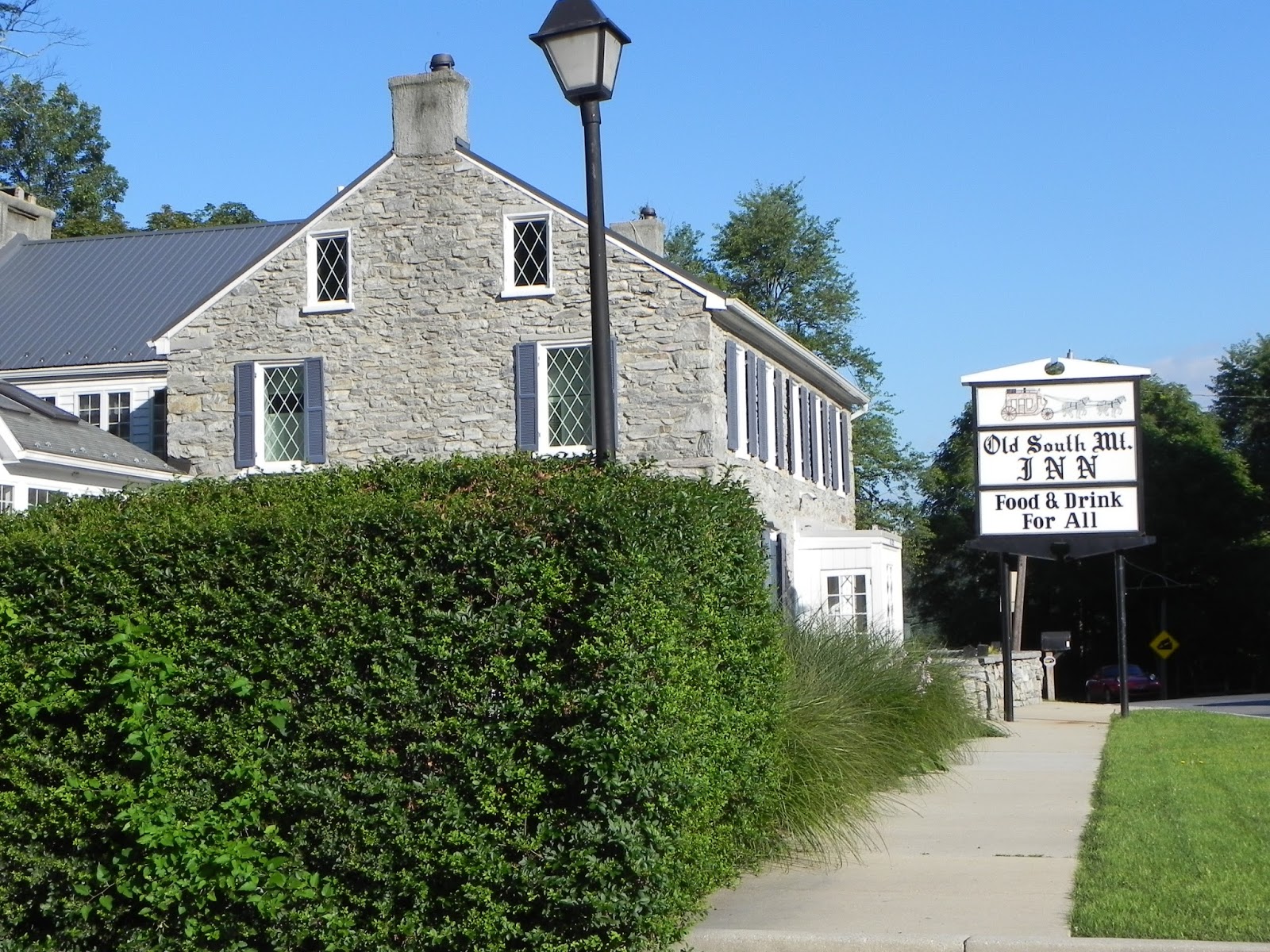
The group met in the parking lot of the Old South Mountain Inn at Turner's Gap. Around thirty people showed up for the event. In fact, my friend and I actually had to circle the lot to find a parking spot! The weather was perfect -- cool, sunny, and no humidity. Tom first led the group to some high ground along the Old National Pike and explained the fighting at Turner's Gap. We also had a chance to take in some simply stunning scenery.

The Old South Mountain Inn dates to the 18th century. Henry Clay, Andrew Jackson, and other dignitaries stayed here. During the Battle of South Mountain, the building served as Confederate Gen. D.H. Hill's headquarters.

View from the side of the mountain at Turner's Gap. The battle raged farther down the mountain from here.

Tom entertains the crowd with the tale of how the Iron Brigade allegedly got its name in the fighting at Turner's Gap. He is a bit skeptical of the historical evidence on the issue. The post-war Dahlgren Chapel is in the background.

Another highlight of the tour was the walk along the Appalachian Trail to Fox's Gap, the scene of some intense combat between the Federal Ninth Corps and assorted Confederate commands. The trail in this part follows the old Wood Road that was used during the battle. The path, which we accessed off the inn's parking lot, climbed steeply until we emerged into an open field at the site of the Wise Farm. Tom once again gave an in-depth talk on the fighting. We also had a chance to visit the monuments dedicated to Gen. Jesse Reno (USA) and Gen. Samuel Garland (CSA), who were both mortally wounded here, as well as the North Carolina Monument.

The group hikes up the Appalachian Trail to Fox's Gap.

View across the Old Sharpsburg Road (today's Reno Monument Road) to the Jesse Reno Monument in Wise's South Field. Reno fell mortally wounded in this vicinity while leading the Ninth Corps in the fighting at Fox's Gap.
The North Carolina Monument at Fox's Gap, dedicated to the North Carolina troops who fought at or near here on September 14, 1862.
Most of the group returned to the inn by way of the trail. We had a tight schedule and little time left for lunch, so my friend and I grabbed a quick sandwich at the Battleview Market before re-joining the crowd at Antietam National Battlefield.

Tom's focus at Antietam was the lesser-known fighting in the West Woods and around Dunker Church. He aimed to challenge the popular interpretation of a three-phase battle. Many sources break Antietam into geographically distinct morning, midday, and afternoon phases. Instead, fighting occurred simultaneously at various spots, including the West Woods. Tom also took the opportunity to dispute some of the other conventional wisdom about Antietam. Among other things, he defended Gen. Edwin Sumner, who is often blamed for recklessly sending Gen. John Sedgwick's Division to slaughter in the West Woods. Tom challenged us to think and left me wanting to dig a more deeply into his interpretation of events. I wouldn't expect any less from a Savas Beatie author!

The group walked through the West Woods. The tour hit the highlights of Sedgwick's advance and the Confederate counterattack. Tom then took us to a less visited area west of the Dunker Church to see where the 125th Pennsylvania made a desperate stand as Confederates of Lafayette McLaws' division entered the fray. Troops under Gen. George Sears Greene also penetrated the Confederate lines in this part of the field. Tom described how Greene was eventually driven from his salient beyond Dunker Church. During the whole tour, our trusty guide supplemented his narrative of the fighting with ample quotes from the participants.


The group hikes into the West Woods. Tom explained that at the time of the battle in 1862, this area was a woodlot and free of underbrush, unlike today. 

15th Massachusetts Volunteers Monument in the West Woods. The regiment, part of Gen. Willis Gorman's Brigade, Sedgwick's Division, Second Corps, suffered losses of  57% here. (See Antietam on the Web.)


The reverse side of the 15th Massachusetts Monument lists the names of soldiers from the regiment who were killed and mortally wounded at Antietam. Unfortunately, a modern-day bypass bisects the battlefield just down the slope from the monument.

125th Pennsylvania  Volunteer Infantry Monument. The regiment was part of Gen. Samuel Crawford's Brigade, Alpheus Williams' Division, Twelfth Corps. A statue of George A. Simpson, a color sergeant killed at Antietam, sits atop the monument.
Once the tour had ended, I made the requisite stop at the bookstore and picked up a few items. Tom was also nice enough to sign my own copy of his books that I had brought with me from home.  I then bid farewell to the group and  headed out with my friend to see some of the key sites on the battlefield. He had never visited Antietam, so I really wanted to show him what is so captivating about this place. We were pressed for time, but managed to fit in the Cornfield, Bloody Lane, and Burnside Bridge.

The only downside of the day had nothing to do with the SB tour at all. I attempted at various times to live Tweet the days' events, but reception was poor and made the use of Twitter difficult. Moreover, my iPhone battery drained a lot faster than I would have liked. I suppose I learned that technology and battlefield stomping do not always work perfectly well together.

In the end, one of the best parts of the tours was interacting with authors and fellow Civil War enthusiasts, including some of my blog readers. I enjoyed meeting Ted Savas, SB's managing director, as well as Sarah Keeney, the company's marketing director. I had a chance to chat with James Morgan, Ball's Bluff expert and author of A Little Short of Boats; fellow blogger Rea Andrew Redd, who maintains Civil War Librarian; and historian George Deutsch, who is writing a book on the 83rd Pennsylvania. I also met Eugene Schmiel, who has penned a forthcoming biography on Gen. Jacob  Cox. Schmiel shared with the group some insights on Cox that he had gleaned from his research. (Cox led a division at South Mountain and commanded the Ninth Corps at Antietam.) Driving away from Sharpsburg, I knew that it had been a day well spent. Overall, I'd rate the Antietam and South Mountain tours a great success, and I look forward to future Author Conclaves.

Thursday, April 4, 2013

The Pennsylvania Reserves in Northern Virginia 1863, Part I: What to Do with a "Decimated" Division?

This blog has frequently featured stories on the Pennsylvania Reserves.  The division, also known as the Pennsylvania Reserve Volunteer Corps, was encamped around Langley, Virginia during the first winter of the war.  In spring 1862 the Reserves relocated to Alexandria before marching south to Falmouth.  They eventually joined the Army of the Potomac just in time for the Seven Days Battles on the Peninsula.  The Reserves also saw intense combat at Second Manassas, South Mountain, Antietam, and Fredericksburg.  As the bloody second year of the war drew to a close, the Union Army's high command debated the future of the battered division and finally decided to move the Reserves back to the Washington area.  In the next few posts, I will take a look at the return of the storied Pennsylvania Reserves to Northern Virginia. 

Even before the costly engagements at Antietam and Fredericksburg, brigade commander George G. Meade had begun to worry about the state of the Reserves.  The general wrote to his wife on September 4, 1862 that "[o]ur division, the Reserves, is pretty well used up, and ought, strictly speaking, to be withdrawn, reorganized, filled up with recruits, and put in efficient condition."   (Meade 308.)   Meade led the Reserves through the carnage at Antietam, where the division suffered causalities of around 20 percent. (OR, 1:19:1, 270-71.)  After the battle, Meade discussed the "decimated condition" of the division with George B. McClellan, head of the Army of the Potomac.  As he wrote to his wife:
I. . . told [McClellan] that I had no idea they would ever be filled up by recruiting officers, and the only course I saw to adopt was to send them in a body back to Pennsylvania, and ask the Governor and State to fill them up within a specified time; but if it could not be done, they were to be mustered out of service.  (Meade 315.)
Around the same time, Pennsylvania Governor Andrew Curtin attempted to enlist political support for the reorganization of the Reserves.  In a September 30 letter to President Abraham Lincoln, Curtin suggested that the heavily depleted division be returned temporarily to the Keystone State.  The governor explained to the President:
The brilliant history of the Reserve Corps in the war, and the State pride which has followed them since they entered the service, together with the circumstances surrounding their organization, would, I have no doubt, prove such incentives to enlistment that the Corps could be filled to the maximum in a short space of time. (in Sypher 398.) 
Lincoln forwarded Curtin's letter to General-in-Chief Henry W. Halleck and Secretary of War Edwin M. Stanton for consideration.  The General-in-Chief "entirely disapprov[ed] of withdrawing regiments in the field" for purposes of filling the ranks with new recruits.  (OR, 3:2, 625.)  Curtin also wrote to McClellan, who "thought favorably of the plan, but having immediate use for the troops, was unwilling to retire them at that time."  (Sypher 398; OR, 1:21, 878.)   The division would stay at the front for now.

Gen. George G. Meade (courtesy of Civil War Wiki.Net)
After the fight at Fredericksburg in December, Meade tried once again to deal with the poor condition of the Pennsylvania Reserves.  On December 23, he sent a report on the state of the unit to Gen. William B. Franklin, commander of the Left Grand Division.  As Meade told Franklin, only 195 officers and 4,249 enlisted men were present for duty.  Another 159 officers and 3,740 men were absent with permission.  Meade noted that "to fill these regiments to the maximum authorized, will require 153 officers and 4,864 men."  (OR, 1:21, 877-78.)   However, he cautioned that "of the number reported as absent, a very large proportion are the wounded, most of whom are so maimed and disabled that no expectation need be formed of their returning to active duty."  (OR, 1:21, 878.)  Meade felt that in reality a reorganization of the Pennsylvania Reserves "required the appointment of over 200 officers and the enlistment of over 7,000 men."  (OR, 1:21, 878.)

The general proposed a course of action to revitalize the Reserves.  Recruiters had gone to Pennsylvania three different times to fill the ranks, but their efforts had met little success.  Meade recognized that the Army could "consolidate the existing force into a number of regiments equal to the officers and men for duty."  He disliked this plan, since it would "destroy[] the organization, and the prestige which the good conduct of the corps has acquired for it."  (OR, 1:21, 878.)  Instead, Meade recommended that the Reserves be withdrawn temporarily from the field and sent to Pennsylvania for two or three months, "where, it is believed, from the great reputation the corps has acquired, the pride the State takes in it, and the enthusiasm its return would create, that in a short time its ranks would be filled, after pruning them of all useless members."  (OR, 1:21, 878.)

Gen. John F. Reynolds, head of the First Corps and a former commander of the Reserves, forwarded Meade's proposal to Franklin on January 10, 1863.  Reynolds "concur[red] most heartily" in Meade's recommendation to send the division back home to recover and recruit.  (OR, 1:21, 878.)  The next day, Franklin sent Meade's plan to Gen. Ambrose E. Burnside, commander of the Army of the Potomac.  Complimenting the Reserves on their "excellent service," Franklin endorsed Meade's proposal.  (OR, 1:21, 878-79.)

Col. Horatio G. Sickel, who assumed command of the Pennsylvania Reserves upon Meade's promotion at the end of 1862, soon weighed in on the future of the division.  The colonel hoped to enlist Governor Curtin's support in reorganizing the Pennsylvania Reserves.  Sickel sent a copy of Meade's report to Curtin and got the desired response.  The governor readily took up his old cause and forwarded Sickel's correspondence to the War Department.  Secretary of War Stanton, however, had no appetite for Meade's proposal.  According to a history of the Reserves, the Secretary informed Curtin "that numerous similar applications were on file from other States, that all could not be granted without greatly reducing the strength of the army, and that therefore all must be refused."  (Sypher 436.)

The Pennsylvania Reserves had the misfortune of remaining at the front long enough to take part in Burnside's disastrous "Mud March."  But change was in the air by the end of January.  Joseph Hooker took command of the Army of the Potomac and worked with General-in-Chief Halleck to effect a transfer of the Pennsylvania Reserves. The division, however, was far from homeward bound.

Up Next: The Pennsylvania Reserves bid farewell to Hooker's army and board transports for Alexandria.

Sources

Aside from the Official Records, the following sources were useful in compiling this post:

John H. Eicher & David J. Eicher, Civil War High Commands (2001); Joseph Gibbs, Three Years in the Bloody Eleventh: The Campaigns of a Pennsylvania Reserves Regiment (2002); George G. Meade, The Life and Letters of George Gordon Meade, Vol. 1 (1913); J.R. Sypher, History of the Pennsylvania Reserve Corps (1865).

Monday, September 17, 2012

A Trip to Antietam for the 150th Anniversary

Today marks the 150th anniversary of Antietam.  A whirlwind of activity has surrounded the Sesquicentennial commemoration of America's bloodiest day.  I wanted to make it to Antietam National Battlefield this morning, but other obligations got in the way.  That being said, I was fortunate to spend my entire Saturday immersed in 150th events on and near the battlefield.  The day was even more special because my Father joined me.  It was only four years ago that he was gravely ill and unable to travel to my bachelor party outing to Antietam.

My Dad and I left early on Saturday and drove straight to the 150th reenactment of Antietam.  We made good time, until we reached the two-lane country road leading to the farm where the event was being held.  For whatever reason, traffic management left a lot to be desired, and we sat in line for close to thirty minutes before finally entering the site and parking.  Even with the long wait, we had enough time prior to the reenactment to wander through sutler's row and tour the encampments.  The weather was pleasant and cool, a far cry from the high temperatures and humidity of last summer's Manassas events.

I had the opportunity to see and hear the 2nd South Carolina String Band before the reenactment.  Their performance of Bonnie Blue Flag was a highlight of the event.
The battle reenactment that I attended focused on Union Gen. George S. Greene's fight to take the area around the Dunker Church.  (Bloody Lane and Burnside Bridge were reenacted at other times over the weekend.)  This event paled in size when compared to the reenactment of First Manassas last year.  Those who witnessed that large-scale reenactment may never be able to look at another one the same way again.  I pondered why this event was smaller.  Perhaps nothing could match the draw of participating in the first major reenactment of the Sesquicentennial.  Or maybe the scheduling of another Antietam reenactment a few weeks before had something to do with it.  Regardless, the Antietam reenactors put on a solid performance, and the artillery demonstration was particularly impressive.  Before long, however, I found myself growing restless to walk the actual ground where the armies clashed, and after another stop at the Civil War "shopping mall" that is sutler's row, we headed down the road to the National Battlefield.

Not everything was faithful to the time period.  These artillery reenactors moved their pieces into position using pick up trucks....

....although some did it the old-fashioned way!
Union regiments on the way to the field.  Unfortunately, the massive power lines overhead provided another reminder of modern times.

Union troops stream past Dunker Church in the distance.  The event organizers constructed a half-size replica of the historic structure for the reenactment.

Union and Confederates battle around Dunker Church and the West Woods.  At this point, the numbers of "dead" and "wounded" were starting to accumulate on the field, but of course, nothing could ever recapture the true carnage of Antietam. 
The National Battlefield seemed even more crowded than the reenactment.  We had to park close to a mile from the Visitor Center, where the National Park Service had set up various displays and living history demonstrations.  I was truly overwhelmed by the multitude of activities available to us throughout the park, but given time constraints, we had to choose wisely.  

After a brief lunch, my Dad and I checked out the detailed paintings of the battle by James Hope in the Visitor Center.  We then stepped inside the real Dunker Church to listen to a lecture on divided Maryland during the Civil War.  Although I was familiar with much of the story, the Park Ranger was an incredible speaker and managed to capture perfectly the complexity of slavery and loyalties in the Old Line State.  As I listened to his speech, artillery fire cause the wooden floor beneath my feet to vibrate, and carried me, however briefly, back to the day of the fight.

Union reenactors file past the Dunker Church after finishing a living history demonstration near the Visitor Center.
My Dad and I decided to do a quick tour of the battlefield.  I've visited Antietam several times before, and I took my first trip there as as a young lad of twelve.  This past Saturday I wanted to visit the hallowed ground once again and just reflect on the meaning of the place.  I will get back for more detailed tours in the future, but this was about "being there" and commemorating a meaningful anniversary with thousands of other Americans.   

We hit all the main stops, including the North Woods, the Cornfield, Bloody Lane, and Burnside Bridge.  We also visited the Pry House, site of Gen. George McClellan's headquarters.  My Dad and I opted to drive rather than take the Park Service shuttle buses.  Good thing.  The long lines at shuttle stops and the scarcity of buses reassured us that driving was likely the better choice. 

The Cornfield, site of intensely brutal fighting on the morning of September 17. 

Confederate infantry demonstration at Bloody Lane.  The National Park Service scheduled several living history events throughout the battlefield.
As always, the tour of the battlefield was a powerful experience.  There is something about that place. I really feel connected to the past when I am there, and this time was no different.  I can't help but tear up when I look at the hills and fields at Antietam.   I am sure others have similar emotions.  Even with all the crowds, I could still sense a cathedral-like quiet as I walked around.

A reproduction of a Civil War ambulance at the Pry House.  The Pry Barn (behind the ambulance) served as a field hospital at Antietam, primarily for the Second Corps of the Army of the Potomac.  The National Museum of Civil War Medicine now runs a Field Hospital Museum at the site.
A living historian portraying an "embalming surgeon."  Now I've seen it all.  For the 150th anniversary, the Pry House also hosted several living history demonstrations related to Civil War field medicine.  My Dad even extracted a Minie ball from a "leg" inside the Pry Barn--I will spare readers the picture!

Through a stroke of luck, I arrived at Burnside Bridge just as Park Ranger and fellow blogger Mannie Gentile began an overview lecture on the action occurring at the site.  Mannie's presentation was both insightful and stirring.  I don't think I've ever seen such a captivated audience listening to a Park Ranger.  The National Park Service lectures that I heard on Saturday featured slavery and fight for emancipation as a prominent part of the story.
Looking down at Burnside Bridge over Antietam Creek.  Gen. Ambrose Burnside's men eventually pushed across the bridge when Confederate resistance began to weaken.
After our rapid-fire tour of the battlefield, my Dad and I began our trek back to the DC suburbs.  I reflected on the day.  Americans have chosen to remember Antietam in a variety of ways, from reenactments and living history demonstrations to battlefield tours and lectures.  Not all commemorative activities have equal appeal to all people. But I couldn't help but feel moved that whatever our means of remembering the past, we as a nation haven't forgotten the important sacrifices made outside Sharpsburg after 150 years.