Showing posts with label Vermont Brigade. Show all posts

Tuesday, December 9, 2014

Remarkable Photographs and Sketches of Camp Griffin on the Library of Congress Website

Over the last few years, I have devoted considerable attention to the Union Army encampments in the vicinity of present-day McLean, Virginia. Gen. William F. "Baldy" Smith's division established Camp Griffin in October 1861 on property near the villages of Langley and Lewinsville. (The Pennsylvania Reserves, meanwhile, settled down at Camp Pierpont, which stretched along the Georgetown-Leesburg Turnpike and passed through Langley.) Whenever possible, I've tried to publish illustrations related to the camps, including some of George Houghton's fascinating photographs of the Vermont Brigade at Camp Griffin.

Thanks to a fellow blogger at Chooeubhaokhaossian the Great's Temple of History, I recently discovered a treasure trove of photographs and sketches of Camp Griffin on the Library of Congress's Prints & Photographs Online Catalog.  (Click here for the set of images.) The LoC's online collection appears to have expanded. I previously located a few Houghton photographs on the site, and in particular a set showing the separate companies of the 6th Vermont. Now several images (including a few photographs that are entirely new to me) are available for study and exploration. Moreover, the site offers some sketches by Larkin Goldsmith Mead, who was an artist for Harper's Weekly assigned to the Army of the Potomac. According to the LoC, Mead also made topographical drawings for Baldy Smith. I hope to return to some of these remarkable images in the future. For now, head over to the LoC website and take a look at life in camp around Washington during the first fall and winter of the war.

Here is just a sampling of the images:

"Union soldiers in front of tents, probably at Camp Griffin, Langley, Virginia," by George Houghton (courtesy of Library of Congress).
"Second Vermont Camp Griffin 1861," by George Houghton (courtesy of Library of Congress).
"Photographers on the Potomac. Camp Griffin, Virginia," by Larkin G, Mead (courtesy of Library of Congress).

Thursday, July 24, 2014

Passing Through the Old Stomping Grounds, July 1864

Following Jubal Early's defeat at the gates of Washington in July 1864, the Army of the Potomac's VI Corps pursued the Confederates westward to the Shenandoah Valley. Among the Union ranks were men who had spent the first winter of the war at Camp Griffin near Lewinsville, Virginia. They belonged to various units, including the 5th Wisconsin, 7th Maine, 43rd New York, 49th New York, 49th Pennsylvania, and 77th New York, as well as the famed First Vermont Brigade. My ancestor, Pvt. William Baumgarten of Co. K, 102nd Pennsylvania also marched with them. He had only joined the army in March 1864, but had already seen his share of horrific combat during the Overland Campaign.

A stereoscopic view of the 43rd N.Y. at Camp Griffin (courtesy of Wikipedia).

July 20-21, 1864: The Valley to Goose Creek

After suffering defeat at Rutherford's Farm on July 20, Early withdrew up the Valley to Fisher's Hill. The Federal commander, Gen. Horatio Wright, considered the Confederate threat eliminated and ordered the VI Corps and the rest of his force to return to Washington. There the Union soldiers could rest, resupply, and await further orders. (OR, 1:37:2, 419-20.)

Gen. Horatio Wright took command of the VI Corps following Gen. John Sedgwick's death at Spotsylvania (courtesy of Wikipedia). He led his men to the defense of Washington and battled Early at Ft. Stevens.


The VI Corps, along with elements of the XIX Corps, set out during the evening of July 20 from their position near Berryville. The Second Division, including William and the 102nd Pennsylvania, took the lead position in the VI Corps' line of march. [1] Headquarters directed that "[t]he troops will be made to understand that their rations must last them until they reach Washington." (OR, 1:37:2, 406.) After wading across the Shenandoah River, the men pressed on through Snicker's Gap and marched the entire night in wet clothes, taking "brief halts for coffee." (Benedict 492.)

As the sun rose over the Northern Virginia countryside, the columns continued to snake along the turnpike. The tired men of the the 49th Pennsylvania decided to stop in Hamilton for breakfast. According to one diarist from the regiment, "the citizens waved the stars and stripes as we passed through the little village; our bands played and our colors were unfurled." (in Westbrook 213.)

In the afternoon the VI Corps marched through Leesburg and halted near Goose Creek. Here the soldiers rested their sore feet and camped for the night. Those lagging behind on the march were not so fortunate. As the diarist from the 49th Pennsylvania wrote that day, "[John] Mosby is reported in the rear, gobbling up stragglers." (in Westbrook 213.)

July 22, 1864: Goose Creek to Difficult Run & Environs

The wagon train got underway at 4 a.m. on July 22, followed by the VI Corps and the XIX Corps. The day's route took the troops along the Leesburg-Alexandria Turnpike (today's VA-7). Seeking to protect his columns, Wright ordered that "[t]he cavalry under Colonel [Charles Russell] Lowell. . . be kept well out to the front, flanks, and rear, and endeavor to break up the guerrilla parties in the line of march." (OR, 1:37:2, 412.)

The divisions filed past Dranesville, where the Lees burg-Alexandria Turnpike intersected the Leesburg-Georgetown Turnpike (today's VA-193). Both roads led towards Washington. To avoid any confusion among his commanders, Wright made clear in his orders that the two corps were to continue on the Leesburg-Alexandria Turnpike.  

After another long march through heat and dust, the Federal force halted for the night in the vicinity of Difficult Creek. Some of the troops progressed as far as Freedom Hill and Peach Grove Post-Office (today's Tysons Corner) before setting up camp.

July 23-26, 1864: Lewinsville, Langley, and Beyond

The next day, July 23, followed a similar pattern. The two corps began their march around 4 a.m. Before long, they would enter the tiny hamlet of Lewinsville (part of today's McLean). Their route took them past the battlefields where some of the men had fought J.E.B. Stuart in September 1861. They also moved over the very ground once occupied by Camp Griffin. Some of these soldiers had lived here during winter 1861-62 as part of Gen. William F. "Baldy" Smith's division. The diarist from the 49th Pennsylvania observed a few differences from those early days:
 [O]ld Camp Griffin has been changed into contraband farms, and our old parade ground is growing a crop of corn. . . . (in Westbrook 213.) [2]
Union Army map showing Lewinsville and vicinity (courtesy of Library of Congress). Wright's men took the road from Peach Grove P.O. (far left), through Lewinsville (center), to Langley (far right). There the VI and XIX Corps picked up the Leesburg-Georgetown Turnpike to Chain Bridge. Camp Griffin sat on the Mackall, Johnston, and Smoot properties and the surrounding land. Living in this area, I am moved to think that 150 years ago, my ancestor was marching past my very neighborhood on his way to Chain Bridge. How the world is small, even across time!
Wilbur Fisk of the 2nd Vermont even located his former campsite. As he wrote in a letter on August 8, 1864:
There was the same excavation that we had made for the floor of our tent, the same fire-place and chimney and the same log basement. There was my old bedstead made of barrel staves nailed to two poles, and there was my old stool, which I remember used always to be in the other boys' way and which was always a reproach upon my woeful lack of ingenuity. I found too, the identical cup which has served me with coffee many times -- a good one once, but now rusty and half filled with dirt; and there were many other things that I saw around that little spot, uninteresting to others though quite interesting to me. . . . .  An eventful  season of war and strife has passed since we left that ground, and many that were with us then have been laid low by rebel hands; but peace comes not yet. Our regiment was full and strong when it left Camp Griffin, but not one-tenth of those men are with us now. (in Rosenblatt 243-44.)
Continuing along the pike beyond Langley, the VI Corps headed in the direction of Chain Bridge. Some of the men entered familiar territory once again -- on the high ground near the bridge was where soldiers under Gen. Smith had established Camp Advance and started construction of defensive works in September 1861.

Proceeding down a steep hill, Wright's corps reached Chain Bridge, crossed the Potomac, and halted in a rough line stretching from from Battery Vermont to Fort Gaines and Tennallytown. The general immediately took steps to ensure that his corps received adequate supplies. He urged his commanders to "have the wants of their men supplied as rapidly as practicable." (OR, 1:37:2, 425.)

In the end, Wright spent very little time around Tennallytown. Instead of returning to the front before Petersburg, he was dispatched to deal with a new threat from Early. By the morning of July 26, the men were once again on the move. They broke camp and marched that day to Rockville. The campaign against Early was entering a new and prolonged phase.

Postscript

The march of the VI Corps through Lewinsville and Langley was a bittersweet homecoming for some. By summer of 1864, the war had taken a terrible toll, and many soldiers never lived to see the old campgrounds for a second time. Others had left the ranks due to wounds, disease, or the end of enlistment. The survivors also looked upon a landscape that had undergone a revolutionary transformation. In place of picket lines, drills, and military parades were contrabands, marking the transition from slavery to freedom. A return to the "stomping grounds" of 1861-62 symbolized just how far the war had progressed since those early days of relative calm and innocence, before the massive bloodletting and the fight for emancipation.

Notes

[1] Incidentally, William received a head wound in skirmishing around Snicker's Gap a few days before and may possibly have made the trip by ambulance. The exact timing and circumstances of William's wounding is somewhat uncertain based on available sources.

[2] By summer 1864, the contraband farm, Camp Wadsworth, sat on land where Camp Griffin was once located. (See my post here for more information.) Camp Beckwith, another contraband farm, sat north of the village of Lewinsville.


Sources

George Grenville Benedict, Vermont in the Civil War, Vol. 1 (1886); Butler County PAGenWeb, "Genealogical Inquiries" (contains excerpt on Wm. Baumgarten from 1889 book, Presidents, Soldiers and Statesmen, Vol. 1); John H. Niebaum, History of the Pittsburgh Washington Infantry: 102nd (Old 13th) Regiment Pennsylvania Veteran Volunteers and Its Forebears, 1792 to 1930 (1931); Official Records, 1:37:1, 406-457 & 1:37:2, 272 et seq.; Emil & Ruth Rosenblatt, Hard Marching Every Day: The Civil War Letters of Private Wilbur Fisk (1992 ed.); Robert Westbrook, History of the 49th Pennsylvania Volunteers (1897).

Thursday, May 15, 2014

Commemorating the 150th of Spotsylvania Court House

This past Monday I headed to Fredericksburg & Spotsylvania National Military Park to attend the Sesquicentennial commemoration of the Union attack on the Mule Shoe Salient during the Battle of Spotsylvania. The fighting on May 12, 1864 was some of the most intense and brutal combat of the entire Civil War. An early morning Federal attack by the Union II Corps on Gen. Robert E. Lee's lines at the salient led to an initial breakthrough. The Confederates threw in reinforcements to beat back the Union onslaught. The fighting lasted for twenty-two long hours and resulted in a stalemate. The infamous "Bloody Angle" was the scene of a particularly ferocious struggle. All told, both sides suffered around 17,000 casualties that day.

Fredericksburg & Spotsylvania NMP has offered a myriad of events to commemorate the Sesquicentennial of the Wilderness and Spotsylvania. Work has been pretty busy in recent weeks, so I had to be selective. Given the prominent place of the Bloody Angle in the narrative of the Overland Campaign, I opted to attend some of Monday's activities at the battlefield.

I headed down I-95 under an early morning sky. Arriving at the battlefield, I couldn't help but notice the difference in weather compared to the same time 150 years ago. The combat at the Mule Shoe Salient took place in foggy, rainy, and muddy conditions. By contrast, the sun on Monday was strong and bright as the day got underway. I was also struck by the number of cars parked along the road around the Bloody Angle stop. A couple hundred hardcore enthusiasts had already come to participate in the pre-dawn hike covering the Union attack, and high turn-out also characterized the tours that I attended. Don't let anyone tell you that the Sesquicentennial is suffering from a lack of interest!

Until Monday, I had never before visited Spotsylvania. I immediately felt chills as I looked out over the ravines and remnants of the earthworks at the Bloody Angle. Here I stood to ponder the enormity of what was happening at that very moment on that very ground 150 years ago. As I have come to learn during the Sesquicentennial, nothing can surpass the feeling of commemorating a battle on the anniversary day.

Red and white carnations covered the remains of the Confederate earthworks at the Bloody Angle.

The National Park Service maintained a "silent sentinel" for 22 hours, May 12-13, to commemorate the 22 hours of non-stop combat at the Mule Shoe Salient.
I attended a two-hour tour at 8 a.m. covering the famous "Lee to the rear!" episode and the Confederate response to the initial Union attack at the salient. We even stopped at the supposed spot where the Rebel commander was urged to turn around and get out of harm's way. At 12:30 I participated in a two-hour hike examining the lesser-known fighting at the east face of the salient, including the site of the Union IX Corps engagement with Confederates under Gen. James Lane. The Park Rangers on both tours were highly informative and helped visitors to make sense of what happened and where. I am always impressed by their knowledge and their professionalism.

Cars lined both sides of the road around the Bloody Angle.

Eric Mink discusses the role of Col. Simon Griffn's brigade (Potter's Division, IX Corps) in the Union attack on the east side of the Mule Shoe Salient. This picture gives a good idea of how large the tour groups were on Monday.
Luckily I found some time to see other sites at Spotsylvania, including the location of Col. Emory Upton's May 10 attack on the Mule Shoe Salient. Following the afternoon hike, I also toured the Wilderness battlefield, where I had the opportunity to visit Saunders Field, the Tapp Field, the site of James Longstreet's wounding, and other well-known spots. I was particularly interested in seeing the Brock Road-Orange Plank Road intersection due to some personally meaningful connections. Everywhere I went on both fields I came across flags and flowers from recent Sesquicentennial commemorations, reminding me that yesterday's sacrifices have not faded from our memory despite the passage of time.

Throughout my personal Wilderness and Spotsylvania tours I relied on the Civil War Trust's Overland Campaign Battle App, which I just installed on my iPhone last week. The app's GPS-enabled map was indispensable to making sure I didn't miss anything I wanted to see.

Monument to Gen. John Sedgwick on the Spotsylvania Battlefield. The Union commander of the VI Corps was killed near here by a Confederate sharpshooter on May 9, 1864.

A visitor placed this lone flower on the monument to Union Gen. Alexander Hays, who fell here on May 5, 1864 during the first day of the fighting in the Wilderness.

The critical intersection of the Brock Road and Orange Plank Road on the Wilderness Battlefield. My ancestor, William Baumgarten, first experienced combat near this spot on May 5, 1864. His regiment, the 102nd Pennsylvania, was part of Gen. Frank Wheaton's brigade of Gen. George Getty's VI Corps division. Getty's men played a key role in defending against Confederate Gen. A.P. Hill's advance on the intersection during the first day of the battle.
Monument dedicated to the First Vermont Brigade at the Wilderness Battlefield. In October 1861, the Vermont Brigade established Camp Griffin near the area where my home now sits in McLean, VA. The men spent the first winter of the war there before heading off to the front. At the Wilderness, the brigade, under the leadership of Col. Lewis A. Grant, also fought as part of Getty's Division at Brock Road. The unit experienced over 1,200 casualties in the battle.
Sesquicentennial events are also social occasions, and this one was no exception to the rule. I had a chance to meet fellow blogger Damian Shiels, who came all the way from Ireland to visit Civil War battlefields and attend the 150th commemorative events at Wilderness and Spotsylvania. I also had the pleasure of meeting John Cummings, who maintains the Spotsylvania Civil War Blog. My friend and Civil War expert Todd Berkoff and I walked together on the first tour, and I appreciated his insights on the battle. I also got to catch up over lunch with Robert Moore, another friend and fellow blogger. He and I joined Damian on the hike of the east side of the salient.

My visit to Spotsylvania on Monday was one of my most meaningful Sesquicentennial experiences. I am pleased that I could walk the hallowed ground at the Mule Shoe Salient to learn about and honor those who fought there 150 years ago. The personal side tour of the Wilderness also allowed me to commemorate the sacrifices that my ancestor made on that battlefield. All told, it was a trip to remember. And now on to Cold Harbor....

Thursday, March 21, 2013

Upcoming Civil War Lectures of the McLean Historical Society

As many readers know, I often attend meetings of the McLean Historical Society (MHS) and have even spoken to the group on a couple of occasions.  I recently had the honor of being chosen to serve on the MHS Board of Directors.  Needless to say, I am looking forward to greater involvement with an organization that has done so much to preserve our local history in this part of Northern Virginia.


Under the leadership of Paul Kohlenberger, the MHS has hosted some interesting lectures on Civil War-related subjects, ranging from the Battle of Lewinsville to John S. Mosby's operations in Fairfax.  This spring promises more of the same.  I'd like to inform readers about the following Civil War programs on the MHS calendar:

April 9  Mike Henry, the Fairfax County Park Authority's Director of Colvin Run Mill, will discuss the history of the mill during the Civil War.  (I've written briefly about Colvin Run Mill here.)

April 16  The MHS is sponsoring a special event featuring  Howard Coffin, a preeminent historian on Vermont and the Civil War.  Coffin will speak about soldiers from the Green Mountain State at Camp Griffn.  I've blogged extensively about the camp, which served as quarters for William F. "Baldy" Smith's division from October 1861 to March 1862.  The Vermont Brigade comprised a part of Smith's command.

June 11  Roger Mudd, a long-time McLean resident and award-winning journalist, is presenting a lecture entitled, "Where Exactly IS Ball's Hill?"  The talk will focus on the Civil War experiences of the Ball family.  Mudd now resides on land that once belonged to the Balls.  The lecture promises to offer a fascinating look at civilians impacted by the war in Northern Virginia.

All of these events start at 7:30 and are held at the McLean Community Center, 1234 Ingleside Avenue, McLean, Virginia.  If you live in the area, I'd encourage you to come to one or all of these events. And if you happen to be in town, please feel free to stop by.  I hope to see you there!

Thursday, January 10, 2013

McLean Historical Society: Follow-Up on Speaking Engagement

As readers are aware, this past Tuesday I spoke before the McLean Historical Society (MHS) about the Union Army encampments in the McLean area during the first fall and winter of the Civil War.  I am extremely grateful that the MHS invited me to talk about this topic, which has been one of the main focuses of this blog.  All told, around 50 people turned out for the event.  It warmed my heart to see that so many people were interested in learning about the Civil War camps in my part of Northern Virginia.  The audience was not strictly "local" either.  At least one Facebook fan from DC showed up, along with a member of the neighboring Bull Run Civil War Roundtable.

A few people in the crowd were also descendants of families who lived in this area during the mid-19th century.  Dan Smoot's ancestor, Jacob Smoot, owned Salona at the time of the Civil War.  Jacob, a Southern sympathizer, fled Salona with his family and moved to Georgetown.   He was also arrested by Union authorities early in the war.  Gen. "Baldy" Smith used Salona as his divisional headquarters, and the Vermont Brigade encamped on and around the Smoot property.  (The present-day owner of historic Salona was also present).  Doug Mackall is the descendant of William W. Mackall, a Confederate general who lived in the McLean area after the war.  The home of Doug's distant relative, Dr. Richard Mackall, became brigade headquarters for Gen. Winfield Scott Hancock.  The DC area is often viewed as transient, but people like Dan and Doug remind us that some families have deep roots dating back more than 150 years.  Who could have imagined that in 2013 a transplant from the Commonwealth of Pennsylvania would be speaking about local citizens who were so deeply affected by the Civil War in front of their very descendants? 

Detail from 1862 Union Army map showing the area where the divisions of "Baldy" Smith and George McCall established Camps Griffin and Pierpont, respectively.  The Mackall and Smoot properties are plainly visible in the center of the map.
The audience engaged in a lively Q&A session, and I also had time to speak one-on-one with some of the attendees following the main event.  A woman from McLean informed me that just the other day she found three Civil War bullets in her yard!  Others told me about some recent relic discoveries on a large plot of land near my house which apparently confirm the existence of a Union Army campsite.  Another attendee alerted me to a book about the experiences of the Comte de Paris, who served on George B. McClellan's staff.  Entitled Voyage en Amérique 1861-1862 : Un prince français dans la guerre de Sécession (2011), the book devotes considerable attention to the Comte's time in Northern Virginia.  I plan to order a copy soon and see what gems I can uncover.  I'll let readers know in future posts. 

This was my second time speaking before the MHS, and I enjoyed every minute of it.  I also walked away with some interesting stories and insights from those who attended.  Thanks to all who came to hear about the camps!

Thursday, December 20, 2012

"Baldy" Smith's Division and Dranesville

Today marks the 151st anniversary of the Battle of Dranesville.  I've written a few times about this engagement that pitted Gen. E.O.C. Ord's brigade of Pennsylvania Reserves against a smaller force under Gen. Jeb Stuart.  I even authored the lead piece on the battle for the Civil War Trust's website.  Not too long ago historian John Hennessy sent me a period newspaper article that has shed some additional light on the events surrounding the fight at Dranesville.

Ord's men, accompanied by the famed Bucktails and a force of artillery and cavalry, set off from Camp Pierpont in Langley, Virginia during the early morning hours of December 20, 1861.  Gen. George A. McCall, commander of the Pennsylvania Reserves, ordered Gen. John F. Reynold's brigade to follow in support.  Ord ran into Stuart's men at the tiny hamlet of Dranesville, and a brisk fight ensued.  Reynold's troops, who were stopped at Difficult Run along the Leesburg-Georgetown Turnpike (VA-193), marched towards the battlefield.  Gen. George G. Meade's brigade of Reserves also left Langley and headed down the pike to Dranesville.  Both brigades arrived too late to participate in the fight, which resulted in a Union tactical victory.

The role that Reynolds and Meade played (or did not play) is well known.  Thanks to the article that John Hennessy sent my way, I recently learned that the Gen. William F. "Baldy" Smith's division also got involved in the day's events.  Smith's men were quartered for the winter at Camp Griffin, in the same general vicinity as Camp Pierpont (today's McLean, Virginia).  His command included the Vermont Brigade and another brigade under Gen. Winfield S. Hancock.  According to a December 24, 1861 account from a soldier-correspondent of the 6th Vermont:
On Thursday last, Gen. McCall had a fight with some 8000 of the enemy.*  About one o'clock, on that day, our brigade was drawn up, together with Gen. Hancock's brigade, the batteries of [Capt. Thaddeus] Mott and [Capt. Romeyn] Ay[res], also some Maine regiments, for the purpose of proceeding to the scene of action and if possible to flank the enemy on their retreat. ** We marched at a rapid pace some ten or twelve miles in the vicinity of Hunter's Mills and Drainsville [sic], but come to a sudden halt on account of a bridge being burnt.  All we had to do was to "about face" and march back, reaching camp a little before eight, tired enough to rest.  The next morning at four we were tramped out on picket. ("A March," Vermont Journal (Windsor), Jan. 4, 1862, courtesy of John Hennessy.)
This article intrigued me, as I didn't recall coming across any references to Smith's men playing a role, however remote, in the engagement at Dranesville.  I at once searched for additional references and found a letter that Corporal Dan Mason, Co. D, 6th Vermont sent to his fiancee, Harriet B. Clark.  The facts in this correspondence closely track the details from the Vermont Journal article.  On December 27, 1861, Mason wrote:
I dare say you have heard of the battle at Drainsville a few days since We heard the firing from our camp. Gen McCalls division of Penn soldiers went out in the morning on a foraging & scouting expedition (this Div is encamped about a mile north of our camp) Our division started about 2 oclock P M. to assist them if nessessary We marched 12 miles we came to a branch of the Potomac the rebels had burned the bridge so that we were compelled to face about & march homeward the boys were in the best of spirits until the order to about face came. that made them look disappointed quite a number fell out by the way & were picked up the ambulances which follow an army to pick up those that are wounded or sick & are not able to march. . . . (spelling and grammar as in original; courtesy of Vermont Historical Society, On-Line Collection of Dan Mason Letters.)
Co. D, 6th Vermont Volunteer Infantry at Camp Griffin (courtesy of Library of Congress)
Both of these accounts explain that the march to Dranesville was interrupted when Smith's men stumbled upon a destroyed bridge.  Given that the Pennsylvania Reserves moved freely back and forth along the Leesburg-Georgetown Turnpike, including the portion that crosses the Potomac tributary of Difficult Run, it appears that Smith's men took a different route towards Dranesville.  Their line of march towards Dranesville may have continued due west from Camp Griffin (today's McLean) in the direction of Hunter's Mills, or could have turned northwest onto the Leesburg-Alexandria Turnpike (current VA-7).  Both routes passed over creeks, and Confederate soldiers may very well have burned the bridge at any of the crossings.  (For a detailed map, see here.)

The mobilization of Smith's men on the afternoon of December 20 makes sense.  A fight had erupted at Dranesville between a Union brigade and a Confederate force of unknown size.  As word reached the camps around Langley, Smith took action to render assistance to the Pennsylvania Reserves.  Of course, Ord beat Stuart without needing help from other brigades.  In any event, Smith's men were blocked at the site of a burned down bridge, and it is unclear how much they could have contributed that day.

Notes

*The Battle of Dranesville occurred on a Friday, not a Thursday.  The correspondent greatly exaggerated the size of Stuart's force, which consisted of 1,600 infantry, 150 cavalry, and a four-gun battery of artillery.  (OR, 1:5, 490.)
**"Our brigade" means the Vermont Brigade.  Two Maine regiments --the 6th and 7th Maine-- belonged to Smith's division. The 6th Maine was part of Hancock's brigade.  (See George B. McClellan, Report on the Organization and Campaigns of the Army of the Potomac (1864).)

Tuesday, October 9, 2012

The Future of Salona: Preserving a Local Civil War Site

This past Thursday the Salona Task Force held a public meeting on the future of the historic Salona property in McLean, Virginia.  By my own estimate, a few hundred interested citizens came to the event at the McLean Community Center.  The meeting gave the Task Force the opportunity to showcase various proposals for the development of the site and to solicit feedback from the community.

Readers may recall that the Salona house was the site of Union General William F. "Baldy" Smith's headquarters from October 1861 to March 1862.  Regiments from the Vermont Brigade of Smith's division stayed on the surrounding land, which was part of Camp Griffin.  And the property's historic significance is not limited to the Civil War.  President James Madison likely spent the night at Salona when the British attacked and burned Washington during the War of 1812. 

Fairfax County acquired a perpetual conservation easement on a 41.5-acre section of Salona in 2005.  The easement protects the historic property, while at the same time permitting limited recreational use on ten acres.  A couple of years ago, the county released a draft master plan for Salona.  This document tried to be all things to all people.  The proposed plan called for two rectangular athletic fields, a 100-space parking lot, a dog park, a playground, a picnic area, educational and environmental features, historical interpretation, and trails.

The Salona house, adjacent to the proposed park land.  The 7.8-acre residential core of Salona is protected by a perpetual easement granted to the Fairfax County Board of Supervisors in 1971.  Salona is listed on the National Register of Historic Places and the Virginia Landmarks Register.
A photograph of Salona by George Houghton, taken when the house was being used as Baldy Smith's headquarters (courtesy of Vermont Historical Society).
 
A view of the meadowland at Salona from Rt. 123.
Not surprisingly, in 2011 Fairfax decided to kick the issue to a Task Force, which was charged with reaching out to the community and developing recommendations for the park.  The Task Force includes representatives from every conceivable interest connected with Salona.  Members hail from the McLean Citizens Associations, McLean Youth Athletics, the Greater McLean Chamber of Commerce, the Fairfax County History Commission, the Northern Virginia Conservation Trust, the conservation grantors (DuVal family), and the surrounding neighborhood.

A Fairfax County historical marker on Salona was installed in 2010.  (See here for more information.)
The Task Force has an unenviable job.  A split has developed in the community between the local youth sports movement and preservation-minded citizens.  The proponents of the athletic fields apparently have gained quite a following.  In fact, their on-line petition has garnered nearly 1,200 signatures.  At the public meeting the other day, the soccer dads and moms came out in full force with their uniform-clad children in tow.

Granted, McLean's population is growing, and kids need a place to play sports.  However, Salona is not the place for athletic fields (or dog parks, for that matter).  The property is one of the last surviving parcels of open land in McLean.  The meadows fronting Rt. 123 look much like they did 150 years ago.  The historic home sits nearby.  The conservation easement represents a tremendous opportunity for the county to prevent the disappearance of a historically significant piece of land. 

Any plans for Salona must preserve the sense of place that makes the property so special.  Walking in the new Salona park should carry visitors to another time and allow for an exploration of the site's storied past.  Two athletic fields and a large parking lot would do anything but that.  Some critics likely see no point in preserving old meadows.  But that argument misses the point.  Preservation goes beyond just protecting an important structure like the Salona house, but takes into account historic viewsheds.  The scenic features at Salona are an integral component of the property from a historical standpoint; the county's final plans should respect and maintain that landscape.

At Thursday's meeting, the Task Force took a unique approach to educating the public about the possible uses for Salona.  Each room at the community center featured exhibits on a variety of proposals for the park's development.  Task Force members and community groups were on hand to discuss these options with the public.  Attendees also had the opportunity to complete opinion forms that the Task Force will use when assessing the community's views. 

If anything, the meeting demonstrated that historic preservation goals can work hand-in-hand with some of the proposed plans for Salona.  The Fairfax County Public Schools, for example, would like to use Salona as a living classroom for science and history education.  One firm has proposed the construction of a multi-purpose building using the latest in green technology.  The small, discrete structure, which would resemble a farm outbuilding, could function like a museum on the history of Salona.  Interpretive trails installed across the property make sense, as do occasional living history encampments.  Other ideas, such as developing a self-sustaining farm at Salona, seem a bit of a stretch.  And the proposed athletic fields, although technically consistent with the terms of the easement, run counter to the spirit of properly honoring Salona's past.  Overall, however, the community's use and enjoyment of Salona need not be at odds with historic preservation.

The ball is now in the Task Force's court to make the appropriate recommendations for Salona.  Following Thursday's meeting, and months of input from community groups, the Task Force is well positioned to find a solution, however difficult that may be.  Members are well aware of the need to develop Salona in a way that comports with the property's historical significance.  Doing the right thing may not be popular with everyone, but Salona's future depends ultimately on our respect for the past.

Monday, April 23, 2012

Camp Griffin and the 5th Vermont: Yesterday and Today

A few months ago I reviewed an excellent book on George Houghton's Civil War photography. Published by the Vermont Historical Society, "A Very Fine Appearance" covers Vermont soldiers in camp and on campaign in Virginia from 1861-63. The book contains many priceless photographs of the Vermont Brigade at Camp Griffin near present-day McLean, Virginia. As readers are well aware, I've written extensively on Camp Griffin, which was home to Gen. William F. "Baldy" Smith's division during the first winter of the war.  

One of Houghton's photographs has won a degree of fame as the cover illustration for the companion book to Ken Burns' acclaimed public television documentary on the Civil War. The photograph, reproduced below, shows soldiers of the 5th Vermont Infantry during a review in the fall of 1861. The troops stand at attention before a mounted officer. Local historian Carole Herrick has identified this officer as "Col. L.A. Grant." (Herrick 41.)*

5th Vermont at Camp Griffin (courtesy of Vermont Historical Society)
The most distinctive natural feature in the photograph is the large rock outcropping visible to the right of Grant.  This landmark remained undisturbed when the area underwent residential development at the start of the 1950s and survives today.  Local historians have used the outcropping to identify the precise location of the Houghton photograph along Kurtz Road in McLean.  (Hatch 89-91; Herrick 41.)  Many local residents are well aware of the existence of this rock and have mentioned it to me in casual conversation or on this blog.  The actual site of the 5th Vermont's camp was not far from Baldy Smith's headquarters at Salona.

Close-up view of the rock outcropping

This past weekend I took my twin boys for a walk in search of the rock outcropping.  A helpful local pointed me in the right direction, and I finally located the outcropping in the front yard of a private residence along Kurtz Road.  A map of the location at the intersection of Kurtz and Maugh Roads can be found here.  The outcropping is now embedded in a hillside and covered with ivy, but the feature is unmistakable.  I snapped a few quick shots on my iPhone to share with readers.  (My digital Nikon would have worked better, but sometimes it's best not to run around suburban neighborhoods toting a large camera!)

Current view of the rock outcropping along Kurtz Road 

Present-day view of the site of Houghton's photograph of the 5th Vermont.  The arrow indicates the location of the rock outcropping.  Today this area is part of a residential subdivision in the Northern Virginia community of McLean. The Google map linked to above contains a street-level view that allows readers to examine this spot in more detail.

Finding the location of Houghton's well-known photograph of the 5th Vermont is a piece of cake thanks to that rock outcropping.  We are not so lucky with many of the other photographs that Houghton took of the Vermont Brigade at Camp Griffin.  The landscape around here has dramatically changed since the Civil War, and many of the pictures hold few clues as to the precise location where Houghton took them.  That being said, I will continue my search for the campgrounds of the Vermont Brigade and other units that occupied the countryside near Lewinsville and Langley.  The closer I get to understanding where those camps were, the closer I may be to figuring out where Houghton may have taken his photos.  As always, I'll be sure to report my findings on this blog.

Notes
*According to the Vermont in the Civil War website, "L.A. Grant" is Lewis Addison Grant, who was a Lt. Col. when this picture was taken in the fall of 1861.

Sources
Winslow R. Hatch, Old Roads and New Insights: Adventures in Discovery (1985); Carole Herrick, Images of America: McLean (2011); Vermont in the Civil War (website).

Thursday, March 15, 2012

A Mud March to Alexandria: McCall and Smith on the Move

As the middle of March 1862 approached, Union commander George McClellan faced the gargantuan task of transporting his Army of the Potomac to the Peninsula for the planned advance on Richmond.  His divisions, however, were scattered across Northern Virginia following an earlier march towards Centreville and Manssas.  McClellan now had to get these soldiers to Alexandria, Virginia, where they could board transports for Ft. Monroe.  Life was about to get very rough for the men in Little Mac's army.

The Pennsylvania Reserves Leave Hunter's Mills and Take a Detour in a Downpour

As I discussed in Tuesday's post, Gen. George McCall's Pennsylvania Reserves advanced on March 10 from Langley to Hunter's Mills.  On March 14, the general was directed to move his division "on the road towards Alexandria, and await orders" from the newly appointed First Corps commander, Gen. Irvin McDowell.  (Sypher 169.)  At that moment, it was unclear whether McCall would return to Camp Pierpont at Langley, or proceed to Alexandria.  Around six that evening, the men received orders to march.  They reacted with a mixture of curiosity and enthusiasm.  As Private A.F. Hill of the 8th Pennsylvania Reserves remembered:
. . . we hastily pulled down our miniature tents, each making one of the blankets fast to his knapsack—we were to carry them of course. It was rumored that we were to march to Alexandria, there to embark in steam transports, for parts to us unknown. Soon we were in line, soon in motion, directing our steps toward the Alexandria and Leesburg pike.  (Hill 204.)
As a light rain fell, the division crawled north along the road through Hunter's Mills.  The column stretched for about three miles.  A few soldiers "were left to fire the huts and guard the forage, and the great commissary wagons closed in behind the last battalions. . . ."  (Phila. Press, Mar. 17, 1862.)  Flames illuminated the night sky and helped to guide the advance.  After a few hours, the division turned right onto the Leesburg-Alexandria Turnpike and stopped in a "dense woods" around Powell's Mill (today's Colvin Run Mill) between eleven and midnight.  (Woodward, Third Pennsylvania, 65.)  The Pennsylvania boys started camp fires despite the rain and attempted to get a night's rest.

The morning of the fifteenth brought even more miserable conditions.  The rain continued to fall, and to make matters worse, the Confederates had previously destroyed the bridge over Difficult Run, and the creek was unfordable due to the recent spate of inclement weather.  McCall was forced to turn off the pike and march seven miles to the Leesburg-Georgetown Turnpike, where he could cross Difficult Run and send for instructions from McDowell.  Once on the pike to Georgetown, McCall felt that the rains had made continued marching next to impossible, and he asked McDowell for permission to bivouac on the spot, or at least return to the division's old camp in Langley, only four miles away.  McDowell rejected the suggestion, and ordered McCall to "march without delay to Alexandria, with infantry and artillery, and prepare to embark [for the Peninsula] immediately."  (Sypher 170.)  McCall was likely unhappy with McDowell's decision, but had no choice but to obey orders and march the remaining twelve miles to Alexandria.

The division now moved south through low-lying country to re-connect with the Alexandria pike.  As Evan Woodward of the 2nd Pennsylvania Reserves described the remainder of the dismal march that day:
The rain by this time was falling in torrents, flooding the swampy ground, making the marching most tiresome and fatiguing. Soon the ranks were broken, the men scattering, plunging through the mud, and toiling under their knapsacks, made doubly heavy by their blankets and overcoats becoming saturated with water. Soon they commenced dropping out, and laid scattered through the woods for miles. (Woodward 85-86.)
Hill also recalled that "the mud became deep, and the marching was both unpleasant and laborious; a cold wind-was blowing; our clothes became saturated, our shoes were filled with mud." (Hill 204.)  The division reached the Leesburg-Alexandria Turnpike, but the men had dealt with enough for one day.  According to  J.R. Sypher's classic history of the Pennsylvania Reserves, McCall halted his tired men near Falls Church and told McDowell that his division could go no farther that day.  A journal maintained at McDowell's headquarters, however, indicates that "McCall was ordered to encamp where he was, beyond Falls Church, he having got into the mud."  (OR, 1:51:1, 62.)  Whoever was responsible for the respite, the Pennsylvania troops were surely thankful. 

Fairfax Seminary, near Alexandria, Virginia (courtesy of Library of Congress).

At Falls Church, the soldiers combated the rain and managed to start fires "[a]fter much patient labor."  (Woodward, Our Campaigns, 86.)  Woodward recalled the misery in camp that night: ". . . such was the violence of the storm, that it was impossible to put up our tents, the most of the men spending the night in cutting wood and standing around the fires."  (Woodward, Our Campaigns, 86.)  Hill decided he could not bare another uncomfortable night attempting to sleep in the rain.  He walked the remainder of the way to Alexandria along with a few Bucktails from his division.  In Alexandria, the public buildings were open to the soldiers, and Hill found a warm spot on the floor inside a building near the post office.

McCall's men resumed the march at ten on the morning of the sixteenth.  By this time, the weather had improved somewhat from the day before.  As they moved down the pike, the soldiers tramped past "a long line of fortifications erected at different times by the Union and Confederate troops."  (Woodward, Our Campaigns, 86.) 

The division finally halted near the Fairfax Seminary (current-day Virginia Theological Seminary) outside of Alexandria, where the men discovered that they would not be embarking anytime soon.  The soldiers became angry with McCall and "complained of the hard treatment."  (Sypher 171.)  McCall himself "put on record the fact, that this was the only occasion on which the Pennsylvania Reserves, while under his command, complained of the severity of any duties they were required to perform." (Sypher 171.)  Many of the men must certainly have shared Gen. George Meade's sentiment.  As the commander of the Second Brigade wrote to his wife a few days after arriving in Alexandria: "I do not think I have ever seen a much harder march than the one from Hunter's Mills to this place."  (Meade 252.)

"Baldy" Smith's Men Brave the Elements on the Way to Alexandria


Smith's division, including the Vermont Brigade, was encamped at Flint Hill, a few miles north of Fairfax Court House, when orders came to march at six on Saturday morning, March 15.  As the soldiers set out and approached Fairfax, the skies opened.  Just like the Pennsylvania Reserves, the troops in Smith's command were forced to contend with torrential downpours and muddy ground.  The division advanced slowly along the Little River Turnpike towards Alexandria.  Some of the men began to fall out, and officers tried to help weaker soldiers carry their knapsacks or rifles.  All the regiments of the Vermont Brigade, with the exception of the 2nd Vermont, had never experienced such a difficult march.  (in Zeller 58.)  

After about twenty arduous miles, the division finally reached the outskirts of Alexandria and set up camp in a pine woods.  As Corporal Dan Mason of the 6th Vermont recalled in a letter to his fiancee:

I was wet through long before we halted. About the time we stopped it rained harder than ever. My boots were full of water & I felt cold & chilly. Others were in as bad or even worse condition than I was.  Some were inclined to curl up by a tree. They did not seem to care whether they lived or died. (Ltr., Mason to Fiancee, Mar. 31, 1862) (minor corrections made to punctuation/capitalization)
The soldiers lit fires to stay warm and attempted to sleep.  The next morning, steam was literally rising from their saturated bodies.  The men soon learned the disappointing news that their transports were not yet ready.  The movement to the Peninsula would have to wait.  The Vermont Brigade marched about four miles to Cloud's Mill (current-day West End area of Alexandria).  There the soldiers established what they nicknamed "Camp Hard Crackers." 

Detail of 1862 Union Army map of Northeastern Virginia showing the approximate location of McCall's camp at the Fairfax Seminary and Smith's camp at Cloud's Mill (courtesy of Library of Congress)

Smith's division spent several days in camp around Alexandria. Surgeon Alfred Castleman of the 5th Wisconsin worried that his regiment was staying put:
We are sending to Washington for our tents. Our General Smith is building stables, and it looks as if we were again settling down. What does it mean ? Is there another change of programme ? And are we not to embark after all?  (Castleman, entry for Mar. 17, 1862, 100.)
But Castleman's concerns were misplaced.  On March 23, the 13,000 men of Smith's division marched to the Alexandria waterfront with great fanfare and boarded transports to take them down the Potomac to the Chesapeake and Ft. Monroe.

McCall's men, meanwhile, eagerly waited for orders at their camp around the seminary.  McClellan originally intended to move McDowell's corps en masse before any of the other corps.  The transports were slow to arrive, however, so McClellan switched plans.  He sent the other corps by division "as fast as transports arrived" and "determined to hold the 1st corps to the last, and land it as a unit whenever the state of affairs promised the best results."  (McClellan, Own Story, 254, 256.) 

McCall's men learned of yet another change of plans within a few weeks.  At the start of April, President Lincoln decided to hold back the First Corps for the defenses of Washington.  The Pennsylvania Reserves would ultimately be sent to reinforce McClellan in June 1862.  The hard march in the rain and mud to Alexandria had amounted to a whole lot of hurry up and wait.  But those days would pale in comparison to what was in store for the Pennsylvania Reserves once they got to the Peninsula.

Sources:

Russel Beatie, Army of the Potomac: McClellan's First Campaign, March-May 1862 (2007); George Grenville Benedict, Vermont in the Civil War, Vol. 1, (1886); Alfred I. Castleman, Army of the Potomac: Behind the Scenes, A Diary of Unwritten History (1863); M.D. Hardin, History of the Twelfth Regiment Pennsylvania Reserve Volunteer Corps (1890); A.F. Hill, Our Boys: The Personal Experiences of a Soldier in the Army of the Potomac (1864); George Meade, The Life and Letters of George Gordon Meade, Vol. 1 (1913); George B. McClellan, McClellan's Own Story (1887); Philadelphia Press, March 17, 1862; Stephen W. Sears, To the Gates of Richmond: The Peninsula Campaign (1992); J.R. Sypher, History of the Pennsylvania Reserve Corps (1865); O.R. Howard Thomson & William H. Rauch, History of the "Bucktails" (1906); Vermont Historical Society, On-Line Collection of Letters of Dan Mason; Paul G. Zeller, The Second Vermont Volunteer Infantry Regiment, 1861-1865 (2002); Edward Morrison Woodward, History of the Third Pennsylvania Reserve (1883); Edward Morrison Woodward, Our Campaigns (1865).

Tuesday, March 13, 2012

Camp Life at Hunter's Mills and Flint Hill

As I wrote in my last post, divisions under George McCall and "Baldy" Smith left their winter camps on March 10, 1862 and advanced towards Centreville. The soldiers were excited at the prospect of beating Joseph Johnston's Confederates, who had just evacuated their lines around Centreville and Manassas.  By noon, Smith's men had reached the area around Flint Hill, where they stayed for night.  McCall's division, meanwhile, stopped in the neighborhood of Hunter's Mills that same evening. 

Federal commander George McClellan was about to disappoint his men.  The Union soldiers encamped at Hunter's Mills, Flint Hill, and elsewhere soon learned that Johnston had withdrawn beyond the reach of the Army of the Potomac and that McClellan had halted their advance.  As Gen. George G. Meade, commander of McCall's Second Brigade told his wife, "the prospects of another Bull Run battle are much dissipated, unless [the Confederates] have, as the French say, only reculer pour mieux sauter."  (Meade 251.)*  Private A.F. Hill of the 8th Pennsylvania Reserves remembered that when his regiment got the news, "[w]e didn't half like it, for we had hoped to assist [the enemy] in leaving" Centreville and Manassas.  (Hill 204.)  Smith and McCall would now stay put until further orders.**

View of the neighborhood of Hunter's Mills as shown on an 1862 Union Army map of Northeastern Virginia (courtesy of Library of Congress).  The main road through the area (current-day Hunter Mill Road) linked the Leesburg-Alexandria Turnpike with Flint Hill and Fairfax Court House to the south.  The Alexandria, Loudoun, & Hampshire Railroad (present-day Washington & Old Dominion (W&OD) Trail) intersected the road to the north of Difficult Run.  The three brigades of the Pennsylvania Reserves encamped on land surrounding Hunter's Mills.  The soldiers dubbed the camp "Smoky Hollow."  (Sypher 168.) 

Intersection of Hunter Mill Road and the W&OD Trail (Alexandria, Loudoun, & Hampshire Railroad at the time of the war).  The crossroads is located in the center of the 1862 map, above.  Generals McCall, Meade, and E.O.C. Ord had their headquarters to the north of this intersection, and Gen. John F. Reynolds located his headquarters to the south. 
While at Hunter's Mills and Flint Hill, the soldiers received shelter tents for the first time. Each man was issued half a tent, which was attached with buttons to a half belonging to another soldier. Sticks or rifles were used as poles. Corporal Dan Mason of the 6th Vermont, part of the Vermont Brigade, welcomed the protection that the tents provided against the wet March weather. He told his fiancee that "they make quite a comfortable shelter to crawl under in a climate like this." (Ltr., Mason to Fiancee, Mar. 31, 1862.) Most soldiers would have begged to differ. According to a history of the Pennsylvania Reserves, "[t]he men, accustomed to the comfortable tents and huts at Camp Pierpont, received the shelter tents with much dissatisfaction." (Sypher 169.) The soldiers nicknamed the tents "dog houses." (Sypher 169.)  Private Wilbur Fisk of the 2nd Vermont, derisively called the shelter tent a "hencoop with the ends open." (in Zeller 56.) Hill remembered his own experience with the newfangled tents while at Hunter's Mills:
. . . it rained most mercilessly; which rain, aided by a brisk wind, succeeded in entering our frail abode in torrents, drenching us completely. March rains are no delicacy, even in the sunny South; so we huddled together within our narrow house, bumping each other's heads, knocking each other's caps off, and looking very glum. The fact is, these tentblankets, as described, do not constitute a very spacious apartment. (Hill 203.)
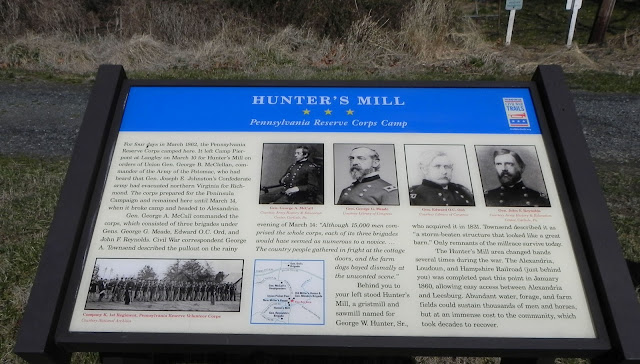
Historical marker commemorating the camp of the Pennsylvania Reserves at Hunter's Mills.  This marker is located to the right of the above intersection.  For more information, see the entry on the Historical Marker Database.
During the march from camp, some of the Pennsylvania Reserves had "foraged quite liberally" from the farms along the way.  (Sypher 168.)  The men stole chicken, milk, and whatever other provisions they could find.  At Hunter's Mills, orders were issued to prohibit foraging, and the Reserves stationed guards to prevent soldiers from leaving camps.  Over at Flint Hill, Private Fisk of the 2nd Vermont recalled that "orders at dress parade gave us to understand that stealing, plundering private dwellings, house burning, and such unsoldierlike depredations would be visited by severe and speedy punishment."  (in Zeller 57.)  The efforts at combating foraging were not altogether successful. As the Philadelphia Press reported, "all the pigs and chickens had mysteriously disappeared from the barnyards" within a few days of the Pennsylvania Reserves' arrival.  (Phila. Press, Mar. 17, 1862.) 

The "Old Miller's Home" located on a rise next to Hunter Mill Road. This house, now on private property, served as brigade headquarters for Gen. Meade in March 1862.  The left side of the house dates to the 18th century.  On March 11, Meade wrote to this wife: "I have been in the saddle all day, posting troops and pickets, and making all the preparations to meet the enemy, though, from the reports in existence and believed, there is not much probability of his showing himself about here ."  (Meade 251.)

Detail of 1862 Union Army map of Northeastern Virginia showing the area around Flint Hill where Smith's division set up camp (courtesy of Library of Congress).  Hunter's Mills sits roughly a half dozen miles to the north of Flint Hill.  The road from Flint Hill led to Fairfax Court House, where McClellan established his headquarters.
Overall, the Pennsyvlanians' stay at Hunter's Mills had a dramatic impact on the neighborhood and the civilians living there.  Correspondent George Alfred Townsend of the Press told readers that "[a] few nights' occupation, by an army, changes the whole appearance of a country."  (Phila. Press, Mar. 17, 1862.)  He observed:
The quartermasters here, for instance, have already opened up new roads and parts of roads to avoid quagmires or steep hills; the timber is cut away for acres; huts and structures of brush dot the bleak summits and slopes; and the untenanted houses are being despoiled for purposes of fuel, and all the fences are torn up. (Phila. Press, Mar. 17, 1862.)   
News of the Union Army's presence spread throughout the region, and contraband slaves began to "arrive hourly."  (Phila. Press, Mar. 17, 1862.) 

Prior to the arrival of the Reserves,  Confederate pickets and scouts populated the area around Hunter's Mills.  Some of these Confederates returned, "either by accident or design."  (Phila. Press, Mar. 17, 1862.)   The Pennsylvanians arrested them, or "compelled" them to take an oath of allegiance to the Union.  (Phila. Press, Mar. 17, 1862.)  At least in one instance, a Confederate scout was spotted and shot dead by Union soldiers.  The Pennsylvanian troops cheered upon learning the news.  As Townsend later described the scene, "[t]housands of brave men were shouting the requiem of one paltry life."  (Townsend 31.)

On March 13, McClellan rode from his field headquarters at Fairfax Court House to Flint Hill, where he conducted a review of Smith's division.  As surgeon Alfred Castleman of the 5th Wisconsin wrote in his diary, about 10,000 men gathered on "a large plain" for the event.  (Castleman 97.)  He considered the review "the most beautiful. . . that I ever beheld."  (Castleman 97.)  Private Fisk walked away inspired, writing that McClellan's "very looks. . . are sufficient to enkindle a spirit of energy and bravery in the hearts of the troops under his command."  (in Zeller 57.)  McClellan reported that night to Secretary of War Edwin M. Stanton that he found Smith's division "in admirable condition and spirits."  (OR, 1:5, 751.)

While in camp, both McCall and Smith got new bosses.  On March 8, 1862, President Lincoln had ordered McClellan to organize five army corps with the men under his command.  McClellan protested to Secretary Stanton that the imminent march on Centreville prevented him from effectively carrying out the President's order.  Stanton relented.  On March 13, when the dust had finally settled on the movement towards Centreville, McClellan issued General Orders No. 101, which assigned his separate divisions to five army corps.  McCall's division was placed with Gen. Irvin McDowell's First Corps, while Smith's division was placed in the Fourth Corps under Gen. Erasmus Keyes.  (McClellan, Report, 58-59.)

McClellan was also busy plotting his next move.  On March 13, the general's new corps commanders endorsed his revised plan to advance on Richmond by way of the Peninsula between the York and James Rivers.  (OR, 1:5, 55-56.)  The soldiers encamped at Hunter's Mills and Flint Hill would soon be on the march again.

Notes

*This phrase can best be translated as "to give way a little in order to take up a stronger position."
**Based on sources used in compiling this post, it is unclear how much the Union troops initially knew about the advance and Johnston's retreat.  When McClellan ordered his divisions forward on March 10, he had received intelligence that Johnston was withdrawing from Centreville.  However, enlisted men may have known little of what was happening, other than that they were apparently on their way to meet the enemy.  High-level officers like Meade presumably had more knowledge of the situation, but even Meade's letter of March 11 to his wife indicates a degree of surprise that a battle was unlikely.

Sources

A special thanks to historian Jim Lewis of the Hunter Mill Defense League (HMDL).  Jim was kind enough to show me around the Hunter Mill Road corridor a couple weeks ago and to discuss the history of the Union encampments in the area with me.  The HMDL does excellent work and has produced a guidebook and documentary about the Civil War history of Hunter Mill Road.  Jim also conducts the popular Hunter Mill Road Corridor History Tour.  The HMDL played a key role in the installation of several historical markers in the Hunter Mill road area, including the one pictured above.  For more information about the HMDL, click here.

The following sources were useful in writing this post:

Russel Beatie, Army of the Potomac: McClellan's First Campaign, March-May 1862 (2007); George Grenville Benedict, Vermont in the Civil War, Vol. 1, (1886); Alfred I. Castleman, Army of the Potomac: Behind the Scenes, A Diary of Unwritten History (1863); M.D. Hardin, History of the Twelfth Regiment Pennsylvania Reserve Volunteer Corps (1890); A.F. Hill, Our Boys: The Personal Experiences of a Soldier in the Army of the Potomac (1864); James G. Lewis, Jr., Hunter Mill Road Civil War Self-Guided Tour (2008); George Meade, The Life and Letters of George Gordon Meade, Vol. 1 (1913); George B. McClellan, McClellan's Own Story (1887); George B. McClellan, Report on the Organization and Campaigns of the Army of the Potomac (1864); Philadelphia Press, March 17, 1862; Stephen W. Sears, To the Gates of Richmond: The Peninsula Campaign (1992); J.R. Sypher, History of the Pennsylvania Reserve Corps (1865); O.R. Howard Thomson & William H. Rauch, History of the "Bucktails" (1906); George Alfred Townsend, Campaigns of a Non-Combatant (1866); Vermont Historical Society, On-Line Collection of Letters of Dan Mason; Paul G. Zeller, The Second Vermont Volunteer Infantry Regiment, 1861-1865 (2002).