Showing posts with label Henry Halleck. Show all posts

Friday, April 11, 2014

A Surprise Visit to Battery Parrott

A few weeks ago I had the pleasure of attending a reception at the residence of the Belgian Ambassador to the United States. Located along Foxhall Rd., N.W. in Washington, this ornate home sits atop the heights dominating the Potomac River near Chain Bridge. Imagine my surprise when I discovered that that the property was the site of Battery Parrott, part of the defenses of Washington during the Civil War. In fact, the Belgian Embassy website even discusses the history associated with the location.

The Union Army erected Battery Parrott in 1862 on land belonging to local widow Ellen King. The battery was named after Robert P. Parrott, a former captain of ordinance and inventor of the Parrott gun.  Battery Parrott was equipped with two 100-pounder Parrott rifles. Gen. John G. Barnard, Chief Engineer for the Department of Washington, later called Battery Parrott one of the "most perfect and complete" batteries in the defenses of the nation's capital. (Barnard 72-73.) Along with Batteries Cameron and Kemble, Battery Parrott swept the Virginia side of the Potomac from Chain Bridge and Forts Marcy and Ethan Allen to Fort DeKalb (Fort Strong).

The remaining earthworks of Battery Parrott are plainly visible in the backyard of the Belgian Ambassador's Residence. The massive Parrott guns were mounted en barbette behind the parapet.
Battery Parrott was garrisoned at various times by companies from the 1st Maine Heavy Artillery, the 1st New Hampshire Heavy Artillery, and the 9th New York Heavy Artillery. Company K of the 1st Maine Heavy Artillery served the longest at the battery, from August 1862 until being sent to the front during the Overland Campaign in May 1864. Writing to Chief of Staff Henry W. Halleck about the state of Washington's defenses in spring 1864, Gen. A.P. Howe, Inspector of Artillery, observed:
Battery Parrott, Capt. Frederic E. Shaw commanding.–Garrison, one company First Maine Heavy Artillery–1 commissioned officer, 1 ordnance-sergeant, 46 men. Armament, two 100-pounder Parrots. Magazines, one; dry and in good order. Ammunition, full supply and serviceable. Implements, complete and serviceable. Drill in artillery, fair. Drill in infantry, fair. Garrison is sufficient. (in NPS at Vol. I, Appendix E.)
As with nearly all of the forts and batteries around the nations capital, Battery Parrott saw no action during the Civil War.
Photo of a 100-pounder Parrott, this one taken at Ft. Totten outside Washington (courtesy Library of Congress)

At the end of hostilities in 1865, the Union military offered King wood and other materials from the battery as compensation for the occupation of her land. The widow refused at first, but relented in October 1865, accepted the in-kind compensation, and signed a release discharging any future claims against the U.S. Government. King nevertheless filed a claim for rent and the taking of timber in May 1874. Despite the earlier release, King prevailed and was awarded compensation by the U.S. Treasury Department in 1875 and 1876.

Detail from 1865 War Department map of the defenses of Washington showing the position of Battery Parrott (center), as well as other features, including Batteries Cameron and Kemble, Chain Bridge, Ft. Marcy, Ft. Ethan Allen, and Ft. Strong (courtesy of the Library of Congress).


The position of Battery Parrott (blue pin) indicated on a modern map of Washington, DC and Virginia. (See here for a larger map.)

Sipping on a Belgian beer and looking out at the earthworks behind the ambassador's house, I couldn't help but chuckle. Things are sometimes ironic like that in Washington. One hundred and fifty years ago, boys from Maine tramped across this very land, while 100-pounder guns stood guard against the possibility of Rebel incursions, however remote. Now internationally-minded professionals were mingling and eating hors d'oeuvres, most oblivious to the importance of the site during our nation's most trying ordeal.

Sources

John G. Barnard, A Report on the Defenses of Washington (1871); Benjamin Franklin Cooling III & Walton H. Owen II, Mr. Lincoln's Forts: A Guide to the Civil War Defenses of Washington (2010 ed.); Historic Preservation Review Board, Government of the District of Columbia, Application for Historic Landmark or Historic District Designation for the Scheele-Brown Farmhouse (2013); National Park Service, A Historic Resources Study: The Civil War Defenses of Washington, Parts I & II (2004); Official Records, Series 1, Vol. XXV, Pt. 2, at 187 (1889).

Thursday, October 10, 2013

The Fallout from the Raid on Camp Beckwith: Lt. Keays Takes the Heat

Last week I wrote about the surprise Confederate attack on the Federal garrison guarding the contraband farm at Camp Beckwith in Lewinsville, Virginia. During the early morning of October 2, 1863, troopers from the 35th Battalion of Virginia Cavalry under Lt. Col. Elijah V. White pounced on the unsuspecting Union force encamped in and around the main house on the farm. When all was said and done, White rode away with 20 prisoners and 64 horses. The Union suffered casualties of  two dead and three wounded.

A messenger alerted the nearby Federal garrison at Fort Ethan Allen. Col. John C. Tidball of the 4th New York Heavy Artillery sent a contingent of men to investigate. Once Tidball gleaned more details about the raid, he sent word to an assistant adjutant-general with the Department of Washington. Gen. Samuel P. Heintzelman, the commander of the Department, wasted no time in ordering his own investigation. On October 2, he sent Capt. Carroll H. Potter to "the scene of the [ ] reported surprise." (OR, 1:29:1, 201.) Potter, an assistant adjutant-general, was told "to make a thorough and rigid examination into the circumstances attending" the attack. (OR, 1:29:1, 201.) Heintzelman seemed convinced from the outset that someone was at fault for what had just happened out in the Virginia countryside. He instructed Potter to "specify on whom the blame should fall" in his official report on the matter. (OR, 1:29:1, 201.)

Potter left Washington at 1:30 p.m. that same day with one commissioned officer and 25 men from Scott's Nine Hundred Cavalry (11th N.Y. Cav.). The party arrived at Camp Beckwith around 5:30 p.m. Potter conducted his investigation in short order and left camp the next morning. After reconnoitering for possible guerrilla activity near Vienna and along the Alexandria, Loudoun & Hampshire Railroad, Potter and his men rode through Falls Church, crossed the Aqueduct Bridge, and returned to headquarters at 4:30 in the afternoon.

William Jeremiah Keays, c. 1869 (courtesy of Rod A. MacDonald). Keays was born in Bytown, Upper Canada (now Ottawa, Ontario) on January 24, 1829. He engaged in various business ventures in Goderich, Ontario before moving with his family to Buffalo, New York in 1861. There he served as an agent for the Great Western Railroad. By the end of 1862, Keays had lost his wife, children, and mother. He enlisted in the 16th New York Cavalry in June 1863. After the Civil War, Keays returned to Canada, where he remarried.  Railroad work brought Keays back to the United States in 1881-82. He died in Buffalo on April 24, 1914, at the age of 84. (I'd recommend reading MacDonald's meticulously researched biography of Keays referenced in the sources section below.)

Potter sent his report to Heintzelman on October 3. Faithful to Heintzelman's order, the captain minced no words in laying the blame for the recent mess on 1st Lt. William J. Keays of Co. B, 16th New York Cavalry, who commanded the cavalry detachment at Camp Beckwith. The report described how Keays's handling of cavalry pickets ultimately led to the Confederate victory:
[The attack] was all done in five minutes from the time [White's men] were known to be in the vicinity, and all done without the least show of resistance on the part of our cavalry or infantry, for as far as I could learn, not a shot was fired at them, or a stand of any description made on the part of our forces, happening, no doubt, from the very foolish position given the cavalry pickets, they being very poorly posted within a very short distance from the camp, and each post being in a ravine, with the men dismounted, their horses in camp unsaddled, as were also those of the entire command. (OR, 1:29:1, 202.)*
In fact, White's men approached along an old wood road that was entirely unguarded. (OR, 1:29:1, 202.) Moreover, Keays appeared to have ignored recent warnings. Potter learned that "Lieutenant Keays had heard it reported by some of the citizens that these guerrillas were in his vicinity, but did not place reliance enough upon the information to take more than the usual precaution." (OR, 1:29:1, 202.)

Standard of the 16th New York Cavalry (courtesy of New York State Military Museum and Veterans Research Center).

Potter observed a deviation in normal security procedures at the time of White's raid. Despite an opportunity to lay the blame elsewhere, the captain made clear that Keays was ultimately responsible for what had occurred:
There was a commissioned officer placed on duty belonging to the cavalry, every night previous to the attack, whose duty it was to look out for the safety of the camp, and see that the picket performed their duty properly; but on the night of the attack, Sergt. S. F. Shaddock, Company B, Sixteenth New York Cavalry, was given this duty to perform. This duty he tried to perform, and would have, had the picket placed out for the safety of the camp been of any use whatever, which was an impossibility arising from the posts given to them, and the manner in which they were posted, i. e., dismounted. (OR, 1:29:1, 202.)
Potter described Shaddock's futile attempt to mount a defense as White's men descended on the garrison:
The moment [Shaddock] heard the enemy advancing, he exerted himself to wake up the officers, who were at the time all in the house and asleep in their blankets; but before he could accomplish his object the enemy were in both of the encampments, taking the men from their beds, and the officers were of no use whatever, their men nearly all having been taken before they were made aware even of the approach of the enemy. (OR, 1:29:1, 202.)
Potter left no doubt that Lt. Keays was to blame. He concluded his already critical report with another stinging indictment:
In my opinion had the pickets been properly posted (even the same number of men used by Lieutenant Keays would have been sufficient), this surprise could not have occurred, and the men in camp could have been formed certainly in time have made some resistance, if not sufficiently strong to drive the enemy entirely away, which I think they could have done had they been prepared to receive them. For this I consider Lieutenant W. J. Keays, Company B, Sixteenth New York Cavalry, entirely to blame. (OR, 1:29:1, 202.)
Heintzelman must have reacted to Potter's findings with a combination of disgust and anger. On October 5, he forwarded Potter's report to the Assistant Adjutant-General of the Union Army with the recommendation that Keays "be summarily dismissed the service of the United States, or tried by general court-martial." (OR, 1:29:1, 203.) On October 8, General-in-Chief Henry Halleck recommended "summary dismissal." (OR, 1:29:1, 203.) Later that same day, Secretary of War Edwin Stanton agreed and ordered Keays's dismissal.

Keays left the army on October 10, but not for long. His commanding officer lobbied to have Keays reinstated, and for whatever reason, the War Department agreed. On December 31, 1863, Keays was restored to duty as a First Lieutenant with his old unit, Company B. The following month he was transferred to Company A. In April 1865, Keays was named captain of Company G and later assigned to the 3rd New York Provisional Cavalry. He was mustered out of service in September 1865.

The attack on Camp Beckwith happened at a time when the Union Army was dealing with bitter partisan warfare throughout Northern Virginia. The brass reacted predictably to Keays's mistakes as commander during the Confederate raid. The Canadian immigrant who had enlisted to fight for his adopted country paid a price for his amateurish handling of the pickets at Camp Beckwith. Luckily, Keays got another chance to prove that he was worthy of the rank on his should straps.

Notes

*According to a modern regimental history, 2nd Lt. Patrick Welch led members of Co. C, 111th New York in a counterattack and drove away White's men. (Husk 87.) This version of events contradicts Potter's account that the Union garrison never had a chance to respond to the raiders.

Sources

Aside from the OR, the following sources were useful in compiling this post:

Rod A. MacDonald, "William Jeremiah Keays" (genealogy website); New York State Military Museum & Veterans Research Center, 11th Cavalry Infantry Regiment (website); New York State Military Museum & Veterans Research Center, 16th Cavalry Regiment (website); Martin W. Rusk, The 111th New York Volunteer Infantry: A Civil War History (2010); Jerry D. Thompson, Civil War to the Bloody End: The Life & Times of Major General Samuel P. Heintzelman (2006); Adrian Tighe, The Bristoe Campaign: General Lee's Last Strategic Offensive with the Army of Northern Virginia, October 1863 (2011).

Friday, June 21, 2013

The Pennsylvania Reserves in Northern Virginia: The Path to Gettysburg

This past spring I wrote a four-part series on the return of the Pennsylvania Reserves to Northern Virginia at the start of 1863. This storied division had experienced heavy losses during the previous year's fighting, and after political intervention by top-ranking generals and Pennsylvania's own governor, the Reserves were sent to the defenses of Washington to rest and recruit. As June 1863 began, the division was scattered across Northern Virginia and Washington City. The month would end with two-thirds of the division on the march north to join the Army of the Potomac in pursuit of Gen. Robert E. Lee's Confederates.

A New Commander and a Return to the Old Dominion

On June 1, 1863, Gen. Samuel P. Heintzelman, commander of the Department of Washington, named Gen. Samuel W. Crawford to replace Col. Horatio G. Sickel at the head of the First and Third Brigades of the Pennsylvania Reserves. (OR, 1:51:1, 1043.) The Second Brigade was to remain attached to the Military District of Alexandria. Heintzelman ordered Crawford to make his headquarters at Fairfax Station, where the First Brigade was encamped. The Third Brigade, which was performing provost duty in Washington City, was directed to cross the Potomac and proceed to Upton's Hill, not far from Falls Church.*
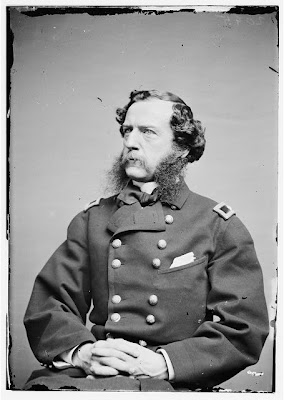
Brig. Gen. Samuel W. Crawford (courtesy of Library of Congress). Crawford was born in Franklin County, Pennsylvania in 1829. He was the surgeon in charge at Ft. Sumter during the bombardment in April 1861. Crawford joined the Union infantry and rose to brigade command by spring of 1862. He briefly led a Twelfth Corps division at Antietam until being wounded in the thigh. Following his recovery, Crawford was given command of the Pennsylvania Reserves.

On the evening of June 1, the men of the Third Brigade under Col. Joseph W. Fisher marched out of the city "to the sounds of martial music." (Columbia Spy, June 6, 1863.) The soldiers "were in fine spirits," and "cheered as they passed through [the] streets, glad again to be in the field." (Phila. Press, June 2, 1863.) Spectators along the sidewalk and in hotel windows echoed the soldiers' hurrahs for Ulysses S. Grant, Joseph Hooker, George B. McClellan, William Rosecrans, and other generals. (Columbia Spy, June 6, 1863.)

Rallying to the Defense of the Keystone State

Events soon took an alarming turn. As talk of a Confederate invasion of Pennsylvania spread, the Reserves grew anxious to leave Northern Virginia and defend their native soil against Lee's army. According to one regimental history, the thought of remaining behind in the defenses of Washington "was rather mortifying." (Woodward, Our Campaigns, 259.) Officers made entreaties to Washington and Harrisburg to have the Reserves return to the field along with the Army of the Potomac. In one instance, the commander of the 2nd Pennsylvania Reserves and his fellow officers petitioned Col. William McCandless, head of the First Brigade:
We, the undersigned. . . having learned that our mother State has been invaded by a Confederate force, respectfully ask, that you will, if it be in your power, have us ordered within the borders of our State, for her defence. 
. . . we have more than once met and fought the enemy, when he was at home. We now wish to meet him again where he threatens our homes, our families and our firesides. 
Could our wish in this behalf be realized, we feel confident that we could do some service to the State that sent us to the field, and not diminish, if we could not increase, the lustre that already attaches to our name. (Woodward, Our Campaigns, 260.)
McCandless received the petition on June 17 and "forwarded it through the proper channel to Washington." (Woodward, Our Campaigns, 259.) Meanwhile, Gens. John F. Reynolds and George G. Meade, who had both led the Reserves through the bloody trials of 1862, requested that the War Department transfer the division to their respective army corps. (See, e.g., Sypher 448; Thomson & Rauch 260; Woodward, The Third Reserve, 226.)

Col. William McCandless (courtesy of PRVC Historical Society).
At Last! -- Rejoining the Army of the Potomac

The fate of the Reserves became part of the larger question of reinforcing Hooker as he chased down Lee's army. General-in-Chief Henry W. Halleck, worried about keeping the nation's capital safe from a possible Confederate advance, maintained a tight grip on the soldiers belonging to the defenses of Washington. (Coddington 96.) In the end, Halleck relented and agreed to send Hooker around 8,400 infantry reinforcements, including two brigades of the Pennsylvania Reserves. (Sears 220.)**

Late on June 23, Hooker directed Crawford "to hold [his] command in readiness to move at very short notice," with ten days' subsistence. (OR, 1:27:3, 273.) Pickets were to remain posted "until further orders." (OR, 1:27:3, 273.) Less than two days later, Hooker put the Reserves in motion to catch up with the rest of the army, which was already in pursuit of Lee. At 9:30 in the morning on June 25, Crawford was directed to "march with your command to-day, via the Leesburg turnpike, to Edwards Ferry, and, if possible . . . cross the river at that point, should you reach the Ferry in season." (OR, 1:27:3, 309.)

Not long afterwards, Hooker was shocked to learn from Crawford that John P. Slough, military governor of Alexandria, had detained the Second Brigade of Pennsylvania Reserves. He fired off a note to Halleck, demanding that "General Slough be arrested at once" and promising that "charges will be forwarded as soon as I have time to prepare them." (OR, 1:27:1, 56.) Hooker sharply warned Halleck, "You will find, I fear, when it is too late, that the effort to preserve department lines will be fatal to the cause of the country." (OR, 1:27:1, 56.) The General-in-Chief wasted no time in brushing aside Hooker's request:
The Second Brigade, to which you refer in your telegram, forms no part of General Crawford's command, which was placed at your orders. No other troops can be withdrawn from the Defenses of Washington. (OR, 1:27:1, 57.)  
That same day, the First and Third Brigades struck camp and began their march from Fairfax Station and Upton's Hill.*** The soldiers proceeded as far as the area around Vienna, where they bivouacked for the night. (OR, 1:27:1, 143; Woodward, Our Campaigns, 261). Early the next morning the Reserves resumed their march. The Pennsylvanians moved up the Leesburg-Alexandria Turnpike, past Dranesville, where many of them had first experienced battle.**** A "violent and constant" rainfall turned the roads into "almost knee-deep" mud. (Woodward, Our Campaigns, 261.) Despite such miserable conditions, the division reached Goose Creek that night. (OR, 1:27:1, 143.) At daylight on June 27, the Reserves headed a short distance to the Potomac and crossed the river at Edwards Ferry via pontoon bridge. (OR, 1:27:3, 353.) The division pushed through Maryland and arrived that night at the mouth of the Monocacy River, "in spite of the heavy roads." (Woodward, Our Campaigns, 261; see also OR, 1:27:1, 143.) Finally, on June 28, the Reserves crossed the Monocacy and marched to Ballinger's Creek near Frederick, where they joined the Fifth Corps. (OR, 1:27:1, 144; Hardin 141.)***** By the time the Reserves caught up with the Fifth Corps, Meade had taken command of the Army of the Potomac, and Gen. George Sykes had replaced him at the head of the corps.

Detail of Edwards Ferry, Goose Creek, and vicinity from 1862 Union Army map of Northeastern Virginia (courtesy of Library of Congress).  The Leesburg Turnpike, also visible here, served as the Pennsylvania Reserves main route of march to the crossing at Edwards Ferry.
The Pennsylvania Reserves continued their movement northward through Maryland and into Pennsylvania. The division arrived at Gettysburg on July 2 during the second day of the battle. That evening, the First Brigade drove into the Plum Run Valley and beat back an assault by troops from James Longstreet's corps on the Union left near Little Round Top. Crawford himself seized the colors and led the charge. The division's overall losses at Gettysburg stood at 26 killed, 181 wounded, and 3 missing. (OR, 1:27:1, 180.) The Reserves had proven their mettle once again and made a contribution to the Confederate defeat. Before long, the Pennsylvanians would return with the rest of the army to the familiar soil of the Old Dominion. In this war, there was no staying away.

Notes

*The 11th Pennsylvania Reserves of the Third Brigade were still stationed in Northern Virginia in June, most likely in the vicinity of Vienna or Fairfax Station. (Gibbs 214-15.)

**The other units sent to Hooker from the Department of Washington included a brigade of New Yorkers under Gen. Alexander Hays and the Second Vermont Brigade under Gen. George Stannard. Both brigades would go on to distinguish themselves at Gettysburg. Halleck also agreed to furnish a division of cavalry under Gen. Julius Stahel, as well as artillery units, including the 9th Massachusetts Battery.

***The drive to replenish the ranks of the Reserves while in the defenses of Washington met with little success. (Gibbs 213; Thomson & Rauch 256-57.) The two brigades that set out on June 25 totaled just 3,817 officers and men. (Coddington 98.)

****The Battle of Dranesville took place on December 20, 1861, and pitted a brigade of the Reserves against J.E.B. Stuart's Confederates.

*****The Pennsylvania Reserves officially became the Third Division of the Fifth Corps.

Sources

Aside from the Official Records, the following sources were useful in compiling this post:

Civil War in the East (on-line database); Edwin B. Coddington, The Gettysburg Campaign: A Study in Command (1979 ed.); Columbia Spy, June 6, 1863; Joseph Gibbs, Three Years in the Bloody Eleventh: The Campaigns of a Pennsylvania Reserves Regiment (2002); Martin D. Hardin, History of the Twelfth Regiment Pennsylvania Reserve Volunteer Corps (1890); Harrisburg Daily Patriot and Union, June 27, 1863; Philadelphia Press, June 2, 1863; Stephen W. Sears, Gettysburg (2003); Jeffrey F. Sherry, "The Terrible Impetuosity: The Pennsylvania Reserves at Gettysburg," Gettysburg Magazine, Issue No. 16, Jan. 1, 1997 (courtesy of P.R.V.C. Hist. Soc.); J.R. Sypher, History of the Pennsylvania Reserve Corps (1865); O.R. Howard Thomson & William H. Rauch, History of the "Bucktails" (1906); Evan M. Woodward, History of the Third Pennsylvania Reserve (1883); Evan M. Woodward, Our Campaigns (1865).

Additional Reading

An excellent and detailed account of the Pennsylvania Reserves' march from Upton's Hill/Fairfax Station to Edwards Ferry, including maps, can be found here, at Craig Swain's Civil War blog, To the Sound of the Guns. Also be sure to check out Craig's on-going series of posts on the march of the Union army through Loudoun County in the days prior to Gettysburg.

For the full story of the Pennsylvania Reserves at Gettysburg, see "The Terrible Impetuosity: The Pennsylvania Reserves at Gettysburg," by James Sherry in Gettysburg Magazine, Issue No. 16, Jan. 1, 1997.

Friday, April 19, 2013

The Pennsylvania Reserves in Northern Virginia 1863, Part II: Farewell to Hooker's Army

As I wrote in my last post, the Pennsylvania Reserves faced a somewhat uncertain future at the start of 1863.  The division had experienced tremendous losses during the bloody battles of 1862.  Gen. George G. Meade, a former commander of the Reserves, took up his old division's cause and pushed to have the Reserves sent back to Pennsylvania to recruit and reorganize.  Pennsylvania's Governor, Andrew Curtin, likewise urged the Lincoln Administration to allow the Reserves to return temporarily to the Keystone State.  These pleas went unheeded at army headquarters, and the Pennsylvanians soon joined the rest of Ambrose Burnside's men on the ill-fated "Mud March."

A Plan is Hatched

By the end of January, the situation began to look brighter for the hard-fought Pennsylvanians.  Gen. Joseph Hooker, the new commander of the Army of the Potomac, and General-in-Chief Henry W. Halleck finally agreed on a plan to deal with the manpower problems facing the Reserves.  The division was to be detached from the Army of the Potomac and sent to the defenses of Washington in exchange for a like number of Pennsylvania troops then stationed around the capital.  (OR, 1:25:2, 12.)  The Pennsylvania Reserves would return to the front once they had some time to replenish their ranks and recover from combat duty.  Gen. Samuel P. Heintzelman, head of the Department of Washington, was less than enthusiastic about the idea.  He worried that the Reserves were ill-equipped for provost duty in Washington given that "some of the companies are commanded by sergeants and corporals."  (OR, 1:25:2, 10.)  Heintzelman told Halleck, "I fear that the exchange cannot be made with any benefit to the service in my command."  (OR, 1:25:2, 10.)  Whatever his objections, however, Heintzelman would have no choice but to accept his superior's decision.

Gen. Joseph Hooker (courtesy of Wikipedia)

Meanwhile, the men in the ranks began to hear rumors about their imminent departure for Washington.  A soldier from Co. H, 6th Pennsylvania Reserves wrote on January 28 to his hometown paper, "[W]e – that is the old regiments of the Pennsylvania Reserve Corps of Volunteers – are soon to be relieved from the front (where they have always been found), by the troops now stationed in and about Washington, while we are to take their place."  (Wellsboro Agitator, Feb. 11, 1863.)  He felt that the division was "not in the least dissatisfied with the arrangement, altho’ we wish to have no men see the service that the Reserves have been obliged to."  (Wellsboro Agitator, Feb. 11, 1863.)  Sgt. Thomas W. Dick of Co. H, 12th Pennsylvania Reserves, informed his brother of "reliable information to the effect that we are going back to Washington to rest and recruit."  (Ltr. from T.W. Dick to Brother, Feb. 2 1863.)  Dick  approved of the plan, telling his brother, "its what should have been done before this There is now but a miserable remnant of the gay old division that marched from [Camp] Pierpont last spring."  (Ltr. from T.W. Dick to Brother, Feb. 2 1863) (grammar as in original)

Orders!

On February 5, Hooker finally issued orders to transfer the Pennsylvania Reserves.  (OR, 1:25:2, 49-50; 52-53.)  He instructed Gen. John F. Reynolds, head of the First Corps, to send the division to Alexandria with instructions to report to Heintzelman for orders.  Hooker added that "[t]he sick and all the baggage of the troops should be taken with them."  (OR, 1:25:2, 50.)  The chief quartermaster would "furnish the transportation," although Hooker told Reynolds that "[t]he details of the embarkation are left with you, with reliance upon your energy and attention."  (OR, 1:25:2, 50.) 

That same day, Reynolds issued an order directing the Pennsylvania Reserves to embark at Belle Plain for Alexandria, "as soon as transportation is furnished."  (OR, 1:51:1, 981.)  The 121st and 142nd Pennsylvania, who were not part of the original Pennsylvania Reserve Volunteer Corps, were ordered to remain behind, along with three artillery batteries.  Reynolds informed the men that they would receive three days' cooked rations for the trip north.  He finished his order on a sentimental note:
In separating from the Pennsylvania Reserve Corps, with which the commanding general has been so closely allied for the past eighteen months, he cannot but express his deep regrets. They are, however, lessened by the hope that soon their thinned ranks will be filled, and they, once more restored and reorganized, will be returned to the field prepared to add new luster to a name already endeared to our patriotic State.  (OR, 1:51:1, 981-82.) 
Wartime view of Belle Plain, Virginia on Potomac Creek (courtesy of Library of Congress)
The men of the Pennsylvania Reserves received news of their impending move with enthusiasm.  According to one regimental history, "[i]n despite of the cold rain the camp-fires were soon brightly burning, around which the boys gathered and talked of the good times coming until late at night."  (Woodward, Third Reserve, 224.)  The next afternoon, February 6, the division struck camp and marched about four miles to Belle Plain on Potomac Creek. The journey lasted well into the evening due to the wet and muddy conditions.  The First Brigade boarded transports during the night and headed up the Potomac.  The Second and Third Brigades set out for Alexandria in the morning.  As the men arrived at the wharves along the river, they must surely have felt a sense of relief to leave behind life at the front, if only for a little while.

Postscript

The transfer of the Reserves soon became mired in a dispute between Hooker and Washington.  Gen. Abner Doubleday, who assumed command of the Pennsylvania Reserves for a short while in the middle of January, had gone to the capital to oversee arrangements for the exchange. (OR, 1:51:1, 974.)  After the division arrived in Washington, Doubleday reported to Hooker that "[t]he Pennsylvania regiments given in place of the Reserves do not contain as many men as the latter brought here."  (OR, 1:25:2, 63.)  He concluded that there was "a deficiency of about 250 men."  (OR, 1:25:2, 63.)  Hooker fired off a dispatch to Halleck on February 10,  insisting that "this deficiency be made up, and that General Heintzelman be directed to send the full number, according to the understanding, viz, the same number of men as were returned in the Pennsylvania Reserves."  (OR, 1:25:2, 63.) Halleck tersely replied that "[r]egiments cannot be broken up in order to exactly equalize."  (OR, 1:25:2, 63.)

Hooker wouldn't let the shortfall go.  He pressed his cause with Heintzelman directly.  (OR, 1:25:2, 69-70.)  The commander of the Washington defenses informed Hooker that he had been told to exchange the Reserves for Pennsylvania troops only and that some of some of the soldiers designated for the Army of the Potomac had been detained in Washington for reasons beyond his control.  He had no more to give.  Heintzelman alleged that "[t]he numbers at my disposal were well understood by General Doubleday when he made the application."  (OR, 1:25:2, 83.)

Hooker next unleashed his wrath on Doubleday, demanding that he "report what agreement was entered into by you with General Heintzelman with regard to the exchange of the Pennsylvania Reserves."  (OR, 1:25:2, 87.)   Doubleday insisted that he had done nothing wrong, claiming that "no special agreement was entered into" between him and Heintzelman.  (OR, 1:25:2, 90.)   He told Hooker:
It was understood that I was to have an equal number of men with those I furnished. I never supposed I should have a less number until the Reserves had actually arrived in Alexandria, and a report of their number was laid before General Heintzelman. He then informed me that the aggregate would be less than that furnished by some 230 men.  (OR, 1:25:2, 90.)
Doubleday also took offense at Hooker's accusation that he had not given his personal attention to the matter, explaining that he had "visited General Heintzelman's office every day, and frequently several times a day, in relation to it," and "was also a daily visitor at the Adjutant-General's Office of the General-in-Chief" concerning the exchange.  (OR, 1:25:2, 90.)  Heintzelman received a copy of Doubleday's response, but when all was said and done, Hooker turned his attention to more pressing matters.   Meanwhile, the Reserves prepared for duty on the picket line in front of the capital.

Up Next:  Military duties in front of Washington.

Sources

Aside from the Official Records, the following sources were useful in compiling this post:

John H. Eicher & David J. Eicher, Civil War High Commands (2001); Joseph Gibbs, Three Years in the Bloody Eleventh: The Campaigns of a Pennsylvania Reserves Regiment (2002); Ltr. from T.W. Dick to Brother, Feb. 2 1863 (courtesy of P.R.V.C. Historical Society); J.R. Sypher, History of the Pennsylvania Reserve Corps (1865); Wellsboro Agitator, Feb. 11, 1863 (courtesy of P.R.V.C. Historical Society); Evan M. Woodward, History of the Third Pennsylvania Reserve (1883); Evan M. Woodward, Our Campaigns (1865).

Thursday, April 4, 2013

The Pennsylvania Reserves in Northern Virginia 1863, Part I: What to Do with a "Decimated" Division?

This blog has frequently featured stories on the Pennsylvania Reserves.  The division, also known as the Pennsylvania Reserve Volunteer Corps, was encamped around Langley, Virginia during the first winter of the war.  In spring 1862 the Reserves relocated to Alexandria before marching south to Falmouth.  They eventually joined the Army of the Potomac just in time for the Seven Days Battles on the Peninsula.  The Reserves also saw intense combat at Second Manassas, South Mountain, Antietam, and Fredericksburg.  As the bloody second year of the war drew to a close, the Union Army's high command debated the future of the battered division and finally decided to move the Reserves back to the Washington area.  In the next few posts, I will take a look at the return of the storied Pennsylvania Reserves to Northern Virginia. 

Even before the costly engagements at Antietam and Fredericksburg, brigade commander George G. Meade had begun to worry about the state of the Reserves.  The general wrote to his wife on September 4, 1862 that "[o]ur division, the Reserves, is pretty well used up, and ought, strictly speaking, to be withdrawn, reorganized, filled up with recruits, and put in efficient condition."   (Meade 308.)   Meade led the Reserves through the carnage at Antietam, where the division suffered causalities of around 20 percent. (OR, 1:19:1, 270-71.)  After the battle, Meade discussed the "decimated condition" of the division with George B. McClellan, head of the Army of the Potomac.  As he wrote to his wife:
I. . . told [McClellan] that I had no idea they would ever be filled up by recruiting officers, and the only course I saw to adopt was to send them in a body back to Pennsylvania, and ask the Governor and State to fill them up within a specified time; but if it could not be done, they were to be mustered out of service.  (Meade 315.)
Around the same time, Pennsylvania Governor Andrew Curtin attempted to enlist political support for the reorganization of the Reserves.  In a September 30 letter to President Abraham Lincoln, Curtin suggested that the heavily depleted division be returned temporarily to the Keystone State.  The governor explained to the President:
The brilliant history of the Reserve Corps in the war, and the State pride which has followed them since they entered the service, together with the circumstances surrounding their organization, would, I have no doubt, prove such incentives to enlistment that the Corps could be filled to the maximum in a short space of time. (in Sypher 398.) 
Lincoln forwarded Curtin's letter to General-in-Chief Henry W. Halleck and Secretary of War Edwin M. Stanton for consideration.  The General-in-Chief "entirely disapprov[ed] of withdrawing regiments in the field" for purposes of filling the ranks with new recruits.  (OR, 3:2, 625.)  Curtin also wrote to McClellan, who "thought favorably of the plan, but having immediate use for the troops, was unwilling to retire them at that time."  (Sypher 398; OR, 1:21, 878.)   The division would stay at the front for now.

Gen. George G. Meade (courtesy of Civil War Wiki.Net)
After the fight at Fredericksburg in December, Meade tried once again to deal with the poor condition of the Pennsylvania Reserves.  On December 23, he sent a report on the state of the unit to Gen. William B. Franklin, commander of the Left Grand Division.  As Meade told Franklin, only 195 officers and 4,249 enlisted men were present for duty.  Another 159 officers and 3,740 men were absent with permission.  Meade noted that "to fill these regiments to the maximum authorized, will require 153 officers and 4,864 men."  (OR, 1:21, 877-78.)   However, he cautioned that "of the number reported as absent, a very large proportion are the wounded, most of whom are so maimed and disabled that no expectation need be formed of their returning to active duty."  (OR, 1:21, 878.)  Meade felt that in reality a reorganization of the Pennsylvania Reserves "required the appointment of over 200 officers and the enlistment of over 7,000 men."  (OR, 1:21, 878.)

The general proposed a course of action to revitalize the Reserves.  Recruiters had gone to Pennsylvania three different times to fill the ranks, but their efforts had met little success.  Meade recognized that the Army could "consolidate the existing force into a number of regiments equal to the officers and men for duty."  He disliked this plan, since it would "destroy[] the organization, and the prestige which the good conduct of the corps has acquired for it."  (OR, 1:21, 878.)  Instead, Meade recommended that the Reserves be withdrawn temporarily from the field and sent to Pennsylvania for two or three months, "where, it is believed, from the great reputation the corps has acquired, the pride the State takes in it, and the enthusiasm its return would create, that in a short time its ranks would be filled, after pruning them of all useless members."  (OR, 1:21, 878.)

Gen. John F. Reynolds, head of the First Corps and a former commander of the Reserves, forwarded Meade's proposal to Franklin on January 10, 1863.  Reynolds "concur[red] most heartily" in Meade's recommendation to send the division back home to recover and recruit.  (OR, 1:21, 878.)  The next day, Franklin sent Meade's plan to Gen. Ambrose E. Burnside, commander of the Army of the Potomac.  Complimenting the Reserves on their "excellent service," Franklin endorsed Meade's proposal.  (OR, 1:21, 878-79.)

Col. Horatio G. Sickel, who assumed command of the Pennsylvania Reserves upon Meade's promotion at the end of 1862, soon weighed in on the future of the division.  The colonel hoped to enlist Governor Curtin's support in reorganizing the Pennsylvania Reserves.  Sickel sent a copy of Meade's report to Curtin and got the desired response.  The governor readily took up his old cause and forwarded Sickel's correspondence to the War Department.  Secretary of War Stanton, however, had no appetite for Meade's proposal.  According to a history of the Reserves, the Secretary informed Curtin "that numerous similar applications were on file from other States, that all could not be granted without greatly reducing the strength of the army, and that therefore all must be refused."  (Sypher 436.)

The Pennsylvania Reserves had the misfortune of remaining at the front long enough to take part in Burnside's disastrous "Mud March."  But change was in the air by the end of January.  Joseph Hooker took command of the Army of the Potomac and worked with General-in-Chief Halleck to effect a transfer of the Pennsylvania Reserves. The division, however, was far from homeward bound.

Up Next: The Pennsylvania Reserves bid farewell to Hooker's army and board transports for Alexandria.

Sources

Aside from the Official Records, the following sources were useful in compiling this post:

John H. Eicher & David J. Eicher, Civil War High Commands (2001); Joseph Gibbs, Three Years in the Bloody Eleventh: The Campaigns of a Pennsylvania Reserves Regiment (2002); George G. Meade, The Life and Letters of George Gordon Meade, Vol. 1 (1913); J.R. Sypher, History of the Pennsylvania Reserve Corps (1865).

Tuesday, September 11, 2012

The Chain Bridge Defenses During the Maryland Campaign, Part III: Sigel Stays Put and Stands Guard

In the last couple of posts, I've followed the story of the Chain Bridge defenses around Washington in the days prior to Antietam.  During the first week of September 1862, Franz Sigel led his corps from Fairfax Court House to the vicinity of Ft. Ethan Allen.  As Gen. George McClellan moved his army across the Potomac to chase down the Robert E. Lee, he left Sigel's men, along with the corps of Fitz John Porter and Samuel P. Heintzelman, to guard the Virginia side of the river in front of the nation's capital.  By September 7, Sigel's line stretched from Ft. Marcy and Ft. Ethan Allen, near Chain Bridge, to Ft. DeKalb in present-day Arlington.

McClellan Tries to Extract Sigel and Other Reinforcements from Washington's Defenses

Before long, McClellan was asking Washington to send him reinforcements, including men from Sigel's corps and the other commands around the capital.  Generally inclined to overestimate Confederate troop strength, Little Mac was no different this time around.  He believed that Lee had "not less than 120,000 men" near Frederick, Maryland. (OR, 1:19:2, 254.)  In fact, the Army of the Potomac had around a two-to-one advantage over Lee.  (Sears, Landscape, 102.)

On September 10, McClellan wrote to General-in-Chief Henry Halleck:
At the time this army moved from Washington, it was not known what the intentions of the rebels were in placing their forces on this side of the Potomac. It might have been a feint to draw away our troops from Washington, for the purpose of throwing their main army into the city as soon as we were out of the way, or it might have been supposed to be precisely what they are now doing. In view of this uncertain condition of things, I left what I conceived to be a sufficient force to defend the city against any army they could bring against it from the Virginia side of the Potomac.  (OR, 1:19:2, 254.)*
McClellan, however, felt that "[t]his uncertainty . . . exists no longer."  (OR, 1:19:2, 254.)  The immediate danger to the capital had passed.  McClellan informed Halleck of the overwhelming number of Confederates at Frederick and warned that "if we should be defeated the consequences to the country would be disastrous in the extreme."   (OR, 1:19:2, 254.)  Little Mac pleaded for Halleck to send him more men:
Under these circumstances, I would recommend that one or two of the three army corps now on the Potomac, opposite Washington, be at once withdrawn and sent to re-enforce this army . . . . (OR, 1:19:2, 254.) 
The commander perceived little threat to Washington:
If there are any rebel forces remaining on the other side of the Potomac, they must be so few that the troops left in the forts, after the two corps shall have been withdrawn, will be sufficient to check them; and, with the large cavalry force now on that side kept well out in front to give warning of the distant approach of any very large army, a part of this army might be sent back within the entrenchments to assist in repelling an attack.  (OR, 1:19:2, 254.) 
McClellan seemed almost nonchalant about the possible capture of the nation's capital:
But even if Washington should be taken while these armies are confronting each other, this would not, in my judgment, bear comparison with the ruin and disaster which would follow a signal defeat of this army.  If we should be successful in conquering the gigantic rebel army before us, we would have no difficulty in recovering it. On the other hand, should their force prove sufficiently powerful to defeat us, would all the forces now around Washington be sufficient to prevent such a victorious army from carrying the works on this side of the Potomac, after they are uncovered by our army? I think not.  (OR, 1:19:2, 254-55.)** 
From his headquarters near Rockville on September 11, McClellan further urged Halleck:
Please send forward all the troops you can spare from Washington, particularly Porter's, Heintzelman's, Sigel's, and all the other old troops. Please send them to Brookville, via Leesborough.  (OR, 1:19:2, 253.)***
President Lincoln himself responded to McClellan's plea for additional soldiers from the defenses of Washington.  (OR, 1:19:2, 253.)  The President understood that the new recruits streaming into Washington were mixed with the three commands and worried that "[i]f Porter, Heintzelman, and Sigel were sent you, it would sweep everything from the other side of the river. . . ." (OR, 1:19:2, 253.)  Instead, he released only the remainder of Porter's Fifth Corps, which was ordered to cross the Potomac and join the Army of the Potomac in the field.  (OR, 1:19:2, 253, 255.)  Lincoln held out the possibility of future reinforcements: 
I am for sending you all than can be spared, and I hope others can follow Porter very soon.  (OR, 1:19:2, 254.)
In the end, however, Sigel's men would stay put near the Chain Bridge defenses while the Army of the Potomac tracked down and fought Lee.

"General McClellan Entering the Town of Frederick, Maryland--The Popular Welcome," Harper's Weekly, Oct. 4, 1862 (courtesy of sonofthesouth.net).
Sigel's Corps and Everyday Life in Front of Washington

During the Maryland Campaign, Sigel's corps underwent a few organizational changes.  Once McClellan took to the field with the main army, Sigel reported to Gen. Nathaniel Banks, whom McClellan had placed in overall command of Washington's defenses. (OR, 1:19:2, 202, 214.)  Under General Orders No. 129, dated September 12, the War Department officially re-designated the three corps of the former Army of Virginia, and Sigel's First Corps became the Eleventh Corps of the Army of the Potomac.  (OR, 1:19:2, 279.) 

As McClellan battled Lee at South Mountain and Antietam, Sigel's men dealt with the mundane routine of camp life.  Soldiers spent the days drilling or on picket duty.  One regiment, the 27th Pennsylvania, changed camps around Chain Bridge several times throughout September and performed picket duty in Falls Church, a few miles in advance of the defensive line.  Gen. Robert Milroy, a brigade commander in Sigel's corps, used his free time to venture into Washington City and sit for his photograph at Mathew Brady's studio.

Not surprisingly, the presence of thousands of Union soldiers from Sigel's corps had an impact on the surrounding community.  Jospeh Sewell lived in Langley, just down the road from Forts Marcy and Ethan Allen where Sigel's men stood guard.  The farmer, like other locals, was no stranger to the Union Army.  Soldiers from Gen. "Baldy" Smith's division lived on and around Sewell's farm during the first winter of the war and had taken their fair share of crops and timber from him.  In September 1862, troops from Milroy's brigade entered Sewell's property and seized thirty barrels of corn.  They also took around three acres of garden vegetables and potatoes.****  Other civilians in the area likely experienced similar losses at the hands of the Union defenders.

Gen. Robert Milroy, from the Brady National Photographic Art Gallery (courtesy of Library of Congress).  Not long after sitting for his photograph, Milroy was sent with his brigade to western Virginia.
After Antietam: Sigel Advances to Centreville and Fairfax Court House 

As the Maryland Campaign drew to a close, Sigel's men were moved forward from the defenses near Washington.  Concerned about a possible Confederate attempt to reoccupy the railroad junction of Manassas, Banks ordered Sigel to send Gen. Julius Stahel's division to Centreville on September 21.  (OR, 1:19:2, 340-41, 344-45, 351.)   A few days later, on September 25, the remainder of Sigel's corps was dispatched to Fairfax Court House to cover an expedition being made to recapture several railroad engines at Bristoe.  (OR, 1:19:2, 356, 359.)  Banks, anxious about Confederate intentions, ordered that Sigel exercise "[g]reat caution. . . to prevent surprise," keep the cavalry "well to the front and on the alert," and "report frequently the state of affairs."  (OR, 1:19:2, 356.)

Banks originally intended to have Sigel's corps "fall back to its former position" following the expedition.  (OR, 1:19:2, 359.)   Sigel's men, however, remained in and around Fairfax Court House and Centreville to act as a "corps of observation."  (OR, 1:19:2, 425, 428.)  In this new role, Sigel kept an eye on Confederate activity in Northern Virginia, but Banks made sure to tell Sigel that "if menaced by a superior force of the enemy," he was "to fall back to the lines of defense."  (OR, 1:19:2, 425.)

The Eleventh Corps eventually ended up in Stafford Court House for the winter.  Although the soldiers missed the bloody encounter at Antietam, as well as the slaughter at Fredericksburg in December, they would go on to experience their fair share of brutal combat during the remainder of the war.  The soldiers of the Eleventh Corps became a scapegoat for the Union defeat at Chancellorsville, where they earned the derisive nickname of the "Flying Dutchmen."  Their reputation also suffered at Gettysburg.  During the tense days of September 1862, however, the corps served a necessary, yet unheralded role, in guarding the nation's capital as McClellan confronted Lee.

Notes

*Stephen Sears demonstrates that this correspondence was likely sent on September 10, even though the OR indicates that it was sent the next day.  (Sears, McClellan Correspondence, 446.)

**In correspondence dated September 13, Halleck rebuked McClellan:  "[Y]ou attach too little importance to the capital. I assure you that you are wrong. The capture of this place will throw us back six months, if it should not destroy us. Beware of the evils I now point out to you. You saw them when here, but you seem to forget them in the distance. No more troops can be sent from here till we have fresh arrivals from the North."  (OR, 1:19:2, 280-81.)

*** Earlier on September 11, Halleck had even suggested to McClellan that he send forward either Sigel's or Porter's corps when another division that Little Mac had requested was unavailable. As Halleck said, "Why not order forward Porter's corps, or Sigel's?  If the main force of the enemy is in your front, more troops can be spared from here." (OR, 1:19:2, 253.)

****The Southern Claims Commission files indicate that Sewell was not granted compensation for the claims he made concerning the taking of this property by Milroy's men.  The Commission considered that the $150 claim for corn rested solely on Sewell's testimony.  The $300 claim for garden vegetables and potatoes was considered a "depredation."

Sources

Aside from the citations to the Official Records above, the following sources were useful in compiling this post:

Samuel P. Bates, History of Pennsylvania Volunteers, 1861-1865, Vol. I (1869); Stephen D. Engle, Yankee Dutchman: The Life of Franz Sigel (1993); Bradley Gottfried, The Maps of Antietam (2012); Charles V. Mauro, The Civil War in Fairfax County: Civilians and Soldiers (2006); Johnathan A. Noyalas, "My Will is Absolute Law": A Biography of Union General Robert H. Milroy (2006); Pennsylvania Daily Telegraph, Sept. 29, 1862; Stephen W. Sears (ed.), The Civil War Papers of George B. McClellan: Selected Correspondence, 1860-1865 (1989); Stephen W. Sears, Landscape Turned Red: The Battle of Antietam (1983); Southern Claims Commission File of Joseph Sewell, available at fold3.com.

Friday, August 31, 2012

The Chain Bridge Defenses During the Maryland Campaign, Part I: Sigel and Company on the Move

This summer's Sesquicentennial calendar is crowded with observances of several key events.  We've just finished Second Manassas and are now headed into the Maryland Campaign and Antietam.  During such times, I start to think about my own little corner of Northern Virginia. What was happening here as the armies left behind the wreckage at Manassas and marched through Maryland on the way to a bloody encounter outside Sharpsburg?   Although far less dramatic than other events unfolding in September 1862, the ground around present-day McLean and North Arlington witnessed a build-up of Gen. Franz Sigel's army corps.  These men played a key role in manning the defenses of Washington while Gen. George B. McClellan hunted down Robert E. Lee's Army of Northern Virginia in the Old Line State.

Born in Germany in 1824, Sigel rose to become a military leader in the Revolution of 1848.  He emigrated to the United States in the early 1850s and eventually settled in St. Louis.   When war broke out, Sigel helped to recruit German-Americans to the Union cause.  He first served out West at Wilson's Creek and Pea Ridge.  Sigel, favored by the Lincoln Administration for his ties to the German-American community, was appointed a major general of volunteers and sent East, where he was named commander of the First Corps of Gen. John Pope's Army of Virginia in June 1862.  Sigel seemed a fitting choice to lead the new corps, whose ranks were filled with many German immigrants.   Sigel's men fought hard at Second Manassas (August 28-30, 1862) and helped to stem James Longstreet's massive counter-attack on the Union left. 

Maj. Gen. Franz Sigel (courtesy of Library of Congress).  German-Americans were recruited to the Union cause with the slogan, "I goes to fight mit Sigel."  The general had a less than stellar record on the battlefield and was later trounced at the Battle of New Market in 1864.

By September 2, Pope's defeated army had concentrated at Fairfax Court House.  The Union commander worried that his men were not up to the task of fighting Lee anytime soon and strongly suggested to general-in-chief Henry W. Halleck that his army return to the safety of Washington's defenses.  On mid-morning September 2, Halleck finally ordered Pope to "bring your forces as best you can within or near the line of fortification."  (OR, 1:12:3, 796-97.) 

The anxious and demoralized Pope wasted no time in carrying out Halleck's instructions.  He soon put his troops on the move towards the outskirts of Washington. Sigel's First Corps, along with Edwin V. Sumner's Second Corps, Army of the Potomac, and Fitz John Porter's Fifth Corps, Army of the Potomac, were told to march "via Vienna toward the Chain Bridge."  (OR, 1:12:2, 86.)*  The Chain Bridge, located above Georgetown, was one of three pivotal crossing points into the nation's capital from Virginia.  Pope cautioned the three corps to "keep well closed up and within easy supporting distance of each other."  (OR, 1:12:2, 86.) 

The men started out towards Chain Bridge with Porter in the lead.  Sigel followed, and Sumner brought up the rear.  (Armstrong 57; Powell 256; McClellan, Own Story, 537-38.)   J.E.B. Stuart, however, was not about to let the Federal troops have an easy time of it.   The Confederate general sent cavalry under Gen. Wade Hampton, along with Capt. John Pelham's flying artillery, to harass the Union column as the men snaked their way along the road towards Vienna and Langley.

McClellan, who was just recently restored to overall command, rode out in the afternoon towards Upton's Hill, where he greeted Irvin McDowell's corps arriving from Fairfax.  Pope and McDowell soon appeared.  While speaking with the two generals, McClellan noticed "rather heavy artillery-firing . . . in the distance."  (McClellan, Own Story, 537.)  Pope speculated that Confederates were likely shelling Sumner's rear guard and "intimated that Sumner was probably in a dilemma."  (McClellan, Own Story, 537.)  McClellan could not help but get in a dig at Pope in his post-war account:
[Pope] could give me no information, of any importance in relation to the whereabouts of the different corps, except in a most indefinite way; had evidently not troubled his head in the slightest about the movements of his army in retreat, and had coolly preceded the troops, leaving them to get out of the scrape as best they could.  He and McDowell both asked my permission to go on to Washington, to which I assented, remarking at the same time that I was going to that artillery-firing. They then took leave and started for Washington.  (McClellan, Own Story, 537.)
McClellan dashed off with an aide and three orderlies to investigate what was happening along the road to Langley.  He first encountered Porter's men after dark.  The soldiers let out a rousing cheer upon recognizing Little Mac and crowded around their beloved commander.  By this time, "the firing had ceased, with the exception of perhaps a dropping shot occasionally."  (McClellan, Own Story, 537.)  McClellan nevertheless continued onward in the moonlight, until he came to Sigel's corps.  As McClellan described the remainder of his excursion:
I . . . soon satisfied myself that Sumner was pursuing his march unmolested, so I sent on to inform him that I was in command, and gave him instructions as to his march. I then returned by the Chain bridge road, having first given Sigel his orders; and at a little house beyond Langley I found Porter, with whom I spent some time, and at length reached Washington at an early hour in the morning.  (McClellan, Own Story, 538.)
Pope, meanwhile, seemed less than troubled by the Confederate action against the retreating Federal column.  He told Halleck:
The whole army is retiring in good order, without confusion or the slightest loss of property. . .  Three army corps pursue the route via Vienna to Chain Bridge, covered by all the effective cavalry.  (OR, 1:12:2, 87.)
 At 7:10 p.m., upon arriving near Washington, Pope sent an update to Halleck:
Command coming in on the road without much molestation. Some artillery firing on the road through Vienna to Chain Bridge, but nothing of a serious character, so far as I can learn.  (OR, 1:12:2, 87.)
Pope was not far off the mark in his assessment.  The 71st Pennsylvania under Col. Isaac Wistar, along with the 1st Minnesota, was protecting Sumner's rear.  Wistar's overall view was that the enemy's shells did "little damage" that night, although stragglers greatly complicated matters for the retreating army corps. (Wistar 48.)  As it was, the narrow road was already crowded with "thousands of disorganized troops and fragments of commands; disorderly wagon trains; guns without officers; caissons without guns."  (Wistar 46.)  However unfairly, Wistar singled out stragglers from Sigel's command for getting in the way of his regiment's rear guard duty:
Many hundred perhaps thousands of Germans from the routed Division of Siegel [sic], had abandoned their colors, thrown away their arms, and deliberately gone to sleep around fires kindled in the woods, a spectacle most exasperating to our men, since these stragglers could have no other design than to be taken prisoners after the passage of the rearguard. The soldiers in ranks begged to be let loose on these 'coffee-boilers,' promising there should be none left for the enemy; but the integrity of the rearguard was of too much importance to permit risking it, even for that just vengeance. Nevertheless, such stragglers did not all go unwhipt of  justice. Unfortunately, the Adjutant's horse being killed and no Major present, the only mounted regimental officers were Lieut.-Col. [William] Jones and myself, who, when otherwise unoccupied, busied ourselves with charging into these sleeping squads of loafers, to the intense delight of the gallant fellows of the hard-worked rearguard.  (Wistar 48-49.)
During the night of September 2 and early morning hours of September 3, Federal soldiers streamed through Lewinsville and entered Langley, only a handful of miles from the Chain Bridge over the Potomac.  (OR, 1:12:2, 87; Wistar 50.)**  Sumner's men took some time to recover from their march, but later on September 3, the Second Corps crossed the Potomac at Chain Bridge and headed to Tennallytown, northwest of Washington City.  They were joined by soldiers from the Second Corps, Army of Virginia (soon to be re-designated as the Twelfth Corps, Army of the Potomac).  Porter's men soon took up a position around Hall's Hill (near current-day US-29 and N. Glebe Rd. in Arlington).  Sigel's corps encamped closest to Chain Bridge, including the area around Ft. Ethan Allen.***  Sigel also kept pickets at Langley. 

As the Union Army sat within Washington's defenses, Lee prepared to invade Maryland.  Before long, the Army of Northern Virginia was fording the Potomac upriver from Washington.  The bulk of McClellan's force would soon be on the move, but not everyone would join in the chase.  After all, someone had to ensure that the nation's capital remained safe while the main body of the army was away. 

Notes

*For a Union Army map of Northeastern Virginia in 1862, click here.  The general route taken by the three army corps from Fairfax Court House through Vienna to Lewinsville, Langley, and Chain Bridge can be traced on this map in detail.  I unfortunately could not post the desired portion of the map at a level of magnification that was satisfactory enough for viewing.

**Precise arrival times are difficult to ascertain. Some elements reached the area around Chain Bridge on the evening of September 2, while the rear guard arrived in Langley "about daylight" on September 3.  (OR, 1:12:2, 466; McClellan, Own Story, 537-38; Wistar 50.)

***The exact placement of Sigel's corps on September 3-4 is unclear.  Sigel received dispatches on September 4 at Ft. Ethan Allen, so presumably most of his men were encamped in that general vicinity.  (OR, 1:51:1, 785).  A history of the 27th Pennsylvania, a regiment in Sigel's corps, indicates that around the same time the unit "was for several days engaged in picket duty" at Langley. (Bates 388.)

Sources

Aside from the citations to the Official Records above, the following sources were useful in compiling this post:

Marion V. Armstrong Jr., Unfurl Those Colors: McClellan, Sumner, & the Second Army Corps in the Antietam Campaign (2008); Samuel P. Bates, History of Pennsylvania Volunteers, 1861-1865, Vol. I (1869); Stephen D. Engle, Yankee Dutchman: The Life of Franz Sigel (1993); George H. Gordon, History of the Campaign of the Army of Virginia Under John Pope (1880); Bradley Gottfried, The Maps of Antietam (2012); Joseph L. Harsh, Taken at the Flood: Robert E. Lee & Confederate Strategy in the Maryland Campaign of 1862 (1999); John J. Hennessy, Return to Bull Run: The Campaign and Battle of Second Manassas (1993); George B. McClellan, McClellan's Own Story (1887); George B. McClellan, Report on the Organization and Campaigns of the Army of the Potomac (1864); William H. Powell, The Fifth Army Corps (Army of the Potomac) (1896); "Franz Sigel (1824-1902)," Encyclopedia Virginia; Isaac Jones Wistar, Autobiography of Isaac Jones Wistar, 1827-1905, in Two Volumes, Vol. II (1914).

Sunday, December 12, 2010

Letter to the Editor: Article on McClellan and Second Manassas


The December issue of Civil War Times ran an article by Edward H. Bonekemper III entitled "General Disobedience: 'Little Mac' let John Pope twist in the wind." Bonekemper makes the compelling case that Major General George McClellan was less than cooperative in assisting Major General John Pope as the Army of Northern Virginia moved to pounce on Pope's Army of Virginia.  As much as I agree with many of Bonekemper's conclusions, I thought that the article was a bit imbalanced and wrote a letter to the editor of Civil War Times.  On Friday I received my February 2011 copy of the magazine and was pleased to see that Civil War Times had published my letter.  In case readers don't subscribe to the magazine, here is my letter as printed in the February issue:
I enjoyed Edward Bonekemper’s article “General Disobedience” in the December 2010 issue. Bonekemper presents convincing evidence that General George McClellan purposely disobeyed orders and undermined General John Pope.  The article downplays, however, another aspect of this unfortunate episode, namely, McClellan’s own exaggerated fears that the Confederates were possibly planning to attack the nation’s capital.
On August 28, 1862, McClellan informed General-in-Chief Henry Halleck that various sources were reporting "the enemy with 120,000 men intend advancing on the forts near Arlington and Chain Bridge, with a view of attacking Washington & Baltimore." As McClellan confirmed in a subsequent letter to his wife, "[a] rumor got out that Lee was advancing rapidly on the Chain Bridge with 150,000 men....I did not get 5 minutes consecutive sleep all night--so thick were the telegrams!"
Always cautious and inclined to imagine worst-case scenarios where he was outnumbered, McClellan seemed to believe that General Robert E. Lee might be trying to get his army between Pope and Washington. McClellan’s paranoia about Lee’s forces may at least in part explain why he held back the II and VI corps until the last possible minute. He was determined to keep the capital safe, even if in his twisted logic that involved leaving Pope to fend for himself.  I am far from a McClellan apologist, but Bonekemper’s article seems to overlook any plausible justification for McClellan’s decisions at the time.
Incidentally, I blogged about McClellan's handling of the II Corps around the time of Second Manassas several months ago.  (See here.) 

Courtesy of Civil War Times Facebook page

Ethan Rafuse over at Civil Warriors was asked to author a rebuttal to Bonekemper's article, which can be found here, on the Civil War Times website.  (A shorter version appears in the "Mail Call" Section of the February issue.)  McClellan clearly generates controversy and debate nearly 150 years later!