Showing posts with label Stonewall Jackson. Show all posts

Friday, October 23, 2015

Civil War History & Wine -- a Great Combination!

Living in Northern Virginia has its perks. After all, Civil War history surrounds us everywhere. As a added bonus, wineries dot the rolling countryside just beyond the inner suburbs. On Father's Day, my wife and children took me to The Winery at Bull Run, which offers the best of both worlds. Opened in 2012 by Jon and Kim Hickox. the winery sits on land adjacent to the Manassas National Battlefield Park and the famous Stone Bridge.

During the Civil War, the property was the site of Hillwood. The Weir family, who owned the estate at the time, lived at their nearby plantation known as Liberia and left the property in the hands of a tenant or caretaker. (Liberia served as Gen. P.G.T. Beauregard's headquarters around the time of First Manassas.  Gen. Irvin McDowell also did a stint there in 1862.) On July 21, 1861, soldiers under then-Colonels William T. Sherman and Erasmus Keyes marched across Hillwood on their way to ford Bull Run and join the Union attack. Capt. James Carlisle's battery of U.S. artillery also took position on the ridge line at Hillwood. During Second Manassas in August 1862, Confederate troops under A.P. Hill crossed the property en route to link up with the remainder of Stonewall Jackson's wing of the Army of Northern Virginia. As the Union forces retreated across the Stone Bridge following their defeat on August 30, they too passed by Hillwood. In other words, this land is an important piece of the story of both battles.

Following the devastation of the Civil War, the property was returned to family farming and other economic activities. The Hickox family purchased the land in 2008 and set to work on establishing their winery. Today, the winery's two vineyards are planted with Norton and Traminette varieties. The Winery at Bull Run also farms grapes on 115-acres in Rappahannock County, Virginia.

The remains of the Hillwood house (c. 1840s/50s) on the winery grounds. A fire nearly destroyed the historic structure in 1990. In 2008, Jon Hickox took down the damaged walls but preserved the foundation.


The Tasting Room represents two styles of Virginia barns. The darker wood structure built of reclaimed stone and wood is about the same size as the 19th century barn that stood at Hillwood. The white structure is typical of the 1920s dairy barns that were seen across Northern Virginia until the 1950s. 


The Tasting Room at the winery features display cases filled with relics that were found on the property and at other places nearby. Pictured above is a variety of artifacts from a field hospital that was located in front of the Hillwood house.

Additional artifacts in the Tasting Room, including artillery shells, Minie balls, and a State of New York belt buckle.

A view over the vineyard. Both Union and Confederate troops crossed this property at the time of the fighting at Manassas in July 1861 and August 1862. US-29, the Warrenton Turnpike during the war, is beyond the distant treeline.

What I believe to be a reconstructed winter cabin, similar to those used by Confederates in Centreville during the winter of 1861-62. 

One of several historical markers placed on the grounds at the winery. This one has a rather fanciful depiction of Hillwood, the Stone Bridge, and environs, during First Manassas.

The Winery at Bull Run represents a successful marriage of preservation and agricultural tourism. Large swaths of commercial and residential development have largely spoiled this part of Northern Virginia; the Hickoxes ensured that the pastoral and historic landscape of Hillwood would be preserved for generations to come. An outing to the winery is a must for any Civil War enthusiast. And the allure of wine tasting will make it easy for other family members to indulge in your love of history.

Sources & More Information
Local historian Chuck Mauro has written an interesting history of the Hillwood property and winery. The booklet is available for purchase at the winery's Tasting Room.

For more information on visiting The Winery at Bull Run, go to the vineyard's website here.

Friday, October 26, 2012

A Detour to Delaplane, Virginia: The First Bull Run Campaign and the Manassas Gap Railroad

This past weekend I decided to take the family for an outing in the countryside.  On Saturday morning we put the boys in their car seats, jumped into the SUV, and headed to Sky Meadows State Park in Fauquier County.  My wife and I first visited the park back in 2010.  The historic home of Mt. Bleak, located on the grounds of Sky Meadows, has several connections to Mosby's Rangers and the Civil War.  (I wrote a post about my previous visit here.)  Of course, I couldn't resist taking a little detour to another Civil War site on the way to Sky Meadows. 

Near the confluence of Goose Creek and Crooked Run we pulled off Rt. 17 and stopped at Delaplane.  This tiny hamlet, known as Piedmont Station during the Civil War, appears much as it did in the mid-nineteenth century.  The Manassas Gap Railroad reached the area in 1852.  The company decided to place a new station near the point where the railroad crossed the vital transportation link of the Dumfries-Winchester Road (now Rt. 17).  The town grew up around the station, and by the start of the Civil War, had become an important rail center in Fauquier County.  Piedmont Station was renamed Delaplane in 1874 and today is designated as a Historic District on the National Register of Historic Places.

Civil War Trails marker on Delaplane Grade Rd., just to the south of the old Manassas Gap Railroad line.  Today the tracks are part of the Norfolk Southern system. 
Piedmont Station played a key role in the First Bull Run Campaign.  Gen. Joseph E. Johnston, commander of the Confederate Army of the Shenandoah, received an urgent order on July 18, 1861 to join forces with Gen. P.G.T. Beauregard at Manassas Junction.  The general, worried that his volunteer army would take too long to march to Beauregard's assistance, opted instead to send his army by rail.  Johnston proceeded to Piedmont Station and oversaw preparations for the transportation of his men to Manassas Junction.

Close-up of the Civil War Trails marker.  (More information can be found here on the Historical Marker Database.)  The marker makes the claim that "[h]ere. . . trains were used for the first time in history to move troops to impending battle." 
Meanwhile, Johnston's army was on the move out of the Shenandoah Valley.  Gen. Thomas J. Jackson's brigade left the Winchester area around noon on July 18.  After marching all day and night, they passed through Ashby's Gap and stopped in Paris at two in the morning of July 19.  (Incidentally, I wrote about Paris and Jackson-related sites a few years ago.)  Jackson allowed his men a few hours of rest before they set out to complete the remaining six miles to Piedmont Station. They arrived at six in the morning.  Patriotic civilians greeted Jackson's troops at the station and offered them food and drink.  Jackson's men, likely basking in the glow of admirers, ate their breakfast and then boarded the train of freight and cattle cars for Manassas.  Progress was slow.  The 34-mile trip took an incredible eight hours.  Jackson, of course, would go on to earn the nickname "Stonewall" on the battlefield of Manassas on July 21. 

Two original railroad buildings dating to 1852.  These structures have been used as depots, warehouses, and stores.  The National Register of Historic Places Registration Form for Delaplane notes that "[t]he survival of these two large antebellum brick structures associated with the railroad is a rare occurrence in Virginia since few antebellum brick buildings of this scale can be documented anywhere else in Virginia."  (p. 16.)
Despite logistical difficulties, regiments from the brigades of Col. Francis Bartow and Gen. Barnard Bee followed Jackson over the course of the next day or so.  The brigade of Col. Arnold Elzey, under the temporary command of Gen. Edmund Kirby Smith, did not leave Piedmont Station until the early morning hours of July 21.  The men arrived at Manassas mid-day and marched quickly to the sounds of battle.  Elzey's troops smashed into the Federal right on Chinn Ridge and helped to secure the Confederate victory.
Another view of the antebellum railroad buildings, taken from Rokeby Rd.  The railroad line runs in front of the buildings.


Looking west down the old Manassas Gap Railroad tracks from Rokeby Rd. in Delaplane.  A Virginia State Historical Marker on Piedmont Station and First Manassas sits to the right.  (See here for text.)  The white SUV is traveling south on Rt. 17, the old Dumfries-Winchester Rd. 
Today Delaplane sits almost untouched by time.  You'll find no Starbucks, McDonald's, or strip malls there.  It isn't hard to imagine Jackson's troops mounting the rail cars and starting their journey towards Manassas and fame.  Walking next to the tracks, I was reminded of the contribution that this village made to modern military history.  Railroads played an important part in the Civil War, and Johnston's operation at Piedmont Station stood near the very start of it all.  Although the means of transportation proved a little slower than Johnston may have liked, his actions at Piedmont Station demonstrated the value of harnessing railroad technology to military advantage.  That's big stuff for such a small place, and well worth a stop to look around and ponder.

Sources

William C. Davis, Battle at Bull Run (1985 ed.); Bradley M. Gottfried, The Maps of First Bull Run (2009); Joseph E. Johnston, Narrative of Military Operations (1874); National Register of Historic Places Registration Form, Delaplane Historic District (2003); Ethan Rafuse, A Single Grand Victory: The First Campaign and Battle of Manassas (2002).

Thursday, August 23, 2012

After Second Manassas: A Tour of Ox Hill and Other Sites

This past weekend I set out to explore some of the nearby sites in Fairfax County related to the tense days following Second Manassas.  I had long wanted to make this excursion, and the fast-approaching 150th anniversary of the battle provided the perfect opportunity.  The sites, which sit relatively close to one another, are easy to visit within a few hours and were a perfect compliment to my tour of the Second Manassas battlefield earlier this year.   

Ox Hill/Chantilly

I first stopped at Ox Hill Battlefield Park, which is located just off I-66 in the heavily developed Fair Lakes area of Fairfax.  The Battle of Ox Hill (or Chantilly in the North) was fought amidst a violent thunderstorm on September 1, 1862.  The engagement arose when Robert E. Lee attempted to cut off John Pope's line of retreat following the Union defeat at Second Manassas.  As Stonewall Jackson moved down Little River Turnpike (present-day US-50), however, Pope struck first.  Union divisions under Isaac Stevens and Philip Kearny attacked Jackson's much larger force at Ox Hill on the afternoon of September 1.  The short fight, which ended in a stalemate, cost both armies about 1,500 killed and wounded.  Stevens and Kearny were counted among the dead.  That night Union troops marched towards the safety of Washington's defenses.  Lee, meanwhile, had other ideas in mind, and within days his men were fording the Potomac into Maryland.

Little remains of the actual battlefield.  Residential and commercial development has tragically swallowed most of the landscape where the armies met.  Fortunately for us and future generations, men like Ed Wenzel fought hard to save a critical part of the battlefield from destruction.  The Fairfax County Park Authority now runs the 4.8-acre battlefield site.  As serendipity would have it, this same land happens to mark the spot where Stevens likely fell during the engagement.
The sign at the entrance to the battlefield along West Ox Road.  Note the commercial development and traffic congestion just outside the park boundary.

I was extremely impressed with Ox Hill.  The Park Authority has installed a series of interpretive markers along a stone loop trail.  The historical signage does a truly remarkable job of explaining and illustrating what happened there.  I found the maps on the markers particularly useful for understanding unit positions in relation to where I was standing.  I supplemented the markers with an excellent 25-minute audio tour that I downloaded to my iPod from the Park Authority website.  The recording features insightful commentary from Wenzel and other historians. 

A view across the field of the Union advance to the spot where Stevens was shot dead leading the 79th New York ("Highlanders") against the Confederate line at the edge of the woods.  After Stevens was killed, the Union soldiers pushed ahead and drove back Harry Hays' Louisiana Brigade.  A marker explains the attack and Stevens' death.


The Fairfax County Park Authority has recreated a cornfield and split rail fence that were located on the land at the time of the battle.  Kearny was killed when he accidentally rode into Confederate lines that stood in a part of the cornfield just outside the current park boundaries.

A white quartz stone and boulders marking the location of Stevens' death on the Ox Hill battlefield.  John Ballard, a Confederate veteran who owned the land after the Civil War, placed the markers here.  This photograph is taken from the area of the Confederate lines behind the split rail fence. 
Monuments to Stevens (l) and Kearny (r).  The plaque on the Kearny stone erroneously indicates that the general was killed on this spot, when in fact he fell 100 yards to the west (right of the photograph), outside the current park boundary. Two sons of the slain generals, Hazard Stevens and John Watts Kearny, attended the dedication ceremony in October 1915.  The monuments are probably the best known feature of the Ox Hill battlefield.  The white quartz stone and boulders are visible to the right, just beyond the monuments and the marker.

I felt moved to stand on the very ground where Stevens lost his life.  Readers may remember that I have written extensively about the Battle of Lewinsville.  On September 11, 1861, then-Colonel Stevens led the 79th New York and other Federal units on a reconnaissance of the neighborhood around Lewinsville, Virginia (present-day McLean).  A smaller Confederate force under J.E.B. Stuart attacked the Union troops as they prepared for the return to camp.  Stevens successfully withdrew his men under the cover of artillery fire.  I couldn't help but think that a little short of a year later and less than twenty miles from Lewinsville, Stevens would lose his life while bravely rallying the Highlanders in an attack on the Confederate lines at Ox Hill.   

St. Mary of Sorrows/Fairfax Station

The second part of my tour focused on Union efforts to treat and evacuate the wounded in the wake of Second Manassas and Ox Hill.  The Union Army sent thousands of wounded soldiers to Fairfax Station on the Orange & Alexandria Railroad.  The men were laid on the ground around St. Mary of Sorrows Catholic Church and on the hillside near the railroad tracks.  Here the injured soldiers awaited transportation from Fairfax Station to the hospitals in Washington and Alexandria. 

The War Department asked for volunteer nurses to help with the large number of causalities at Second Manassas.  The roads and rails to the front were soon clogged with citizens responding to their country's call.  Unfortunately, many of the would-be Good Samaritans were more interested in drinking the supplies of medicinal alcohol than in helping the wounded.  Clara Barton, however, was anything but a pretender.  After procuring a load of supplies from the Sanitary Commission, the Patent Office clerk and future founder of the American Red Cross boarded a train on August 31, 1862 and headed to Fairfax Station.  Over the next few days, she and her fellow volunteers tirelessly cared for the wounded soldiers.  On September 2, 1862 Barton climbed aboard the last train of wounded to leave Fairfax Station.  As Barton described her narrow escape:
The conductor stood with a torch which he applied to a pile of combustible material beside the track. And we rounded the curve which took us from view as we saw the station ablaze, and a troop of [Confederate] cavalry dashing down the hill. (in Epler 46.)

The picturesque St. Mary of Sorrows Catholic Church was my first stop after leaving Ox Hill.  During the late 1850s, Irish Catholic immigrants came to this part of Fairfax to work on the Orange & Alexandria Railroad.   Priests traveled all the way from St. Mary's in Alexandria and said Mass for local Catholics in boxcars.  The need for a permanent church building soon became apparent, and in 1858, the Bishop of Richmond laid the cornerstone for St. Mary's.  Railroad workers helped to build the church, which was dedicated in September 1860.  As I strolled through the now peaceful churchyard, I imagined Barton and her band of volunteers moving about and comforting the wounded soldiers.

St. Mary of Sorrows Catholic Church.  The original church, a one-room, clapboard building, was enlarged in the late 19th century.  After Second Manassas, Union surgeons operated on the wounded inside St. Mary's.  Soldiers who died from their injuries while in the Fairfax Station area were buried in the churchyard, but later moved to Arlington National Cemetery.

Historical marker at the entrance to St. Mary's commemorating Clara Barton's service there after Second Manassas and Chantilly.

I next drove a short distance to the Fairfax Station Railroad Museum, which is housed in the former railroad station.  Erected in 1903, the building sits across the street from its original location next to the railroad tracks. The first station, built in 1852, fell victim to the Second Manassas Campaign.   The Union Army rebuilt the depot after Antietam.  Other stations followed in 1873, 1891, and 1903.  The railroad closed the station permanently in 1973.  Unfortunately the museum is only open on Sundays so I could not check out the history displays and model trains.  I took the time to read a Civil War Trails marker in front of the station and talked with a history intern from George Mason who was preparing for an upcoming Sesquicentennial event at the museum.  A return trip, however, is in order.

The Fairfax Station Railroad Museum, located in the 1903 train station.  A Civil War Trails marker in front of the station describes Barton's feelings on arriving at Fairfax Station in August 1862: "We were a little band of almost empty-handed workers, literally by ourselves, in the wild woods of Virginia, with 3000 suffering dying men crowded upon a few acres within our reach."  The station at the time of the Civil War was a two-story building.  Union soldiers wrote about surgeons performing amputations on the station's first floor.

After touring Fairfax Station, I grabbed lunch in the City of Fairfax and then visited a few sites associated with other periods during the Civil War.  (More to come in future posts!)  Overall, I would recommend that visitors add Ox Hill, St. Mary's, and Fairfax Station to any itinerary involving Second Manassas.  The tour gave me a real feel for the days following the battle.  Ox Hill alone tells the powerful story of an engagement that resulted in the deaths of two rising stars in the Union Army.  The park also teaches an important lesson about battlefield preservation.  St. Mary's and the land around Fairfax Station speak to the hardships endured by ordinary Union soldiers, as well as the sacrifices of Barton and other courageous volunteers.  Although more obscure compared to places like Manassas National Battlefield, these sites certainly merit a detour in their own right.

Sources

Aside from the websites referenced in the main text, the following sources were useful in compiling this post:

David H. Burton, Clara Barton: In the Service of Humanity (1995); Percy H. Epler, The Life of Clara Barton (1915); Elizabeth Brown Pryor, Clara Barton: Professional Angel (1987); Stephen W. Sears, Landscape Turned Red: The Battle of Antietam (1983).

The books on Clara Barton provide incredibly moving descriptions of the conditions of the wounded at Fairfax Station and explain Barton's role in greater detail. I'd recommend reading these accounts before touring St. Mary's and the Fairfax Station area.

Additional Tourist Information & Sesquicentennial Events

Hyperlinks to the websites for Ox Hill Battlefield Park, St. Mary's Church, and the Fairfax Station Railroad Museum can be found in the main text above.

There are several upcoming Sesquicentennial activities related to Ox Hill and the aftermath of Second Manassas:

Ox Hill Battlefield Park will be holding an all-day commemorative event on Saturday, September 1, the 150th anniversary of the engagement.  More information can be found here.

This upcoming weekend, the Fairfax Station Railroad Museum will be hosting an event to commemorate the medical treatment and evacuation of the wounded after Second Manassas.  The focus on Civil War medicine and Clara Barton should make this an interesting event.  See here for more details.

St. Mary of Sorrows is holding a candlelight memorial service in memory of those soldiers killed and wounded at Second Manassas and Ox Hill.  Information on this unique event can be found on the church's homepage.

Friday, August 17, 2012

A Visit to the Battlefield of Second Manassas

As we approach the 150th anniversary of Second Manassas, I wanted to share a few impressions of a trip that I took a few months ago.  Each year of the Sesquicentennial, I have a goal of visiting a few sites associated with the events that took place in the corresponding year during the Civil War.  This past April I decided to tour the battlefield of Second Manassas, a short 30 minute drive from home.  I picked up my friend, Rufino, at a nearby Metro station and headed out I-66 to Manassas National Battlefield Park.  A little music from the 2nd S.C. String Band set the mood as we drove west.

Based on some initial research I had done on visiting the battlefield, I decided to take the audio driving tour.  I've gravitated towards this method of touring ever since a childhood trip to Gettysburg.  My Dad was a big fan, and I suppose his fondness rubbed off on me.  I purchased the audio tour and guidebook at the Henry Hill Visitor Center.  The package is produced by a private company known as "Travel Brains," but don't let the name fool you.  Overall, the tour was worthwhile and provided detailed information to supplement the National Park Service (NPS) brochure and the markers on the battlefield.  Those Civil War enthusiasts with extensive knowledge of the battle may find the tour a tad too basic.  I haven't read much on Second Manassas, so I appreciated the refresher.  The CD also gave useful, on-the-scene interpretations of what I was seeing on the battlefield.

A tour of the Second Manassas battlefield requires driving on some busy area roads.  As we headed down U.S.-29 (Lee Highway), I noticed tailgaters pressuring me to move faster.  Such behavior made my visit a little less pleasurable and prevented a more careful study of the surrounding terrain.  Pulling in and out of some tour stops also proved a bit dicey.  Needless to say, I am glad to hear that a by-pass of the battlefield is in the works.

The audio tour for some odd reason does not include the Brawner Farm, Tour Stop 1 on the NPS brochure.  Whatever you do, however, don't miss going to the Brawner Farm.  The NPS opened the site in 2007 after restoring the post-Civil War farmhouse and installing an Interpretive Center on Second Manassas.  Despite the old-school technology, the electric map in the farmhouse offers an excellent overview of troop positions over the course of the three-day engagement.  A variety of exhibits place the battle in a larger context and cover such topics as the court-martial of Gen. Fitz John Porter, a scapegoat of the Union defeat at Second Manassas.

The restored farmhouse at the Brawner Farm site.  The present structure was built after the Civil War and was enlarged in 1905.  John Brawner and his family moved to this site in 1857.  He leased the property and worked as a tenant farmer.  The original house was damaged during Second Manassas, and the Brawners moved away not long after the battle.
The Brawner Farm, of course, was the scene of Stonewall Jackson's attack on Union soldiers from John Pope's Army of Virginia on the evening of August 28, 1862.  Jackson intended to draw Pope into battle and prevent him from concentrating with the remainder of the Federal Army.  The fight is perhaps best known as the site of an encounter between two of the Civil War's most famous units--the Iron Brigade and the Stonewall Brigade.  Rufino and I took the Ranger-guided tour of the battle at Brawner Farm.  The Ranger re-traced the Union and Confederate lines and really helped us to visualize the brutal, close-range fighting that took place there.

View from the position of the Stonewall Brigade towards the area of the Union lines occupied by the Iron Brigade.
The Stone House (Tour Stop 3), at the junction of Sudley-Manassas Road (today's VA-234) and the Warrenton Turnpike (present-day U.S.-29).  The home is one of two pre-Civil War buildings that is still standing on the grounds of the national park.  During Second Manassas, the Stone House served a field hospital for the wounded.  Pope's retreating Federal troops passed by the house on the way back to the defenses of Washington.
The Unfinished Railroad (Tour Stop 6) made a lasting and haunting impression.  On August 29, 1862, elements of Pope's army launched a series of attacks against Jackson's men, who were positioned along the grade of an unfinished railroad.  Today, the tranquility of the quiet, wooded setting stands in sharp contrast to the savage killing that happened at the same spot 150 years ago.  Although a breeze gently blew through the trees, the air seemed strangely leaden.  I am not an overly supernatural person, but I somehow felt surrounded by the very spirits of those who had fought and died there.

Looking down the unfinished railroad cut.  Confederate defenders from Jame Archer's Brigade, A.P. Hill's Division, occupied the ground to the left.  Federal soldiers from Col. Daniel Leasure's Brigade of Isaac Stevens' Division of the Ninth Corps, Army of the Potomac attacked across the cut.  The bodies of Union dead and wounded covered the slope of the embankment.  A one-mile loop trail allows visitors to explore this truly hallowed ground. 
A few other stops on the battlefield also deserve top billing.  The Deep Cut (Tour Stop 7) witnessed a massive Federal assault on Jackson's right flank by Porter's Fifth Corps and part of Gen. Irvin McDowell's Third Corps on the afternoon of August 30, 1862.  At one point, Jackson's men, running low on ammunition, threw rocks at their attackers.  It is well worth the time to hike up the slope where the Union force advanced to the Confederate lines along the unfinished railroad bed.  The sweeping view from the top conveys a feeling for the vastness of the Union attack.  Chinn Ridge (Tour Stop 10) was the site of a Federal fight to delay Gen. James Longstreet's counter-attack on the afternoon of August 30.  Nearly 30,000 Confederates had surged forward and overwhelmed the Union left flank.  A desperate stand by Union troops on Chinn Ridge helped to prevent complete annihilation of Pope's army.  The placement of markers and artillery do a commendable job of interpreting the fighting that occurred there.

Looking up the slope towards the site of the Confederate line at the Deep Cut.  Porter's men advanced across this ground on August 30.  The Groveton Monument, erected by Union veterans after the war, is visible at the top of the hill to the center-right.
The unfinished railroad bed at the Deep Cut.  Confederates from William E. Starke's Division repulsed the Federal attack from this position.  I can't help but wonder whether some of the rocks were intentionally placed there to evoke images of the famous "stone fight."
Marker on Chinn Ridge indicating the position of the 73rd Ohio Infantry of Col. Nathaniel McLean's Brigade, First Division, First Corps, Army of Virginia, which fought to stem the tide of Longstreet's advancing Confederates on August 30.
Vantage point of a gunner with the 5th Maine Battery on Chinn Ridge.  Longstreet's men advanced across the field in front of the 12-pounder Napoleon.  The fighting here bought Pope additional time to mount a defense at Henry Hill.
As Rufino and I left the battlefield, I pondered why Second Manassas lives in the shadows of the much smaller battle that occurred there in July 1861.  The Park Ranger at Brawner Farm told me that around one in three tourists go to the Henry Hill Visitor Center, compared to just one in ten who stop by the Interpretive Center for Second Manassas.  The 1861 engagement looms large as the first major land battle of the war.  The exalted Stonewall Jackson won his nom de guerre there.  And we've all heard about the death of poor widow Henry or the congressmen and civilians who rode out to watch the battle.  The country, so the story goes, lost its innocence on the fields of Manassas and braced for a long, violent war.  This is the stuff of myth and legend. 

Second Manassas, although a significant victory for Robert E. Lee, is sandwiched in between Lee's emergence at the Seven Days Battles and Antietam, the bloodiest single day in U.S. history.  The long-dominant Lost Cause school of interpretation had little use for Longstreet and his spectacular counter-attack, and the Northern victors of the war viewed Union commanders like Pope, McDowell, and Franz Sigel as less than heroic or else entirely forgettable.  Is it any wonder that the battle failed to inspire the popular imagination in the same way as First Bull Run?  Second Manassas, however, deserves more from us.  After all, the battle, which resulted in yet another crushing Union defeat, showcased the formidable fighting prowess of Lee's Army of Northern Virginia and opened the way for the Confederate invasion of Maryland.  I hope that the 150th anniversary will focus more attention on this critical and fascinating battle.  And those looking for a perfect way to commemorate Second Manassas this year should consider heading to the battlefield and walking the very ground where the armies clashed.

For more information:

The National Park Service website for Manassas National Battlefield Park contains a wealth of information on visiting the battlefield of Second Manassas.

For more details on Second Manassas, check out the Civil War Trust's page on the battle.

The National Park Service is planning several days of Sesquicentennial-related activities from August 25-September 2, 2012.  More information can be found here. 

The City of Manassas and Historic Manassas, Inc. are also sponsoring 150th commemorative activities.  Check out the schedule here.

Thursday, August 9, 2012

A Few Book Reviews

Publishing companies often contact Civil War bloggers to review their latest and greatest works on the nation's bloodiest conflict.  I enjoy seeing what's new in the world of Civil War publishing and welcome the opportunity to get the most recent releases.  And who am I to turn down a free book?  Of course, the books come with strings attached since I am supposed to write a review or at least spread the word.  Given how busy I am outside of my Civil War pursuits, I barely have enough time to read the books that I buy, let alone receive on a complimentary basis.  That being said, when I get a noteworthy book from a publisher, I like to follow through and write a review.  In today's post, I take a long overdue look at a couple of books that publishers have sent my way.

The Library of Congress Illustrated Timeline of the Civil War by Margaret E. Wagner, Little, Brown and Company (2011): I'll admit it. I am a sucker for so-called coffee table books. As an avid bibliophile, I like to acquire, admire, and display attractive books. My collection naturally focuses on the Civil War. From the moment I received the The Library of Congress Illustrated Timeline of the Civil War, I was hooked. The richly illustrated book, which marches through the war on an almost daily basis, draws from the extensive archives at the Library of Congress. More than a mere recitation of the war's chronology, the book offers a visual feast on each and every page. The author has chosen a striking array of photographs, engravings, maps, drawings, and other illustrations. Readers will find the usual suspects, but the book also contains a myriad of rare and previously unpublished images. The text, although necessarily concise, also benefits from a thoughtful use of quotations from primary source documents. 


E.B. Long's classic work, The Civil War Day by Day, presents a more comprehensive, in-depth chronology of the war than the Library of Congress book.  Wagner sometimes overlooks events, including aspects of the war in Northern Virginia during the second half of 1861 and the start of 1862.  Her book also skips entire days.  But the Illustrated Timeline of the Civil War more than compensates for these shortcomings with the quality of the writing and illustrations.  Long's massive book, although more detailed and better suited to research, is less captivating by comparison.  The Illustrated Timeline of the Civil War is the kind of book to browse through casually and enjoy.  Think of it as a printed companion to the Sesquicentennial, particularly for those with less knowledge on the history of the war.  All told, The Library of Congress Illustrated Timeline of the Civil War is a valuable, and handsome, addition to the world of Civil War reference books.  And it doesn't look bad on a coffee table either.

The Iron Way: Railroads, the Civil War, and the Making of Modern America by William G. Thomas, Yale University Press (2011):  This year I promised myself that I would read more about the economic and social history of the Civil War.  Being a bit of a train buff, I also wanted to dig a little deeper into the subject of railroads and the war.  The Iron Way was a perfect place to start.  William G. Thomas, a professor at the University of Nebraska-Lincoln, offers a sweeping and ground-breaking examination of railroads before, during, and after the Civil War.  He combines strong scholarship with a thoroughly readable style.  The book, incidentally, is paired with an excellent digital history project, Railroads and the Making of Modern America.

Thomas shows just how critical railroads were to regional identities in the antebellum period and dispels old myths about the South as an economic backwater. In fact, the region was building and expanding railroad networks at a rapid pace during the 1850s. Rail penetration continued to grow and in many instances approached the level in the Northern states. Thomas explains just how intimately connected slavery was to this spectacular development. Companies bought and rented slaves to help construct and maintain railroads. Ironically, the technological progress brought by the railroads also ensured the very survival and perpetuation of the peculiar institution. So much for the argument that modernization would lead to the demise of slavery. Meanwhile, the North's own views about free labor and the advance of American civilization were tied up with the expansion of the railroads to the West.


As the war descended on the country, railroads naturally played a pivotal role.  They transported troops and moved supplies.  But the railroads also served as avenues of destruction and violence.  Thomas explores the growth of irregular warfare along the rail corridors throughout the South as men like John Mosby and John Morgan targeted Union supply lines and the soldiers protecting them.  This fighting became increasingly brutal and contributed to the ruin of the very rail infrastructure that the South had built before the war.  Thomas's interpretation is a valuable addition to the current body of scholarship on guerrilla warfare as popularized in Donald Sutherland's A Savage Conflict.

Thomas also focuses on the evolution in strategic thinking about the railroads.  Both sides had to figure out how to assimilate the new technology and create what Thomas calls a "railroad generalship."  George B. McClellan, however unfairly, is singled out for his failure to grasp the importance of railroads during his 1862 Peninsula Campaign.  By contrast, Stonewall Jackson ranks among the military leaders who clearly understood the role that railroads could play in winning the war. 

Thomas reserves his highest praise for William T. Sherman, who mastered the art of railroad generalship.  The greater part of an entire chapter examines how Sherman incorporated the railroad into his campaign to take Atlanta and beyond.  As Thomas writes, "[t]he maneuvers were carefully planned reconfigurations of the southern landscape, aimed at crippling railroad networks and severing southern communities from one another."  (p. 157.)  The March to the Sea, moreover, "was another, even more elaborate maneuver to control the Confederacy's network of railroads."  (p. 158.)  The Union's successful application of railroad generalship resulted in the destruction of track, bridges, and other infrastructure throughout the South.  Ironically enough -- in a book filled with irony -- the Union military in Georgia and elsewhere helped to put the railroads back together again during and after the war.

Thomas shows convincingly that the railroads also played a key part in the African-American struggle for emancipation and civil rights.  Before the war even started, fugitive slaves like Frederick Douglas were riding the rails northward to freedom.  During the war, contrabands flocked to the Union lines around railroad centers.  Here the escaped slaves could find work on the rails or enlist in the Union Army.  In the post-war South, racists sought to undermine black advances and imposed segregation on the railroads.  Thomas tells the story of a brave African-American wash woman, Catherine Brown, who successfully challenged such segregation in court, but her story was the exception and not the rule.
 
The Iron Way amazingly covers a lot of ground in only 274 pages of text and endnotes. If you are looking for a purely military study on railroad strategy and tactics in the Civil War, or a history of the U.S. Military Railroads, Thomas's book is not the one for you.  However, for those readers seeking a comprehensive account of the social, economic, and military importance of railroads in the Civil War era, Thomas has put together a definitive work that will set a standard for years to come.

Monday, June 18, 2012

Trip to Winchester, Day 2: Cemeteries and Battlefields

A couple weeks ago I wrote about the first half of my weekend escape to Winchester.  Back in May, I spent the greater part of a Saturday afternoon walking the streets of Old Town and visiting a few historic sites, including the famed headquarters of Stonewall Jackson.  I even threw in a little French & Indian War history for good measure.  After a few drinks and an evening stroll through the streets with a fine cigar, I returned to my hotel to recharge and prepare for another full day. 

The Final Resting Places of Winchester

On Sunday my friend Ken, and I started with Winchester's Civil War cemeteries.  We first drove to the Mt. Hebron Cemetery on E. Boscawen Street.  Mt. Hebron was established in 1844 on land adjacent to 18th century Reformed and Lutheran graveyards.  The Stonewall Confederate Cemetery is located within Mt. Hebron on ground that saw action during the Third Battle of Winchester (Sept. 19, 1864).  The cemetery, which was dedicated in 1866, contains the graves of over 2,500 Confederate dead.  Eleven former Confederate states, plus Kentucky and Maryland, have dedicated sections in the cemetery, and several states have erected monuments to their fallen soldiers.   As I walked past the endless rows of headstones, I felt overcome by a sense of sadness and loss. Cemeteries such as this one force us to confront the tragic human cost of the Civil War in a way that just reading about battles cannot do.

A view of Stonewall Confederate Cemetery looking towards the Unknown Soldiers Monument (1879).  Over 800 unknown Confederate soldiers lay buried beneath the monument.

The grave of the Patton Brothers at Stonewall Cemetery.  Col. George S. Patton, grandfather of the famous World War II general of the same name, was mortally wounded at the Third Battle of Winchester on September 19, 1864.  His brother, Col. Waller Tazewell Patton, was mortally wounded at Gettysburg during Pickett's Charge on July 3, 1863.  Other notable burials at the Stonewall Cemetery include Confederate cavalry commander Turner Ashby and Gen. Robert Daniel Johnston of North Carolina.
Ken and I next drove right around the corner to the Winchester National Cemetery, located on National Avenue.  The cemetery sits on land that was used for burials during the Civil War.  It was officially dedicated in 1866, the same year as the Stonewall Cemetery, and was transferred to the U.S. Government in 1870.  The National Cemetery contains the graves of Union soldiers who died in battles and campaigns throughout the region, including Winchester, Front Royal, New Market, Harpers Ferry, and Romney.   Fifteen monuments rise above the plain white headstones.  Most are dedicated to Union regiments who fought in the Shenandoah Valley, including the 12th Connecticut, 38th Massachusetts, 123rd Ohio, and 8th Vermont.  Two monuments, however, commemorate the sacrifices of soldiers from Massachusetts and Pennsylvania, and a third was erected to honor the Sixth Army Corps. 


Looking over Winchester National Cemetery towards the 114th New York Monument.  When I visited, each headstone was decorated with a flag in preparation for Memorial Day.

Bronze soldier atop the Massachusetts Monument at the National Cemetery. The Commonwealth of Massachusetts erected the monument in 1907.
Touring the Battlefields of 1862

Following our visit to the cemeteries, my friend and I turned our attention to the scene of the fighting.  The Winchester area witnessed several key battles between 1862-64.  The focus of my Sesquicentennial-themed trip was the 150th anniversary of Jackson's Valley Campaign, so we stuck to the battlefields from 1862.   At the Visitor Center we picked up a driving tour of the 1862 Winchester battlefields published by the Shenandoah Valley Battlefields Foundation.  (Incidentally, I could not find a copy of the brochure on the web prior to my trip.) 

We first visited a few sites associated with the First Battle of Winchester, one of Jackson's key victories in the Valley Campaign.  After defeating the small Federal garrison at Front Royal on May 23,1862, Jackson moved down the Valley (north) in pursuit of the main Union force under Gen. Nathaniel P. Banks.  On May 25, Jackson pounced on Banks' men, who were positioned on the ground south of Winchester. Following a devastating attack against Banks' right flank on Bowers Hill, the Union line collapsed, and the retreating soldiers fled through the streets of Winchester.  Jackson's tired men tried to catch up with Banks, but the Union army managed to cross the Potomac and escape into Maryland.  Jackson soon moved back up the Valley to avoid being caught in a trap by two separate Union commands converging on him from the east and west.  He soundly defeated these armies at the start of June and left the Valley to join Robert E. Lee before Richmond.

Sadly, little remains of the First Winchester battlefield.  Much of the land is blanketed with commercial and residential development.  In fact, the general area where the battle began is now marked by a Sheetz station!  The driving tour is useful for getting a sense of the scope of the engagement and the terrain on which the men fought, but don't expect to see much aside from a historical marker commemorating the battle.

View of Camp Hill along Kent St.  Following an initial morning attack by Confederates under Gen. Isaac Trimble, Union soldiers from Gen. Dudley Donnelly's brigade fell back to Camp Hill.  The 46th Pennsylvania, 5th Connecticut, and 28th New York made a stand here, but ultimately were forced to withdraw.

View towards the crest of Bowers Hill from a residential subdivision along Ramseur Lane (note the manicured lawn).  Gen. Richard Taylor's Louisiana Brigade moved from the southwest and across this area to attack the Union right flank positioned atop the hill.   
Lucky for current and future generations, the Kernstown battlefield is an entirely different story.  The First Battle of Kernstown, fought on March 23, 1862, was the opening shot of Jackson's Valley Campaign and marked Jackson's only defeat as an independent commander.  Erroneously believing that he outnumbered his opponent, Jackson launched an attack on the Union line around Kernstown.  After a failed attempt to flank the Federal artillery on Pritchard's Hill, the action shifted westward to Sandy Ridge.  Jackson's men were no match for the large Union force under Col. Nathan Kimball.   The Confederates began to run out of ammunition, and before long, Kimball forced Jackson from the field.  Although a tactical loss, Jackson's attack at Kernstown spooked the Federal authorities in Washington, who redirected troops to the Valley and retained Gen. Irvin McDowell's corps around the capital.  This shift of resources deprived Gen. George McClellan of men for his move on Richmond by way of the Peninsula.

Our first stop was the Rose Hill farm, which is run by the Museum of the Shenandoah Valley.  The property was the scene of the fight along Sandy Ridge.  Unfortunately, the site was closed, and we were unable to do the walking tour.  Instead, we took a look at the the farm from the road and read the Civil War Trails marker at the entrance.  I will need to get back to Rose Hill someday to do the site justice.  (Perhaps as a detour during my battlefields of 1864 tour?)

View of the William W. Glass farm, or Rose Hill, from the entrance to the Museum of the Shenandoah site.  The engagement along Sandy Ridge took place to the east of the house.  After a desperate two-hour fight, the Confederate line faltered.  The Stonewall Brigade under Gen. Richard Garnett left the field first, followed by Col. Samuel Fulkerson's brigade.  Jackson, furious that Garnett had withdrawn without explicit permission, relieved Garnett of command and pressed charges against him.  Garnett was later killed at Gettysburg. 
Our next stop is a true gem and well worth a visit if you do nothing else in the Winchester area.  The Kernstown Battlefield encompasses Pritchard's Hill and the surrounding property, including the 1854 Pritchard House.  The site is a true preservation success story.  Through efforts led by the Kernstown Battlefield Association (KBA), the property was spared from developers' bulldozers in the early 2000s.  Aside from the First Battle of Kernstown, the site was also the scene of fighting during the Second Battle of Winchester (June 13-15, 1863) and the Second Battle of Kernstown (July 24, 1864).

Ken and I stopped at the Visitor Center.  Although a bit outdated in style, the small collection of exhibits does a thorough job of helping visitors make sense of the various engagements that took place on the Pritchard farmland.   We also had the good fortune of dropping by on a day when the KBA was offering docent-led tours of the Pritchard House.  The outside of the Pritchard House is largely restored, but the inside is still a work in progress. Our guide, Sue Golden, took us through the rooms of the home and provided valuable insights into the sad history of the Pritchard family during and after the war. 

The Pritchard House, built in 1854.  Samuel Pritchard and his family took shelter in the house's basement each time the armies fought on their property.  The house also served as a hospital following the battles.  Union Gen. Philip Sheridan's cavalry chief, Alfred Torbert, used the Pritchard House as headquarters in 1864.  Like many families in the Valley, the war devastated the Pritchard's business and property.  After the war, Mr. Pritchard filed a claim with the Southern Claims Commission for over $5,000 in damages, but the Commission rejected his claim on the grounds that Pritchard had been disloyal to the Union.

Looking up to the top of Pritchard's Hill from the walking path.  Federal guns occupied this high ground during the First and Second Battles of Kernstown and the Second Battle of Winchester.
Ken and I next hiked across the battlefield in the mid-day sun.  The Walking Trail Guide (available in the Visitor Center) and informative historical markers helped to make the tour a true learning experience.  And of course, nothing beats walking over the very terrain where the fighting occurred.  Standing atop Pritchard's Hill, I could surely see why Jackson's men fared so badly against the Federal artillery placed there.

Looking out towards the site of the Confederate advance towards Pritchard's Hill during the First Battle of Kernstown. Fulkerson led the 37th and 23rd Virginia in a movement to flank the Federal batteries atop the hill. The 33rd Virginia, part of Garnett's brigade, followed. The artillery fire became so hot that the regiments turned to the west and took refuge in woods on Sandy Ridge.  The historical marker explains the action that took place here.

Stone fence along Pritchard's Lane.  Union Col. James Mulligan's troops made a last-ditch stand against Jubal Early's Confederates at this spot during the Second Battle of Kernstown.  Mulligan was mortally wounded and later died in the Pritchard House.
Ken and I spent about two hours exploring the battlefield.  When all was said and done, the trip to the Kernstown Battlefield was a highlight of the Winchester weekend and was the perfect end to a perfect Civil War weekend.  My friend and I returned to McLean, comparing impressions from the last couple days. Winchester is well worth a trip, whether you live in the DC area or elsewhere.  And because I concentrated on 1862 this time around, I couldn't be happier that I have every reason to get back to the Winchester area within the next couple of years.

Information and Sources
Aside from the links provided above, the following sites are useful for planning a trip to Winchester's 1862 battlefields:

1) Shenandoah at War by the Shenandoah Valley Battlefields Foundation.

2)  The Kernstown Battlefield site by the KBA.

The Visitor Center at Kernstown Battlefield also sells First and Second Battles of Kernstown: Pritchard-Grim Farm.  This booklet provides a good overview of the two engagements and features pieces by well-known historians Gary Ecelbarger and Scott Patchen.

Wednesday, June 6, 2012

Trip to Winchester, Day 1: The Sites in Old Town

A couple weekends ago I headed out to Winchester, Virginia with one of my best friends.  My wife gave me a free pass for a "guy's weekend," and being the ever faithful Civil War enthusiast, I decided to go somewhere associated with the battles and campaigns of 1862.  (Lucky for me, my friend Ken also enjoys military history.)  I've made it a goal to visit a few major sites associated with each year of the Civil War over the course of the Sesquicentennial.  For 1862/2012, I toured the Second Manassas Battlefield in April and plan on getting back to Antietam and Fredericksburg later this year.  I had never visited any sites related to Stonewall Jackson's 1862 Valley Campaign and decided to add one to my list for this year.  Winchester seemed like a logical place to start.  The recent feature on Winchester in the Civil War Monitor also peaked my interest.  If that wasn't enough, the town is only about a 90-minute drive from where I live in Northern Virginia, making it an easy destination for a quick overnight trip.

Winchester has a long and remarkable history dating to colonial times.  Names like Stonewall Jackson and George Washington loom large.  During the Civil War, Winchester occupied a strategic location at the northern end of the agriculturally rich Shenandoah Valley.  Both Union and Confederate armies viewed Winchester as a gateway for invasion and attack.  Not surprisingly, the war had a dramatic impact on the town and its citizens.  The Winchester area witnessed six major battles between 1862-64, and the town allegedly changed hands over seventy times throughout the war.

My friend and I arrived in Winchester about noon on a Saturday.  After the requisite stop at the Visitor Center, we headed to the Old Court House Civil War Museum, which is located in the former Frederick County Courthouse.   The building was constructed in 1840 and served as a courthouse until 1984.  During the Civil War, the courthouse was used by both Union and Confederate forces as a hospital and prison.  Some of the graffiti left behind by prisoners is still visible on the courthouse walls. 

The "old school" museum upstairs contains a truly dizzying array of Civil War artifacts.  The entire second floor is filled with display cases of buttons, belt buckles, weapons, corps badges, bayonets, artillery shells, and other objects.  The museum has interpreted each artifact in minute detail.  I'd recommend a stop at the museum, but if you are really into this sort of thing, be forewarned that you could spend hours looking at the displays.

The old Frederick County Courthouse at 20 N. Loudoun St., now the site of a Civil War museum housing an extensive collection of artifacts from the conflict.

Example of graffiti on the courthouse wall.  Private John F. Richards enlisted with the 16th Massachusetts in Westford, Massachusetts (my wife's hometown) in April 1861.  He was captured in Loudoun County, Virginia in July 1863 and held at the courthouse briefly before being transferred to Belle Isle Prison in Richmond, where he later died.  The graffiti in the courthouse is now preserved behind glass, and the museum has placed interpretative information on the wall next to the inscriptions.
Following the trip to the courthouse, my friend and I continued our walk through the streets of Old Town Winchester.  Years ago, Ken picked up a copy of a self-guided walking tour of Civil War Winchester published by Preservation of Historic Winchester.  He brought the brochure along, and we followed the tour as we explored Old Town.  A few of the notable homes included Philip Sheridan's Headquarters and the house where Jackson and his wife stayed during the first winter of the war.   The walking tour is a must-do for those seeking to understand fully Winchester's role in the Civil War.

Lloyd Logan Home (1850), 135 N. Braddock St. This house served as headquarters for Union Gen. Robert Milroy in 1863 and Gen. Philip Sheridan in 1864.  Milroy angered the citizens of Winchester when he expelled the Logans from the house and moved in with his own family.
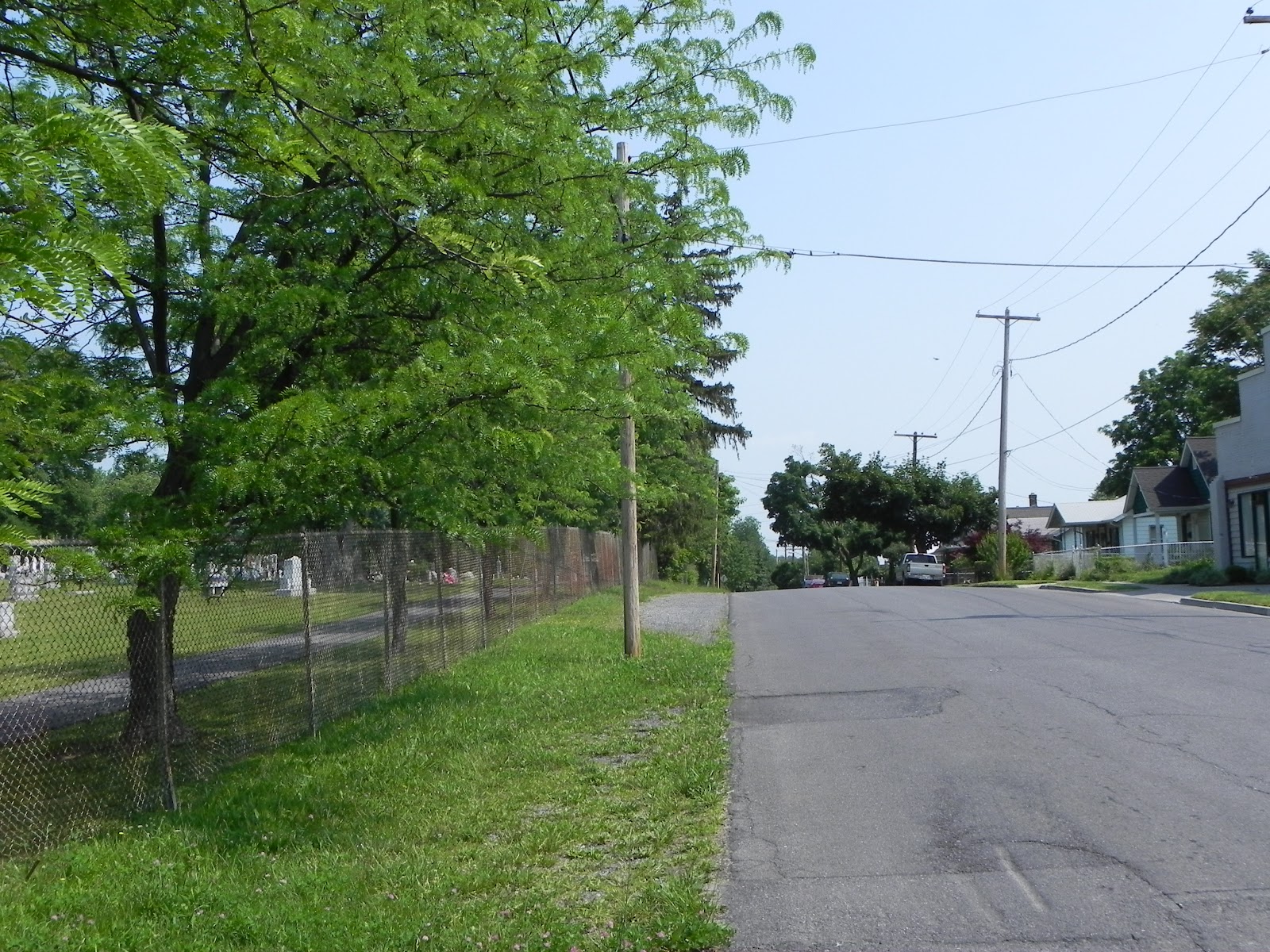
Kent Street Presbyterian Manse (c. 1845), home of Dr. and Mrs. James R. Graham, 319 N. Braddock St.  Dr. Graham was pastor of the Kent Street Presbyterian Church, where Stonewall Jackson attended services during his time in Winchester.  Jackson and his wife lived here as guests during the first three months of 1862.
We proceeded up N. Braddock Street to our next destination--Stonewall Jackson's Headquarters.  At the time of the war, the house belonged to Lt. Col. Lewis T. Moore of the 4th Virginia.  Moore, who was convalescing in Richmond, invited Jackson to use his home as headquarters while Jackson was serving as head of the Valley District.  Jackson worked there from November 1861 to March 1862.  He also resided in the Moore home for part of the time, until moving into the Graham home picture above.

The museum tour guide provided an overview of Jackson's life and explained many of the historic objects on display in the rooms of the house.  I was pleasantly surprised that the tour steered clear of overblown, Lost Cause-style rhetoric about Jackson.  The house contains a multitude of Jackson's personal belongings, including his prayer book, camp chest, quilt, and desk.  The museum touts the display as "the largest collection of Jackson memorabilia."   And I suppose they are right.  Where else can you see the sculptor's model of that Stonewall-on-steroids statue located on the Manassas Battlefield?  The museum also displays artifacts from others who served with Jackson.  I particularly enjoyed seeing Turner Ashby's saddle and William Pendleton's camp chest.

Stonewall Jackson's Headquarters at 415 N. Braddock St. The Gothic Revival-style house was built in 1854 by William Fuller.  Lt. Col. Moore purchased the home in 1856.  Jackson wrote to his wife in November 1861:  "The situation is beautiful.  The building is of cottage style and contains six rooms, on above the other.  My lower room, or office, has matting on the floor, a large fine table, six chairs, and a piano.  The walls are papered with elegant gilt paper.  I don't remember to have seen a more beautiful papering."
After spending time at the Jackson headquarters, Ken and I stopped at George Washington's Office, which dates to the time of the French & Indian War.  Perhaps unknown to many readers, I am also an enthusiast of this early American conflict, which has a strong connection to my hometown of Pittsburgh.  For anyone interested in colonial history, I can't say enough about this site.  Part of the structure served as Washington's office in Winchester while he supervised the construction of Fort Loudoun on the north side of the town between September 1755 and December 1756.  At the time, Washington was serving as the colonel of the Virginia Regiment.  The museum contains a number of fascinating exhibits about the early history of Winchester and Washington's time there.  Visitors are bound to pick some interesting tidbits about the area during the French & Indian War.  Even if you've come to Winchester mainly for the Civil War history, don't miss this place.

George Washington's Office at 32 West Cork & Braddock Streets.  The  log cabin where Washington had his office is now at the center of this building. 
That evening Ken and I dined at the Union Jack Restaurant and Pub, which has an extraordinary beer list.  Hat tip to Robert Moore and the Civil War Monitor for pointing this place out!  It was a perfect spot to end the day and enjoy an adult beverage or two.

Up Next
In the next installment, I'll examine Winchester's Civil War cemeteries and take readers on a tour of First Winchester (what's left of it) and Kernstown.

Information and Sources
Aside from the links provided above, the following websites are useful for planning a trip to Winchester:
1) Winchester-Frederick County Visitor Center
2) Old Town Winchester

I picked up a copy of Civil War Winchester by Jerry W. Holsworth to learn more about the war in this pivotal Shenandoah Valley town.