Showing posts with label 69th New York. Show all posts

Sunday, July 24, 2011

Manassas 150th Events, Part II: The Reenactment

Yesterday I attended the large-scale reenactment of the Battle of First Manassas with my father and good friend Ken.  The event was held on the grounds of a farm not far from the Manassas National Battlefield Park.  (In fact, the shuttle bus drop off point was at the Brawner Farm, a National Park site connected with the Second Battle of Bull Run.)  The early morning ride west along I-66 went smoothly, but we hit traffic on the road to the giant parking lot at Jiffy Lube Live.  All told, it took us around 25 minutes just to enter the lot -- a sure signs of the crowds to come.  Kudos to the event staff, who ran a very tight ship.  Local news sources report that around 11,000 spectators attended yesterday's reenactment, yet the crowds were moved along very efficiently from place to place. 

At the event parking lot, we were handled bottled water and boarded an air conditioned bus that took us to the Brawner Farm.  From there we walked quite a distance to the grandstands.  I am thankful that we paid the extra money for seating, since I was not inclined to stand in a crowd for two and a half long hours while the temperature climbed to around 100 degrees.  The heat and humidity were once again the enemy as at Thursday's events, although I was well equipped with bottled water and sunscreen.


Heading to the grandstand, I felt transported back to the dirt roads around Manassas 150 years ago.  Here, Confederate soldiers march towards the sounds of enemy artillery.
I was impressed with the reenactment.  Out on an open field, around 8,700 reenactors faithfully recreated the movements of the Battle of First Manassas, starting with Matthews Hill.  The organizers planned the action so that the climax on Henry Hill played out in front of the grandstand.  A narrator provided context and explained what was taking place.  Observing so many men in action gave a feel for the tactics used during the battle.  Whatever your opinions about reenacting (and I know some people certainly knock this hobby), the event surely helped many in the audience understand what had happened near Manassas 150 years ago.  And I have a feeling that for better or for worse, more people elected to go to the reenactment than to the events at Mansassas NBP or across Prince William County; if they got exposed to First Manassas, the reenactment was it.

South Carolina troops dressed in a hodgepodge of uniforms move towards the front.  I was struck by how well the reenactors mastered the non-standardized look at the time of First Manassas. 

A contingent of U.S. Marines arrives on Henry Hill to support the artillery batteries of Captains Charles Griffin and James Ricketts.

Ricketts' gunners in position on Henry Hill.


Confederate troops who have overrun Ricketts' Battery clash with the 69th New York.
More Confederate reinforcements enter the chaos of the battlefield.

A Confederate regiment unleashes a volley into the Union forces who have retaken Ricketts' Battery.  The massive power lines in the background were a noticeable intrusion on the attempt to recreate a 19th century battlefield.

The 69th New York fights back.
We left the reenactment a little early to avoid the huge exodus and get out of the heat, so I did not have time to check out the massive encampment.  (Of course, once you've seen one, you've seen them all!)  Our next stop was the City of Manassas.  We parked at the Prince William County Fairgrounds, the point of origin for the city's 150th anniversary activities.  The lot was empty compared to the parking area at Jiffy Lube Live.  After boarding yet another air conditioned bus, we disembarked along Main Street in the heart of Old Town Manassas, a quaint Southern hamlet.  At the time of the battle, the railroad junction consisted of just a few buildings.  After the Civil War, the town grew to become the transportation and commercial hub of Prince William County.  A fire destroyed Manassas in 1905.  Many of the current historic structures date from the early 1900s.

Looking down Main Street in Old Town Manassas.  The railroad still runs through the town.  Depsite living in the Washington area for many years, this was my first trip to Old Town.
My Dad, Ken, and I all grabbed a beer and sandwich at a local watering hole and then walked the streets of Old Town -- perhaps against our better judgment in light of the heat.  Our first stop was Prospero's Books, which has a solid collection of used Civil War books and prints.  I had seen this store on the local news and wanted to stop by to browse.  We also walked past various outdoor vendors who had set up in Old Town for the 150th.  I was fortunate to stumble upon artist Brian Kammerer's booth.  I have seen Brian's Civil War art on the Internet, and finally was able to meet the artist in person and chat about his work.  Brian creates illustrations of Civil War campaigns from an overhead prospective, similar to the maps in Bruce Catton's classic, American Heritage Picture History of the Civil War.  His unique work is well-researched and extremely detailed.  I purchased several prints for my home office.  At Brian's booth I also met fellow blogger Bernard Kempinski, who is building an O-scale model railroad depicting the U. S. Military Railroad Aquia-Fredericksburg line in 1863.

My crew had planned to got to Liberia Plantation and few of the other sites around Manassas, but the temperatures got the best of us.  We settled on a brief visit to the Manassas Museum and a walk around the living history encampment on the grounds of the museum, before going back to our car.  

The Manassas Museum in Old Town Manassas.  The museum tells the story of Manassas, including the role that the vital railroad junction played in the Civil War.
I particularly liked this quote from Jubal Early displayed at the museum.  Early was a delegate to the Virginia Convention and had been a forceful opponent of secession.  Later a Confederate general, Early became a major proponent of the Lost Cause school of thought after the war.
Part of the living history encampment on the museum lawn.
Overall, the last few days were a whirlwind of Civil War-related activity.  I was deeply satisfied to be able to participate in some of the major events commemorating the 150th anniversary of First Manassas and to share that experience with so many other enthusiasts and historians.  As we headed back to McLean, my friend Ken asked me, "Have you had your fill for now?"  "Never," I responded.

Thursday, July 14, 2011

McDowell and Civilians in Northern Virginia: Trying to Do the Right Thing (Part II)

As I discussed earlier this week, by the middle of July 1861 Federal commander Irvin McDowell had already taken several measures to protect civilians in Northern Virginia from the impact of war.  McDowell's orders reflected a conciliationist approach towards non-combatants, but not all men in the ranks shared his view.  As the Union Army prepared to move on the Confederate position near Manassas, the raw, undisciplined recruits would put McDowell's policy to the test.

The Union Army left camp in and around Washington on July 16, 1861 and headed into the heart of Northern Virginia.  During their march over the next couple of days, the Union soldiers grew increasingly unrestrained.  Colonel William T. Sherman commanded the men in his brigade to respect private property and refrain from foraging, but to no avail.  Volunteers ignored his orders, questioned his authority, and took whatever they pleased.  According to one account, Sherman reprimanded a Wisconsin solider for stealing mutton.  The solider countered that he was hungry and asserted that "it was rebel mutton, anyhow."  Sherman arrested the soldier; the mutton, however, was cooked and served to Sherman's staff at mealtime.  (William C. Davis, Battle at Bull Run: A History of the First Major Campaign of the Civil War, p. 96 (1981 ed.); Ethan S. Rafuse, A Single Grand Victory: The First Campaign and Battle of Manassas, p. 85 (2002).)

Meanwhile, some soldiers resorted to more drastic forms of pillage.  In Vienna, Federal troops in Brigadier General Daniel Tyler's division ransacked a grocery store that belonged to an alleged secessionist.  The ringleaders were Ohio boys who may have been motivated by a desire to avenge the Confederate attack on their fellow Ohioans in Vienna the month before.  Sergeant Dan Littlefield of the 3rd Michigan "did not think it was right to steal and destroy private property in that manner."  He worried that "if we go through the country that way, many would join the southern [sic] army that otherwise would not."  (excerpted in Steve Soper, The "Glorious Old Third": A History of the Third Michigan Infantry, 1855 to 1927, Ch. 9 (2007).)  McDowell would have agreed.

General William T. Sherman, later in the Civil War (courtesy of Library of Congress).  On the march to Manassas, Sherman tried in vain to keep his soldiers under control.
Around midday on July 17, Colonel David Hunter's division entered Fairfax Court House without a fight.  The soldiers found that the Confederates had abandoned the town and put a torch to a few buildings before retreating.  Some Union troops raised a flag over the courthouse, and then things rapidly deteriorated.  As an ashamed regimental chaplain wrote the following year:
I am sorry to say, that the occupation of Fairfax by our troops was marked, in some instances, by pillage and destruction. Several unoccupied houses were forcibly entered, their furniture injured or smashed to pieces, and many articles stolen and carried away. There was no reason for such wilful destruction of property, and there was no excuse for it. It left enemies behind us, when we might have secured friends. Men, who would have scorned to do such a thing at home, seemed eager and more than ready to lay their hands upon what was not their own. Many things were taken which could not possibly be carried upon the march, and which were thrown aside the next morning, and left upon the road. There was such an element of meanness and of cowardice in all this, that I could not help condemning it then, and I condemn it now. There is some glory in winning a trophy in a fair fight. But the appropriation of private property in a defenceless town, is nothing better than theft. It does not rise even to the dignity of burglary, for that requires a certain amount of courage. (Augustus Woodbury, A Narrative of the Campaign of the First Rhode Island Regiment, in the Spring and Summer of 1861, p. 82 (1862).)

Wartime photo of Fairfax Court House (courtesy of Library of Congress).  Advancing Union troops looted the county seat on July 17, 1861.
Around the same time, Federal soldiers under General Tyler, including Sherman's men, marched into the hamlet of Germantown.  As William Lusk of the 79th New York wrote to his mother, "soon the soldiers were ransacking the houses for food, destroying and burning what they could not use themselves."  However, he was "happy to say the boys in my company had little hand in these doings, as such paltry work finds little countenance from its officers." (William Thompson Lusk, War Letters of William Thompson Lusk, p. 52 (1911).)  A few bad seeds decided to burn down the village, and before long, Germantown was in flames.  

The 69th New York came upon one of the burning houses.  Major Thomas F. Meagher of the 69th, future leader of the Irish Brigade, disavowed any involvement by his men and condemned this spiteful act.  He wrote:
Whose was the scurvy and malignant hand that fired the deserted homestead? It is for the regiments of the Brigade, in advance of the 69th to answer. With them rests the responsibility of this savage riotousness and mischief. The house was doomed irrevocably when the 69th came up. The Irish regiment swept by the blazing ruin, cursing the ruffians who had played the barbarous prank, and maddened with the thought of the disgrace it would bring on the Federal Flag. (Thomas F. Meagher, "The Last Days of the 69th in Virginia," in Michael Cavanaugh, Memoirs of Gen. Thomas Francis Meagher, p. 393 (1892).)
McDowell witnessed what his men had done at Fairfax Court House.  He was angered by the behavior of his men and their blatant disregard for his orders to respect civilian property in Northern Virginia. On July 18, McDowell dashed off General Orders No. 18 (OR, Series 1, Vol. 2, Part 1, pp, 743-44), in which he began:
It is with the deepest mortification the general commanding finds it necessary to reiterate his orders for the preservation of the property of the inhabitant of the district occupied by the troops under his command.

Hardly had we arrived at this place when, to the horror of every right-minded person, several houses were broken open and others were in flames by the act of some of those who, it has been the boast of the loyal, came here to protect the oppressed and free the country from the domination of a hated party.
He followed with a dose of guilt and shame:

The property of this people is at the mercy of troops who we right-fully say are the most intelligent, best-educated, and most law-abiding of any that were ever under arms. But do not, therefore, the acts of yesterday cast the deeper stain upon them? 

It has been claimed by some that their particular corps were not disgraced. This is of but little moment; since the individuals are not found out, we are all alike disgraced.
McDowell adopted measures to stop further acts of plunder and destruction, and reiterated his previous order to protect the civil liberties of the local inhabitants:
Commanders of regiments will select a commissioned officer as regimental provost-marshal, and ten men as a permanent police force under him whose special and sole duty it shall be to preserve the property from depredation, and arrest all wag-doers, of whatever regiment or corps they may be. Any one found committing the slightest depredations, killing pigs or poultry, or trespassing on the property of the inhabitants, will be reported to headquarters, and the least that will be done to them will be to send them to the Alexandria jail. 
It is again ordered that no one shall arrest or attempt to arrest any citizen not in arms at this time, or search or attempt to search any house, or even to enter the same, without permission.
McDowell concluded:
The troops must behave themselves with as much forebearance and propriety as if they were at their own homes.  They are here to fight the enemies of the country, not to judge and punish the unarmed and helpless, however guilty they may be.  When necessary, that will be done by the proper persons.
The commander once again proved his commitment to a policy of conciliation, and we know that at least some Federal volunteers like Lusk, Meagher, and Woodbury were more than likely pleased with the renewed effort to impose discipline.  In any event, the army was soon on the march again, and within a few days it engaged the Confederates on the battlefield of Bull Run.  The war was going to be a long one after all, and as the months turned into years, McDowell's early attempts to restrain his troops and protect civilian property looked almost quaint. Unfortunately for the residents of Northern Virginia, the war and Union occupation would mar the countryside and transform everyday life, and the Bull Run Campaign was just the beginning.

Friday, July 8, 2011

Aqueduct Bridge over the Potomac: Yesterday and Today

My wife and I decided to take a walk along the Chesapeake & Ohio (C&O) Canal in Georgetown this past Memorial Day.  Our little attempt at exercise gave me the perfect opportunity to check out the remains of the Aqueduct Bridge, which are located next to the canal path in the vicinity of present-day Key Bridge.  Readers may recall that I have mentioned the Aqueduct Bridge in numerous posts over the past year.  This bridge was one of three river crossings into Virginia from the D.C. side of the Potomac at the time of the Civil War.

The Aqueduct Bridge dates to the antebellum period, when Alexandria comprised part of the federal District of Columbia.  Alexandria, a port city, desired to benefit from the trade that was moving along the C&O Canal to rival Georgetown.  In 1830, a group of Virginia merchants formed the Alexandria Canal Company.  They sought to extend the C&O Canal to the Virginia side of the Potomac River, and from there, to Alexandria.  The Aqueduct Bridge, known as the Alexandria Aqueduct or Potomac Aqueduct, was designed to carry the canal across the river. Construction on the bridge and the Alexandria Canal began in the early 1830s and was completed in 1843.  The bridge, an engineering marvel of the 19th century, cost a staggering sum of around one million dollars.  With the extension of the C&O Canal to Cumberland, Maryland in 1850, the Aqueduct Bridge played a key role in bringing coal from western Maryland to the the port at Alexandria. 

The Aqueduct Bridge featured prominently at the start of the Civil War.  Virginia voters officially approved secession on May 23, 1861, and in the early morning hours of May 24, Union soldiers moved to occupy Alexandria and Arlington Heights.  A Federal column including the 5th, 28th, and 69th New York crossed the Aqueduct Bridge into Virginia.  Not long afterward, the Union Army constructed Forts Corcoran, Bennet, and Haggerty to guard the approaches to Aqueduct Bridge from the Virginia side of the river.  These forts comprised part of what would become the ring of defenses built to protect Washington during the war. 

The Aqueduct Bridge from the Washington side, with the C&O Canal in the foreground, ca. 1862-65 (courtesy of Library of Congress).
In his A Report on the Defenses of Washington to the Chief of Engineers, U.S. Army (1871), Brevet Major General John Gross Barnard noted that the Union military decided that a "permanent and secure bridge connecting Washington with the Virginia shore" was preferable to the use of the Aqueduct Bridge to transport military supplies to Alexandria by way of the canal. Some officers, as well as the canal company, initially objected to the suspension of canal operations across the Aqueduct Bridge. A "boat bridge" was contemplated for military purposes, but proved an unrealistic alternative given concerns about water depth, flooding, ice, and currents. Barnard described the subsequent transformation of the Aqueduct Bridge:
The tow-path of the aqueduct did indeed furnish a narrow passageway to horsemen and footmen; but this was far from adequate to the military exigencies. Accordingly, early in the winter of 1861-'62, the water was shut off from the aqueduct and its trough converted into a double-track wagonroad, the floor being overlaid with 4-inch planks and long inclines, on trestles, forming connections with the roads on either side.
Eventually three blockhouses and a rifle trench were placed at the Virginia end of the Aqueduct Bridge. The head of the bridge was also enclosed with a stockade to protect more effectively against cavalry raids. The Union Army contemplated placing a shore battery in Georgetown to command the length of the bridge, but decided against this defensive measure.  A guard of one officer and thirty men usually covered each end of the Aqueduct Bridge.

One of the blockhouses near Aqueduct Bridge on the Virginia side (courtesy of Library of Congress).

Barnard, who oversaw the construction of the the defensive works around the nation's capital, concluded in his report that "the aqueduct served perfectly, throughout the entire period of the war, its new destination, and was recognized as an important and essential adjunct to the 'Defenses of Washington' and to the great military operations in Virginia."

Looking at the top of the remains of the Aqueduct Bridge's Washington abutment along the C&O Canal.  The canal entered here and crossed the Potomac. The Key Bridge dominates in the background.  The office buildings of Rosslyn, Virginia are visible across the Potomac River.

Another view of the Aqueduct Bridge during the Civil War (courtesy of Library of Congress).  This photograph was taken from across the Potomac in Virginia.  The Washington abutment is visible where the bridge hits the shore in Georgetown.

A side view of the Washington abutment.  The arch to the left was expanded in 1889 to accommodate the Washington branch of the Baltimore & Ohio Railroad. 

The bridge was returned to canal usage after the Civil War.  In 1923, the Aqueduct Bridge was closed when the Key Bridge was built next door, and in 1933, the old bridge was largely dismantled.  Today the remaining Washington abutment is a visible reminder of the existence of the Aqueduct Bridge and the place it occupied in the capital's Civil War history.

Sunday, June 12, 2011

Battle of Vienna, June 17, 1861: An Overview

This upcoming Friday marks the 150th anniversary of the so-called "Battle of Vienna." This little-known encounter in Northern Virginia is now getting its fair share of attention, at least in the D.C. area.  The Town of Vienna will even be putting on a reenactment of the battle this Saturday, complete with a locomotive brought in from the Shenandoah Valley.  (More on the train a little later....)  There are some interesting angles to explore in connection with this early action in the Civil War, so I've decided to dedicate the entire week to the skirmish.
General Robert Schenck (courtesy of Library of Congress)
On June 17, 1861, Brigadier General Irvin McDowell, commander of the Union Department of Northeastern Virginia, ordered Brigadier General Robert Schenck to undertake a reconnaissance mission in the direction of Vienna.  Schenck selected the 1st Ohio, and set out with his troops on the Alexandria, Loudoun, and Hampshire Railroad.  At a wagon crossroads near Falls Church, he relieved the 69th New York with two companies.  He sent two other companies to patrol Falls Church, and dispatched an additional two companies to guard the railroad and bridge between the crossroads and Vienna.  With the remaining four companies of 271 men, Schenck proceeded slowly towards Vienna.  A locomotive pushed the train along the tracks.  Most of the soldiers sat on platform cars, while Schenck rode in a passenger car with Col. Alexander M. McCook, commander of the 1st Ohio.

Col. Maxcy Gregg (courtesy of Wikipedia)
The day before, Col. Maxcy Gregg, head of the 1st South Carolina, was ordered to conduct a reconnaissance towards the Potomac River.  He set out from camp near Fairfax Court House with about 575 soldiers and 70 cavalrymen.  At Frying Pan Church, Gregg met an additional 70 cavalry, as well as an artillery detachment of 34 men and two guns.  The force proceeded towards the Potomac, where on June 17 Gregg "went in person to the bank of the river to reconnoiter," but he "could see but few troops of the enemy, and no boats prepared for crossing the river." (Gregg Report, OR, Series 1, Vol. 2, Part 1, p. 129.)   The Confederate troops began the long march back towards camp.  In Vienna, Gregg expected to see the enemy, who had recently sent an expedition to the area, but detecting no Federals, he ordered his men to proceed to Fairfax Court House.  At around 6 p.m., however, "a distant railroad whistle was heard." (Gregg Report, OR, Series 1, Vol. 2, Part 1, p. 129.)  As Gregg wrote in his battle report:
I marched the troops back, placing the two 6-pounder guns on the hill commanding the bend of the railroad, immediately supported by Company B, First South Carolina Volunteers. . . . . The rest of the regiment . . . was formed on the crest of the hill to the right of the guns. The cavalry were drawn up still farther to the right. (Gregg Report, OR, Series 1, Vol. 2, Part 1, p. 129.)
As the 1st Ohio turned the curve outside of Vienna, the Confederate battery opened fire with shot, shell, and grapeshot.  The first platform car was untouched, but the second and third cars received the deadliest fire.  The train encountered some mechanical difficulties, and the engineer could not pull the train out of range of the guns.  (By some accounts, the breaks had locked when the engineer slammed them at the outset of the attack.)  The soldiers, coming to the realization that they were sitting ducks, "left the cars, and retired to right and left of [the] train through the woods."  (Schenck Report, OR, Series 1, Vol. 2, Part 1, p.126.)  Meanwhile, to Schenck's disgust and amazement, the engineer "instead of retiring slowly, as I ordered, detached his engine with one passenger car from the rest of the disabled train and abandoned us, running to Alexandria." (Schenck Report, OR, Series 1, Vol. 2, Part 1, p.126.) Believing that his force was badly outnumbered by as many as 1,500 Confederates, Schenck threw skirmishers out along his flanks and retired towards Arlington.  Without the train, his men were forced to carry the wounded on litters or in blankets.
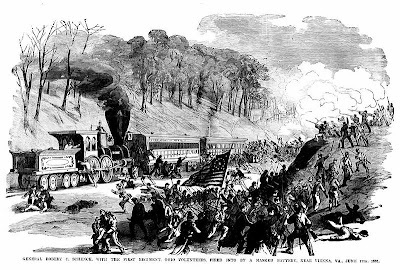
Fanciful sketch of the Battle of Vienna, from Frank Leslie's Illustrated Newspaper (courtesy of Wikipedia)
Gregg dispatched two companies to skirmish with the retiring Union soldiers, but seeing that they were slipping out of his grasp, he sent cavalrymen in pursuit.  As Gregg later recounted, "[f]rom the lateness of the hour, however, the nature of the ground, and the start which the enemy had, they could not be overtaken." (Gregg Report, OR, Series 1, Vol. 2, Part 1, p. 129.)  He also may have been convinced that he was outnumbered by a larger Union force.  Under orders "to avoid any unnecessary engagement, and not to remain absent from my camp more than one night," Gregg marched his regiment back to Fairfax after burning the railroad cars that were abandoned in Vienna. (Gregg Report, OR, Series 1, Vol. 2, Part 1, p. 129.)

A Unionist from Vienna eventually loaded six of the dead into his wagon and took them to Schenck's camp.  In all, Schenck reported eight dead and four wounded in the engagement.  The casualties came entirely from Companies G and H, which had been positioned on the second and third rail cars.

In the immediate aftermath of the skirmish, McDowell wanted to move in force upon Vienna.  As he wrote in his official report, "[h]ad the attack not been made, I would not suggest this advance at this time; but now that it has, I think it would not be well for us to seem even to withdraw."  (McDowell Report, OR, Series 1, Vol. 2, Part 1, p. 125.) General-in-Chief Winfield Scott, however, opposed the idea of sending more troops in the direction of the town.  He would soon recall Brigadier General Daniel Tyler from an advanced position at Falls Church, which Scott viewed as too exposed and vulnerable.

The news of the skirmish at Vienna spread across the North. The New York Times was particularly critical of the defeat, which followed closely on the heels of the Union loss at Big Bethel.  According to a June 20, 1861 article, a local man had flagged the train near Vienna and warned the 1st Ohio of an impending disaster, but Schenck did not halt the train or prepare his soldiers for an attack.  (Schenck makes no mention of this episode in his report.)  The Times also questioned the failure of the Union force to send scouts or skirmishers ahead of the train to ascertain any dangers.  As the Times wrote on June 19:
In the present case an entirely inadequate body of men was actually within the enemy's lines, in a railroad train, with no more careful exploration of the country than a traitorous engineer, or an accidental glance from a car-window, might furnish. . . .   Surely, the simplest knowledge of military matters must condemn so heedless a movement as to the last degree reckless and unscientific, and may fairly sit in judgment upon those who planned it. The entire policy of these detached and apparently purposeless expeditions is questionable. If they are understood to be what are technically known as reconnaissances in force, they should have force in the possession of flying-artillery, and dragoons. To enter upon doubtful territory, where the enemy may be in the greatest strength, without precaution, is simply foolhardiness.
Such reporting fed concerns about the preparedness of the Union volunteers camped around Washington.  As journalists dissected the action at Vienna, however, the Union high command was busy contemplating its next move.  

Note on Sources

The Battle at Bull Run by William C. Davis and The Glories of War: Small Battles and Early Heroes of 1861 by Charles P. Polland, Jr. contain fairly detailed accounts of the Battle of Vienna.


Thursday, March 17, 2011

Happy St. Patrick's Day!: The 69th New York at Fort Corcoran


Like many Civil War enthusiasts, I have always been fascinated with the exploits of the famed Irish Brigade, even though I don't have a drop of Irish blood in my body!  On this St. Patrick's Day, I was looking for an interesting Northern Virginia connection to the unit.  It turns out that Fort Corcoran in Arlington was constructed in May 1861 with the help of the 69th New York State Militia, a regiment which eventually formed the core of the Irish Brigade.  The fort, one of the first built around Washington during the Civil War, defended the approaches to the Aqueduct Bridge, along with Forts Bennett and Haggerty.  Fort Corcoran was named after Colonel Michael Corcoran, leader of the 69th New York.  The regiment fought at Bull Run and re-enrolled as the 69th New York State Volunteers when its 90-day enlistment period expired.  Colonel Thomas Francis Meagher, who replaced Colonel Corcoran after his capture at Bull Run, sought to organize an all-Irish unit.  His wish was granted, and he soon was leading the Irish Brigade.

Officers of the 69th New York State Militia at Ft. Corcoran, 1861.  Col. Corcoran is at the far left. (courtesy of the Library of Congress)