Showing posts with label Civil War Medicine. Show all posts

Thursday, June 25, 2015

A Trip to Gettysburg with the Kids

As the followers of this blog's feeds on Facebook and Twitter know, I often take my twin sons to Civil War sites in and around Northern Virginia. I am a big believer in exposing them to history at an early age. They may not really "get it," but I am sure that deep down, an understanding, or better yet, an interest, is taking root.

Truth be told, I started reconnecting with the war just as the boys were born. In those early days, I spent what little down time I had writing posts and researching, much to my wife's chagrin! As the boys grew, I grew too, as a writer, blogger, and amateur historian. I suppose it was fitting that for their fifth birthday I would take them to the granddaddy of all Civil War battlefields -- Gettysburg. I also planned to make the vacation their first camping trip. My own parents could hardly believe that their son, a fan of the luxury hotel, was voluntarily returning to a campground after all these years. We opted on a Kamp Kabin at the Gettysburg/Battlefield KOA -- not exactly roughing it, but try spending a few days with little boys and no access to a private restroom.

The twins are no strangers to battlefields. After all, they first visited Manassas National Battlefield Park when they were almost three. Since then, they've returned to Henry Hill on numerous occasions. (We are only twenty-five minutes away. How wonderful it is to have a major Civil War battlefield at your doorstep.) They've also crossed Burnside Bridge at Antietam and walked through the historic streets of Harpers Ferry. But I would be lying if I didn't admit a bit of trepidation about spending a few days at Gettysburg with them. Manassas is one thing, but Gettysburg is quite another.

Even before driving up US-15, I started by kindling some enthusiasm for the story of the battle. I showed the boys some edited scenes from the film, Gettysburg. Jack would continually ask me, "Who won, the blue guys or the gray guys?" every time he saw a scene from the battle. I had nightmares that he'd do the same once out on the field. Drawing from their recognition of a few key Civil War personalities, I also told them about Lee leading the Confederates, and how President Lincoln gave a speech there.


Excited to be camping....

Gettysburg is a family-friendly place, which makes visiting with little ones easier than at some destination like California wine country. However, I was determined to keep the kids away from the tourist traps and show them the proper way to visit a Civil War site. It is never too early to teach kids how to engage in respectable and respectful tourism.

We started at the Gettysburg National Military Park Visitor Center. Unfortunately, and perhaps surprisingly, our first run-in with a Ranger was a little disappointing. He brushed us off when I asked for those Civil War NPS collectors cards and advised that we should come back tomorrow to get them instead. He never explained why. The Park Service redeemed itself the next day when a new Ranger handed each of my very happy boys a complete set of Gettysburg cards.

The film at the VC may have been a bit much for the boys' little brains -- try teaching concepts of slavery and emancipation to rising kindergartners -- but the Cyclorama had them in awe. They marveled at what they were seeing and couldn't believe that it was only a painting. We also walked through the museum. The boys each spent time looking at various artifacts from the battle and watching the informational videos. Jack was a bit more engaged; Cam moved at breakneck pace so that we would leave to check-in at the campground sooner.

Of course, battlefield stomping took top billing for us. We visited some key sites on Thursday evening. The first time Jack looked out over the field where Pickett's men advanced, he exclaimed to me, "That was a long way to march!" Pretty insightful for a new preschool graduate. We also made our way to the Father William Corby Monument, where I produced a copy of the statue in green plastic from their toy soldier set and told them what the good padre was doing there. We eventually reached the Angle and the Copse of Trees. Jack stood mesmerized by the stone wall. He remembered seeing scenes of all those "blue guys" waiting there to receive the Confederate charge.


Jack looks at the Union position around the Angle.

We rose early on Friday and headed back to the battlefield to beat the crowds and the heat. Best idea ever. The boys and I had most of the stops to ourselves, including Little Round Top. Jack could only shout "Wow!" when he looked out over the field from up there. The boys particularly loved climbing to the top of the 44th New York Monument, or "the castle" as they called it. I also walked with the twins to the scene of the 20th Maine's fight, and reminded them of the scene in the film where the men in blue fixed bayonets and rushed the Confederate attackers. After Little Round Top, we stopped at Devil's Den, but the boys surprisingly took a pass on checking out the huge boulders. Seeing the Pennsylvania Monument, Jack and Cam were eager to meet the challenge of going all the way to the top. Only later did I realize that Cam was confronting his own fear of heights. No wonder he rushed to get back down!


Native sons checking out the Virginia Monument.
Jack gestures towards the staging area for Pickett's division. As friend Harry Smeltzer of Bull Runnings put it, Jack already has a good point and a certain future with the NPS!

Before heading back to the campground, we stopped at the Seminary Ridge Museum. Although I knew that the boys were a bit too young, I really wanted to check out this relatively recent addition to the Gettysburg scene. Just like everything else, the admissions fee is waived for little ones under six, so I didn't lose too much money in doing so! The boys were moved by the lifelike wax tableaux of hospital scenes at the Seminary. They had a lot of questions about the care of the wounded, and I used the visit as a way of teaching them that war is a "bad thing that hurts people."


From the top of the Pennsylvania Monument.
Studying a hospital scene at the Seminary Ridge Museum.

We spent Friday afternoon shopping for souvenirs on Steinwehr Avenue. Jack and Cam both bought a few Civil War-themed items, including the requisite bag of plastic soldiers. After eating an ice cream and waiting out a torrential downpour while visiting Oak Hill, we headed back to our cabin. As I watched the boys play outside with toy sword and miniature flags, I knew that something had sunk in when I saw them charge, shouting "Irish Brigade forward!"


"Dad, can I get this?"

On Saturday I took the twins to Steam Into History in New Freedom, Pennsylvania, about an hour east of Gettysburg. If your kids like trains as much as mine do, and like their father does, this is a must-see attraction. We did the hour long excursion to Glen Echo. The train is pulled by a replica of the 4-4-0 locomotive that took Lincoln to Gettysburg. Passengers sit in recreated 19th century passenger cars. Jack and Cam were thrilled to hear the steam whistle as the train chugged along past small towns and farms. As an added bonus, the day we rode an entertainer dressed in Union blue told local stories about the Civil War and sang songs from the era. Overall, a family won't go wrong paying a visit to Steam Into History.


What a fine example of Industrial Age beauty!

Returning to Ashburn, I considered the trip a success. The boys seemed impressed with the battlefield, and I am sure they learned a thing or two. Meltdowns were kept to a minimum. I suppose flexibility on my part was key -- the schedule can't be too fixed or rigid with little ones in tow. And you got to make room for a swim in that campground pool. Jack and Cam may not remember every little detail about what they did, but I am pretty sure they will always remember their first trip to Gettysburg. We all do!

Wednesday, January 28, 2015

Contraband Camp Developments, Late Summer and Fall 1864, Part I

As the Union Army fought over the future of Northern Virginia's contraband camps in the late summer of 1864, the Friends' Association for the Aid and Elevation of the Freedmen continued its work to improve the lives of former slaves living on government farms near Washington. Established by Philadelphia Quakers at the start of the year, the organization provided supplies and teachers to supplement the efforts of Union military authorities. But the debate within the government was not without consequences, and by the end of 1864, the Friends would face the unwelcome challenge of a new and harsher policy towards the contrabands.

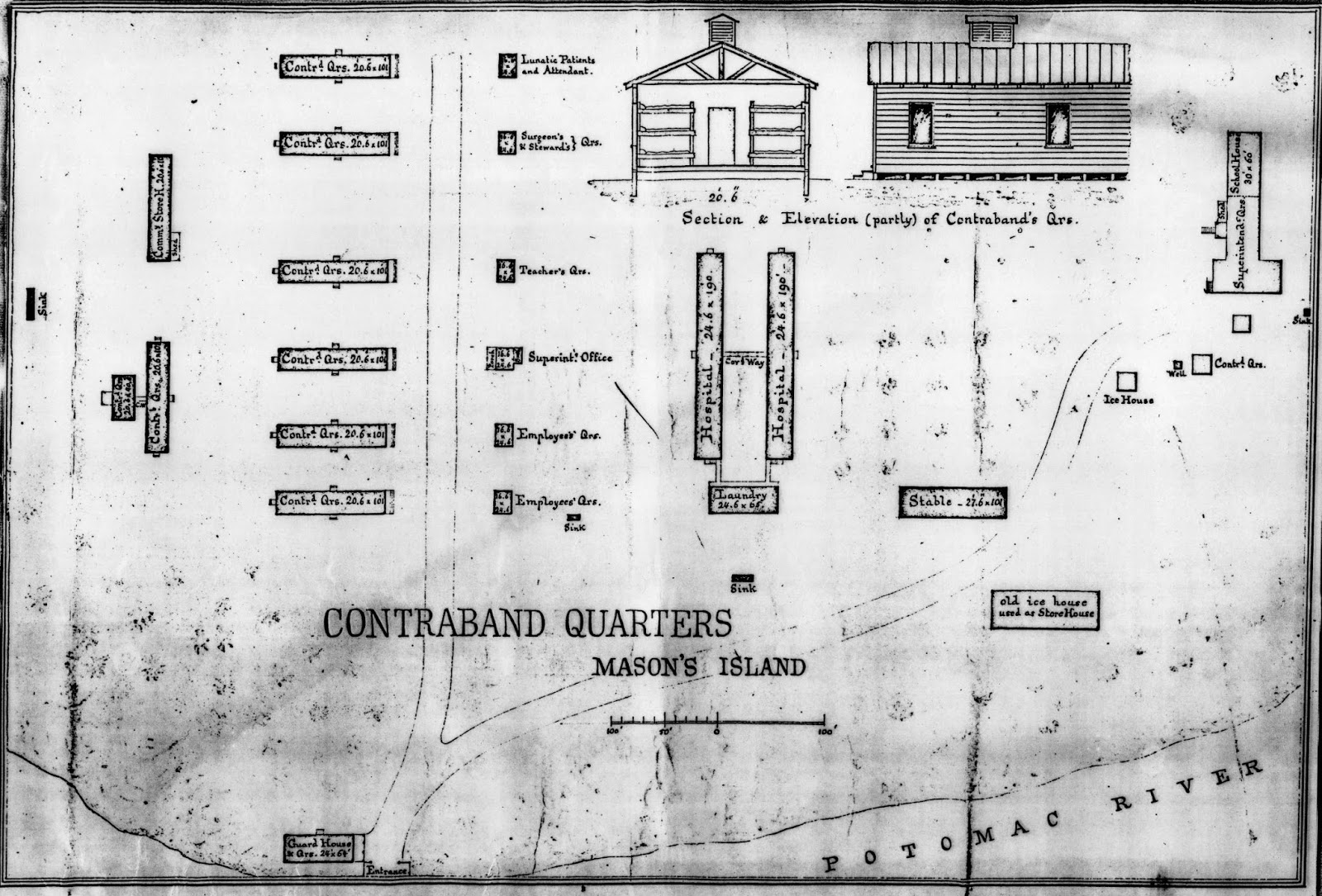
An important part of the Friends' charitable activities centered on education. Since starting work in Northern Virginia earlier in the year, the association had sent teachers to Camp Rucker in Falls Church, Camp Wadsworth in Langley, and Mason's Island. In August 1864, the Friends decided to increase the number of teachers to meet the growing needs of the contraband community. Mary McLain was dispatched to Camp Wadsworth, while Margaret Preston was installed at Mason's Island. [1]

Map of contraband quarters at Mason's Island (courtesy of TR Center). Hospital buildings are shown in the center of the drawing.

The Friends also provided the contraband camps with clothing, sewing supplies, dry goods, and other household items. At least some of these donations were sold to the freedmen and women, presumably at a discount. [2] In September 1864, the Friends' Association decided to disband its Committee on Supplies and established a new Sanitary Committee. The Board appropriated $500 to the committee for the purchase of hospital supplies for Mason's Island. That month, the committee issued the call for donations in the Friends' Intelligencer:
The undersigned, a sanitary committee of said Association, solicit from Friends and others, contributions of hospital stores, which will be judiciously distributed by nurses and teachers sent out by the Association to Mason’s Island, Camp Wadsworth, and other points in the vicinity of Washington. 
The articles most needed, are dried fruits,such as apples, peaches, cherries, plums, and blackberries; also blackberry and other syrups, and all other articles suitable for the sick and convalescent.
Contributions of bed-covering, and clothing for women and children, will be very acceptable, as they are greatly needed. Free transportation has been granted by Government from Philadelphia. (456.)

At the same time the Friends were intensifying their involvement with the camps, Capt. Joseph Brown, an assistant quartermaster, took over primary responsibility for the contrabands in the Department of Washington from the outgoing Chief Quartermaster, Lt. Col. Elias Greene. Brown pursued decidedly stricter policies than Greene, who had lost his job as the result of an Army report critical of his management of the contraband camps. Brown, the head of the Department's Bureau of Freedmen and Government Farms, wanted to rid the government of the expense and trouble of caring for the freedmen and women in the camps and tried to send as many to the Northern States as possible. He also departed from Greene's policy of keeping families together. Brown thought nothing of apprenticing children to local households and hiring out their parents on separate jobs.

Toward the end of September the Friends' Sanitary Committee sent Louisa J. Roberts and Margaret A. Griscom to Mason's Island. Roberts wanted to meet with the new Chief Quartermaster of the Department of Washington, Col. John Ellison, to explain "the wants of our teachers and the people among whom they labor." (First Annual Rpt. 10.) Following her conversations with Ellison, Roberts reported that "[o]ur teachers appear to have his entire confidence, and he seems willing to do all that lies in his power, to promote their comfort and efficiency." (First Annual Rpt. 10.) As to Mason's Island, the visitors found:
The condition of the people. . . is much improved; the great mortality that prevailed during the latter part of the summer, has given place to a more healthy condition, attributable to the success that has attended our efforts to provide hospital accommodations, and to the approach of colder weather. (First Annual Rpt. 11.)
Nonetheless, Roberts and Griscom saw indications of troubles yet to come. As the Friends' Education Committee reported in October, "many grievances were found to exist at Camp Wadsworth, and it was believed that through their representations to the proper authorities most of these would be redressed." (Friends' Intelligencer 521.) The Friends were betting on the willingness of the new military leadership to assist, but Brown's policies were fast becoming a part of the problem.

Up Next

Camp Wadsworth suffers a setback.

Notes

[1] Preston was also charged with nursing responsibilities, as the circumstances required.

[2] According to the Friends' Association's First Annual Report:
The people on the two farms composing [Camp Wadsworth] evince a desire to support themselves, and they have paid for a considerable  portion of the clothing distributed among them. (10.)
Sources

Ira Berlin et al., Freedom: A Documentary History of Emancipation, 1861-1867, Selected from the Holdings of the National Archives of the United States, Series I, Volume II, The Wartime Genesis of Free Labor: The Upper South (1993); Board of Managers, Friends' Assn. for the Aid and Elevation of the Freedmen, First Annual Report of the Board of Managers of the Friends' Assn. for the Aid and Elevation of the Freedmen (1865);  Friends' Intelligencer: A Religious and Family Journal, Vol. XXI (1865).

Tuesday, December 23, 2014

Christmas 1864 in Washington City

Just as with Thanksgiving, I have been covering Christmas for each year of the Sesquicentennial. Over the past week, I've re-posed to Facebook my previous entries covering the first three Christmases of the war. Now we've at long last come to the final holiday season celebrated by a divided nation.

During the first winter of the war, Washington was surrounded by the sprawling camps of the Army of the Potomac. Soldiers talked longingly of home at Christmas, and many anxiously awaited their first encounter with the enemy in battle. By the end of 1862, this same army had experienced much carnage and scored few successes. Military hospitals lined the streets of Washington, and caring citizens mobilized to feed the sick and wounded. The following year, the inhabitants of the nation's capital celebrated the major Union victories of the past summer and fall. The press coverage was enthusiastic and hopeful. However, by Christmas 1864, the war had taken a tremendous toll in death and suffering. The papers describe a somewhat subdued holiday observance. Perhaps people were just a tad more jaded this year, after the bloodshed at places like the Wilderness and Cold Harbor, and the continuing grind of siege warfare before Petersburg. The end was drawing near, but it hadn't come just yet, and it couldn't come fast enough.

"Christmas Morning," Harper's Weekly, Dec. 31, 1864 (courtesy of sonofthesouth.net).
A "drizzling rain" fell on Sunday, December 25, and Washington's streets "were merged in mud." (Wash. Even. Star, Dec. 27, 1864.)  Despite the dreary weather, congregants filled the churches in the nation's capital. As the Daily National Republican reported:
The Episcopal and Catholic churches (as is their custom) were appropriately and beautifully decorated with festoons, garlands, and wreaths of evergreen, and the anniversary exercises in commemoration of the natal day of the Saviour of the World were of the most impressive character. In all of the churches choirs, rich in melody, chanted the praises of him whom the wise men of the East came to worship over eighteen hundred years ago, and at the announcement of whose birth the shepherds of Judea were astounded. 
With the religious community the day was one, therefore, of peculiar pleasure and satisfaction, for the pulpits were all occupied by eloquent and feeling divines, who, for the time, dropping sectarian and doctrinal feelings, plead the merits of the Savior. . . .(Dec. 27, 1864.)
The paper also made a few other observations about the holiday among the non-churchgoing crowd:
With the irreligious portion of the community, or those who did not attend church, the day was also a comparatively quiet one. There was no rowdyism upon the streets, but all was quiet and peaceable. True, guns, pistols, and "villainous gunpowder" in the shape of squibs and firecrackers were let off to the annoyance of some, but this was confined to a few localities, and the police and other authorities were indefatigable in their efforts to prevent the breach of Sabbath day order and propriety. (Dec. 27, 1864.)
As in years past, the patients in the city's military hospitals also took part in the holiday celebrations. At Campbell Hospital, the men sat down to "a table laden with turkeys, vegetables, sauces, preserves, jellies and a multitude of other eatables to which they did ample justice." (Wash. Even. Star, Dec. 27, 1864.) That evening, a social ball was held in the "gaily decorated" reading-room hall, "where "patients, officers and visitors mingled, and all enjoyed themselves to the fullest extent; the excellent band of the hospital adding largely to the pleasures of the occasion." (Wash. Even. Star, Dec. 27, 1864.)

"The Union Christmas Dinner," Harper's Weekly, Dec. 31, 1864 (courtesy of sonofthesouth.net). As the newsweekly described the theme of the illustration: "Today, then, under the Christmas evergreen, the country asks only for peace, and breathes only good will to all men. Despite the sharp war, its bountiful feast is spread, It stands, as Mr. [Thomas] NAST represents in the large picture in today's Number, holding the door open to welcome the rebellious children back to the family banquet. It does not forget one of their crimes. It remembers the enormity of their attempt. It will take good care that the root of bitterness is destroyed forever, and that the peace of the household shall be henceforth secure. But it asks what it can command. It invites where it can enforce. It says now, as it has said from the beginning, 'Submit to the laws made by all for the common welfare, and there will be no more war.'"

At Stanton Hospital, the patients took dinner in the dining hall "beautifully decorated with evergreens, American flags and shields being displayed from prominent positions." (Wash. Even. Star, Dec. 27, 1864.) In the middle of the room "stood a large Christmas tree, tastefully trimmed, which attracted the attention of all present, and which many of the patients declared reminded them of Christmas times at home." (Wash. Even. Star, Dec. 27, 1864.)

At Lincoln Hospital, "an examination of the colored school (composed mostly of the children of the contraband laborers employed about the hospital. . .) took place in the presence of the parents and friends of the scholars, numbering about 100, and after its conclusion. . . each scholar received a Christmas gift of a cornucopia with candies. . . ." (Wash. Even. Star, Dec. 27, 1864.) Following a big Christmas dinner, an effigy of Jefferson Davis was lit on fire over the stove in plain view of the patients, "giving a vivid representation of the Union soldier's idea of the arch traitor's 'hereafter.'" (Wash. Even. Star, Dec. 27, 1864.) According to the Evening Star, "[t]his affair caused great excitement and Jeff was groaned lustily, while many exclaimed 'Amen' to the doom foreshadowed to him." (Dec. 27, 1864.)

Presumably because Christmas fell on the Sabbath, Monday "was observed as the grand festival-day." (Wash. Daily Natl. Rep., Dec. 27, 1864.) That morning the residents of Washington awoke to the boom of a tremendous 300-gun salute at Franklin Square in honor of Gen. William T. Sherman's recent capture of Savannah. The rest of the day was a bit more low-key:
The prominent business places of the city were closed, no papers were issued during the day, and all gave themselves up to enjoyment. There was more shooting and more noise than upon the Sabbath, but all must acknowledge that it was one of the most quiet Christmas celebrations known here for a long time. There was but little intoxication and no serious brawls, and it is safe to assert that no city the size of Washington, and its mixed population, passed a more orderly holiday. (Wash. Daily Natl. Rep., Dec. 27, 1864.)
That evening, "social parties were given, and the theatres and other places of amusement were open, and the citizens and strangers gave themselves up to enjoyment." (Wash. Daily Natl. Rep., Dec. 27, 1864.)

Overall, Christmas 1864, despite the two-day holiday, seemed a bit subdued in the streets of Washington. Inhabitants of the war-weary capital attended services and headed to various performances around town, but if press reports shed any light, intoxicating beverages played a less prominent role! The patients at the military hospitals also enjoyed bountiful dinners and in-house entertainment, although without many of the high-profile guests who had attended in previous years. President Lincoln, for his part, had received a rather satisfying "Christmas gift" from General Sherman, and the news of the latest victory surely helped to boost spirits and engender hope that the Confederacy's fate would soon be sealed.

Last, but not least, I'd like to wish my readers a Very Merry Christmas and Happy Holidays! Thanks for following the blog, and see you next year!

Sources

Washington Daily National Republican, Dec. 27, 1864; Washington Evening Star, Dec. 27, 1864).


Wednesday, November 26, 2014

Thanksgiving 1864 in Washington City

As Thanksgiving Day fast approaches, I wanted to take a look like I do every year at how the holiday was celebrated in and around Washington during the Civil War. For each year of the Sesquicentennial I've been concentrating on Thanksgiving at the corresponding time 150 years ago. It's hard to believe that we have at long last come to the final Thanksgiving of the Civil War. In a year, the war would be over, and the long process of reunion and reconstruction begun. But in 1864, Sherman was on the march in Georgia, Grant was dug in before Petersburg, and Lincoln had just won reelection. The nation gathered around the table on November 24, hopeful that the bloodshed would soon end and peace would return to the land.

Like other places around the country, Washington City greeted Thanksgiving with enthusiasm. The Washington Evening Star provided readers with an overview of the holiday in the nation's capital:
Yesterday, the day designated by President Lincoln as a day of Thanksgiving, was very generally observed. Public offices, banks and places of business were closed, and the people set themselves to a hearty observance of the day, not forgetting to pay due attention to that estimable feature of the occasion, the Thanksgiving Dinner, which sent up its appetizing odor throughout the length and breath of the city. The weather was just the thing for thanksgiving day purposes, with a mild crispness, not cold, but cool enough to be bracing, and to make it pleasant to gather about the glowing fire and the smoking board at nightfall. (Nov. 25, 1864.)
The papers in particular discussed the Thanksgiving celebrations at the military hospitals in Washington, which were decorated for the occasion with patriotic banners and festive greenery. Convalescing soldiers feasted on a full Thanksgiving dinner thanks to the generosity of public and private donors. The menu for 500 patients at Armory Square Hospital was typical:
Roast beef, roast veal, boiled ham, roast turkey, roast goose, chicken pie, cranberry sauce, cranberry tart, apple pie, mixed cakes, jellies, smoked beef, bologna sausage, bread, butter, celery, oyster stew, oysters raw, cheese, crackers, ice cream, baked rock fish, boiled cod fish, sweet potatoes, Irish potatoes, [cole] slaw, picked cucumbers, pickled beets, apples, almonds, raisins, figs, coffee, tea, cocoa. (Wash. Daily Natl. Rep., Nov. 25, 1864.)
Other hospitals across the city served similar feasts, but "the non-receipt of the poultry" at the Quartermaster's Hospital caused a postponement of the holiday until Saturday! (Wash. Even. Star, Nov. 25, 1864.)

"United We Stand," Harper's Weekly, Dec. 3, 1864, by Thomas Nast (courtesy of sonofthesouth.net). The newsweekly offered some words of thanks: "THE American people have this year such reason as they never had before to give humble and hearty thanks to Almighty God. . . . First of all by a singular unanimity the people have resolved that the authority of their Government and the order of civil society shall be maintained, and have expressed their will by the re-election of the President whose name is identified with the defense of the Union and the perpetuity of the American principle. . . . They thank God that the great State of Maryland, torn by civil war, has deliberately renounced the system from which all our woes have sprung, and has led the march of the Slave States in the path of equal liberty and justice, the way of permanent peace. . . . They thank God that the defeat of rebels and the consternation of foreign foes foretell the triumph from which peace and prosperity shall flow."

Following dinner, the patients enjoyed speeches, musical entertainment, and dancing late into the night. At Campbell Hospital, Gov. Oliver Morton of Indiana paid a visit. According to the Daily National Republican, the governor, "with his characteristic good nature, yielded to the pressing demands of the company, and, curing a pause in the dance, addressed them in a brief speech, full of patriotic wisdom and fervor." (Nov. 25, 1864.) The patients and guests  "were most enthusiastic in their praise of this gallant champion of the good cause, and gained new enthusiasm from this eloquent appeals," so much so that the dancing last until 11. (Nov. 25, 1864.)

"Thanksgiving-Day in the Army. After Dinner: The Wish-Bone," Harper's Weekly, Dec. 3, 1864, by Winslow Homer (courtesy of sonofthesouth.net).
On November 25, the Daily National Republican offered the following editorial to readers recovering from Thanksgiving Day excesses:
Second only to the American eagle is that other great American bird, the turkey. How many of the latter were laid upon the altar of their country yesterday we can state only approximately. Sheridan's army had turkey dinners, the armies of the Potomac and the James feasted on turkeys, and the soldiers in our hospitals had turkey to right of them, turkey to left of them. The gallants tars of the navy received cargoes of turkeys, which were duly stowed away under their hatches.
Sherman's brave boys probably dined upon sweet potatoes and spring pork, commonly called "shoat,"in the southern plantations. Sherman being beyond the reach of the Commissions and State Agencies, is obliged to forge upon a country where turkies (as well as the American eagle) are scarce, and his men are themselves "gobblers" about this time, unless they have been gobbled by the rebs. This last supposition has but little probability, however, for Sherman's army would make too heavy a meal for rebel digestion.
The soldiers in the camps and in the hospitals of the military department of Washington, fared sumptuously. . . and our citizens enjoyed the festival in their own houses with the unusual zest, after having duly attended service in the churches. Turkies were rather high, but "the goose" was higher, and the American Eagle soared above all. (Nov. 25, 1864.)
After a fully satisfying day of rest and celebration, the busy work of the nation's capital would resume in earnest. There was unfinished business to conduct; a war to be won. And as much as the citizens of Washington City had to be thankful for in 1864, they would have even more blessings to count in a year's time.

On a personal note, I'd like to wish all of my readers a Happy Thanksgiving! Enjoy the good times with family and friends, eat plenty of turkey, and see you in December.

Sources

Washington Daily National Republican,Nov. 25, 1864; Washington Evening Star, Nov. 25, 1864.

Tuesday, December 24, 2013

Christmas in Washington, 1863: A Merry Time Was Had by All

As the end of the year 1863 fast approached, Washington City prepared to celebrate Christmas. Citizens in the nation's capital and elsewhere across the North had witnessed some important victories over the last twelve months, although at the cost of far too many dead and wounded. Perhaps the hope for an end to hostilities in the upcoming year took the sting off the awareness that the country was once again celebrating Christmas while divided and at war.

The weather in Washington leading up to the holiday was "quite cold," and "much ice was formed not only on the creeks and ponds, but in the river." (Alex. Gazette, Dec. 28, 1863.) The predicted snowfalls, however, never materialized. Residents woke up on Christmas morning to find "the river was nearly frozen across" to the point where "navigation became impeded." (Alex. Gazette, Dec. 28, 1863.)

"Christmas, 1863," Harper's Weekly, Dec. 26, 1863 (courtesy of sonofthesouth.net)

Despite the cold and frosty weather, the residents of the nation's capital got out and celebrated the holiday with cheer and "remarkable good order for so large and miscellaneous a population as Washington city now shelters." (Wash. Even. Star, Dec. 26, 1863.) As the Washington Evening Star reported:
Most of the business places were closed, and trade was for the time suspended, and all had the one end in view -- enjoyment. The restaurants and saloons were open and large bowls of the favorite Christmas drink, "egg-nogg," displayed upon innumerable sideboards, invited the attention of drinkers. The street cars ran all day, and many availed themselves of the opportunity to enjoy a ride and visit their friends about the city and Georgetown. But Washington never experienced a more quiet and orderly Christmas, and there was no evidence whatever of rowdyism. The day passed off admirably, and in many churches the people assembled in the morning to celebrate in a religious manner the natal day of the Saviour. . . . The theatres too were open, and attracted large audiences, both afternoon and evening. (Wash. Even. Star, Dec. 26, 1863.)
Curiously, the same edition of the Evening Star indicates a few episodes of "rowdyism" involving African-Americans in the northern part of the city. Either the editor missed the inconsistencies, or the paper drew a divide based on race when tallying incidents of rowdyism.

Campbell Army Hospital (courtesy of N.I.H.)
Patients at the U.S. military hospitals in Washington also marked the holiday, and several political dignitaries attended the festivities to offer their support. The Evening Star described the scene at Campbell Hospital, located at the northern boundary of 5th and 6th Street, N.W.:
Previously to partaking of the dinner the visitors were shown through the buildings and grounds, finding all the hospital department in admirable order -- the men in each ward having apparently tried to outdo those of the others in decorating their wards, and in some the decorations were very tasty, consisting of colored paper, cut into a variety of shapes, evergreens, etc. In all the wards were well arranged aquariums, containing a variety of beautiful fish. The company assembled in the reading-room while the tables in the dining-room were being prepared, where they were regaled with excellent music from the band of the 14th N.H. regiment. (Wash. Even. Star, Dec. 26, 1863.)
Dinner was served at 3 o'clock. Sen. Jacob Collamer of Vermont "urg[ed] the soldiers to remember that in this war, more than in any other, had they the sympathies of the people who rejoice with them that the beginning of the end is approaching." (Wash. Even. Star, Dec. 26, 1863.) The 200 patients and their guests partook in "an excellent dinner, consisting of turkeys, chickens, oysters, a variety of vegetables, pies, cakes, &c." (Wash. Even. Star, Dec. 26, 1863.) Afterwards, "a band of minstrels gave a concert, followed by a short play, and a promenade to the music of the band closed the festivities." (Wash. Even. Star, Dec. 26, 1863.)

Sen. Charles Sumner of Massachusetts visited the patients at Emory Hospital, east of the Capitol. The Evening Star reported:
After a sumptuous dinner had been partaken of, the visitors were entertained with a concert of Ethiopian and other melodies by the soldiers. These entertainments have been found to have a good effect on the patients. (Wash. Even. Star, Dec. 26, 1863.)
Secretary of War Edwin Stanton, Senator Edwin Morgan of New York, and Senator Henry Wilson of Massachusetts all visited Stanton Hospital (along I Street, N.W. between 2nd and 3rd Streets, N.W.). The entire place "was dressed in evergreens with admirable taste." (Wash. Even. Star, Dec. 26, 1863.) The Secretary made a few patriotic remarks to the assembled patients:
Soldiers, I hope that when the next anniversary of the day you are now celebrating occurs, that this war will be ended, and you will have returned to your homes and your firesides. When you shall have so returned, you will be considered as honored guests of the nation. You have periled your lives upon the battle-field, or you have suffered in camps from the ravages of disease incidental to great armies. . . .
 . . . If we can end this rebellion with the extinction of Slavery, will it not be a great triumph? You will, at the end of this great rebellion, when making a review of it, have the satisfaction of knowing that you have aided the Government of the United States in discharging the duties incumbent on that Government when it was in peril. And, furthermore, you will experience the feeling that you have materially aided to make the country free. (N.Y. Times, Dec. 29, 1863.)
The men greeted Stanton's speech with applause, and Morgan then made a short speech, which was likewise "well received." (N.Y. Times, Dec. 29, 1863.) The soldiers at Stanton Hospital also enjoyed a full Christmas meal.

Similar celebrations occurred at other hospitals around town. Senator Morgan appeared at Douglas Hospital, where 300 patients ate Christmas dinner. Meanwhile, "[t]he patients at Lincoln Hospital. . .were gratified by a visit from Senator Sumner." (Wash. Even. Star, Dec. 26, 1863.) Armory Square Hospital "was decorated for the occasion, and was well supplied with tables loaded down with all the desirable delicacies and substantials." (Wash. Even. Star, Dec. 26, 1863.) Patients there presented the chaplain with a "handsome gold watch." (Wash. Even. Star, Dec. 26, 1863.)

By all accounts, Christmas 1863 in the nation's capital was celebrated with as much merriment as a people at war could muster. The sick and wounded at the Union military hospitals also enjoyed a welcome change from the everyday routine. As the skies turned rainy towards the end of December and 1864 began, civilians and soldiers alike faced a hard year ahead. And yet another Christmas would come and go before the nation would celebrate the holidays united once more.

Sources

Alexandria Gazette, Dec. 28, 1863; N.Y. Times, Dec. 29, 1863; Washington Evening Star, Dec. 26, 1863; R.D. Winthrop, "The War Hospitals, 1861-1865, Washington, DC," available at PA-Roots.

Wednesday, December 18, 2013

A Plea to Remember the Sick and Wounded at Christmas

The other day while doing research for my annual Christmas post, I came across a moving piece in the December 9, 1863 edition of the New York Times. By the end of the war's third year, U.S. military hospitals in Washington and elsewhere were filled with thousands of sick and wounded soldiers. The Times made an impassioned and thoughtful plea for readers to remember these patients at Christmas. I will have more to say next week about Christmas 1863 in Washington's military hospitals. For now, I thought the Times article was worth sharing in its entirety:

Christmas in the Hospitals
During the next four weeks there will be a very large sum, we dare not guess how much, spent here and elsewhere in the purchase of books, jewelry, pictures and ornaments to make a merrier Christmas for children and friends, and relatives of all degrees. There is no period of the year at which the sale of luxuries is so great, and in which money is spent with such an open hand; and this lavish outlay is intended, and rightly intended, to mark the glow which, in all Christian countries, the season and its associations are sure to communicate -- the best and tenderest passions of the heart. There are very few -- and these few must be strangely constituted -- who do not find their sympathies enlarged and quickened, their asperities smoothed down, and all their affections warmed as the great Feast of Peace and Good Will draws near. Against marking it by as costly gifts as people's purses may bear, or their feelings prompt, we should, in ordinary years, have not a word to say.       
But it seems to us that this is an extraordinary year, and that we are all called on for an extraordinary recognition of the terrible weight of the responsibilities which it has imposed upon us. It has been a year filled from first to last with blood and tears; a year which has spread sorrow, like a tide, over the whole land; which has brought bereavement into a thousand homes; put out the fires on thousands of happy hearths, and taken all hope and all joy out of thousands of lives, which, until 1863, were filled with both one and the other. We cannot, and we do not expect those whom misfortune has not touched, to be constantly dwelling on these things. The ordinary business of life would have to be suspended, if we were all of us to make it our duty to keep our thoughts constantly fixed on the havoc of the war. No nerves could long resist the influence of perennial mourning. The work of the world has to be done, no matter how many fall or how many weep; and it can only be done by people whose ordinary thoughts are cheerful, and whose imagination is not forever haunted by scenes of blood and suffering. We have, therefore, no sympathy with the cant which declares all enjoyment unbecoming, as long as our young men are in the field and the cannon are sounding. If this were so, we should soon be all of us unfit for either war or peace.       
But there are undoubtedly some seasons when we are bound to think of those who suffer, and, above all, those who suffer on our behalf; think of them with our whole hearts and souls, and think of little else; seasons when we are bound, not less for their sake than for our own, to weep with, those that weep, and Christmas is certainly the chief of them. We are nearly all of us supporters of this war. There will hardly be a man, woman or child seated round a fireside next Christmas Day who has not in some way or other helped to send soldiers to the field, either by advice, by influence, by taunts, by exhortation, or by money. We have filled the air with trumpet calls, and hundreds of thousands of young men, in the very pride of life, have answered them. They have gone out because we thought it was a brave and noble thing to do, and because they hoped to live through it, and come back to enjoy our thanks and admiration. Thousands of them -- we will not say how many thousand -- have, during the past six months, fallen in our cause. Many thousands are dead -- are past all help and all sympathy, leaving vacant places in homes all over the country that can never be filled up. But a very much larger number have been prostrated by wounds or disease, and are now lying scattered in hospitals all across the continent, suffering in various ways, and in various degrees, for want of proper clothing, of proper food, of proper nursing; depressed, anxious, lonely. Thousands more are dragging their scarred of mutilated or broken-down bodies homeward, to struggle for life as best they may. We advised them to take up arms for the Union a year or two years ago, and clapped our hands and waved our handkerchiefs when they marched away. We surely, when Christmas comes round, and we are seeking to quicken our love for all in any way connected with or dependent on us, will keep the plight of these men in our memories, and open our hands for them, also, when they are so open for everybody else.       
We hope, therefore, that those who are blessed with the means of offering handsome and costly gifts to their friends at Christmas time, will not forget, when they sally out to make their purchases, that there is not a cent of the money they propose to spend which might not make a wounded soldier happier, better or more comfortable -- which might not either render his death easier, or his recovery more certain; and that there is hardly a sick or wounded man in one of the hospitals whom we, who are here at home eating and drinking and making merry, have not had some hand in bringing there. The war will not last always; the indications are, at present, that it will soon be over, and by this time next year the hospital patients will all either be dead or well enough to dispense with our aid. All we ask for them, therefore, is the charity of one Christmas, and it only needs a very little self-restraint to bestow it. We are satisfied that there are very few of the young people who are the usual recipients of Christmas presents who would not gladly consent to have the money that would be spent on them handed over for the relief of the soldiers, and we are quite certain that they would feel all the happier and all the better for having made such a sacrifice. There are, we are satisfied, few women who would not willingly forego a piece of jewelry -- if she were sure its price would make life a little brighter or make death a little less painful to a sick or wounded man.       
If the matter is only laid in this light before families, who usually look forward to a Christmas made merry by presents, we believe we know what the response would in a vast majority of cases be. It is not often that the chance offers itself of doing a noble act at so fitting a season, and we believe thousands have only to think about it, to avail themselves of it. 
The WOMAN's CENTRAL ASSOCIATION OF BELIEF, which has for the two last years been the branch of the Sanitary Commission in this City which devotes itself to the collection and forwarding of supplies for the sick and wounded, finds, for some reason or other, that its stores were never so low as at present; the aid it receives from branch associations in the country never so scanty; and the want of general interest in its operations apparently never so small; and yet its needs are as great as ever. This ought not to be. There is nobody who has ever had a hand in this work who ought not to be ashamed of wearying of it, as long as our soldiers do not weary of death and wounds and sickness. These men are still ready for the march and the battle, fall just as freely, flinch just as little now as a year ago. Can we not stand by them for one year more? Ought we not to be ready to stand by them for ten years more, if they ask it, or need it? The Woman's Central Association are in want of everything -- of woolen shirts and drawers; of sheets, of blankets, of quilts, of old clothes; of tea, coffee, sugar, wine, brandy, jollies -- in fact, of everything that a sick or wounded man, lying half dead in torn and bloody and mud-covered clothes, can possibly require. Everybody can think of something that will make him comfortable, or save him; and every one who wants to do an act of Christian charity -- we say nothing of helping a great cause -- on this great Christian festival, can do it by sending boxes containing the above articles to the WOMAN's CENTRAL RELIEF ASSOCIATION, No. 10 Cooper Union, New-York. Those who prefer it can send money; but there is hardly anybody in this land of plenty who cannot send something. E.L.G.

Ward in Carver General Hospital, Washington, DC (courtesy of Civil War Washington)

Reflecting the same spirit 150 years later, I would also encourage readers to support the men and women who have been wounded fighting for our country in today's wars. This Christmas, please consider a donation to the Wounded Warrior Project or other such charity.

Wednesday, November 27, 2013

Thanksgiving 1863 in Washington and Alexandria

President Lincoln issued a proclamation in October 1863 declaring the last Thursday of November as a national day of Thanksgiving. During the countdown to the holiday, Gen. Ulysses S. Grant defeated the Confederate Army of Tennessee in a series of engagements before Chattanooga. News of the Union victories began to appear in newspapers prior to Thanksgiving Day, providing the country with even more reason to give thanks.

Last week, I discussed how the residents of Washington City and Alexandria prepared to mark the Thanksgiving holiday in November 1863. Now, on the eve of our own family celebrations, I'd like to take a look at Thanksgiving Day observances in the two cities.

People in Washington and Alexandria awoke to stunning autumn weather on Thanksgiving morning, November 26. As the Washington National Republican observed: "The day dawned bright and beautiful. The atmosphere was cool and bracing. Every heart, therefore, leaped high with joyous thrillings." (Nov. 27, 1863.) Similarly, the Alexandria Gazette reported on November 27 that "[y]esterday was one of the most delightful days -- as to weather-- we have had this fall."

The Washington Evening Star provided an overview of the holiday in the nation's capital:
Yesterday being Thanksgiving day, it was celebrated by a general suspension of business throughout the city, and in accordance with the recommendation of the authorities was very generally observed. Services of an appropriate character were held at all the churches, and all were well attended. Others celebrated the day by attendance upon one or the other of the place of amusement, all of which were open. The street cars were filled on every trip, mostly by those who took the occasion for a ride from the Navy Yard to Georgetown and intervening points. The day was indeed recognized as one justly set apart for thanksgiving and joy on account of the many victories which have recently crowned the Union arms; and when about 12 o'clock, the extra Star appeared, announcing further victories and new causes of gratulations, the public felt indeed that the day was one for the exchange of gratulations and the pouring out of devout thanksgiving. (Nov. 27, 1863.)
The Gazette was a little less verbose, but also took note of the observance of Thanksgiving in Alexandria:
Business in this place was suspended yesterday. In the Methodist Episcopal, Methodist Protestant, and Christ Church, religious services were held and addresses delivered, and collections taken up for the Federal prisoners confined in Richmond. (Nov. 27, 1863.)
The National Republican devoted considerable space to summarizing the Thanksgiving Day sermons around town. Most notably, at the Calvary Baptist Church, the Rev. T.R. Howlett "preached an eloquent and truly patriotic sermon." (Wash. Natl. Rep., Nov. 27, 1863.) He thanked God "for the glorious results of our many victories." (Wash. Natl. Rep., Nov. 27, 1863.)  The paper observed that "[o]n this point, the speaker dwelt at some length, referring to several of the most important battles, closing with the last, the glad intelligence of which so appropriately reached the ears of a grateful people this very day." (Wash. Natl. Rep., Nov. 27, 1863.) Howlett also reminded his congregation about the meaning of the war :
We should today thank God for the brightening prospects of freedom. The conflict in which we are now engaged is to settle forever the principles of the Declaration of Independence. From the womb of the storm, universal liberty is to be  born. (Wash. Natl. Rep., Nov. 27, 1863.)

"Thanksgiving-Day," Harper's Weekly, Dec. 5, 1863, by Thomas Nast (courtesy of Gilder Lehrman Institute)
The patients in military hospitals throughout the capital also had an opportunity to partake in the Thanksgiving Day festivities. As the National Republican reported:
. . . suffice it to say that a merry time was enjoyed by all -- both patients and invited guests. There was a superfluity of turkeys, roast beef, plum pudding, and all the little etceteras which go to constitute a good sumptuous Thanksgiving dinner. In the afternoon the religious exercises were held by the chaplains, and in two or three a dance was held in the evening. We venture the assertion that the inmates of the hospitals of our city yesterday spent as happy a time as was possible for the surgeons-in-charge and the noble women of our city who act as nurses could possibly make them. (Nov. 27, 1863.)
At Emory Hospital east of the Capitol, "'Do they miss me at home' was on the lips of all." (Wash. Natl. Rep., Nov. 27, 1863.) The paper described some of the day's entertainment for the convalescing soldiers:
The band of the 15th New York discoursed the most exquisite music. "Yankee Doodle" and the "Star Spangled Banner" were rendered with a spirit we have seldom seen equalled. (Wash. Natl. Rep., Nov. 27, 1863.) 
The patients even presented assistant surgeon W.H. Ensign with "a splendid silver service, a pitcher, two goblets, and salver, exquisitely and appropriately engraved." (Wash. Natl. Rep., Nov. 27, 1863.)

Across the Potomac in Alexandria, the hospitals were also filled with holiday cheer. According to the Gazette, "several of the U.S. Hospitals were decorated, and in all of them, the inmates were provided with repasts." (Nov. 27, 1863.)

As in the previous two years, Thanksgiving provided welcome relief from the everyday routine of civilian and military life in and around the nation's capital. Grant's victories made the holiday that much more meaningful and offered hope for the future. Alas, another Thanksgiving would come and go before the bloodletting would end and the U.S. flag would waive once again over the capital of a reunited country.

On a personal note, I'd like to wish readers Happy Thanksgiving! See you in December! Be forewarned, however, that due to the end of the year rush to make trade deals, things may slow a bit around here next month. Regardless, I have a few good posts in the works that I hope to share.

Sources
Alexandria Gazette, Nov. 27, 1863; Washington Evening Star, Nov. 27, 1863; Washington National Republican, Nov. 27, 1863

Thursday, November 21, 2013

Preparing for Thanksgiving in Washington City and Alexandria, November 1863

Thanksgiving is one of my favorite holidays. Each year since starting the blog, I've taken a look at how the day was celebrated in and around the nation's capital at the time of the Civil War. As I wrote a few years ago, Thanksgiving was not yet a national holiday when the war began. Instead, individual states set aside a day in November to give thanks. Soldiers and civilians alike took the opportunity to observe the holiday with food, religious services, and numerous diversions.

This year marks the 150th anniversary of a key event in the history of Thanksgiving. On October 3, 1863, President Abraham Lincoln issued a proclamation designating the last Thursday in November "as a day of Thanksgiving and Praise to our beneficient Father who dwelleth in the Heavens." (Alex. Gazette, Oct. 5, 1863.) This proclamation laid the groundwork for the national holiday that we know today. (The full text of proclamation is available here.)

The country enthusiastically embraced Lincoln's call. By mid-November, the Alexandria Gazette reported:
Large preparations are making at the North for "Thanksgiving Day," 26th of November. Raisons [sic], lemons and grapes, &c., are arriving, opportunely, in vessels from Malaga, &c. (Alex. Gazette, Nov. 13, 1863.)
Residents in Washington found the stores well-stocked for the upcoming holiday. The Perpetual Market on H Street advertised the "finest lot in Washington" of turkeys and other birds for "THANKSGIVING DINNERS." (Wash. Evening Star, Nov. 24, 1863.) Meanwhile, the Philadelphia Provision Store on Pennsylvania Avenue offered for sale a "large lot of TURKIES, CHICKENS, DUCKS, and GAME of all kinds." (Wash. Evening Star, Nov. 24 1863.) A.M. Bininger & Co., also on Pennsylvania Avenue, announced "FOR THE HOLIDAYS. . . THE MOST COMPLETE ASSORTMENT OF WINE AND LIQUORS TO BE FOUND IN THE METROPOLIS." (Wash. Evening Star, Nov. 25, 1863.)


A play on President Lincoln's Thanksgiving Day Proclamation from a merchant in Washington City, Washington Evening Star, Nov. 25, 1863

Businesses adopted holiday operating hours in both Washington and Alexandria. The Gazette carried a notice informing readers that due to the "day of Thanksgiving and Prayer," the market in Alexandria would be closed on Thursday, November 26. Instead, the market would remain "open all day on the Wednesday preceding." (Alex. Gazette, Nov. 21, 1863.)  Similarly, the Center Market in Washington was scheduled to be open Wednesday afternoon, the 25th, rather than the next morning. (Wash. Evening Star, Nov. 25, 1863.) Gen. John Slough, the military governor of Alexandria, even issued a notice concerning proper commercial practices on Thanksgiving Day:
Thursday, the 26th inst., having been set apart by the proclamations of the President of the United States and the Governor of the State of Virginia as a day of thanksgiving and praise to Almighty God for his many blessings conferred on us as a people, so that the occasion may be properly observed, all citizens and soldiers in this command are notified that they will be expected, upon that day, to abstain from ordinary business pursuits except those unavoidably necessary. (Alex. Gazette, Nov. 24, 1863.)
No word on whether the provost marshal attempted to enforce Slough's notice, but whatever the case, today's big box retailers could learn a thing or two from our ancestors in 1863 about respecting the Thanksgiving holiday!
Family shopping for Thanksgiving Day turkey, c. 1860s (courtesy of PostersGuide)
The papers contained reminders of the religious nature of the holiday. Among the houses of worship in Washington, the E Street Baptist Church, the Unitarian Church, and the Wesley Chapel placed special notices about Thanksgiving Day services. (Wash. Evening Star, Nov. 25, 1863; Wash. Natl. Rep., Nov. 25, 1863.) The U.S. Christian Commission "made an appeal to the several pastors and congregations of the District to present the claims of the Commission on Thanksgiving Day, and take up a collection to aid them in their work." (Wash. Natl. Rep., Nov. 25, 1863.)

Thanksgiving Day also provided ample opportunity for fun and entertainment. The Evening Star noted that the Smithsonian Museum would be open to the public on Thanksgiving from 9 a.m. to 4 p.m. (Wash. Evening Star, Nov. 25, 1863.) Those who were more theatrically inclined had the option of attending one of the many performances around town. Ford's New Theatre on 10th Street was staging "TWO GRAND PERFORMANCES" of Po-Ca-Hon-Tas, or, Ye Gentle Savage on Thanksgiving Day. (Wash. Natl. Rep., Nov. 25, 1863.) Meanwhile, "THE ENTIRE ITALIAN OPERA COMPANY OF IMPRESARIO GRAU" was performing at Grover's Theatre near Willard's Hotel (today's National Theater). (Wash. Natl. Rep., Nov. 25, 1863.) For the more adventurous and sports-minded, the Meridian Hill House uptown was hosting a "GRAND SHOOTING MATCH" with the prize of a 200-pound "live bear." (Wash. Evening Star, Nov. 25, 1863.) Readers were reminded that "street cars stop near the house."(Wash. Evening Star, Nov. 25, 1863.)

Thousands of sick and wounded soldiers filled hospitals in Alexandria and Washington. They too would have a chance to celebrate the holiday. As the Gazette observed on November 25:
Preparations are in the making at all the U.S. hospitals in this place, for the observance of to-morrow as a day of thanksgiving. Dinners and refreshments are to be furnished at all of them, and supplies have been received therefor. (Alex. Gazette, Nov. 25, 1863.)
The pages of the local newspapers in November 1863 tell the story of two cities preoccupied with preparations for Thanksgiving Day. Far away in Tennessee, Gen. U.S. Grant stood ready to break the Confederate hold on Chattanooga. By Thanksgiving, the nation would be receiving the blessings of yet another victory in a year that had already witnessed Gettysburg and Vicksburg.

Sources

Alexandria Gazette, Oct. 5, Nov. 13, 21, 24, & 25; "Thanksgiving History," Plimouth Plantation (website); Washington Evening Star, Nov. 24 & 25, 1863; Washington National Republican, Nov. 25, 1863.

Thursday, May 23, 2013

The Pennsylvania Reserves in Northern Virginia 1863, Part IV: Daily Life in the Department of Washington

Today's post marks the final installment in my series on the Pennsylvania Reserves in Northern Virginia during the first half of 1863. The veteran division from the Keystone State arrived in Alexandria at the start of February 1863. The Union Army had sent the men to the Department of Washington to rest and recruit away from the front lines. As I wrote last week, the Reserves spent a lot of time on picket, fatigue, and guard duty. The constant threat of attacks by Confederate guerrillas made the work a little less than pleasant, but the men otherwise settled into the daily routine of camp life.

The weather proved uncooperative during the Reserves' first few months in Northern Virginia. As Richard Woolworth of the 4th Pennsylvania Reserves told his sister on March 22, "[s]now, hail, rain and sunshine alternately make the walking very disagreeable. We have been hoping for a change for the better but have been disappointed." A regimental history of the Bucktails recalled:
The winter. . . was remarkably severe, snow alternating with heavy rain making things generally uncomfortable. Even as late as March 31st, eighteen inches of snow were recorded; nor was this the last fall, as on April 5th, another heavy snow storm obstructed the camp. (Thomson & Rauch 245.)
All of the wet weather made for hard marching. The 2nd Pennsylvania Reserves broke camp on March 28 and headed for Fairfax Station. The distance was just four miles, but constant downpours had turned the road into a nearly impassable mess. The men "plunged through the mud up to their knees" and labored for several hours to reach their destination. (Woodward 256.) Towards the end of April, the weather began to show signs of improvement. Americus Murray of Co. H, 4th Pennsylvania Reserves told his cousins that on April 21, "[t]he Weather is pleasant and warm, the buds are opening, and the grass is growing very nicely, and I hope that we have had our last cold storm for this Spring."

Despite all of the miserable weather, the men reported generally healthy conditions in camp. Private Lewis Prall of Co. A, 1st Pennsylvania Reserves, informed his sister on March 16, "There is not much sickness here now. There is no cases of smallpox around here. All the boys are well and lively." Woolworth of the 4th felt much the same. He noted to his sister on March 22 that "we mostly enjoy good health." Of the sixteen sick soldiers, most were "very trifling cases." One man, who appeared "very low spirited" and "home sick," was sent to his family. The Bucktails, meanwhile, suffered from an outbreak of smallpox, but "the cases were few and the disease did not spread." (Thomson & Rauch 246.)

Soldiers' letters back home testify to relatively comfortable conditions in camp. Prall of the 1st Pennsylvania Reserves told his sister in March:
We have a good tent with a large fireplace in it and have six woolen blankets over us. We sleep warm at night. We get plenty to eat. We get fresh bread 3 times a week, also fresh beef besides sugar, coffee, crackers, rice, beans, salt pork, salt beef, and several other things. We have plenty to wear and will soon have plenty of money – we expect to get paid this week.
Sgt. Thomas Dick, Co. A, 12th Pennsylvania Reserves wrote to his brother on March 6 that "[w]e have comfortable quarters plenty of soft br[ea]d fresh beef and other things in proportion." Family members also supplemented the soldiers' victuals with packages from home. At the end of March, Prall "went to Alexandria to the express office and brought up 21 boxes for the regiment," including his own. The contents of Prall's package were "in good order" and "nothing was spoiled, except two or three pies was a little moldy."

Camp of the 1st Pennsylvania Reserves (30th Pennsylvania Infantry) near Fairfax Court House, June 1863 (courtesy of fold3.com; information on photo from MOLLUS-Massachusetts Civil War Photographs, U.S. Army Heritage & Education Center). 
Like all soldiers, the men of the Pennsylvania Reserves found a variety of ways to pass their down time in camp. Reading and letter writing were popular. The soldiers also bet their paychecks on card games like poker. Prall turned to a more productive past time and whittled rings from wood to send to his mother and little sister. Col. Charles Taylor of the Bucktails, who would soon fall at Gettysburg, sponsored a target shooting contest and offered a fifty cent prize to the winner. Some of the Reserves spent their free time playing baseball. Sgt. Dick of the 12th Reserves seemed rushed to finish a letter to his sister so he could enjoy the weather and check out the friendly athletic competition:
For it is such a beautiful day outside, that I can scarcely content myself to remain indoors while I write it. I can hear the loud shouts of the boys who are engaged at a game of ball while I write.
Some soldiers also took advantage of the proximity of the nation's capital. Murray of the 4th Reserves wrote to his cousins of an April trip to Washington City:
I have been in Washington to day and visited some places of interest. It is a grand sight to go over the Capitol grounds and view that noble structure, which is not yet finished, and will not be for a number of years yet. The Capitol is built of marble, and when completed will be one of the finest buildings in the world. The Capitol grounds are at present covered with a growth of fresh green grass; the parks contain a great variety of trees and shrubs, which are just putting forth their green leaves. The avenues and promenades are bordered by a great variety of flowers, many of which are already in full blossom.
A wartime view of Washington showing the unfinished Capitol dome and Trinity Episcopal Church, c. 1863 (courtesy of The Atlantic). Such sights awaited the men of the Pennsylvania Reserves who visited Washington City.
Camp life also provided time for quiet reflection. Sgt. Dick spoke for many in the Reserves when he wrote to his brother on March 6 about the sacrifices of the past year:
Our company presents quite a different appearance now to what it did when we were here before It is but a skeleton of its former self. We now draw rations for over 40 men. how does that compare with last winter when we drew rations for over 90 men; and the missing where are they? The bones of some of them black in the blood stained soil of the peninsula: Some of them repose on the disastrous plains of manasses; While others who fell at south mountain and antietam received a decent burial in the faithful old state of Maryland. I thought I had done. But others yet who perished at Fredericksburg go to swell the number in the graveyard of Virginia. There are others still who may be classed among the missing of Co H. some of them are languishing in the hospitals that have become so common in our land and others I suppose you see almost daily: some with their arms hangings powerless by their sides; and others with their limbs bent in an uncomely shape. and some with an empty coat sleeve that shows to plainly that they were members of the glorious old reserve.
Dick was all too aware of the toll that the war had taken. As he and the other soldiers continued their duty in front of Washington, an even bigger fight loomed on the horizon. Before long, many of these same men would be marching off to defend their home soil against Robert E. Lee's Confederates.

Sources

Ltr. from Thomas Dick to Brother, Mar. 6, 1863; Ltr. from Thomas Dick to Sister, Mar. 25, 1863; Ltr. from Americus Murray to Cousins, Apr. 19, 1863; Ltr. from Lewis Prall to Sister, March 16, 1863; Ltr. from Lewis Prall to Unknown (likely Sister), Apr. 1, 1863; Ltr. from Richard Woolworth to Sister, Mar. 22, 1863; O.R. Howard Thomson & William H. Rauch, History of the "Bucktails" (1906); Evan M. Woodward, Our Campaigns (1865).

Spelling and grammar are as in the original letters.

I would like to thank the Pennsylvania Reserve Volunteer Corps Historical Society for publishing all of the letters referenced in this post. This group is doing invaluable work to preserve the story of the Reserves. Please check out the society's website and lend your support.

Sunday, December 23, 2012

Christmas in Washington 1862: A Dinner for the Sick and Wounded

As Christmas of 1862 approached, Elizabeth Smith, the wife of Interior Secretary Caleb B. Smith, was busy organizing a holiday dinner for patients of the military hospitals in and around Washington.  Following the carnage at Fredericksburg, many wounded soldiers were transported to the nation's capital for treatment.  Their presence added to the numbers of the Union Army's sick and wounded who were already recuperating in Washington.   Theses men faced the sad reality of Christmas away from loved ones back home, and Smith and others like her were determined to bring some holiday cheer to the hospital wards.

Smith and her fellow volunteers raised donations from across the Union to help defray the cost of the Christmas meal.  The New York Times noted that "a large outlay will of course be required," and informed readers that "[a]ny sums left with United States Marshal MURRAY, at his office in Chambers-street, will be duly acknowledged and forwarded to Washington."  (N.Y. Times, Dec. 10, 1862.)  The City of Philadelphia alone raised three thousands dollars, while the Baltimore & Ohio Railroad "volunteered to transport supplies over their road free of charge."  (Daily Morning Chronicle (Wash., D.C.), Dec. 25, 1862, in Hay & Hill at 294-95.) 

The editors of the Daily National Republican (Wash., D.C.) could barely contain their enthusiasm on Christmas morning:
To-day, this city is to witness a scene never witnessed  here before--the Christmas dinner to the sick and wounded soldiers in the hospitals, got up under the auspices of Mrs. Secretary Smith and the noble ladies associated with her in this grand Christian effort.  (Daily National Republican, Dec. 25, 1862.)
The Cleveland Morning Leader described the grand Christmas event for readers:
Accounts say that nowhere else in the world than in America could have been seen the sight which made this holiday remarkable and memorable--the banqueting of 35,000 wounded and sick soldiers upon a Christmas dinner, spread by the hands of individual benevolence.
Tables were set and abundantly and elegantly covered in the largest wards of the different hospitals.  The room were ornamented by volunteer hands with evergreens and flowers.  Volunteer waiters, gentlemen and ladies of the first families in the land, tenderly and devotedly served the wounded warriors in every hospital, waiting first on those too injured to be moved to the tables.  (Cleveland Morning Leader, Dec. 29, 1862.)
The dinner also provided the soldiers with entertainment and a chance to rub elbows with some of Washington's bigwigs:
To make the festive occasion more complete in most of the hospitals, hired or volunteer singers sang songs of home and country; in others, members of Congress and Cabinet officers made speeches happily fit to the occasion, and moved socially among the tables.  (Cleveland Morning Leader, Dec. 29, 1862.)
President Lincoln and the First Lady even visited the sick and wounded soldiers at several of the hospitals.  The couple "rejoiced the hearts of the brave volunteers . . . with their presence and soothing and consoling words."  (Daily National Republican, Dec. 27, 1862.)  The pro-Administration Daily National Republican noted:
Many were the exclamations heard of "Honest man, God bless you;" "Here is one volunteer who prays for your long life and happiness;" "May Heaven protect you;" "Providence must have selected you to rule us in such an hour" . . . . (Daily National Republican, Dec. 27, 1862.)
"Washington, D.C. Mess hall at Harewood Hospital heated by elaborate stoves" (courtesy of Library of Congress).

The Cleveland Morning Leader reported that "[o]ver seven thousand turkeys and chickens were consumed at this novel Christmas dinner."  (Cleveland Morning Leader, Dec. 29, 1862).  The paper explained that "this immense amount of poultry came mostly from Maryland and Pennsylvania, but four car loads of it came all the way from Chicago."  (Cleveland Morning Leader, Dec. 29, 1862.)  In addition, "[t]hree hundred turkeys, sent from ever-generous Albany, came cooked and ready for the table."  (Cleveland Morning Leader, Dec. 29, 1862.) 

Given the magnitude of the event and the number of actors, there were a few glitches.  The Daily National Republican stated that "[i]n some of the hospitals. . . through the non-arrival of a portion of the supplies. . . there was delay and annoyance."  (Daily National Republican, Dec. 27, 1862.)  Moreover, "in one or two cases the unaccommodating spirit and incompetency of the officers in charge, had a very unpleasant effect."  (Daily National Republican, Dec. 27, 1862.)  Overall, however, Mrs. Smith and her volunteers pulled off quite the organizational feat.  As the Daily National Republican exclaimed, "the ladies have every cause for gratulation and praise."  (Daily National Republican, Dec. 27, 1862.)

The Christmas dinner in Washington's military hospitals offered a grateful nation the opportunity to do something for the men who were fighting to put down the rebellion.  The year had proven a very difficult one, and there were two more wartime Christmases yet to come.  Violent and savage battles, as well as sickness and disease, had already extracted a heavy toll in suffering and death.  At least on this one day, the sick and wounded soldiers in and around Washington could try to enjoy a little holiday cheer and hope for the time when they would be reunited with loved ones.

"Santa Claus in Camp," Harper's Weekly, Jan. 3, 1863 (courtesy of sonofthesouth.net)
Finally, I'd like to wish all of my readers Happy Holidays!  As always, thanks for taking the time to visit and read the blog.  See you in 2013!

Sources

"Bridging the River," National Review, Dec. 24, 2007; Cleveland Morning Leader, Dec. 29, 1862; Daily National Republican, Dec. 25, 1862; Daily National Republican, Dec. 27, 1862; N.Y. Times, Dec. 10, 1862; John Hay & Douglas Hill, An Idler: John Hay's Social and Aesthetic Commentaries for the Press During the Civil War, 1861-1865 (2006);