Showing posts with label Guerrillas. Show all posts

Wednesday, January 15, 2014

Mosby's Attempt to Raid the Contraband Camp Near Falls Church

Last fall I wrote about a Confederate attack on the contraband farm at Camp Beckwith in Lewinsville. The contraband camps in Northern Virginia made inviting targets for Confederate guerrillas, who could surprise and overpower the small Union garrisons and ride away with horses, crops, and prisoners. Even before the Lewinsville raid in October 1863, the Confederates set their sights on another contraband camp close to Falls Church. The episode involved none other than the Gray Ghost, John S. Mosby, and his partisan rangers.

At the start of the Civil War, Major William D. Nutt resided in Alexandria County (present-day Arlington), just across the border from Falls Church.* He worked as a clerk at the U.S. Department of the Treasury until resigning in April 1861. An ardent secessionist, Nutt fled his property as Union troops arrived in September 1861. Not long afterwards, his home was burned to the ground by Gen. Louis Blenker's men. As a soldier from the 21st New York described the scene, "[t]he remains of a fine piano and other heavy furniture litter the grounds; the garden and outbuildings are sacked and destroyed, and the stock appropriated by the ravagers." (Mills 121.) Nutt ended up in Richmond, where he took a position as a clerk with the Confederate Treasury Department.**

On May 30, 1863, the Union Army took Nutt's property for use as a contraband farm named Camp Rucker. The camp was one of five established across Northern Virginia during the same time period. The former slaves quartered on Major Nutt's land numbered 105 by the end of June 1863.

Mosby and some of his Rangers (courtesy of Wikipedia). Mosby is seated in the center, with a plume in his hat.
Meanwhile, Mosby and his band continued their attacks on Federal targets throughout Northern Virginia. Mosby's most daring and well-known exploit involved the March capture of a sleeping Union general in Fairfax Court House. The summer brought more trouble for the Union authorities. In mid-August, the Alexandria Gazette carried an item entitled, "MOSBY'S LATEST RAID." (Alex. Gazette, Aug. 19, 1863; all citations hereinafter to same unless otherwise indicated.) The paper had learned the details from "a gentleman residing near Falls Church, not far from Bailey's Cross Roads."


Detail from 1862 Union Army map showing the general area of Mosby's raid of August 16 1863, including Falls Church, Maj. Nutt's property (Camp Rucker), Ft. Buffalo, and Bailey's Cross Roads (courtesy of Library of Congress). The Leesburg-Alexandria Turnpike is the road running through Falls Church past Munson's Hill to Bailey's Cross-Roads.
On Sunday, August 16, "just about daylight, Mosby and fifty-four of his men were seen about a mile from fort Buffalo, with three Union soldiers and some horses with harness that they had captured from a train of sutlers early in the night before." The group "disappeared suddenly in the woods," but at 9 o'clock that night Mosby and fifteen of his men, along with the three prisoners, resurfaced "at the northwest end of Falls Church village." The raiders then rode outside of town, "through by the contraband camp on Major Nutt's place," and joined the Leesburg-Alexandria Turnpike (today's VA-7)  near Ft. Buffalo. They proceeded down the pike to a point one mile below Bailey's Cross Roads before doubling back.

Mosby stopped when he got to Camp Rucker. The Gazette reported what happened next:
Mosby and six men dismounted and approached the contraband camp, when the guard halted him; he gave some reply and moved on, when the guard shot and one of the Union prisoners made his escape. Moseby [sic] then fell back and moved through Falls Church up the turnpike to a little tavern, where they stopped, and was telling the keeper of the hotel where they had been, and that they could go where they pleased, when a detachment of the California cavalry came up and drove them beyond Difficult run four miles from Dranesville.***
Assuming the Gazette had the story right, Mosby and his band went on quite a ride the night of August 16. The article doesn't report much in the way of booty aside from what the Confederates seized when they attacked the sutler train earlier in the day. Mosby obviously had a raid on Camp Rucker in mind when he stopped at Maj. Nutt's place, but quick action by an alert Federal guard foiled the potential disaster and allowed one prisoner to escape. Only a few months later, Elijah White and his men would have a bit more success in attacking another contraband farm at Camp Beckwith.

Notes

*Nutt's farm was somewhere in the vicinity of the modern-day East Falls Church Metro Station.

**Some sources indicate that Nutt entered the Confederate military. I have not uncovered Nutt's service record. At the very least, Nutt worked for the Confederate Treasury Department based on information contained in Confederate citizens files in the National Archives.

***This unit was likely the 2nd Massachusetts Cavalry, which was comprised on some troopers from California. The 2nd Massachusetts was doing duty in the Department of Washington at the time.

Sources

Alexandria Gazette, Apr. 11, 1861, May 11, 1861, Jan. 10, 1863, Aug. 19, 1863; Bradley E. Gernand, A Virginia Village Goes to War: Falls Church During the Civil War (2002); James O'McClure, "The Old Twenty-First: Interesting History of the 'First Buffalo Regiment,'" Western New Yorker, Jan. 21, 1897; J. Harrison Mills, Chronicles of the Twenty-First Regiment, New York State Volunteers (1863); Beth Mitchell, Fairfax County in 1860: Property Owners (original map book available at Virginia Room, City of Fairfax Regional Library); N.A.R.A., Files for William D. Nutt in Confederate Papers Relating to Citizens or Business Firms, 1861-65 (available at fold3.com); New York Times, Aug. 9, 1863; Oliver Willcox Norton, Army Letters, 1861-1865 (1903); "2nd Massachusetts Cavalry,"  Civil War in the East (website);

Wednesday, October 30, 2013

Civil War Fairfax 1863 Exhibition at the Fairfax Museum and Visitor Center

A few weeks ago I finally had the opportunity to see the Civil War Fairfax 1863 exhibition at the Fairfax Museum and Visitor Center. The museum has assembled an impressive array of artifacts to explore the story of the war's third year in Fairfax Court House and the surrounding area. The exhibit covers themes such as emancipation, life in the Union Army camps, partisan warfare, and civilians. Curator Susan Gray, who was nice enough to give me a personal tour of the exhibition, provided some interesting insights into the numerous objects on display.

Any exhibition on 1863 in Fairfax would be incomplete without a section devoted to John Mosby and his Rangers, who rode into the headlines with the daring raid on Fairfax Court House in March of that year. The museum has chosen to showcase some real treasures. One wall is covered with items that were found in Mosby's saddlebags when Union soldiers stole his horse, including papers signed by Turner Ashby and J.E.B. Stuart. Memorabilia from post-war reunions of Mosby's Rangers is also on display.

Entrance to the exhibition, with Mosby front and center
The museum has not forgotten about other partisan activity. An interpretive panel discusses the Chinquapin Rangers, an irregular cavalry company raised in Fairfax and Prince William Counties. A Burnside carbine and Colt Army revolver belonging to a member of the Loudoun Rangers are also on display. As the label accompanying the weapons reminds us, "Yes, There Were Union Partisan Rangers!"

A section dealing with emancipation discusses the fate of freed slaves in Northern Virginia, including the contraband camps in Fairfax. (I provided the museum with research on the camps, which they kindly attributed to me as part of the exhibit.) The display features a rare photograph of a slave family at the Volusia farm in eastern Fairfax County near Alexandria. The photograph was likely taken in 1862 by Lt. James E. Larkin, whose regiment, the 5th New Hampshire, had established a camp at Volusia.

Portion of the exhibition dealing with the impact of emancipation. The enlarged photograph of a slave family at Volusia is visible at the center of the display.
By 1863, Fairfax played home to many Union regiments serving in the outer defenses of Washington, and the museum dedicates considerable space to examining the life of the common soldiers encamped in the area. An outside individual loaned the museum many items from his impressive personal collection, including cartes de visite from the 17th New York Light Artillery, an original Union artillery uniform, and a carved bone grip pocket knife belonging to a member of the 7th Michigan Cavalry. As an added bonus, the section on Union Army life features an interesting display of Civil War-era dog tags (called "medals" at the time). Soldiers purchased the brass or pewter discs from sutlers and had their names stamped on one side. The reverse side usually displayed a patriotic-themed design.

A colorful print of the military record of Company I, 16th Vermont Infantry (1862). The regiment was encamped in Fairfax Courthouse and southern Fairfax County from December 1862 until June 1863, when it marched north with the rest of the Second Vermont Brigade to repel the Confederate invasion of Pennsylvania. The 16th Vermont participated in the defense of the Union center during Pickett's Charge.

The exhibition also looks at the civilian side of the war in Fairfax. Most of the interpretation focuses on locals who were rounded up by the Union authorities on suspicion of disloyalty and sent to Old Capitol Prison. For the romantics out there, another wall is dedicated to the relationship between Antonia Ford, a Confederate spy, and Union Maj. Joseph C. Willard, a co-owner of Washington's famed Willard Hotel. Among the artifacts are Ford's love letters to Willard, as well as the couple's DC marriage certificate.

The ledger book for Thomas Harrison's store, which was located to the west of Fairfax Court House. Notes in the ledger refer to the arrest of Harrison and several of his neighbors by the Union Army following Mosby's Fairfax Raid in March 1863.

If you live in the area, or are just visiting during the holidays, be sure to check out Civil War Fairfax 1863. I spent a long time studying the artifacts and reading the interpretive panels. Although covering the usual suspects (i.e., Mosby), the exhibition doesn't neglect other important topics like contrabands and civilian-military relations. Kudos to Susan Gray and the museum staff for organizing such an informative and interesting exhibition. I left learning a thing or two, and I am sure you will too.

About Visiting

Civil War Fairfax 1863 runs now through January 12, 2014. For more information about visiting, see the Fairfax Museum and Visitor Center homepage. While at the museum, be sure to check out the permanent collection, which features other Civil War-related items.

Thursday, October 10, 2013

The Fallout from the Raid on Camp Beckwith: Lt. Keays Takes the Heat

Last week I wrote about the surprise Confederate attack on the Federal garrison guarding the contraband farm at Camp Beckwith in Lewinsville, Virginia. During the early morning of October 2, 1863, troopers from the 35th Battalion of Virginia Cavalry under Lt. Col. Elijah V. White pounced on the unsuspecting Union force encamped in and around the main house on the farm. When all was said and done, White rode away with 20 prisoners and 64 horses. The Union suffered casualties of  two dead and three wounded.

A messenger alerted the nearby Federal garrison at Fort Ethan Allen. Col. John C. Tidball of the 4th New York Heavy Artillery sent a contingent of men to investigate. Once Tidball gleaned more details about the raid, he sent word to an assistant adjutant-general with the Department of Washington. Gen. Samuel P. Heintzelman, the commander of the Department, wasted no time in ordering his own investigation. On October 2, he sent Capt. Carroll H. Potter to "the scene of the [ ] reported surprise." (OR, 1:29:1, 201.) Potter, an assistant adjutant-general, was told "to make a thorough and rigid examination into the circumstances attending" the attack. (OR, 1:29:1, 201.) Heintzelman seemed convinced from the outset that someone was at fault for what had just happened out in the Virginia countryside. He instructed Potter to "specify on whom the blame should fall" in his official report on the matter. (OR, 1:29:1, 201.)

Potter left Washington at 1:30 p.m. that same day with one commissioned officer and 25 men from Scott's Nine Hundred Cavalry (11th N.Y. Cav.). The party arrived at Camp Beckwith around 5:30 p.m. Potter conducted his investigation in short order and left camp the next morning. After reconnoitering for possible guerrilla activity near Vienna and along the Alexandria, Loudoun & Hampshire Railroad, Potter and his men rode through Falls Church, crossed the Aqueduct Bridge, and returned to headquarters at 4:30 in the afternoon.

William Jeremiah Keays, c. 1869 (courtesy of Rod A. MacDonald). Keays was born in Bytown, Upper Canada (now Ottawa, Ontario) on January 24, 1829. He engaged in various business ventures in Goderich, Ontario before moving with his family to Buffalo, New York in 1861. There he served as an agent for the Great Western Railroad. By the end of 1862, Keays had lost his wife, children, and mother. He enlisted in the 16th New York Cavalry in June 1863. After the Civil War, Keays returned to Canada, where he remarried.  Railroad work brought Keays back to the United States in 1881-82. He died in Buffalo on April 24, 1914, at the age of 84. (I'd recommend reading MacDonald's meticulously researched biography of Keays referenced in the sources section below.)

Potter sent his report to Heintzelman on October 3. Faithful to Heintzelman's order, the captain minced no words in laying the blame for the recent mess on 1st Lt. William J. Keays of Co. B, 16th New York Cavalry, who commanded the cavalry detachment at Camp Beckwith. The report described how Keays's handling of cavalry pickets ultimately led to the Confederate victory:
[The attack] was all done in five minutes from the time [White's men] were known to be in the vicinity, and all done without the least show of resistance on the part of our cavalry or infantry, for as far as I could learn, not a shot was fired at them, or a stand of any description made on the part of our forces, happening, no doubt, from the very foolish position given the cavalry pickets, they being very poorly posted within a very short distance from the camp, and each post being in a ravine, with the men dismounted, their horses in camp unsaddled, as were also those of the entire command. (OR, 1:29:1, 202.)*
In fact, White's men approached along an old wood road that was entirely unguarded. (OR, 1:29:1, 202.) Moreover, Keays appeared to have ignored recent warnings. Potter learned that "Lieutenant Keays had heard it reported by some of the citizens that these guerrillas were in his vicinity, but did not place reliance enough upon the information to take more than the usual precaution." (OR, 1:29:1, 202.)

Standard of the 16th New York Cavalry (courtesy of New York State Military Museum and Veterans Research Center).

Potter observed a deviation in normal security procedures at the time of White's raid. Despite an opportunity to lay the blame elsewhere, the captain made clear that Keays was ultimately responsible for what had occurred:
There was a commissioned officer placed on duty belonging to the cavalry, every night previous to the attack, whose duty it was to look out for the safety of the camp, and see that the picket performed their duty properly; but on the night of the attack, Sergt. S. F. Shaddock, Company B, Sixteenth New York Cavalry, was given this duty to perform. This duty he tried to perform, and would have, had the picket placed out for the safety of the camp been of any use whatever, which was an impossibility arising from the posts given to them, and the manner in which they were posted, i. e., dismounted. (OR, 1:29:1, 202.)
Potter described Shaddock's futile attempt to mount a defense as White's men descended on the garrison:
The moment [Shaddock] heard the enemy advancing, he exerted himself to wake up the officers, who were at the time all in the house and asleep in their blankets; but before he could accomplish his object the enemy were in both of the encampments, taking the men from their beds, and the officers were of no use whatever, their men nearly all having been taken before they were made aware even of the approach of the enemy. (OR, 1:29:1, 202.)
Potter left no doubt that Lt. Keays was to blame. He concluded his already critical report with another stinging indictment:
In my opinion had the pickets been properly posted (even the same number of men used by Lieutenant Keays would have been sufficient), this surprise could not have occurred, and the men in camp could have been formed certainly in time have made some resistance, if not sufficiently strong to drive the enemy entirely away, which I think they could have done had they been prepared to receive them. For this I consider Lieutenant W. J. Keays, Company B, Sixteenth New York Cavalry, entirely to blame. (OR, 1:29:1, 202.)
Heintzelman must have reacted to Potter's findings with a combination of disgust and anger. On October 5, he forwarded Potter's report to the Assistant Adjutant-General of the Union Army with the recommendation that Keays "be summarily dismissed the service of the United States, or tried by general court-martial." (OR, 1:29:1, 203.) On October 8, General-in-Chief Henry Halleck recommended "summary dismissal." (OR, 1:29:1, 203.) Later that same day, Secretary of War Edwin Stanton agreed and ordered Keays's dismissal.

Keays left the army on October 10, but not for long. His commanding officer lobbied to have Keays reinstated, and for whatever reason, the War Department agreed. On December 31, 1863, Keays was restored to duty as a First Lieutenant with his old unit, Company B. The following month he was transferred to Company A. In April 1865, Keays was named captain of Company G and later assigned to the 3rd New York Provisional Cavalry. He was mustered out of service in September 1865.

The attack on Camp Beckwith happened at a time when the Union Army was dealing with bitter partisan warfare throughout Northern Virginia. The brass reacted predictably to Keays's mistakes as commander during the Confederate raid. The Canadian immigrant who had enlisted to fight for his adopted country paid a price for his amateurish handling of the pickets at Camp Beckwith. Luckily, Keays got another chance to prove that he was worthy of the rank on his should straps.

Notes

*According to a modern regimental history, 2nd Lt. Patrick Welch led members of Co. C, 111th New York in a counterattack and drove away White's men. (Husk 87.) This version of events contradicts Potter's account that the Union garrison never had a chance to respond to the raiders.

Sources

Aside from the OR, the following sources were useful in compiling this post:

Rod A. MacDonald, "William Jeremiah Keays" (genealogy website); New York State Military Museum & Veterans Research Center, 11th Cavalry Infantry Regiment (website); New York State Military Museum & Veterans Research Center, 16th Cavalry Regiment (website); Martin W. Rusk, The 111th New York Volunteer Infantry: A Civil War History (2010); Jerry D. Thompson, Civil War to the Bloody End: The Life & Times of Major General Samuel P. Heintzelman (2006); Adrian Tighe, The Bristoe Campaign: General Lee's Last Strategic Offensive with the Army of Northern Virginia, October 1863 (2011).

Wednesday, October 2, 2013

Confederate Attack on the Contraband Camp at Lewinsville, October 2, 1863

Today marks the 150th anniversary of a little-known attack on the Federal garrison at Camp Beckwith in Lewinsville, Virginia. The encounter embarrassed the Union Army, sparked a War Department investigation, and led to the removal of an officer from command. The Confederates, meanwhile, rode away with a score of prisoners and a welcome supply of horses. Although meriting only a few lines in the Alexandria Gazette, the whole affair stood as yet another example of the guerrilla warfare that was plaguing the Union authorities across Northern Virginia.

Lewinsville (present-day McLean) was a relatively quiet place in the early fall of 1863. The village had witnessed a couple minor skirmishes in September 1861. The following month, Union forces occupied Lewinsville and the surrounding countryside. The massive Union presence ended when the Army of the Potomac left for the Peninsula. Union details continued to picket the area given Lewinsville's proximity to Washington and the strategic river crossing at Chain Bridge.

In June 1863, Union authorities established a contraband farm known as Camp Beckwith on abandoned secessionist lands near the crossroads at Lewinsville.* By the start of October, a mixed garrison of cavalry and infantry kept watch over the farm. 1st Lt. William J. Keays of Co. B, 16th New York Cavalry headed a detachment of 40 enlisted men, one second lieutenant, and one acting lieutenant.** Only 30 of the cavalrymen were fit for duty at the time. The infantry guard consisted of 17 men from Co. C, 111th New York under the command of 2nd Lt. Patrick H. Welch.***

Flank marker, 16th N.Y. Cavalry (courtesy of New York State Military Museum and Veterans Research Center).

The main house at Camp Beckwith was "used as a headquarters for the officers, and for the workmen on the farm." (OR, 1:29:1, 202.)****  The infantry and cavalry camps for the enlisted men were located a few paces on either side of the dwelling. Welch positioned the camp guard at three picket posts around the house. Dismounted cavalry pickets covered three approaches to the camp: the road to the Alexandria-Leesburg Turnpike (likely today's Lewinsville Rd.); the road to Chain Bridge (current-day Chain Bridge Rd. through the center of McLean); and a wood road leading to the Georgetown-Leesburg Turnpike (modern-day road unknown).  (A map of the camp superimposed on present-day McLean can be found here.) Keays placed two troopers at each location during the day, and three at night. Curiously, the pickets left their horses back at the main camp.

Camp Beckwith was surely a tempting target for the Confederates. After all, the Union military kept and maintained scores of horses on the farm. Local citizens began to report nearby guerrilla activity to Lt. Keays. The cavalry officer, however, took no added measures in response to the warnings.

Lt. Col. Elijah Viers ("Lige") White, commander of the 35th Battalion of Virginia Cavalry (courtesy of Find-a-Grave). Born near Poolsville, Maryland in 1832, White settled in Loudoun County, Virginia following a stint fighting with pro-slavery forces in Bleeding Kansas. At the outbreak of the Civil War, he served with the Confederate cavalry and was eventually given permission to raise his own command. The 35th Battalion performed regular cavalry service and also participated in partisan activities in Northern Virginia. At the time of the raid on Camp Beckwith, White's men were detached from the Army of Northern Virginia.

Unfortunately for the Union garrison at Camp Beckwith, the civilians had legitimate grounds for concern -- Lt. Col. Elijah V. White, commander of the 35th Battalion of Virginia Cavalry, had set his sights on the contraband farm at Lewinsville. During the night of October 1, the Confederate partisan led 50 troopers from the direction of Dranesville towards Camp Beckwith.***** They approached in the darkness along an old unguarded pathway through the woods and regrouped on a hill overlooking the enemy encampment. Around 12:40 a.m. on October 2, the troopers dashed towards the Union garrison and descended on the unsuspecting Yankees. A cavalry sergeant on duty tried to wake the officers inside the house, but his efforts came too late to make much of a difference. White overwhelmed the Union force within five minutes. When the attack was over, the Confederate partisans rode away with 20 prisoners and 64 horses, including thirteen work horses used on the farm. (OR, 1:29:1, 203.) Union casualties totaled two dead and three wounded, although White's men escaped without any losses. (OR, 1:29:1, 202; 203.)

Col. John C. Tidball (courtesy of Wikipedia). This picture was taken at Fair Oaks, Virginia in June 1862 when Tidball was a captain.
In the immediate aftermath of the raid, a messenger was dispatched to alert the garrison at Ft. Ethan Allen, about five miles away near Chain Bridge. Upon learning of White's attack at 2:30 a.m., Col. John C. Tidball, commander of the 4th New York Heavy Artillery at the fort, sent 300 men under Lt. Col. Thomas Allcock to assess the situation. At five that morning, Allcock sent additional details about the raid. Tidball dashed off a report to Capt. Thomas Thompson, an assistant adjutant general with the Department of Washington. Tidball concluded his dispatch with a remark about the vulnerability of Camp Beckwith prior to the attack:
The inducement for this raid, as I some time since reported, was so great that I am surprised that the enemy have so long resisted the temptation. (OR, 1:29:1, 201.)
The high command in Washington wasted no time in getting to the root cause of the early morning mishap at the contraband farm.

Up Next

The fallout from the raid on Camp Beckwith and the blame game.

Notes

*I recently wrote about the region's contraband camps, including the possible location of Camp Beckwith. See here, here, and here.

**The troopers of Co. B were mainly from Buffalo.

***The infantrymen of Co. C were recruited in the New York counties of Cayuga and Wayne.

****Based on previous research, the home may have been the Windy Hill farmhouse. (See here.)

*****Although Union reports indicate that White had 150 men, White himself reported a force of only 50. (OR, 1:29:1, 200, 202, 203.)

Sources

Aside from the OR, the following sources were useful in compiling this post:

Alexandria Gazette, Oct. 6, 1863; Taylor M. Chamberlin & John M. Souders, Between Reb and Yank: A Civil War History of Northern Loudoun County, Virginia (2011); New York State Military Museum & Veterans Research Center, 16th Cavalry Regiment (website); New York State Military Museum & Veterans Research Center, 111th Infantry Regiment (website); Martin W. Rusk, The 111th New York Volunteer Infantry: A Civil War History (2010); Jerry D. Thompson, Civil War to the Bloody End: The Life & Times of Major General Samuel P. Heintzelman (2006); Adrian Tighe, The Bristoe Campaign: General Lee's Last Strategic Offensive with the Army of Northern Virginia, October 1863 (2011).

Thursday, May 16, 2013

The Pennsylvania Reserves in Northern Virginia 1863, Part III: Military Duties in and Around Washington

Following a brief interlude, I return this week to the story of the Pennsylvania Reserves in Northern Virginia during the first half of 1863. The hard-fighting division had suffered heavy losses in the bloodletting of the previous year. Generals and politicians lobbied tirelessly to have the Reserves sent back to the Keystone State to recuperate and fill their ranks with new recruits. (See Part I.) In the end, the Union Army settled on an alternative course of action designed to accomplish the same goals. (See Part II.)

At the start of February 1863, the division's three brigades boarded transports at Belle Plain, Virginia and headed up the Potomac.* The Reserves were slated to join the newly-formed 22nd Corps of the Department of Washington, composed of soldiers who were assigned to the defense of the nation's capital. On February 7, the Pennsylvanians disembarked at the port of Alexandria and marched towards their old campgrounds around Fairfax Seminary.

Orders finally came on February 10. (OR, 1:51:1, 985.) Gen. Samuel P. Heintzelman, commander of the Department of Washington, directed the First Brigade to proceed to Fairfax Courthouse. The Second Brigade was ordered to Upton's Hill, while the Third Brigade was to occupy Minor's Hill.** The Reserves performed a variety of tasks, from the mundane to the downright dangerous.

Gen. Samuel P. Heintzelman, commander of the Department of Washington and 22nd Corps (courtesy of Wikimedia Commons).
The experience of the 2nd Pennsylvania Reserves was typical of the regiments assigned to the area around Fairfax. The 2nd took the Orange & Alexandria Railroad from Alexandria to Fairfax Station on February 12 and established camp near Fairfax Court House. On February 21 the men received orders to guard the fords across Bull Run. The 2nd's picket line stretched for seven miles. As one regimental historian described duty there:
Our posts at the fords were almost nightly visited by the guerrillas, who exchanged a few shots with the pickets and disappeared. When a shot was fired, not knowing the strength or object of the enemy, the reserve at the post was turned out, and as this occurred several times through the night, the men's sleep was constantly liable to be disturbed. This tour of duty lasted sixteen days, and we were all glad when it was over. (Woodward, Our Campaigns, 254.)
During the night of March 8, the 2nd Reserves proceeded to Union Mills and the next day returned to camp at Fairfax. By March 16, the regiment was on the move again. This time they were assigned to dig rifle pits outside town along the road to Centreville. Finally, on March 28, the 2nd marched four miles to Fairfax Station, where the men established a more permanent camp. As May got underway, the partisan rangers became more active, and the 2nd had to contend with intensified attacks on the picket lines and the railroad around Fairfax.

The Bucktails, also from the First Brigade, proceeded to Fairfax on February 12. Here they engaged in picket and scouting duty, dug rifle trenches, cut trees, and buried dead horses. On the night of March 8, Confederate ranger John Mosby captured Gen. Edwin Stoughton in a raid on Fairfax. Accordingly, "to guard against a repetition of such a humiliating experience, the Bucktails were ordered to move their camp closer to the village." (Thomson & Rauch 47.) A regimental history claims that due to this precautionary measure, "Mosby's Rangers did not again penetrate the Union line in that vicinity" while the Bucktails were in Fairfax. (Thomson & Rauch 247.)

The 4th and 7th Pennsylvania Reserves performed guard duty at Camp Convalescent, a few miles from Alexandria along Four Mile Run.*** This massive facility was home to thousands of soldiers recovering from wounds and illnesses. Camp Convalescent consisted of fifty barracks as well as officers' quarters, dining rooms, cook houses, and hospitals.

Period engraving of Camp Convalescent, outside of Alexandria (courtesy of NYPL Digital Gallery). The camp was new when the Pennsylvania Reserves arrived for guard duty in early 1863. The conditions at the previous camp had become so bad that it earned the nickname, "Camp Misery."
Regiments from the Third Brigade were also detailed to areas outside Minor's Hill. The 11th Pennsylvania Reserves encamped in Vienna near the Alexandria, Loudoun & Hampshire Railroad. Private Lindley H. Addleman described the daily routine in a letter to his sister:
. . .we halve been doing fatigue duty pretty near every day since we came but it is easy [work] Some days we load carrs with cordwood and Some days we on load hay oats and corn and rashions for the cavalry well that is what we halve to do beside camp guarding. (Spelling and grammar as in original.)
The 12th Pennsylvania Reserves were assigned to a spot near the railroad bridge over Bull Run in February and early March. Sergeant Thomas Dick of Company H seemed far from bothered by his routine. As he told his brother in a February 22 letter, "[o]ur duty is not very arduous here." Dick came on duty "about once a week . . .to guard the railroad." The sergeant seemed almost nonchalant about the risks involved:
Have nothing to annoy us but the guerrillas They pop one over occasionally. Major Larimer of the 5th was killed a short time ago while leading a skirmishing party. (Grammar as in original.)
New orders arrived on April 19. Heintzelman directed the Second Brigade, "except the detachment now on duty at the Convalescent Camp," to "report without delay to Brigadier General John P. Slough, military governor of Alexandria." (OR, 1:51:1, 1008.) The commander kept the 11th Pennsylvania Reserves in Vienna, but ordered the remainder of the Third Brigade to report immediately to Gen. J.H. Martindale, the military governor of Washington. The First Brigade remained in Fairfax Court House and environs.

The 3rd Pennsylvania Reserves, along with other regiments in the Second Brigade, contributed to the defense of Alexandria. Following the Union defeat at Chancellorsville in May, earthworks were erected around the city. The 3rd encamped about a mile from the fortifications. An alarm was raised "a number of times, but no enemy appeared." (Woodward, The Third Reserve, 226.) Moreover, "upon several occasions," the regiment acted "as a guard to the railroad trains carrying forage to [Joseph] Hooker's army, they going as far as Warrenton Junction." (Woodward, The Third Reserve, 226.)

The regiments of the Third Brigade performed provost duty in Washington. The men maintained order and guarded Confederate prisoners and U.S. Government property. Private Benjamin Addleman of the 10th Pennsylvania Reserves and Lindley's brother, was quartered in barracks on East Capitol Hill. In a May 12 letter to his sister, Benjamin reported that "there has been a great many prisoners fetched to Washington from the army of the Potimack." Just the other day, he "helpt to fetch 795 rebls from the wharf. . . ." (Spelling and grammar as in original.) Thomas Dick of the 12th guarded Old Capitol  Prison at the end of May. As he told his sister, "we are off duty two days and on one: It is very nice duty."

Old Capitol Prison, Washington, DC (courtesy of Wikimedia Commons). The building served as the temporary meeting place for Congress (1815-19) after the British burned the Capitol during the War of 1812. Old Capitol Prison held Confederate sympathizers, spies, and prisoners of war. The Supreme Court now sits on this location east of the U.S. Capitol.  
By the start of June 1863, the three brigades of the Pennsylvania Reserves were scattered across Northern Virginia and Washington. Since arriving in February, the Pennsylvanians had fended off attacks by partisan rangers, built entrenchments, and performed other necessary but mundane tasks. As one history of the Reserves summed up military life during that time, "picket duty here [was] more arduous than it was with the Army of the Potomac, and altogether the duties were no lighter nor the quarters any better than they were in the active army." (Hardin 137; see also Sypher 434; Thomson & Rauch 245; Woodward, The Third Reserve, 226.) Men like Thomas Dick and Lindley Addleman, however, may have begged to differ. Whatever the case, much harder days were only a month away for many of the soldiers.

Notes

*The Pennsylvania Reserves were under the overall command of Col. Horatio G. Sickel. The First Brigade, led by Col. William McCandless, was composed of the 1st, 2nd, 6th, and 13th (Bucktails) Pennsylvania Reserves. The Second Brigade, under Col. Henry C. Bolinger, was composed of the 3rd, 4th, 7th, and 8th Pennsylvania Reserves. The Third Brigade, under Col. Joseph W. Fisher, was composed of the 5th, 9th, 10th, 11th, and 12th Pennsylvania Reserves.

**Upton's Hill sits on the Arlington County-Fairfax County boundary. Minor's Hill is a bit farther to the northwest and also straddles the border between the two counties. Both eminences are to the east of Falls Church and northwest of Alexandria. For a period map, see here.

***Camp Convalescent sat on land belonging to the present-day Army-Navy Country Club in Arlington County.

Sources

"Brief History of the 7th Pennsylvania Reserves (36th Infantry)," from Samuel Bates, History of the Pennsylvania Volunteers, 1861-1865 (1869-71) (courtesy of Pa. Res. Hist. Soc.); "Brief History of Company B, 7th Reserves, 'The Biddle Rifles,'" Perry County in the Civil War (courtesy of Pa. Res. Hist. Soc.); James G. Barber, Alexandria in the Civil War (1988); Civil War in the East (on-line database); Joseph Gibbs, Three Years in the Bloody Eleventh: The Campaigns of a Pennsylvania Reserves Regiment (2002); Martin D. Hardin, History of the Twelfth Regiment Pennsylvania Reserve Volunteer Corps (1890); Ltr. from Benjamin P. Addleman to Sister, May 12, 1863 (courtesy of Pa. Res. Hist. Soc.); Ltr. from Lindley H. Addleman to Sister, Apr. 30, 1863 (courtesy of Pa. Reserves Hist. Soc.); Ltr. from Thomas W. Dick to Brother, Feb. 22, 1863 (courtesy of Pa. Reserves Hist. Soc.); Ltr. from Thomas W. Dick to Sister, May 31, 1863 (courtesy of Pa. Res. Hist. Soc.); Ltr. from Americus Murray to Cousins, Apr. 19, 1863 (courtesy of Pa. Reserves Hist. Soc.); "Other Government Buildings: Old Capitol Prison," Mr. Lincoln's White House (website); J.R. Sypher, History of the Pennsylvania Reserve Corps (1865); O.R. Howard Thomson & William H. Rauch, History of the "Bucktails" (1906); Evan M. Woodward, History of the Third Pennsylvania Reserve (1883); Evan M. Woodward, Our Campaigns (1865).

Thursday, March 7, 2013

A Walking Tour of Mosby's Raid on Fairfax

This week marks the 150th anniversary of John S. Mosby's famous raid on Fairfax Court House.  A couple years ago, I discussed the event and the impact it had on the defenses of Washington.  During the night of March 8, 1863, Mosby set out for Fairfax with twenty-nine men.  The group slipped through the Union lines and entered the town early on March 9.  Mosby hoped to bag his nemesis, Col. Percy Wyndham, but the Union cavalry officer had gone to Washington for the night.  Not one to leave empty-handed, Mosby located the headquarters of Gen. Edwin H. Stoughton, commander of a Union infantry brigade.  He boldly entered the home, woke the general from his drunken slumber, and arrested him.  Mosby and his fellow rangers also made off with two captains, 30 enlisted men, and 58 horses.   The daring raid behind enemy lines gave the Federals in Washington quite a fright and won Mosby the praise of Robert E. Lee and Jeb Stuart. 

The hapless Gen. Edwin Stoughton (courtesy of National Archives)

Several buildings that are associated with the raid survive to this day.  Late last summer, I stopped in Fairfax after a morning trip to Ox Hill Battlefield Park.  I found a parking spot near the courthouse and walked to the Mosby-related sites, which are all located within a few blocks of one another. 

The Fairfax Courthouse was my first stop.  This iconic structure, dating to 1800, is listed on the National Register of Historic Places.  During the raid, the courthouse square served as the rendez-vous spot for Mosby's men, who broke into squads to round up prisoners and horses around town.  The Union telegraph operator was captured as he slept in his tent on the square.

The Fairfax Courthouse. A Civil War Trails marker out front tells the story of the courthouse during the conflict.  Both Union and Confederate troops occupied the building at one time or another.  The trappings of a construction site detracted from an otherwise picture-perfect scene!
A few blocks away along Chain Bridge Road sits the Moore House (c. 1840).  In 1863, the building belonged to Thomas Murray.  Mosby believed that Wyndham was using Murray's house as his headquarters.  He and several of his men descended on the home, but they soon learned that their intelligence was faulty.  Murray informed Mosby that Wyndham was saying at Judge Henry Thomas' house on the other side of the courthouse.  Mosby sent a small group to the Thomas residence, but Wyndham had already left for Washington City.  The raiders consoled themselves with taking the Union officer's "fine wardrobe and several splendid horses that they found in the stables."  (Mosby, Belford's Monthly, 125.)

The Moore (Murray) House, where Mosby unsuccessfully sought Sir Percy Wyndham, the officer who had called him a horse thief.  According to a marker outside the home, Mosby retorted that "the only horses he had every stolen had Union troopers on their backs armed with two pistols and a saber."  After the war, the house belonged to R. Walton Moore, a Congressman and State Department counselor under President Franklin Roosevelt.  The building is now used for commercial purposes.
The highlight of any Mosby-related tour of Fairfax is the Dr.William Gunnell House.  Be aware that the building is tucked away on the grounds of the Truro Anglican Church, a short distance from the main strip; I almost walked right past it!  On the morning of March 9, Mosby learned from a captured guard that Stoughton was quartered at Gunnell's residence.  The commander and a few men rode out to the house, where they entered and mounted the staircase to Stoughton's bedroom.  Mosby described what happened next:
There were signs in the room of having been revelry in the house that night. Some uncorked champagne bottles furnished an explanation of the general's deep sleep. He had been entertaining a number of ladies from Washington in a style becoming a commanding general. The revelers had retired to rest just before our arrival with no suspicion of the danger that was hovering over them. The ladies had gone to spend the night at a citizen's house. . . . As, the general was not awakened by the noise we made in entering the room, I walked up to his bed and pulled off the covering. But even this did not arouse him. He was turned over on his side snoring like one of the seven sleepers. With such environments I could not afford to await his convenience or to stand on ceremony. So I just pulled up his shirt and gave him a spank. Its effect was electric. The brigadier rose from his pillow and in an authoritative tone inquired the meaning of this rude intrusion. He had not realized that we were not some of his staff. I leaned over and said to him: "General, did you ever hear of Mosby?" "Yes," he quickly answered, "have you caught him?" "No," I said, "I am Mosby—he has caught you." (Mosby, Belford's Monthly, 126-27.)
A couple of markers around the house commemorate the general's capture. 


The Dr. William P. Gunnell House (c. 1835).  Stoughton was sleeping in a bedroom on the left front side of the second floor.  The part of the home to the right of the front door was added after the war.  The William Gunnell House is now a private residence.
Historical marker describing the significance of the William Gunnell House to Mosby's raid on Fairfax Court House.  (See here for more information on the marker.)

Marker commemorating Mosby's raid on Fairfax and the capture of Stoughton.  The United Daughters of the Confederacy placed the marker here in 1937.  The marker makes the exaggerated claim that Mosby captured 100 prisoners and horses.  The spire of the Truro Church is visible in the background.  (See here for more information on the marker.)
Mosby and his men made their last stop at the Joshua Gunnell House.  At the time of the raid, Lt. Col. Robert Johnstone of the 5th N.Y. Cavalry was staying here with his wife.  As the Confederates approached the house, Johnstone threw open the window on the second floor and asked their affiliation.  The raiders laughed, and Mosby dispatched some men to search the house.  While Johnstone's wife kept the Rebels at bay, Johnstone slipped out the back door in his nightclothes and hid under the outhouse.  Unable to find the Union officer, the Confederates left town with their prisoners and horses in tow.  Mosby tells the remainder of the story best:
[Johnstone] lay there concealed and shivering with cold and fear until after daylight. He did not know for some time that we had gone, and he was afraid to come out of his hole to find out. His wife didn't know where he was. In squeezing himself under shelter he had torn off his shirt, and when he appeared before his wife next morning, as naked as when he was born and smelling a great deal worse, it is reported that she refused to embrace him before he had taken a bath.  (Mosby, Belford's Monthly, 128.)
As a result of this unfortunate episode, Johnstone earned the embarrassing nickname of "Outhouse Johnstone."

Joshua Gunnell house (c. 1830) (courtesy of Historical Marker Database).  The site is now dedicated to commercial use.
The Federal authorities wasted no time in rounding up citizens suspected of aiding Mosby.  Among those arrested was Antonia Ford, a young woman who lived with her father, Edward, close to the courthouse in what is today known as the Ford Building.  The Ford family had hosted Stoughton's sister, mother, and three of the general's aides.  Stoughton and Ford had also spent time together, and an anonymous letter to the New York Times even went so far as to allege a "very intimate" relationship between the two.  Ford and her father were arrested on charges of spying and sent to Old Capitol Prison in Washington.  Although Ford helped the Confederates during the First Manassas Campaign, her role in Mosby's raid is somewhat uncertain.  After the war, Mosby claimed that she was "as innocent as Abraham Lincoln."  Incidentally, Ford was arrested by Maj. Joseph C. Willard, the Union Provost Marshall in Fairfax and an owner of Willard's Hotel in Washington. Willard allegedly lobbied for her release from Old Capitol and married her several months later in March 1864.


The Ford Building (c. 1835) on Chain Bridge Road, where Antonia Ford resided in March 1863 (courtesy of Historical Marker Database).  According to the marker out front, a search of the house by Union authorities after the raid  "revealed an honorary aide-de-camp commission to Antonia from Gen. Jeb Stuart."  The structure currently houses offices.
The Fairfax Raid played no small part in shaping the legend of the Gray Ghost of the Confederacy.  Anyone with an interest in the Civil War, or Mosby in particular, should visit Old Town Fairfax and check out the sites related to the partisan commander's bold venture behind Union lines.

For More Information. . .

Lucky for us, Mosby liked writing about his wartime exploits in Northern Virginia.  I'd recommend that readers check out these two accounts of the Fairfax Raid by the Gray Ghost himself:
Mosby certainly had a way of spinning a yarn!  Nothing can beat this first-hand description of the raid and Stoughton's ignominious capture.

The City of Fairfax has put together a map and description of the key historic sites in town, including the buildings connected to Mosby's Fairfax Raid.  You will find all of the relevant addresses here if you wish to follow my walking tour.

I also would like to mention two guidebooks that cover the Fairfax Raid, as well as a multitude of other Mosby sites across the region:

Sesquicentennial Event

The City of Fairfax will be hosting an all-day event on Saturday, March 9 to commemorate the 150th anniversary of Mosby's Fairfax Raid.  Aside from the requisite reenactment, the event will feature interpretive stops outside Mosby-related sites, as well as Mosby scholars symposium, book signing, and film screenings.  More information on this event can be found here.

Additional Sources

Aside from the information cited above, the following sources were useful in compiling this post:

James A. Ramage, Gray Ghost: The Life of Col. John Singleton Mosby (1999); Jeffry D. Wert, Mosby's Rangers (1991); Ashley M. Whitehead, Antonia Ford (1838-1871), in Encyclopedia Virginia.

Thursday, August 9, 2012

A Few Book Reviews

Publishing companies often contact Civil War bloggers to review their latest and greatest works on the nation's bloodiest conflict.  I enjoy seeing what's new in the world of Civil War publishing and welcome the opportunity to get the most recent releases.  And who am I to turn down a free book?  Of course, the books come with strings attached since I am supposed to write a review or at least spread the word.  Given how busy I am outside of my Civil War pursuits, I barely have enough time to read the books that I buy, let alone receive on a complimentary basis.  That being said, when I get a noteworthy book from a publisher, I like to follow through and write a review.  In today's post, I take a long overdue look at a couple of books that publishers have sent my way.

The Library of Congress Illustrated Timeline of the Civil War by Margaret E. Wagner, Little, Brown and Company (2011): I'll admit it. I am a sucker for so-called coffee table books. As an avid bibliophile, I like to acquire, admire, and display attractive books. My collection naturally focuses on the Civil War. From the moment I received the The Library of Congress Illustrated Timeline of the Civil War, I was hooked. The richly illustrated book, which marches through the war on an almost daily basis, draws from the extensive archives at the Library of Congress. More than a mere recitation of the war's chronology, the book offers a visual feast on each and every page. The author has chosen a striking array of photographs, engravings, maps, drawings, and other illustrations. Readers will find the usual suspects, but the book also contains a myriad of rare and previously unpublished images. The text, although necessarily concise, also benefits from a thoughtful use of quotations from primary source documents. 


E.B. Long's classic work, The Civil War Day by Day, presents a more comprehensive, in-depth chronology of the war than the Library of Congress book.  Wagner sometimes overlooks events, including aspects of the war in Northern Virginia during the second half of 1861 and the start of 1862.  Her book also skips entire days.  But the Illustrated Timeline of the Civil War more than compensates for these shortcomings with the quality of the writing and illustrations.  Long's massive book, although more detailed and better suited to research, is less captivating by comparison.  The Illustrated Timeline of the Civil War is the kind of book to browse through casually and enjoy.  Think of it as a printed companion to the Sesquicentennial, particularly for those with less knowledge on the history of the war.  All told, The Library of Congress Illustrated Timeline of the Civil War is a valuable, and handsome, addition to the world of Civil War reference books.  And it doesn't look bad on a coffee table either.

The Iron Way: Railroads, the Civil War, and the Making of Modern America by William G. Thomas, Yale University Press (2011):  This year I promised myself that I would read more about the economic and social history of the Civil War.  Being a bit of a train buff, I also wanted to dig a little deeper into the subject of railroads and the war.  The Iron Way was a perfect place to start.  William G. Thomas, a professor at the University of Nebraska-Lincoln, offers a sweeping and ground-breaking examination of railroads before, during, and after the Civil War.  He combines strong scholarship with a thoroughly readable style.  The book, incidentally, is paired with an excellent digital history project, Railroads and the Making of Modern America.

Thomas shows just how critical railroads were to regional identities in the antebellum period and dispels old myths about the South as an economic backwater. In fact, the region was building and expanding railroad networks at a rapid pace during the 1850s. Rail penetration continued to grow and in many instances approached the level in the Northern states. Thomas explains just how intimately connected slavery was to this spectacular development. Companies bought and rented slaves to help construct and maintain railroads. Ironically, the technological progress brought by the railroads also ensured the very survival and perpetuation of the peculiar institution. So much for the argument that modernization would lead to the demise of slavery. Meanwhile, the North's own views about free labor and the advance of American civilization were tied up with the expansion of the railroads to the West.


As the war descended on the country, railroads naturally played a pivotal role.  They transported troops and moved supplies.  But the railroads also served as avenues of destruction and violence.  Thomas explores the growth of irregular warfare along the rail corridors throughout the South as men like John Mosby and John Morgan targeted Union supply lines and the soldiers protecting them.  This fighting became increasingly brutal and contributed to the ruin of the very rail infrastructure that the South had built before the war.  Thomas's interpretation is a valuable addition to the current body of scholarship on guerrilla warfare as popularized in Donald Sutherland's A Savage Conflict.

Thomas also focuses on the evolution in strategic thinking about the railroads.  Both sides had to figure out how to assimilate the new technology and create what Thomas calls a "railroad generalship."  George B. McClellan, however unfairly, is singled out for his failure to grasp the importance of railroads during his 1862 Peninsula Campaign.  By contrast, Stonewall Jackson ranks among the military leaders who clearly understood the role that railroads could play in winning the war. 

Thomas reserves his highest praise for William T. Sherman, who mastered the art of railroad generalship.  The greater part of an entire chapter examines how Sherman incorporated the railroad into his campaign to take Atlanta and beyond.  As Thomas writes, "[t]he maneuvers were carefully planned reconfigurations of the southern landscape, aimed at crippling railroad networks and severing southern communities from one another."  (p. 157.)  The March to the Sea, moreover, "was another, even more elaborate maneuver to control the Confederacy's network of railroads."  (p. 158.)  The Union's successful application of railroad generalship resulted in the destruction of track, bridges, and other infrastructure throughout the South.  Ironically enough -- in a book filled with irony -- the Union military in Georgia and elsewhere helped to put the railroads back together again during and after the war.

Thomas shows convincingly that the railroads also played a key part in the African-American struggle for emancipation and civil rights.  Before the war even started, fugitive slaves like Frederick Douglas were riding the rails northward to freedom.  During the war, contrabands flocked to the Union lines around railroad centers.  Here the escaped slaves could find work on the rails or enlist in the Union Army.  In the post-war South, racists sought to undermine black advances and imposed segregation on the railroads.  Thomas tells the story of a brave African-American wash woman, Catherine Brown, who successfully challenged such segregation in court, but her story was the exception and not the rule.
 
The Iron Way amazingly covers a lot of ground in only 274 pages of text and endnotes. If you are looking for a purely military study on railroad strategy and tactics in the Civil War, or a history of the U.S. Military Railroads, Thomas's book is not the one for you.  However, for those readers seeking a comprehensive account of the social, economic, and military importance of railroads in the Civil War era, Thomas has put together a definitive work that will set a standard for years to come.

Thursday, April 7, 2011

Was This Really America?

I recently finished Daniel Sutherland's excellent book, A Savage Conflict: The Decisive Role of Guerrillas in the American Civil War.  If anyone out there still has a romanticized view of the Civil War, this book is sure to cure them of that misconception.  Sutherland details the pervasiveness of guerrilla warfare during the war.  Although many guerrilla bands served a military function, by mid-war, numerous gangs of outlaws also roamed the Southern countryside.  Near anarchy and senseless violence descended on many communities.  Even farming became dangerous, as guerrillas robbed and attacked men out working their fields.  And traveling from one city or town to another must surely have been a risky and frightening proposition.  The Union Army reacted predictably by using increasingly harsh tactics to deal with the guerrillas and the civilian populations that were suspected of supporting them.  Commanders ordered summary executions, had property seized, and banished families.

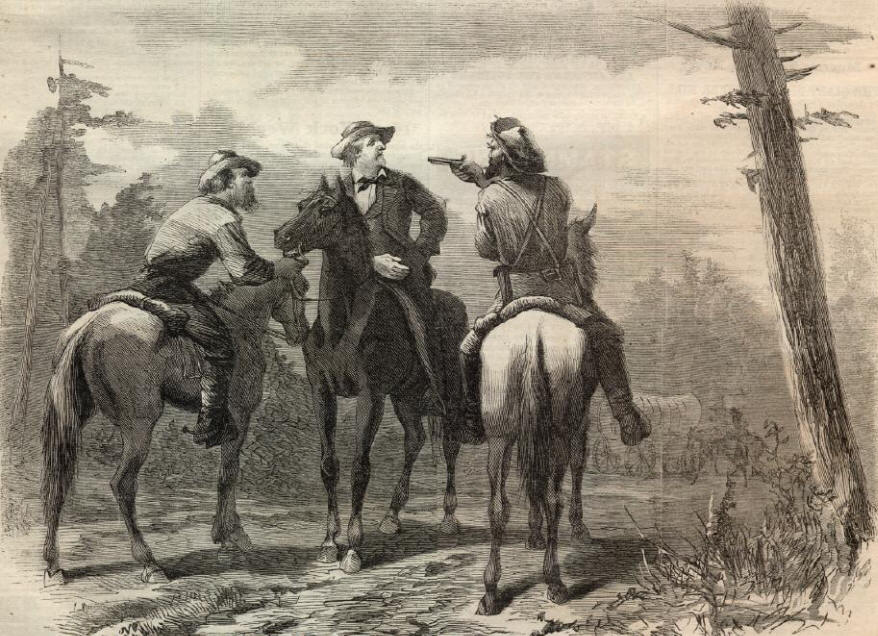
"Guerrilla Depredations -- 'Your Money or Your Life!,'" Harper's Weekly, Dec. 24, 1864 (courtesy of sonofthesouth.net)

All of this got me to thinking about the way we remember the Civil War in light of recent military history.  How many of us have sometimes thought of our Civil War as different from the multitude of  "civil wars" that have plagued other countries in modern times?  Lawless guerrillas and the deaths of innocent civilians are somehow contemporary Latin American or African  problems.  Surely, FARC, machete-wielding fighters, the contras, civilian casualties, or right-wing paramilitaries are a world away from the glories of Civil War battlefields and those Kurtz & Allison lithographs?  We all know that when our boys in blue or gray weren't giving water to dying enemy soldiers, they were exchanging coffee, newspapers, tobacco, and jokes with the other side.  Sutherland's book makes you think twice. Our Civil War was every bit as brutal and unrestrained as the civil wars of recent times.  We shouldn't expect any less when a fratricidal conflict unleashes passions and pent-up frustrations on both sides.  Somehow we may like to think we are different.  But the nature of civil war knows no boundaries.

Thursday, September 23, 2010

Mosby: Good or Bad?


While recently touring the site where Mosby's Rangers were officially organized in 1863, I encountered a fellow visitor and his wife.  The gentleman asked me if I was a Civil War buff, to which I enthusiastically responded "Yes."  I then asked him the same question.  He hesitated, and then replied, "Sort of," before expressing his disgust with the hero worship directed towards Colonel Mosby.   To this man, Mosby was nothing more than a bandit, and his Rangers took the coward's way out, unlike his great grandfather, who had shouldered a musket and marched off to war as a member of the 5th Alabama.

This man got me thinking.  Are Mosby and his Rangers worthy of admiration?  There is certainly a tendency to romanticize their wartime adventures.  The very idea of taking a general hostage in his own bedroom is the stuff of legend.  (See here.)  And there is something incredible about a handful of mounted men being able to outsmart far superior numbers.  (See here.)  But was Mosby a legitimate military figure, or a common criminal in cavalryman's clothing?

Mosby's irregular brand of warfare was an important component of the Confederacy's military operations in the Eastern theater of war.  Mosby and his troopers disrupted the rear of the Union Army, seized valuable supplies and ammunition, took prisoners, and forced Washington to divert resources in an effort to eliminate the threat to men and materiel.  Mosby's value to the war effort was recognized by no less a general than Robert E. Lee.  In fact, when the Confederacy repealed the Partisan Ranger Act, largely at Lee's urging, Mosby's command was exempted along with one other group.


Colonel John S. Mosby (courtesy of Wikipedia Commons)


In my mind, I've always made a distinction between Mosby and other guerrilla leaders, such as William Quantrill.  For the most part, Mosby enforced discipline on his ranks and avoided large-scale bloodshed and retribution killings, such as Quantrill's massacre at Lawrence, Kansas in 1863.  This is not to say that Mosby's men always had clean hands.  For example, Mosby ordered a retaliatory execution after several of his Rangers were killed by Federal troops under General Philip Sheridan.  (See here.)   Mosby's men also took livestock, horses, and crops from Quakers and Union sympathizers in Loudoun County.   There is no denying, however, that Mosby was an exceptional military leader, skilled in the ways of irregular warfare.  For this, he is certainly worthy of the admiration that many have accorded him.  As Jeffry Wert concluded in his book Mosby's Rangers, Mosby and his men have "earned a place among some of the finest guerrilla warriors in history."