Showing posts with label George B. McClellan. Show all posts

Tuesday, August 11, 2015

What I've Been Up To....

I recently finished Ethan Rafuse's impressive tome, McClellan's War: The Failure of Moderation in the Struggle for the Union. I've always found Gen. George McClellan a fascinating and complex person. Rafuse's biography challenges much of the conventional wisdom about Little Mac. He emerges as a more sympathetic character, whose devotion to Whig principles and the policy of conciliation became increasingly irrelevant as the war hardened and emancipation entered the picture. But I digress for the purposes of this post.

Rafuse dedicated an entire chapter to McClellan's last campaign, which took place in Loudoun Valley, Virginia in late October and early November 1862. Very little has been written about this period, including the cavalry battles at Philomont and Unison. Given that the 1862 Loudoun Valley Campaign largely occurred a places within 25 to 45 minutes drive from my home, I figured it might be interesting to read more about it, and to explore the ground where the marching and fighting actually occurred. As an added bonus, it is a postscript to the Antietam Campaign, which has been a focus of my studies on the war in the East.

The North Fork ford along Jeb Stuart Rd. in Philomont. On November 1, 1862, the Confederate cavalry crossed at this point and clashed with Union forces. Maj. John Pelham's Horse Artillery fired from high ground on the far side of the creek. (Be warned! Do not try to cross here in your vehicle unless you are sure of its off-road capabilities!)

Fighting occurred near the Unison United Methodist Church (1832) on November 2, 1862. Union casualties were treated in the church following the fight.

Aside from Rafuse's chapter, two resources have quickly become invaluable. In winter 1999, Blue & Gray published an issue featuring "Little Mac's Last Stand: Autumn 1862 in Loudoun Valley, Virginia" by Patrick J. Brennan. The article is accompanied by a driving tour on the campaign. More recently, the National Park Service, in conjunction with the Unison Preservation Society, published Civil War in Loudoun Valley: The Battle of Unison, November 1-3, 1862. This little book contains invaluable maps of all the fighting that took place between forces under Jeb Stuart and Alfred Pleasonton, as well as photographs of landmarks related to the battle. As far as I know, this book can only be obtained by sending a check directly to the Unison Preservation Society. It is well worth the price -- it contains detailed information that likely exists nowhere else in a secondary source.

I've already done some preliminary exploring at Unison and Philomont, and you may have seen pictures of my site visits on Facebook or Twitter. I may do a few blog posts as I dig deeper, but for now I am undecided about what direction my research will take. Sometimes it is just fun to get back to the basics and do a deep dive into a local topic that is a bit more obscure. As an added bonus, I get to tour some of the most historic and scenic countryside in the United States!

Wednesday, June 3, 2015

A Talk with Eugene Schmiel, Author of "Citizen-General: Jacob Dolson Cox and the Civil War Era"

A couple of years ago I had the pleasure of meeting Gene Schmiel during a Savas Beatie Author Enclave at South Mountain and Antietam. At the time, Gene was putting the finishing touches on his biography of Union Gen. Jacob Cox. The book, Citizen-General: Jacob Dolson Cox and the Civil War Era was published by Ohio University in 2014. Gene's biography received many favorable reviews and has been featured as a History Book Club Reading Selection. Gene was nice enough to take the time to answer some questions about his book and Cox. I think you'll find his responses interesting, to say the least. And if you'd like to meet Gene and hear him speak about "Jacob Cox and the West Point-'Political General' Divide in the Union Army," be sure to head to the Loudoun County Civil War Rountable next Tuesday, June 9, at 7:30 p.m.


Q. First off, tell readers a little about yourself.

A. I am a retired U.S. Department of State Foreign Service Officer who served overseas in Sweden, South Africa, Djibouti, Kenya, and Iceland. I was Charge’ d’Affaires at three embassies and Consul General in Mombasa, Kenya. I now work part-time at the State Department on international political-military and terrorism-related issues.

Before joining State, I was an Assistant Professor of History at St. Francis University (Pennsylvania). I earned my Ph.D. from The Ohio State University, where I met my wife, Bonnie Kathryn. We have two children, David and Jennifer, and five grandsons. My wife and I wrote a book in 1998 about our life in the Foreign Service entitled, Welcome Home: Who are You?  Tales of a Foreign Service Family. We live in Gainesville, Virginia

Q. Why did you choose Jacob Cox as the subject for a biography? 

A. My focus in grad school was 19th century U.S. history, and Jacob Cox’s life (1828-1900) was in many ways a microcosm of the most important developments during that era. His military career, his role in Ohio and national politics, his tenure as both a railroad and a university president, and his authorship of highly-respected histories of the Civil War all made him one of the most important figures from the era about whom no one had written a biography. He even became one of the world’s most renowned amateur microscope scientists and wrote thirty-two articles about that topic for scholarly journals. In sum, he was a “Renaissance Man in the Gilded Age.” My dissertation was the “first draft” of that biography, and my book Citizen General: Jacob Dolson Cox and the Civil War Era was the conclusion of that process.

Q. What sources helped you the most? 

A. The Cox papers at the Oberlin College archives were by far the most important. Cox was not only an avid correspondent, but also someone with a sense of history, who saved his letters and most of those he received from other prominent individuals. Thankfully, he also had good handwriting! Among other important sources were the Official Records, the papers of Cox’s contemporaries and friends such as James A. Garfield and Rutherford B. Hayes, and Cox’s writings, especially his histories and extensive number of reviews of Civil War books.

Q. How would you describe the thesis of your book?

A. In my preface I noted that in his book, The Civil War Dictionary, Mark Boatner wrote that it “might well be titled, ‘What ever happened to J.D. Cox?’” His thesis was that Cox, like many others in the war, had served well, but had been forgotten. So, in effect, my goal was to answer Boatner’s question, as follows: Jacob Cox was one of the best Northern “citizen generals” in the Civil War, an influential postwar political leader, and the ablest participant-historian of the war, one whose writings have been both recognized as authoritative and objective and quoted by serious Civil War historians ever since.

Q. How do you rate Cox among Civil War Union generals?

A. I think it would be fair to say that a consensus of Civil War historians would place Cox in the top five of the “political” generals, along with men such as “Black Jack” Logan, Joshua Chamberlain, and Alpheus Williams. [William T.] Sherman clearly agreed – he thought so much of Cox’s ability that not only offered him a chance to command the 23rd Corps on the March to the Sea, but he also offered Cox a brigadier generalship in the Regular Army at the end of the war. The fact that Sherman and Grant both suggested to President Andrew Johnson that he choose Cox as Secretary of War to resolve the dispute with Congress over the “Tenure of Office” Act is additional evidence of Cox’s abilities and reputation.

Q. What sets Cox apart from other political generals in the Civil War? 

A. One key difference was that Cox was not politically prominent before the war, having served just one term as a back bencher in the Ohio Senate. Most historians, when using the term “political generals,” point to men like Logan, Butler, and Banks, all of whom were prominent already in national or state politics, and who could “demand” senior positions and commands. By contrast, Cox worked his way up and was given increasingly important positions by the senior generals whom he impressed with his ability, e.g. Rosecrans, McClellan, Burnside, Sherman, and Schofield.

Secondly, Cox was not a self-promoter – often to his detriment.  In his letters to his wife he often expressed dismay that incompetents (both political and West Pointers) were getting good press and that others were more successful in lobbying Congress for promotions.

Third, he always sublimated his political views to military necessity.  For example, when he served under John Schofield, a Democrat, during the Atlanta, Franklin-Nashville, and North Carolina Campaigns, Cox wrote to his wife that Schofield’s views were irrelevant on the battlefield and that he would carry out his orders without question.

Fourth, whereas McClellan and Sherman, among others, looked down on volunteer officers, they seemed to make an exception for Cox, whose abilities they respected as they offered him substantive responsibilities. They knew that Cox was, as I put it in the book, the “quintessential subordinate” officer, and that they could rely on him totally.

Q. Tell us about Cox’s relationship with Gen. George McClellan. 

A. In the beginning the two were very close, but after the war, Cox adjudged both that McClellan had critical weaknesses as a commander and that he was two-faced when dealing with his subordinates and superiors.

McClellan began the war as commander of Ohio’s troops and Cox was the military chief of staff of Ohio Governor William Dennison. They clearly got along well, and McClellan was impressed by Cox’s study of military tactics and history, as well as his intellectual command of military matters. McClellan, despite his prejudice against “volunteers,” chose Cox to command troop training at Camp Dennison and gave him an autonomous command in the West Virginia Campaign.

During the Maryland Campaign, Cox’s “Kanawha Division” was the advance element of the Army of the Potomac in taking Frederick and helping win the Battle of South Mountain. At the Battle of Antietam, Cox was tactical commander of the Union left wing, and he came within minutes of sweeping Lee’s forces from the field. McClellan praised him for his efforts and supported his promotion to Major General, even as he regretted Cox’s orders that October to go back to West Virginia to push back a Confederate offensive.

Cox noted in his letters and writings that he always respected McClellan during the war and believed he was the general best qualified to command Union troops. However, when he began doing research for his book reviews and his books, he came to a very different set of conclusions. He was especially taken aback when reading McClellan’s Own Story, from which he discovered that McClellan was two-faced and inclined to blame others for his failings. While preparing his review of that book, Cox made multiple notes in the margins of his copy of the text. Among his outraged comments were, “I don’t believe a word of it”; “Quintessence of nonsense!”; “What Stuff;” and “Always a lion in the way!” In his review, his wrote that that the book was “full of blinding self-esteem,” in which “everyone is a rogue and incapable except McClellan.”

In many ways Cox’s review and his articles about McClellan in West Virginia and the Battle of Antietam in the Battle and Leaders of the Civil War, and his section on the latter battle in his Military Reminiscences set the historiographical foundation for the judgment about McClellan’s shortcomings as a commander. As he wrote in the Antietam article, noting acerbically McClellan’s claim in his memoirs that because he led the Maryland Campaign without written orders, the administration could have charged him with usurpation of command, “The suggestion of McClellan twenty years afterward that it had all been a pitfall prepared for him, would be revolting if…the absurdity of it did not prove that its origin was in a morbid imagination.” Finally, underscoring that throughout his campaigns McClellan’s army greatly outnumbered the enemy and his equipment and supplies were far better, Cox commented that “McClellan’s persistent outcry that he was sacrificed by his government destroys even that character for dignity and that reputation for military intelligence which we fondly attributed to him.”

Q. Why do you think Cox hasn’t attracted the attention of other Union generals like Winfield Scott Hancock? 

A. Not being a West Pointer, he had no major command positions, and partly as a result he suffered from what he called the problem of being a second in command and being forgotten in the writing of history. In fact, that was a key impetus to his career as an historian.

Also, Cox was what might be called “colorless.” That is, he was a staid, stoic, and unemotional intellectual who lacked the common touch.  He had been a divinity student at Oberlin, and for some time a career as a minister and professor of theology seemed likely in his future. While his men respected him, they never “loved” him in the way McClellan’s did. These characteristics made him an effective commander since he never lost control of himself and was always a voice of calm reason, even during the most tempestuous moments of the conflict – except once (see the next item).

Finally, as noted above, he was not a self-promoter, so while others sought and got the limelight, the reticent Cox always said he would rely on history to recognize his contributions.

Q. In your view, what was Cox’s most important military accomplishment during the Civil War?

A. If I had to pick one, it would be his command of the defensive line at the Battle of Franklin, November 30, 1864. His commander, John Schofield, made Cox acting commander of the 23rd Corps and most of the 4th Corps and ordered him to set up a defensive line to protect the withdrawal of troops and the wagon train on its way to Nashville. Schofield did not even visit Cox during the day, so confident was he that Cox would, as always, perform his responsibilities effectively.

When John Bell Hood decided to attack frontally at Franklin, most generals on both sides were surprised. Cox too thought Hood would try to outflank the Union forces, but having seen Hood attack frequently on the Atlanta Campaign, he decided to set up a strong bulwark against a frontal attack. The only problem was that he had to leave a gap in the line for the wagon train and withdrawing troops.  He set up a second line behind the first in case Hood did in fact attack. When that happened and fleeing Union troops, with rebels just behind them, poured through the opening, Cox faced a major challenge. At that moment, everything he had fought for and all of the contributions he had made to the Union war effort were at risk.

In the book I wrote that it was at that moment that, for one of the few times in his life, Cox dropped his stoic veneer and became an emotional “warrior” – though even then in a controlled manner. He rode to the front, waving his sword and screaming at his men to meet the challenge. But he still was calm enough to, at one point, calm his nervous horse, which was bucking wildly because of the noise. The Union forces met the challenge, and Cox’s leadership was the critical element of their success.   He was the “unsung hero” of the Battle of Franklin.

Q. What were Cox’s most enduring contributions outside of the war? 

A. Cox was the ablest participant-historian of the Civil War, and his books and articles about the war are his enduring legacy. His two-volume Military Reminiscences, in particular, is frequently cited by modern Civil War historians not only because it is a primary source, but also because Cox has been shown to be a superb historian. His books on the Atlanta Campaign, on the Battle of Franklin, and on Sherman’s March to the Sea, the Franklin-Nashville Campaign, and the North Carolina Campaign all have stood the test of time. His five articles in the Battles and Leaders of the Civil War volumes, as well as his 161 reviews of books for the Nation magazine from 1874-1900, are further evidence of the quality of his research and historical writing.

Q. Why didn’t Cox ultimately succeed in politics like some other well-known Ohioans?

A. When the war ended, most political observers would have said that Cox was someone whose rise to national political prominence was inevitable. He had a sterling war record, was one of the founders of the Ohio Republican Party, and had close friends in the national political and military leadership. Also, his home base of Ohio was important because that state was the home of five of the next six presidents, all of whom had war records (Grant, Hayes, Garfield, Harrison, and McKinley). When Cox was elected Governor of Ohio in 1865, he could have used that position as a springboard to be as Grant’s ultimate successor. (In fact Grant’s successor was Cox’s successor as governor, Rutherford B. Hayes).

Instead Cox’s established reputation as an uncompromising intellectual intent on speaking his own mind at all times proved to be his political downfall. He also lacked charisma and tended to give political speeches which were academic-oriented.  His first political problems came when he suggested in the Ohio campaign (in his famous “Oberlin Letter”) that a possible solution to the racial problems of the postwar South was the creation of a special area where blacks would be given special privileges and protected from white reaction. The practical politicians all told him to say nothing about the issue, but he insisted that he wanted to contribute to the national debate. The plan was considered too radical – even if the blacks would not be forced to go there – and political leaders now knew that Cox had a strong independent streak.

Then, as the division between Andrew Johnson and the Radical Republicans widened, Cox supported Johnson for some months, and then tried to play a peacemaking role between the two. He was soon seen as insufficiently “loyal” by both sides, and decided not to run for re-election. Finally, in 1870 Cox resigned from Grant’s Cabinet on another matter of principle, civil service reform, and became a leader of the Liberal Republican party. Its loss meant that whereas in 1865 his political future seemed wide open, by 1873, he was in permanent national political exile. He did serve one term in the House of Representatives, where he hoped to help implement the policies of his wartime subordinate, Rutherford B. Hayes, but again his stubborn commitment to principle and refusal to become a “practical politician” convinced him to leave politics.

In an introspective letter written to a friend in 1885, Cox said that he well knew that he had a golden political future in 1865, but that:
My experience of public life had probably been about as great as may come unsought to one who has stubbornness of opinion.  Enough, at best, to warrant me in thinking that I too could have cut a more prominent figure had I thought the game worth the candle…and so without disappointment or envy, regret or longing, I have been able to go my way thinking my own thoughts, advocating my own opinions, calling no mob master.
Q. How did Cox’s early Whig views influence his stance on issues like racial equality?

A. Cox’s first political affiliation was with the Whigs, which he joined just as it was undergoing its death throes in the early 1850s.  He joined the Whigs rather than the Free-Soilers, in great part because the former’s membership was representative of Anglo-Saxon elites with moderate views on slavery and its expansion. Despite Cox’s education at Oberlin College, he was not a radical on racial issues, though he was, of course, intensely anti-slavery.

Like other Whigs who joined the Republicans, he believed that blacks should be free, but that they would inevitably be second-class citizens. Unlike many Whigs, he didn’t support overseas colonization, but during the war he suggested in a letter that black soldiers who performed well might be given land in Texas which would be off-limits to whites. That idea was the germ of his proposal in the “Oberlin Letter.” Cox, who as a former divinity student and potential professor always wanted to stimulate intellectual thought, saw this as an attempt to stimulate a dialogue about possible solutions. His political friends, including Garfield, warned him not to do it, but his instinct was always to be “tutelary.” It was exactly the wrong approach at that point in his political career – he paid the price, but as noted above, he was always his own man.

Q. Are there any other Civil War books on the horizon?

A. Not for a while, if at all. I do have an article coming out in October in an Ohio history magazine, Timelines, about Cox’s near-miss at Antietam, when his forces, on the verge of taking Sharpsburg and breaking the Confederate right wing, were hit in the flank by A.P. Hill’s men and forced to halt their advance.

I also might do some articles about related topics from Cox’s life. One would be about his close friendship with Jack Casement, who was his subordinate during the war. Casement, who was the main builder of the Union Pacific Railroad, was Cox’s complete opposite in personality: brusque, abrasive, coarse, etc., but also, like Cox, a quintessential subordinate.   It was a friendship of complete opposites.
---------------------------
Thanks so much to Gene for taking the time to answer my questions. Cox is truly a fascinating subject for a biography, all the more so given his relative obscurity among Civil War generals!

Tuesday, October 28, 2014

Political Disturbances in the Streets of Washington City, October 1864

As the presidential election of 1864 drew near, political tensions in Washington City reached a breaking point. Partisans of both President Abraham Lincoln and the Democratic nominee, Gen. George B. McClellan, mobilized to show their support. Although residents of Washington City could not legally vote in the election, their interest in national politics ran deep. Others lived and worked in Washington, but could claim the right the cast their ballots elsewhere, most notably the Union soldiers who garrisoned the defenses around Washington. Lincoln and McClellan supporters attended rallies, paraded through the streets, and debated the issues in barrooms and hotel lobbies. Given the intensity of the passions on both sides, it is perhaps not surprising that the nation's capital witnessed political unrest and violence in the weeks before election day.

On October 21, 1864, thousands gathered for a huge torchlight procession for the Lincoln-Johnson ticket. Only a few days before, Gen. Phil Sheridan had won a stunning victory over the Confederates at Cedar Creek. Among the marchers were government employees, soldiers, delegations from military hospitals, and members of city and state Lincoln-Johnson organizations. They carried elaborate patriotic banners, proclaiming fealty to the President and Union generals in the field.

As the procession neared Democratic headquarters at Parker's Hall, someone threw a stone, cutting one of the marchers above the eye.  The police rushed to calm the crowd and maintain order, but more trouble soon arose in front of the hall, when a young onlooker grabbed a torch from the hands of a solider in the procession.  The soldier retook the torch and began to beat his assailant before the police intervened and arrested the civilian. Just then, someone set fire to the Democratic flag hanging above the street. According to the Washington Evening Star:
. . . the lower portion of muslin, containing the names of McClellan and [George] Pendleton, was consumed before the flag could be drawn in, [and] caused considerable excitement at that point, but the active exertions of the police prevented any serious difficulty. There is some dispute as to whether the flag was fired accidentally or purposely, but the weight of the evidence is that one of the horsemen in the procession in resentment of some provocation, real or imagined, applied his torch to one corner of the flag in passing under it.... (Oct. 22, 1864.)
The flames were extinguished, and "the flag was run out amid cheers from the McClellan men, who afterwards held indignation meetings in the hall and on the sidewalk...." (Wash. Evening Star, Oct. 22, 1864.) The procession finished without any other serious incidents, but tensions were clearly running high.
Poster for Democratic nominees George McClellan (for President) and George Pendleton (for Vice President) (courtesy of Wikipedia)
McClellan-Pendleton flag from the 1864 presidential election (courtesy of Legendary Auctions).

According to the October 22 edition of the Washington Daily National Republican, "[t]he act of burning the McClellan flag last night is universally condemned, and no doubt due reparation will be made by the Union clubs." Although the paper implied that McClellanites had likely provoked the procession, "the act of burning the flag at Democratic Headquarters was as unjustifiable as it was rash." (Oct. 22, 1864.)

A few days later, on October 25, the Democrats held a flag raising in the city's Sixth Ward. As a procession of McClellan supporters neared the event, they shouted "d__d flag burners" and "dirty niggers" to a group of people who had gathered in front of a Lincoln & Johnson Club meeting hall. (Wash. Even. Star, Oct. 26, 1864.) A fight erupted, although the police "succeeded in restoring order." After the McClellan-Pendleton flag appeared above the street, "a number of fights  took place at times, and amid the cheers and groans of the opposite parties, several bricks and stones were thrown." (Oct. 26, 1864.) The Evening Star reported:
Towards 10 o'clock the uproar became so great that it was impossible for the speakers to be heard, and they came down from the stand and attempted to form a procession, when a shower of stones came down--but by which party it was commenced it is impossible to determine, there being so many conflicting report--and quite a number were struck, and some badly injured. (Oct. 26, 1864.) 
A "number of pistol shot were fired," and one of the bullets grazed a young drummer boy. (Oct. 26, 1864.) The police helped to prevent a further outbreak of violence between "Navy Yard boys" and the McClellan supporters.

Another Democratic rally and McClellan flag raising took place on November 1. This time, "there was a large detail of police. . . including a number of mounted, on the ground to suppress any disorder. . . . (Wash. Even. Star, Nov. 2, 1864.) The Evening Star observed that "there were some on both sides who undoubtedly were prepared for a fight," but the strong police presence prevented another outbreak of violence. (Nov. 2, 1864.)

Today, the streets of Washington seem calm compared to the disorder and chaos of 150 years ago. The stakes were high, and political passions erupted in displays of aggression and violence. Within a week of the Democratic rally on November 1, Lincoln would emerge victorious at the polls. The McClellan-Pendleton flag would fly no more.

Sources

Margaret Leech, Reveille in Washington: 1860-1865 (1941); Washington Daily National Republican, Oct. 22, 1864; Washington Evening Star, Oct. 22, Oct. 26, Nov. 2, 1864.

Thursday, April 4, 2013

The Pennsylvania Reserves in Northern Virginia 1863, Part I: What to Do with a "Decimated" Division?

This blog has frequently featured stories on the Pennsylvania Reserves.  The division, also known as the Pennsylvania Reserve Volunteer Corps, was encamped around Langley, Virginia during the first winter of the war.  In spring 1862 the Reserves relocated to Alexandria before marching south to Falmouth.  They eventually joined the Army of the Potomac just in time for the Seven Days Battles on the Peninsula.  The Reserves also saw intense combat at Second Manassas, South Mountain, Antietam, and Fredericksburg.  As the bloody second year of the war drew to a close, the Union Army's high command debated the future of the battered division and finally decided to move the Reserves back to the Washington area.  In the next few posts, I will take a look at the return of the storied Pennsylvania Reserves to Northern Virginia. 

Even before the costly engagements at Antietam and Fredericksburg, brigade commander George G. Meade had begun to worry about the state of the Reserves.  The general wrote to his wife on September 4, 1862 that "[o]ur division, the Reserves, is pretty well used up, and ought, strictly speaking, to be withdrawn, reorganized, filled up with recruits, and put in efficient condition."   (Meade 308.)   Meade led the Reserves through the carnage at Antietam, where the division suffered causalities of around 20 percent. (OR, 1:19:1, 270-71.)  After the battle, Meade discussed the "decimated condition" of the division with George B. McClellan, head of the Army of the Potomac.  As he wrote to his wife:
I. . . told [McClellan] that I had no idea they would ever be filled up by recruiting officers, and the only course I saw to adopt was to send them in a body back to Pennsylvania, and ask the Governor and State to fill them up within a specified time; but if it could not be done, they were to be mustered out of service.  (Meade 315.)
Around the same time, Pennsylvania Governor Andrew Curtin attempted to enlist political support for the reorganization of the Reserves.  In a September 30 letter to President Abraham Lincoln, Curtin suggested that the heavily depleted division be returned temporarily to the Keystone State.  The governor explained to the President:
The brilliant history of the Reserve Corps in the war, and the State pride which has followed them since they entered the service, together with the circumstances surrounding their organization, would, I have no doubt, prove such incentives to enlistment that the Corps could be filled to the maximum in a short space of time. (in Sypher 398.) 
Lincoln forwarded Curtin's letter to General-in-Chief Henry W. Halleck and Secretary of War Edwin M. Stanton for consideration.  The General-in-Chief "entirely disapprov[ed] of withdrawing regiments in the field" for purposes of filling the ranks with new recruits.  (OR, 3:2, 625.)  Curtin also wrote to McClellan, who "thought favorably of the plan, but having immediate use for the troops, was unwilling to retire them at that time."  (Sypher 398; OR, 1:21, 878.)   The division would stay at the front for now.

Gen. George G. Meade (courtesy of Civil War Wiki.Net)
After the fight at Fredericksburg in December, Meade tried once again to deal with the poor condition of the Pennsylvania Reserves.  On December 23, he sent a report on the state of the unit to Gen. William B. Franklin, commander of the Left Grand Division.  As Meade told Franklin, only 195 officers and 4,249 enlisted men were present for duty.  Another 159 officers and 3,740 men were absent with permission.  Meade noted that "to fill these regiments to the maximum authorized, will require 153 officers and 4,864 men."  (OR, 1:21, 877-78.)   However, he cautioned that "of the number reported as absent, a very large proportion are the wounded, most of whom are so maimed and disabled that no expectation need be formed of their returning to active duty."  (OR, 1:21, 878.)  Meade felt that in reality a reorganization of the Pennsylvania Reserves "required the appointment of over 200 officers and the enlistment of over 7,000 men."  (OR, 1:21, 878.)

The general proposed a course of action to revitalize the Reserves.  Recruiters had gone to Pennsylvania three different times to fill the ranks, but their efforts had met little success.  Meade recognized that the Army could "consolidate the existing force into a number of regiments equal to the officers and men for duty."  He disliked this plan, since it would "destroy[] the organization, and the prestige which the good conduct of the corps has acquired for it."  (OR, 1:21, 878.)  Instead, Meade recommended that the Reserves be withdrawn temporarily from the field and sent to Pennsylvania for two or three months, "where, it is believed, from the great reputation the corps has acquired, the pride the State takes in it, and the enthusiasm its return would create, that in a short time its ranks would be filled, after pruning them of all useless members."  (OR, 1:21, 878.)

Gen. John F. Reynolds, head of the First Corps and a former commander of the Reserves, forwarded Meade's proposal to Franklin on January 10, 1863.  Reynolds "concur[red] most heartily" in Meade's recommendation to send the division back home to recover and recruit.  (OR, 1:21, 878.)  The next day, Franklin sent Meade's plan to Gen. Ambrose E. Burnside, commander of the Army of the Potomac.  Complimenting the Reserves on their "excellent service," Franklin endorsed Meade's proposal.  (OR, 1:21, 878-79.)

Col. Horatio G. Sickel, who assumed command of the Pennsylvania Reserves upon Meade's promotion at the end of 1862, soon weighed in on the future of the division.  The colonel hoped to enlist Governor Curtin's support in reorganizing the Pennsylvania Reserves.  Sickel sent a copy of Meade's report to Curtin and got the desired response.  The governor readily took up his old cause and forwarded Sickel's correspondence to the War Department.  Secretary of War Stanton, however, had no appetite for Meade's proposal.  According to a history of the Reserves, the Secretary informed Curtin "that numerous similar applications were on file from other States, that all could not be granted without greatly reducing the strength of the army, and that therefore all must be refused."  (Sypher 436.)

The Pennsylvania Reserves had the misfortune of remaining at the front long enough to take part in Burnside's disastrous "Mud March."  But change was in the air by the end of January.  Joseph Hooker took command of the Army of the Potomac and worked with General-in-Chief Halleck to effect a transfer of the Pennsylvania Reserves. The division, however, was far from homeward bound.

Up Next: The Pennsylvania Reserves bid farewell to Hooker's army and board transports for Alexandria.

Sources

Aside from the Official Records, the following sources were useful in compiling this post:

John H. Eicher & David J. Eicher, Civil War High Commands (2001); Joseph Gibbs, Three Years in the Bloody Eleventh: The Campaigns of a Pennsylvania Reserves Regiment (2002); George G. Meade, The Life and Letters of George Gordon Meade, Vol. 1 (1913); J.R. Sypher, History of the Pennsylvania Reserve Corps (1865).

Friday, March 1, 2013

February 2013: A Month of Acquisitions

Last month I made a few welcome additions to my ever-growing collection of antique books and newspapers related to the Civil War.  I am always on the lookout for intriguing acquisitions at a reasonable price, and February was a month of particularly notable discoveries.  I tend to gravitate towards publications with a Northern Virginia or Washington connection, although I am always open to purchasing books or papers on other interesting topics.

The on-line auction site eBay is an excellent starting point for finding original Civil War-era newspapers.  A few weeks ago I bid on, and won, a May 25, 1861 edition of Harper's Weekly.  This issue focuses heavily on the early days of the war in Washington.  In fact, I illustrated a two-part series on Union volunteers arriving in the nation's capital with prints from this edition of Harper's Weekly.  (See here and here.)   The front page features a dramatic engraving of the 11th New York Fire Zouaves fighting to extinguish flames that threatened to engulf the famed Willard's Hotel.  (The complete story can be found here.)  A few other prints depict the quartering of Federal troops in the U.S. Capitol and at the Treasury Department.  I also was drawn to a full-page illustration of the 79th New York on parade by Winslow Homer.  This regiment, which fought at Bull Run, was later commanded by Isaac Stevens and played at key role at Lewinsville, a local engagement near and dear to my heart.

Front cover of the May 25, 1861 issue of Harper's Weekly, showing "Willard's Hotel, Washington, Saved by the New York Fire Zouaves."  The paper noted that the soldiers "worked like heroes, performing wonderful feats of agility and bravery."  Their leader, Col. Elmer Ellsworth, was shot dead in Alexandria, Virginia by a secessionist the day before this issue appeared.
"The Seventy-Ninth Regiment (Highlanders) New York State Militia," Harper's Weekly, May 25, 1861.  The parade depicted here likely took place in New York City prior to the regiment's departure for Washington.

"Galleries Under the Senate Chamber, Converted into Granaries," Harper's Weekly, May 25, 1861.  
One evening last month I also spent some time browsing AbeBooks and ended up purchasing an 1881 first edition of John C. Ropes' The Army Under Pope for less than twenty dollars.  This slim book was part of a multi-volume series, Campaigns of the Civil War, published by Charles Scribner's Sons.  My copy, including a fold-out map, is in very good condition, with the exception of some minor shelf and edge wear.  Ropes, a lawyer and historian, founded the Military Historical Society of Massachusetts.  Incidentally, he was also a co-founder of the Boston law firm Ropes & Gray.  Ropes dedicated the book to his youngest brother Henry, a lieutenant in the 20th Massachusetts who fell at Gettysburg.

The Army Under Pope, which appeared less than 20 years after Second Manassas, offers a critical examination of John Pope's performance as commander of the short-lived Army of Virginia.  Ropes made use of official battle reports that were appearing in print for the first time.  The author defends Gen. Fitz John Porter, who was court-martialed and dismissed from the Union Army for his alleged failures at Second Bull Run.  In other passages that I've read, Ropes tackles the popular argument that Gen. George B. McClellan intentionally contributed to Pope's defeat. 

Of course, I don't purchase all of my books on-line.  One day in February I was browsing the shelves at my favorite bookstore, The Old Book Co. of McLean, when the owner alerted me to an 1860 first edition of Ezra B. Chase's Teachings of Patriots and Statesmen; or, the "Founders of the Republic" on Slavery.  I took one look and knew that I couldn't let this one get away.

The front cover of Teachings of Patriots and Statesmen, first edition, J.W. Bradley (publishers), Philadelphia, 1860.  I was particularly drawn to the gilt-embossed American eagle design.
At the outset, Chase informed readers that the was taking a non-controversial approach:
In compiling the following pages, I have not been influenced by partisan purposes; neither have I compiled them for the notoriety of having my name appended to a book. The country is sufficiently flooded already with partisan literature—books written for political advantage, or pecuniary gain, or both. To such authorship I do not aspire. If I have cherished an ambition in reference to this work, it has been an ambition to place before the people information upon the subject that is now agitating the country, upon which they can rely,—the views and opinions of those distinguished patriots and statesmen who formed the government, and whose intentions and principles should be heeded and carried out, if we would preserve it from disruption and decay. 
The book contains the text of various speeches and writings related to slavery, from the time of the Articles of Confederation through the 1860 election.  Chase covers such controversial issues as the Compromise of 1850, the Kansas-Nebraska Act, and the Dred Scott decision.  He also quotes liberally from the Founding Fathers, including George Washington, Thomas Jefferson and James Madison.  Chase's book is a piece of history from a time when the nation was on the brink of war over slavery.  The copy at the Old Book Co. was in good condition, and the price was right, so I walked out the owner of this unique work.

I have no idea how many copies of Teachings of Patriots and Statesmen sold in 1860.  Presumably interest in such publications ran high as sectional tensions over slavery mounted.  Chase, a Democratic lawyer and former Speaker of the Pennsylvania House of Representatives, became embroiled in controversy during the Civil War.  After losing an 1861 election for district attorney by a narrow margin attributable to the absentee soldiers' vote, Chase challenged the Pennsylvania law allowing for military voting before the state supreme court and won.  (See here.)  Chase was also arrested in 1862 for encouraging men to abstain from enlisting in the Union Army.  (See here.) 

All told, February was a better than expected month for acquisitions.  The discoveries that I made remind me why I enjoy the hobby of collecting antique books and newspapers.  Owning a tangible, written connection to the Civil War era brings the past alive on the paper before me in a way that a modern publication cannot do.  My only hope now is that I find a way to get more space, but I don't think a new home library is yet on the horizon!

Friday, November 16, 2012

Little Mac, Lincoln, and Military Reviews: Engravings from Frank Leslie's

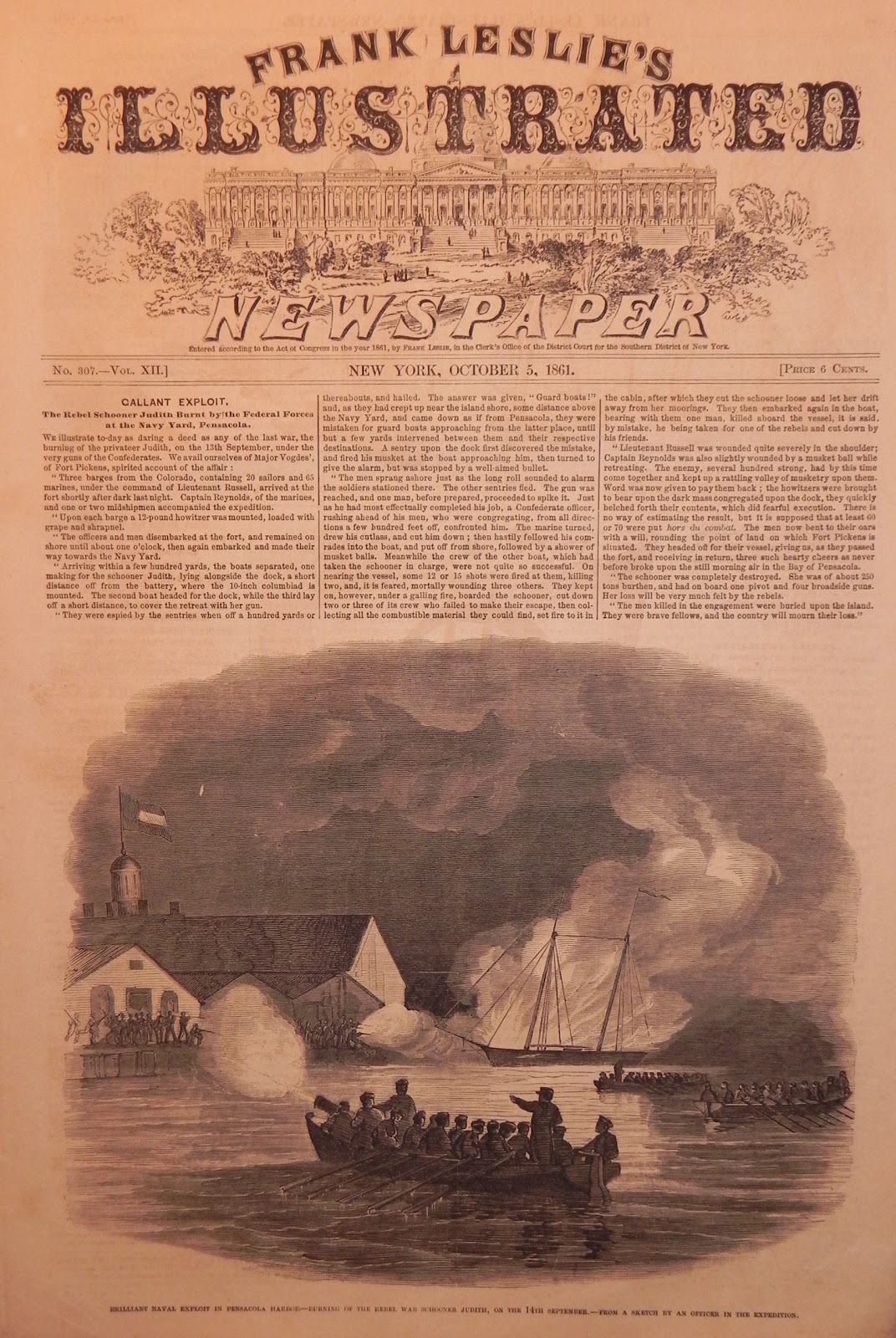
My hobby of collecting Civil War newspapers has become quite the obsession.  I often search eBay and other online sites for additions to my collection, which focuses heavily on the lesser-known aspects of the war in and around Washington.  The other day I won an auction for an October 5, 1861 edition of Frank Leslie's Illustrated Newspaper.  This particular issue contains a multitude of interesting engravings and articles about the time when all was truly quiet along the Potomac.  Two oversized illustrations pertain to military reviews, which were all the rage with the Army of the Potomac in the fall of 1861.

Cover of the Oct. 5, 1861 edition of Frank Leslie's Illustrated Newspaper, showing "Brilliant Naval Exploit in Pensacola Harbor--Burning of the Rebel War Schooner Judith on the 14th September."
Berdan's Sharpshooters Take Aim
On September 20, 1861, President Lincoln, accompanied by Secretary of State William H. Seward and the Prince de Joinville of France, rode out to Camp Burnside near Washington to review soldiers under the command of Col. Hiram Berdan.  Known popularly as "Berdan's Sharpshooters," this famed regiment was composed of top marksmen from across the Union.  "At a late hour," Gen. George B. McClellan finally arrived on the field and greeted the President and Secretary of State.  (Frank Leslie's, Oct. 5, 1861, 326.)  McClellan dismounted and chatted with the Prince and his sons before proceeding to review Berdan's men at target practice.  According to Frank Leslie's:
General McClellan walked down the line of the troops, looking every man in the eye, and afterwards watched with interest the progress of the shooting.  He complimented the men for their skill, and expressed his gratitude to Colonel Berdan at the neatness and excellent discipline that pervaded the camp. . . .  (Frank Leslie's, Oct. 5, 1861, 326.)
Other dignitaries were in attendance that day, along with "[a] large number of ladies and citizens of Washington."  (Frank Leslie's, Oct. 5, 1861, 326.)  It is unclear whether this is the same review of Berdan's men where Lincoln fired a rifle "to the great delight of the many soldiers and civilians surrounding."  (Stevens 10.)  The President on that occasion apparently remarked, "Boys, this reminds me of old-time shooting."   (Stevens 10.)  The article in Frank Leslie's makes no mention of the President's participation.

"'Sharpshooting'--Trial of Skill of Berdan's Riflemen, Before General McClellan and Staff, Near Washington, Friday, September 20--From a Sketch by our Special Artist Attached to General McClellan's Command," Frank Leslie's Illustrated Newspaper, Oct. 5, 1861.  McClellan is presumably the person standing in uniform talking to the men in top hats.
The newsweekly chose to illustrate the event with a two-page spread of McClellan, his staff, and spectators gathered to watch the sharpshooters engage in target practice.  The paper reported that of 240 shots fired at a distance of three-quarters of a mile, "130 hit the target, and nearly all the other shots struck very near it."  (Frank Leslie's, Oct. 5, 1861, 326.)  Overall, the Frank Leslie's correspondent considered that "[t]he affair was successful, so far as the shooting was concerned, and was highly interesting to the spectators."   (Frank Leslie's, Oct. 5, 1861, 326.)  Not to be outdone, the rival Harper's Weekly published a front-page illustration of Berdan's Sharpshooters on the same day.

A Grand Review of Artillery and Cavalry

On September 24, McClellan held yet another review of his army in the making.  Frank Leslie's accorded the event a two-page spread in the October 5 edition.  Once again, the accompanying article portrayed  McClellan as the man of the hour.  This grand review involved over 2,000 troopers from "two full regiments of cavalry, the 5th regular and the Kentucky Volunteers, together with such portions of the Lincoln, Ira Harris and Cameron Guards as had their horses and sabres."  (Frank Leslie's, Oct. 5, 1861, 327.)  In addition, "there were eight batteries of U.S. Regular Flying Artillery, comprising 48 heavy rifled and howitzer field pieces, with caissons, carriages, horses, riders and gunners, in full quota." (Frank Leslie's, Oct. 5, 1861, 327.) 

The artillery and cavalry units were encamped "near the extremities of Seventh and Fourteenth streets" and had to march about three miles to the parade ground, which sat a mile east of the Capitol.  The paper reported that "[t]housands of men, women and children streamed after them" as they made their way through the streets of Washington to the review.  (Frank Leslie's, Oct. 5, 1861, 327.)  Many dignitaries assembled on the parade ground, including the President, the First Lady, and Secretary of the Treasury Salmon P. Chase. 

Finally, "at four o'clock General McClellan, accompanied by his staff -- among whom were the Comte de Paris and Duc du Chartres -- rode upon the ground, and were received with six guns."  (Frank Leslie's, Oct. 5, 1861, 327.)  The day culminated in McClellan's review of the assembled cavalry and artillery units:
The General rode slowly along the line, and carefully scrutinized the equipment, arms and bearing of the troops.  He then inspected the artillery. . . .  Eight batteries numbering 48 heavy guns, then rode in thunderous line before the young Commander-in-Chief, and elicited his hearty approval.  This closed the review, and by sundown the glorious pageant was over.  (Frank Leslie's, Oct. 5, 1861, 327.)
"Grand Review in Washington of Eight Batteries of Artillery and Three Regiments of Cavalry, by the President, General McClellan, and a Portion of the Cabinet, Tuesday, September 24--From a Sketch by our Special Artist Attached to General McClellan's Command," Frank Leslie's Illustrated Newspaper, Oct. 5, 1861.  McClellan sits mounted at the center of the engraving.  It is unclear which figure is the President.  The person in the black coat and top hat next to McClellan most resembles Lincoln, although according to the accompanying article, the President was seated in a carriage with his wife and Secretary Chase during the review.  In the engraving, a carriage with two men and a woman is visible to the left.  The bearded individual in the carriage could also be the President.  Perhaps Frank Leslie's should have gotten better engravers!
Harper's Weekly was even more effusive, calling the review "[o]ne of the finest displays of cavalry and artillery ever witnessed upon this continent."  (Harper's Weekly, Oct. 12, 1861, 652.)  The New York Times struck a more reserved, if not critical, tone:
The display was most grand and impressive, but it lacked the spirit and hurrah of a European review. Gen. MCCLELLAN reviews very much as if he were minutely inspecting the equipments of the men. This gives him perhaps a very good knowledge of the material which he has in his hand, but it does little or nothing to arouse martial spirit or to awaken enthusiasm. It brings out no evidence of the dashing recklessness which carries all before it, and which nine times out of ten alone wins battles.  (N.Y. Times, Sept. 25, 1861.)
The Times was on to something.  Although McClellan was a superb organizer and administrator, he certainly lacked the aggressiveness it took to crush the Confederacy.  On the other hand, the Times misread Little Mac's ability to inspire his own men, who ended up admiring McClellan perhaps more than any other commander of the Army of the Potomac.

These engravings and related stories make the war seem like a sideshow compared to the carnage that was to follow over the course of four long years.  The nation, however, was hungry for war news, and the papers were there to report on whatever was happening around the nation's capital at the time.  Surely McClellan didn't mind the publicity.  Reviews offered the chance to stir patriotic feelings and showcase the Union's military might.  And the October events were only a preview for what was to come.  A few months later, on November 20, the general would conduct the grandest review of them all at Bailey's Crossroads. 

Sources

Adam Goodheart, "Killing Jeff Davis," N.Y. Times Disunion Blog, Aug. 6, 2011; Harper's Weekly, Oct. 5, 1861; Harper's Weekly, Oct. 12, 1861; New York Times, Sept. 25, 1861; C.A. Stevens, Berdan's United States Sharpshooters in the Army of the Potomac, 1861-1865 (1892).

Monday, September 17, 2012

A Trip to Antietam for the 150th Anniversary

Today marks the 150th anniversary of Antietam.  A whirlwind of activity has surrounded the Sesquicentennial commemoration of America's bloodiest day.  I wanted to make it to Antietam National Battlefield this morning, but other obligations got in the way.  That being said, I was fortunate to spend my entire Saturday immersed in 150th events on and near the battlefield.  The day was even more special because my Father joined me.  It was only four years ago that he was gravely ill and unable to travel to my bachelor party outing to Antietam.

My Dad and I left early on Saturday and drove straight to the 150th reenactment of Antietam.  We made good time, until we reached the two-lane country road leading to the farm where the event was being held.  For whatever reason, traffic management left a lot to be desired, and we sat in line for close to thirty minutes before finally entering the site and parking.  Even with the long wait, we had enough time prior to the reenactment to wander through sutler's row and tour the encampments.  The weather was pleasant and cool, a far cry from the high temperatures and humidity of last summer's Manassas events.

I had the opportunity to see and hear the 2nd South Carolina String Band before the reenactment.  Their performance of Bonnie Blue Flag was a highlight of the event.
The battle reenactment that I attended focused on Union Gen. George S. Greene's fight to take the area around the Dunker Church.  (Bloody Lane and Burnside Bridge were reenacted at other times over the weekend.)  This event paled in size when compared to the reenactment of First Manassas last year.  Those who witnessed that large-scale reenactment may never be able to look at another one the same way again.  I pondered why this event was smaller.  Perhaps nothing could match the draw of participating in the first major reenactment of the Sesquicentennial.  Or maybe the scheduling of another Antietam reenactment a few weeks before had something to do with it.  Regardless, the Antietam reenactors put on a solid performance, and the artillery demonstration was particularly impressive.  Before long, however, I found myself growing restless to walk the actual ground where the armies clashed, and after another stop at the Civil War "shopping mall" that is sutler's row, we headed down the road to the National Battlefield.

Not everything was faithful to the time period.  These artillery reenactors moved their pieces into position using pick up trucks....

....although some did it the old-fashioned way!
Union regiments on the way to the field.  Unfortunately, the massive power lines overhead provided another reminder of modern times.

Union troops stream past Dunker Church in the distance.  The event organizers constructed a half-size replica of the historic structure for the reenactment.

Union and Confederates battle around Dunker Church and the West Woods.  At this point, the numbers of "dead" and "wounded" were starting to accumulate on the field, but of course, nothing could ever recapture the true carnage of Antietam. 
The National Battlefield seemed even more crowded than the reenactment.  We had to park close to a mile from the Visitor Center, where the National Park Service had set up various displays and living history demonstrations.  I was truly overwhelmed by the multitude of activities available to us throughout the park, but given time constraints, we had to choose wisely.  

After a brief lunch, my Dad and I checked out the detailed paintings of the battle by James Hope in the Visitor Center.  We then stepped inside the real Dunker Church to listen to a lecture on divided Maryland during the Civil War.  Although I was familiar with much of the story, the Park Ranger was an incredible speaker and managed to capture perfectly the complexity of slavery and loyalties in the Old Line State.  As I listened to his speech, artillery fire cause the wooden floor beneath my feet to vibrate, and carried me, however briefly, back to the day of the fight.

Union reenactors file past the Dunker Church after finishing a living history demonstration near the Visitor Center.
My Dad and I decided to do a quick tour of the battlefield.  I've visited Antietam several times before, and I took my first trip there as as a young lad of twelve.  This past Saturday I wanted to visit the hallowed ground once again and just reflect on the meaning of the place.  I will get back for more detailed tours in the future, but this was about "being there" and commemorating a meaningful anniversary with thousands of other Americans.   

We hit all the main stops, including the North Woods, the Cornfield, Bloody Lane, and Burnside Bridge.  We also visited the Pry House, site of Gen. George McClellan's headquarters.  My Dad and I opted to drive rather than take the Park Service shuttle buses.  Good thing.  The long lines at shuttle stops and the scarcity of buses reassured us that driving was likely the better choice. 

The Cornfield, site of intensely brutal fighting on the morning of September 17. 

Confederate infantry demonstration at Bloody Lane.  The National Park Service scheduled several living history events throughout the battlefield.
As always, the tour of the battlefield was a powerful experience.  There is something about that place. I really feel connected to the past when I am there, and this time was no different.  I can't help but tear up when I look at the hills and fields at Antietam.   I am sure others have similar emotions.  Even with all the crowds, I could still sense a cathedral-like quiet as I walked around.

A reproduction of a Civil War ambulance at the Pry House.  The Pry Barn (behind the ambulance) served as a field hospital at Antietam, primarily for the Second Corps of the Army of the Potomac.  The National Museum of Civil War Medicine now runs a Field Hospital Museum at the site.
A living historian portraying an "embalming surgeon."  Now I've seen it all.  For the 150th anniversary, the Pry House also hosted several living history demonstrations related to Civil War field medicine.  My Dad even extracted a Minie ball from a "leg" inside the Pry Barn--I will spare readers the picture!

Through a stroke of luck, I arrived at Burnside Bridge just as Park Ranger and fellow blogger Mannie Gentile began an overview lecture on the action occurring at the site.  Mannie's presentation was both insightful and stirring.  I don't think I've ever seen such a captivated audience listening to a Park Ranger.  The National Park Service lectures that I heard on Saturday featured slavery and fight for emancipation as a prominent part of the story.
Looking down at Burnside Bridge over Antietam Creek.  Gen. Ambrose Burnside's men eventually pushed across the bridge when Confederate resistance began to weaken.
After our rapid-fire tour of the battlefield, my Dad and I began our trek back to the DC suburbs.  I reflected on the day.  Americans have chosen to remember Antietam in a variety of ways, from reenactments and living history demonstrations to battlefield tours and lectures.  Not all commemorative activities have equal appeal to all people. But I couldn't help but feel moved that whatever our means of remembering the past, we as a nation haven't forgotten the important sacrifices made outside Sharpsburg after 150 years.

Tuesday, September 11, 2012

The Chain Bridge Defenses During the Maryland Campaign, Part III: Sigel Stays Put and Stands Guard

In the last couple of posts, I've followed the story of the Chain Bridge defenses around Washington in the days prior to Antietam.  During the first week of September 1862, Franz Sigel led his corps from Fairfax Court House to the vicinity of Ft. Ethan Allen.  As Gen. George McClellan moved his army across the Potomac to chase down the Robert E. Lee, he left Sigel's men, along with the corps of Fitz John Porter and Samuel P. Heintzelman, to guard the Virginia side of the river in front of the nation's capital.  By September 7, Sigel's line stretched from Ft. Marcy and Ft. Ethan Allen, near Chain Bridge, to Ft. DeKalb in present-day Arlington.

McClellan Tries to Extract Sigel and Other Reinforcements from Washington's Defenses

Before long, McClellan was asking Washington to send him reinforcements, including men from Sigel's corps and the other commands around the capital.  Generally inclined to overestimate Confederate troop strength, Little Mac was no different this time around.  He believed that Lee had "not less than 120,000 men" near Frederick, Maryland. (OR, 1:19:2, 254.)  In fact, the Army of the Potomac had around a two-to-one advantage over Lee.  (Sears, Landscape, 102.)

On September 10, McClellan wrote to General-in-Chief Henry Halleck:
At the time this army moved from Washington, it was not known what the intentions of the rebels were in placing their forces on this side of the Potomac. It might have been a feint to draw away our troops from Washington, for the purpose of throwing their main army into the city as soon as we were out of the way, or it might have been supposed to be precisely what they are now doing. In view of this uncertain condition of things, I left what I conceived to be a sufficient force to defend the city against any army they could bring against it from the Virginia side of the Potomac.  (OR, 1:19:2, 254.)*
McClellan, however, felt that "[t]his uncertainty . . . exists no longer."  (OR, 1:19:2, 254.)  The immediate danger to the capital had passed.  McClellan informed Halleck of the overwhelming number of Confederates at Frederick and warned that "if we should be defeated the consequences to the country would be disastrous in the extreme."   (OR, 1:19:2, 254.)  Little Mac pleaded for Halleck to send him more men:
Under these circumstances, I would recommend that one or two of the three army corps now on the Potomac, opposite Washington, be at once withdrawn and sent to re-enforce this army . . . . (OR, 1:19:2, 254.) 
The commander perceived little threat to Washington:
If there are any rebel forces remaining on the other side of the Potomac, they must be so few that the troops left in the forts, after the two corps shall have been withdrawn, will be sufficient to check them; and, with the large cavalry force now on that side kept well out in front to give warning of the distant approach of any very large army, a part of this army might be sent back within the entrenchments to assist in repelling an attack.  (OR, 1:19:2, 254.) 
McClellan seemed almost nonchalant about the possible capture of the nation's capital:
But even if Washington should be taken while these armies are confronting each other, this would not, in my judgment, bear comparison with the ruin and disaster which would follow a signal defeat of this army.  If we should be successful in conquering the gigantic rebel army before us, we would have no difficulty in recovering it. On the other hand, should their force prove sufficiently powerful to defeat us, would all the forces now around Washington be sufficient to prevent such a victorious army from carrying the works on this side of the Potomac, after they are uncovered by our army? I think not.  (OR, 1:19:2, 254-55.)** 
From his headquarters near Rockville on September 11, McClellan further urged Halleck:
Please send forward all the troops you can spare from Washington, particularly Porter's, Heintzelman's, Sigel's, and all the other old troops. Please send them to Brookville, via Leesborough.  (OR, 1:19:2, 253.)***
President Lincoln himself responded to McClellan's plea for additional soldiers from the defenses of Washington.  (OR, 1:19:2, 253.)  The President understood that the new recruits streaming into Washington were mixed with the three commands and worried that "[i]f Porter, Heintzelman, and Sigel were sent you, it would sweep everything from the other side of the river. . . ." (OR, 1:19:2, 253.)  Instead, he released only the remainder of Porter's Fifth Corps, which was ordered to cross the Potomac and join the Army of the Potomac in the field.  (OR, 1:19:2, 253, 255.)  Lincoln held out the possibility of future reinforcements: 
I am for sending you all than can be spared, and I hope others can follow Porter very soon.  (OR, 1:19:2, 254.)
In the end, however, Sigel's men would stay put near the Chain Bridge defenses while the Army of the Potomac tracked down and fought Lee.

"General McClellan Entering the Town of Frederick, Maryland--The Popular Welcome," Harper's Weekly, Oct. 4, 1862 (courtesy of sonofthesouth.net).
Sigel's Corps and Everyday Life in Front of Washington

During the Maryland Campaign, Sigel's corps underwent a few organizational changes.  Once McClellan took to the field with the main army, Sigel reported to Gen. Nathaniel Banks, whom McClellan had placed in overall command of Washington's defenses. (OR, 1:19:2, 202, 214.)  Under General Orders No. 129, dated September 12, the War Department officially re-designated the three corps of the former Army of Virginia, and Sigel's First Corps became the Eleventh Corps of the Army of the Potomac.  (OR, 1:19:2, 279.) 

As McClellan battled Lee at South Mountain and Antietam, Sigel's men dealt with the mundane routine of camp life.  Soldiers spent the days drilling or on picket duty.  One regiment, the 27th Pennsylvania, changed camps around Chain Bridge several times throughout September and performed picket duty in Falls Church, a few miles in advance of the defensive line.  Gen. Robert Milroy, a brigade commander in Sigel's corps, used his free time to venture into Washington City and sit for his photograph at Mathew Brady's studio.

Not surprisingly, the presence of thousands of Union soldiers from Sigel's corps had an impact on the surrounding community.  Jospeh Sewell lived in Langley, just down the road from Forts Marcy and Ethan Allen where Sigel's men stood guard.  The farmer, like other locals, was no stranger to the Union Army.  Soldiers from Gen. "Baldy" Smith's division lived on and around Sewell's farm during the first winter of the war and had taken their fair share of crops and timber from him.  In September 1862, troops from Milroy's brigade entered Sewell's property and seized thirty barrels of corn.  They also took around three acres of garden vegetables and potatoes.****  Other civilians in the area likely experienced similar losses at the hands of the Union defenders.

Gen. Robert Milroy, from the Brady National Photographic Art Gallery (courtesy of Library of Congress).  Not long after sitting for his photograph, Milroy was sent with his brigade to western Virginia.
After Antietam: Sigel Advances to Centreville and Fairfax Court House 

As the Maryland Campaign drew to a close, Sigel's men were moved forward from the defenses near Washington.  Concerned about a possible Confederate attempt to reoccupy the railroad junction of Manassas, Banks ordered Sigel to send Gen. Julius Stahel's division to Centreville on September 21.  (OR, 1:19:2, 340-41, 344-45, 351.)   A few days later, on September 25, the remainder of Sigel's corps was dispatched to Fairfax Court House to cover an expedition being made to recapture several railroad engines at Bristoe.  (OR, 1:19:2, 356, 359.)  Banks, anxious about Confederate intentions, ordered that Sigel exercise "[g]reat caution. . . to prevent surprise," keep the cavalry "well to the front and on the alert," and "report frequently the state of affairs."  (OR, 1:19:2, 356.)

Banks originally intended to have Sigel's corps "fall back to its former position" following the expedition.  (OR, 1:19:2, 359.)   Sigel's men, however, remained in and around Fairfax Court House and Centreville to act as a "corps of observation."  (OR, 1:19:2, 425, 428.)  In this new role, Sigel kept an eye on Confederate activity in Northern Virginia, but Banks made sure to tell Sigel that "if menaced by a superior force of the enemy," he was "to fall back to the lines of defense."  (OR, 1:19:2, 425.)

The Eleventh Corps eventually ended up in Stafford Court House for the winter.  Although the soldiers missed the bloody encounter at Antietam, as well as the slaughter at Fredericksburg in December, they would go on to experience their fair share of brutal combat during the remainder of the war.  The soldiers of the Eleventh Corps became a scapegoat for the Union defeat at Chancellorsville, where they earned the derisive nickname of the "Flying Dutchmen."  Their reputation also suffered at Gettysburg.  During the tense days of September 1862, however, the corps served a necessary, yet unheralded role, in guarding the nation's capital as McClellan confronted Lee.

Notes

*Stephen Sears demonstrates that this correspondence was likely sent on September 10, even though the OR indicates that it was sent the next day.  (Sears, McClellan Correspondence, 446.)

**In correspondence dated September 13, Halleck rebuked McClellan:  "[Y]ou attach too little importance to the capital. I assure you that you are wrong. The capture of this place will throw us back six months, if it should not destroy us. Beware of the evils I now point out to you. You saw them when here, but you seem to forget them in the distance. No more troops can be sent from here till we have fresh arrivals from the North."  (OR, 1:19:2, 280-81.)

*** Earlier on September 11, Halleck had even suggested to McClellan that he send forward either Sigel's or Porter's corps when another division that Little Mac had requested was unavailable. As Halleck said, "Why not order forward Porter's corps, or Sigel's?  If the main force of the enemy is in your front, more troops can be spared from here." (OR, 1:19:2, 253.)

****The Southern Claims Commission files indicate that Sewell was not granted compensation for the claims he made concerning the taking of this property by Milroy's men.  The Commission considered that the $150 claim for corn rested solely on Sewell's testimony.  The $300 claim for garden vegetables and potatoes was considered a "depredation."

Sources

Aside from the citations to the Official Records above, the following sources were useful in compiling this post:

Samuel P. Bates, History of Pennsylvania Volunteers, 1861-1865, Vol. I (1869); Stephen D. Engle, Yankee Dutchman: The Life of Franz Sigel (1993); Bradley Gottfried, The Maps of Antietam (2012); Charles V. Mauro, The Civil War in Fairfax County: Civilians and Soldiers (2006); Johnathan A. Noyalas, "My Will is Absolute Law": A Biography of Union General Robert H. Milroy (2006); Pennsylvania Daily Telegraph, Sept. 29, 1862; Stephen W. Sears (ed.), The Civil War Papers of George B. McClellan: Selected Correspondence, 1860-1865 (1989); Stephen W. Sears, Landscape Turned Red: The Battle of Antietam (1983); Southern Claims Commission File of Joseph Sewell, available at fold3.com.