Showing posts with label Edwin Sumner. Show all posts

Friday, August 2, 2013

Savas Beatie Author Conclave: South Mountain and Antietam

This past Tuesday I had the pleasure of attending a portion of the Author Conclave sponsored by Savas Beatie. For those of you who don't already know, Savas Beatie is a publishing company specializing in history and has released some widely acclaimed Civil War books, including battle atlases and biographical studies. Savas Beatie recently offered three days of author-led tours at Gettysburg, South Mountain, Antietam, and Ball's Bluff. Part of the idea was to get authors and readers together on the very ground where fighting occurred. Savas Beatie was gracious enough to offer the tours free of charge.

Given my hectic schedule, I could only attend a couple of the events, so I decided to go to Tom Clemens' tours of South Mountain and Antietam. Tom, a foremost expert on the Antietam Campaign, is the masterful editor of Volumes I and II of Ezra Carman's The Maryland Campaign of September 1862. A few factors influenced my choice. I am a bit of an Antietam Campaign buff and had never visited South Mountain. Plus an opportunity to hear Tom in action was too good to pass up. Needless to say, I was not disappointed.

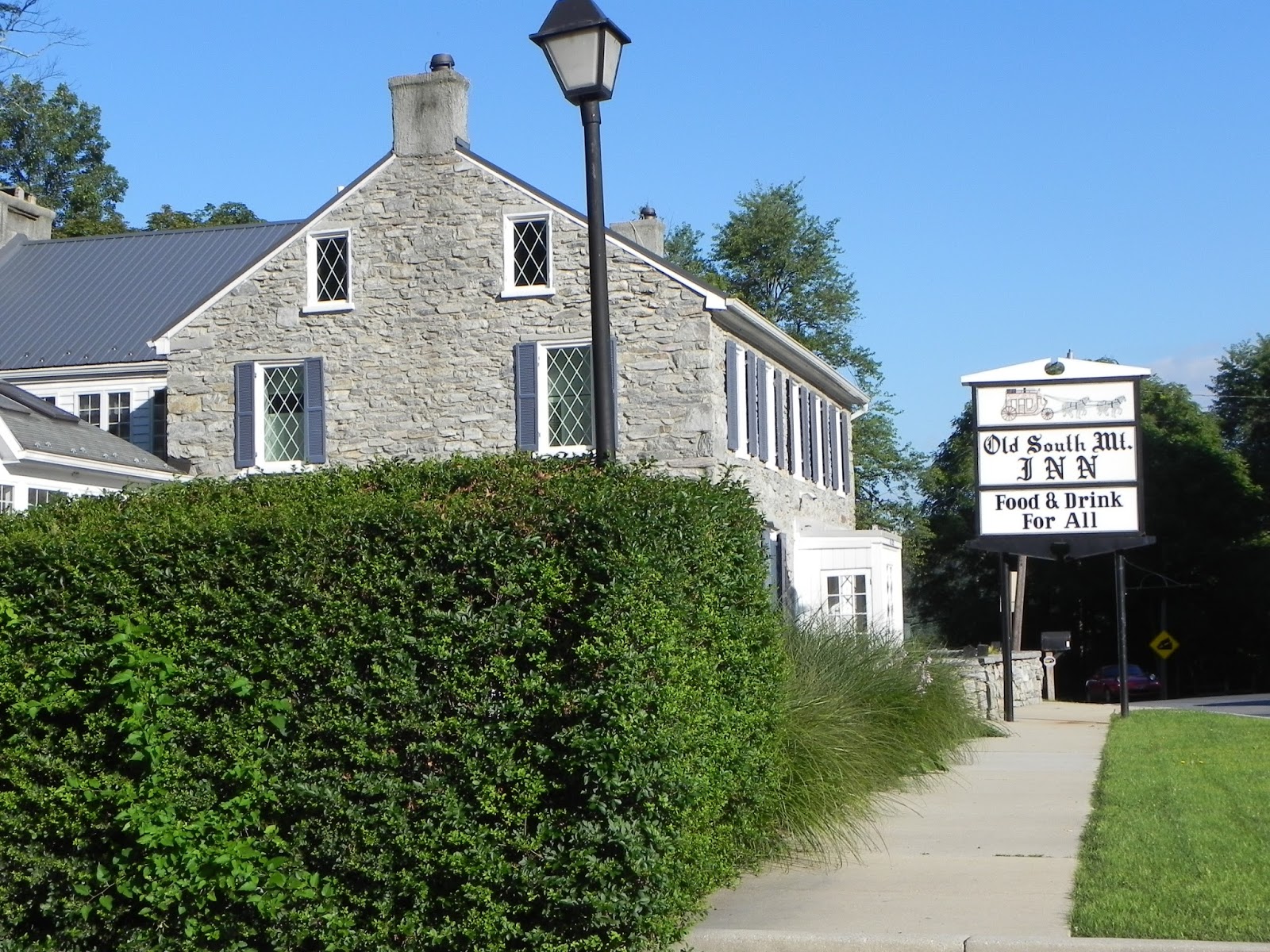
The group met in the parking lot of the Old South Mountain Inn at Turner's Gap. Around thirty people showed up for the event. In fact, my friend and I actually had to circle the lot to find a parking spot! The weather was perfect -- cool, sunny, and no humidity. Tom first led the group to some high ground along the Old National Pike and explained the fighting at Turner's Gap. We also had a chance to take in some simply stunning scenery.

The Old South Mountain Inn dates to the 18th century. Henry Clay, Andrew Jackson, and other dignitaries stayed here. During the Battle of South Mountain, the building served as Confederate Gen. D.H. Hill's headquarters.

View from the side of the mountain at Turner's Gap. The battle raged farther down the mountain from here.

Tom entertains the crowd with the tale of how the Iron Brigade allegedly got its name in the fighting at Turner's Gap. He is a bit skeptical of the historical evidence on the issue. The post-war Dahlgren Chapel is in the background.

Another highlight of the tour was the walk along the Appalachian Trail to Fox's Gap, the scene of some intense combat between the Federal Ninth Corps and assorted Confederate commands. The trail in this part follows the old Wood Road that was used during the battle. The path, which we accessed off the inn's parking lot, climbed steeply until we emerged into an open field at the site of the Wise Farm. Tom once again gave an in-depth talk on the fighting. We also had a chance to visit the monuments dedicated to Gen. Jesse Reno (USA) and Gen. Samuel Garland (CSA), who were both mortally wounded here, as well as the North Carolina Monument.

The group hikes up the Appalachian Trail to Fox's Gap.

View across the Old Sharpsburg Road (today's Reno Monument Road) to the Jesse Reno Monument in Wise's South Field. Reno fell mortally wounded in this vicinity while leading the Ninth Corps in the fighting at Fox's Gap.
The North Carolina Monument at Fox's Gap, dedicated to the North Carolina troops who fought at or near here on September 14, 1862.
Most of the group returned to the inn by way of the trail. We had a tight schedule and little time left for lunch, so my friend and I grabbed a quick sandwich at the Battleview Market before re-joining the crowd at Antietam National Battlefield.

Tom's focus at Antietam was the lesser-known fighting in the West Woods and around Dunker Church. He aimed to challenge the popular interpretation of a three-phase battle. Many sources break Antietam into geographically distinct morning, midday, and afternoon phases. Instead, fighting occurred simultaneously at various spots, including the West Woods. Tom also took the opportunity to dispute some of the other conventional wisdom about Antietam. Among other things, he defended Gen. Edwin Sumner, who is often blamed for recklessly sending Gen. John Sedgwick's Division to slaughter in the West Woods. Tom challenged us to think and left me wanting to dig a more deeply into his interpretation of events. I wouldn't expect any less from a Savas Beatie author!

The group walked through the West Woods. The tour hit the highlights of Sedgwick's advance and the Confederate counterattack. Tom then took us to a less visited area west of the Dunker Church to see where the 125th Pennsylvania made a desperate stand as Confederates of Lafayette McLaws' division entered the fray. Troops under Gen. George Sears Greene also penetrated the Confederate lines in this part of the field. Tom described how Greene was eventually driven from his salient beyond Dunker Church. During the whole tour, our trusty guide supplemented his narrative of the fighting with ample quotes from the participants.


The group hikes into the West Woods. Tom explained that at the time of the battle in 1862, this area was a woodlot and free of underbrush, unlike today. 

15th Massachusetts Volunteers Monument in the West Woods. The regiment, part of Gen. Willis Gorman's Brigade, Sedgwick's Division, Second Corps, suffered losses of  57% here. (See Antietam on the Web.)


The reverse side of the 15th Massachusetts Monument lists the names of soldiers from the regiment who were killed and mortally wounded at Antietam. Unfortunately, a modern-day bypass bisects the battlefield just down the slope from the monument.

125th Pennsylvania  Volunteer Infantry Monument. The regiment was part of Gen. Samuel Crawford's Brigade, Alpheus Williams' Division, Twelfth Corps. A statue of George A. Simpson, a color sergeant killed at Antietam, sits atop the monument.
Once the tour had ended, I made the requisite stop at the bookstore and picked up a few items. Tom was also nice enough to sign my own copy of his books that I had brought with me from home.  I then bid farewell to the group and  headed out with my friend to see some of the key sites on the battlefield. He had never visited Antietam, so I really wanted to show him what is so captivating about this place. We were pressed for time, but managed to fit in the Cornfield, Bloody Lane, and Burnside Bridge.

The only downside of the day had nothing to do with the SB tour at all. I attempted at various times to live Tweet the days' events, but reception was poor and made the use of Twitter difficult. Moreover, my iPhone battery drained a lot faster than I would have liked. I suppose I learned that technology and battlefield stomping do not always work perfectly well together.

In the end, one of the best parts of the tours was interacting with authors and fellow Civil War enthusiasts, including some of my blog readers. I enjoyed meeting Ted Savas, SB's managing director, as well as Sarah Keeney, the company's marketing director. I had a chance to chat with James Morgan, Ball's Bluff expert and author of A Little Short of Boats; fellow blogger Rea Andrew Redd, who maintains Civil War Librarian; and historian George Deutsch, who is writing a book on the 83rd Pennsylvania. I also met Eugene Schmiel, who has penned a forthcoming biography on Gen. Jacob  Cox. Schmiel shared with the group some insights on Cox that he had gleaned from his research. (Cox led a division at South Mountain and commanded the Ninth Corps at Antietam.) Driving away from Sharpsburg, I knew that it had been a day well spent. Overall, I'd rate the Antietam and South Mountain tours a great success, and I look forward to future Author Conclaves.

Friday, August 31, 2012

The Chain Bridge Defenses During the Maryland Campaign, Part I: Sigel and Company on the Move

This summer's Sesquicentennial calendar is crowded with observances of several key events.  We've just finished Second Manassas and are now headed into the Maryland Campaign and Antietam.  During such times, I start to think about my own little corner of Northern Virginia. What was happening here as the armies left behind the wreckage at Manassas and marched through Maryland on the way to a bloody encounter outside Sharpsburg?   Although far less dramatic than other events unfolding in September 1862, the ground around present-day McLean and North Arlington witnessed a build-up of Gen. Franz Sigel's army corps.  These men played a key role in manning the defenses of Washington while Gen. George B. McClellan hunted down Robert E. Lee's Army of Northern Virginia in the Old Line State.

Born in Germany in 1824, Sigel rose to become a military leader in the Revolution of 1848.  He emigrated to the United States in the early 1850s and eventually settled in St. Louis.   When war broke out, Sigel helped to recruit German-Americans to the Union cause.  He first served out West at Wilson's Creek and Pea Ridge.  Sigel, favored by the Lincoln Administration for his ties to the German-American community, was appointed a major general of volunteers and sent East, where he was named commander of the First Corps of Gen. John Pope's Army of Virginia in June 1862.  Sigel seemed a fitting choice to lead the new corps, whose ranks were filled with many German immigrants.   Sigel's men fought hard at Second Manassas (August 28-30, 1862) and helped to stem James Longstreet's massive counter-attack on the Union left. 

Maj. Gen. Franz Sigel (courtesy of Library of Congress).  German-Americans were recruited to the Union cause with the slogan, "I goes to fight mit Sigel."  The general had a less than stellar record on the battlefield and was later trounced at the Battle of New Market in 1864.

By September 2, Pope's defeated army had concentrated at Fairfax Court House.  The Union commander worried that his men were not up to the task of fighting Lee anytime soon and strongly suggested to general-in-chief Henry W. Halleck that his army return to the safety of Washington's defenses.  On mid-morning September 2, Halleck finally ordered Pope to "bring your forces as best you can within or near the line of fortification."  (OR, 1:12:3, 796-97.) 

The anxious and demoralized Pope wasted no time in carrying out Halleck's instructions.  He soon put his troops on the move towards the outskirts of Washington. Sigel's First Corps, along with Edwin V. Sumner's Second Corps, Army of the Potomac, and Fitz John Porter's Fifth Corps, Army of the Potomac, were told to march "via Vienna toward the Chain Bridge."  (OR, 1:12:2, 86.)*  The Chain Bridge, located above Georgetown, was one of three pivotal crossing points into the nation's capital from Virginia.  Pope cautioned the three corps to "keep well closed up and within easy supporting distance of each other."  (OR, 1:12:2, 86.) 

The men started out towards Chain Bridge with Porter in the lead.  Sigel followed, and Sumner brought up the rear.  (Armstrong 57; Powell 256; McClellan, Own Story, 537-38.)   J.E.B. Stuart, however, was not about to let the Federal troops have an easy time of it.   The Confederate general sent cavalry under Gen. Wade Hampton, along with Capt. John Pelham's flying artillery, to harass the Union column as the men snaked their way along the road towards Vienna and Langley.

McClellan, who was just recently restored to overall command, rode out in the afternoon towards Upton's Hill, where he greeted Irvin McDowell's corps arriving from Fairfax.  Pope and McDowell soon appeared.  While speaking with the two generals, McClellan noticed "rather heavy artillery-firing . . . in the distance."  (McClellan, Own Story, 537.)  Pope speculated that Confederates were likely shelling Sumner's rear guard and "intimated that Sumner was probably in a dilemma."  (McClellan, Own Story, 537.)  McClellan could not help but get in a dig at Pope in his post-war account:
[Pope] could give me no information, of any importance in relation to the whereabouts of the different corps, except in a most indefinite way; had evidently not troubled his head in the slightest about the movements of his army in retreat, and had coolly preceded the troops, leaving them to get out of the scrape as best they could.  He and McDowell both asked my permission to go on to Washington, to which I assented, remarking at the same time that I was going to that artillery-firing. They then took leave and started for Washington.  (McClellan, Own Story, 537.)
McClellan dashed off with an aide and three orderlies to investigate what was happening along the road to Langley.  He first encountered Porter's men after dark.  The soldiers let out a rousing cheer upon recognizing Little Mac and crowded around their beloved commander.  By this time, "the firing had ceased, with the exception of perhaps a dropping shot occasionally."  (McClellan, Own Story, 537.)  McClellan nevertheless continued onward in the moonlight, until he came to Sigel's corps.  As McClellan described the remainder of his excursion:
I . . . soon satisfied myself that Sumner was pursuing his march unmolested, so I sent on to inform him that I was in command, and gave him instructions as to his march. I then returned by the Chain bridge road, having first given Sigel his orders; and at a little house beyond Langley I found Porter, with whom I spent some time, and at length reached Washington at an early hour in the morning.  (McClellan, Own Story, 538.)
Pope, meanwhile, seemed less than troubled by the Confederate action against the retreating Federal column.  He told Halleck:
The whole army is retiring in good order, without confusion or the slightest loss of property. . .  Three army corps pursue the route via Vienna to Chain Bridge, covered by all the effective cavalry.  (OR, 1:12:2, 87.)
 At 7:10 p.m., upon arriving near Washington, Pope sent an update to Halleck:
Command coming in on the road without much molestation. Some artillery firing on the road through Vienna to Chain Bridge, but nothing of a serious character, so far as I can learn.  (OR, 1:12:2, 87.)
Pope was not far off the mark in his assessment.  The 71st Pennsylvania under Col. Isaac Wistar, along with the 1st Minnesota, was protecting Sumner's rear.  Wistar's overall view was that the enemy's shells did "little damage" that night, although stragglers greatly complicated matters for the retreating army corps. (Wistar 48.)  As it was, the narrow road was already crowded with "thousands of disorganized troops and fragments of commands; disorderly wagon trains; guns without officers; caissons without guns."  (Wistar 46.)  However unfairly, Wistar singled out stragglers from Sigel's command for getting in the way of his regiment's rear guard duty:
Many hundred perhaps thousands of Germans from the routed Division of Siegel [sic], had abandoned their colors, thrown away their arms, and deliberately gone to sleep around fires kindled in the woods, a spectacle most exasperating to our men, since these stragglers could have no other design than to be taken prisoners after the passage of the rearguard. The soldiers in ranks begged to be let loose on these 'coffee-boilers,' promising there should be none left for the enemy; but the integrity of the rearguard was of too much importance to permit risking it, even for that just vengeance. Nevertheless, such stragglers did not all go unwhipt of  justice. Unfortunately, the Adjutant's horse being killed and no Major present, the only mounted regimental officers were Lieut.-Col. [William] Jones and myself, who, when otherwise unoccupied, busied ourselves with charging into these sleeping squads of loafers, to the intense delight of the gallant fellows of the hard-worked rearguard.  (Wistar 48-49.)
During the night of September 2 and early morning hours of September 3, Federal soldiers streamed through Lewinsville and entered Langley, only a handful of miles from the Chain Bridge over the Potomac.  (OR, 1:12:2, 87; Wistar 50.)**  Sumner's men took some time to recover from their march, but later on September 3, the Second Corps crossed the Potomac at Chain Bridge and headed to Tennallytown, northwest of Washington City.  They were joined by soldiers from the Second Corps, Army of Virginia (soon to be re-designated as the Twelfth Corps, Army of the Potomac).  Porter's men soon took up a position around Hall's Hill (near current-day US-29 and N. Glebe Rd. in Arlington).  Sigel's corps encamped closest to Chain Bridge, including the area around Ft. Ethan Allen.***  Sigel also kept pickets at Langley. 

As the Union Army sat within Washington's defenses, Lee prepared to invade Maryland.  Before long, the Army of Northern Virginia was fording the Potomac upriver from Washington.  The bulk of McClellan's force would soon be on the move, but not everyone would join in the chase.  After all, someone had to ensure that the nation's capital remained safe while the main body of the army was away. 

Notes

*For a Union Army map of Northeastern Virginia in 1862, click here.  The general route taken by the three army corps from Fairfax Court House through Vienna to Lewinsville, Langley, and Chain Bridge can be traced on this map in detail.  I unfortunately could not post the desired portion of the map at a level of magnification that was satisfactory enough for viewing.

**Precise arrival times are difficult to ascertain. Some elements reached the area around Chain Bridge on the evening of September 2, while the rear guard arrived in Langley "about daylight" on September 3.  (OR, 1:12:2, 466; McClellan, Own Story, 537-38; Wistar 50.)

***The exact placement of Sigel's corps on September 3-4 is unclear.  Sigel received dispatches on September 4 at Ft. Ethan Allen, so presumably most of his men were encamped in that general vicinity.  (OR, 1:51:1, 785).  A history of the 27th Pennsylvania, a regiment in Sigel's corps, indicates that around the same time the unit "was for several days engaged in picket duty" at Langley. (Bates 388.)

Sources

Aside from the citations to the Official Records above, the following sources were useful in compiling this post:

Marion V. Armstrong Jr., Unfurl Those Colors: McClellan, Sumner, & the Second Army Corps in the Antietam Campaign (2008); Samuel P. Bates, History of Pennsylvania Volunteers, 1861-1865, Vol. I (1869); Stephen D. Engle, Yankee Dutchman: The Life of Franz Sigel (1993); George H. Gordon, History of the Campaign of the Army of Virginia Under John Pope (1880); Bradley Gottfried, The Maps of Antietam (2012); Joseph L. Harsh, Taken at the Flood: Robert E. Lee & Confederate Strategy in the Maryland Campaign of 1862 (1999); John J. Hennessy, Return to Bull Run: The Campaign and Battle of Second Manassas (1993); George B. McClellan, McClellan's Own Story (1887); George B. McClellan, Report on the Organization and Campaigns of the Army of the Potomac (1864); William H. Powell, The Fifth Army Corps (Army of the Potomac) (1896); "Franz Sigel (1824-1902)," Encyclopedia Virginia; Isaac Jones Wistar, Autobiography of Isaac Jones Wistar, 1827-1905, in Two Volumes, Vol. II (1914).
Thursday, July 15, 2010

Chain Bridge: The Rebels are Coming! The Rebels are Coming!


Chain Bridge seems to be the location that keeps on giving.  Who knew that a bridge could hold so many stories about the Civil War?  As mentioned in my first post on the subject, Chain Bridge saw no real action during the Civil War.  However, at various times throughout the conflict, concerns about a possible Confederate threat to the nation's capital loomed large, and the garrison at Chain Bridge got caught up in events.  One of the most notable episodes occurred in August 1862 during the Second Manassas Campaign.

After General McClellan's failed Peninsula Campaign in the spring and summer of 1862, the Army of the Potomac was ordered to move off the Virginia Peninsula and closer to Washington.  McClellan objected, but to no avail.  The Federal general certainly did not relish the prospect of helping the newly-formed Army of Virginia under Major General John Pope, a pompous general brought East from the Western theater.  By the time McClellan got his army moving towards Washington in mid-August,  General Robert E. Lee's Army of Northern Virginia was moving to destroy the Army of Virginia before McClellan could provide reinforcements. When McClellan arrived in Alexandria on August 26, two of his army corps (the Third and Fifth) were on their way to Pope.  The Sixth Corps under Major General William B. Franklin had just arrived, and the Second Corps under Major General Edwin V. Sumner would disembark in Alexandria a couple of days later. McClellan, who stepped into an ill-defined command situation, began to bicker with General-in-Chief Henry W. Halleck over control of his two remaining corps.


Major General Edwin V. Sumner, head of the Second Corps, Army of the Potomac (Library of Congress)


Major General Henry W. Halleck, General-in-Chief of the Union Army (Library of Congress)

Chain Bridge soon became the focus of attention.  On August 28, McClellan informed Halleck that various sources reported that "the enemy with 120,000 men intend advancing on the forts near Arlington and Chain Bridge, with a view of attacking Washington & Baltimore."  As McClellan confirmed in a subsequent letter to his wife, "there was a terrible scare in Washington" that night when "[a] rumor got out that Lee was advancing rapidly on the Chain Bridge with 150,000 men....I did not get 5 minutes consecutive sleep all night--so thick were the telegrams!"  McClellan, always cautious and inclined to imagine worst case scenarios, believed that Lee might be trying to get his army between Pope and Washington.  He made the defense of the capital his top priority.  Pope would have to wait for the Second and Sixth Corps.


General McClellan and his wife, Mary Ellen (Library of Congress)

Early on the morning of August 29, McClellan reacted to the alleged Confederate advance.  He ordered two regiments and an artillery battery from the Second Corps to march to the vicinity of Chain Bridge on the Virginia side.  By the morning of August 30, three of Sumner's brigades were on both sides of Chain Bridge, and the rest of his corps was in Arlington, including the area around Fort Corcoran.  Lee and Pope, however, were engaged in a ferocious fight around the old battlefield of Bull Run.  Around 2 pm, Halleck ordered Sumner's entire corps, along with the Sixth Corps, to be "pushed forward with all possible dispatch" to the front.  The threat to Washington by way of Chain Bridge had just been as McClellan described it -- a mere "rumor."  Unfortunately for the Union Army, the remainder of McClellan's army was too late to make any difference.  Lee's army soundly defeated Pope's forces and would soon launch an invasion of Maryland.