Showing posts with label Battle of Dranesville. Show all posts

Friday, May 10, 2013

The Pennsylvania Reserves Remember Dranesville -- at Gettysburg!

As many readers may know, I spent last weekend in Gettysburg. I hadn't been to the battlefield in many years, and the visit left me with a lot of impressions and emotions. (More on that in a future post!) As part of my tour, I focused on sites associated with the Pennsylvania Reserves. Two brigades from the division participated in the fighting at Gettysburg. I am fascinated by the Reserves and have written many posts about their time in Northern Virginia. Imagine my surprise when I discovered "Dranesville" inscribed on the 10th Pennsylvania Reserves Monument along with the names of other battles in which the regiment participated. The same goes for the Bucktails (13th Pennsylvania Reserves) Monument. Although I didn't get to all of the monuments for the Pennsylvania Reserves this time around, I searched the Historical Marker Database and noticed that the other regiments who fought at Dranesville (the 6th, 9th, and 12th Pennsylvania Reserves) also listed this small-scale engagement on their monuments. I've written quite a bit about the battle, including an article for the Civil War Trust. Even after experiencing all the carnage at Gettysburg (not to mention other places like Antietam), the former members of these five regiments made sure to commemorate their clash in and around a small Virginia hamlet during the first year of the war. Dranesville rarely appears in most modern accounts of the Civil War, but the hardened veterans of the Pennsylvania Reserves could never forget the sacrifices they made in one of their early and limited battles against the Confederate infantry.

Here are a few pictures that I snapped of the monuments:

Soldier atop the 10th Pennsylvania Reserves Monument at Big Round Top. The 10th Pennsylvania Reserves belonged to the 3rd Brigade, 3rd Division (Pennsylvania Reserves), Fifth Corps, Army of the Potomac. The Maltese Cross on the monument represents the Fifth Corps.


A list of engagements of the 10th Pennsylvania Reserves, starting with Dranesville.


I couldn't help but take this close-up of Dranesville on the 10th Pennsylvania Reserves Monument.

The 13th Pennsylvania Reserves Monument near the Wheatfield. The 13th Pennsylvania Reserves were better known as the "Bucktails." The regiment belonged to the 1st Brigade, 3rd Division (Pennsylvania Reserves), Fifth Corps, Army of the Potomac. The soldier atop the monument is appropriately wearing a bucktail attached to his cap!

List of engagements in which the Bucktails participated, starting with Dranesville.

Thursday, December 20, 2012

"Baldy" Smith's Division and Dranesville

Today marks the 151st anniversary of the Battle of Dranesville.  I've written a few times about this engagement that pitted Gen. E.O.C. Ord's brigade of Pennsylvania Reserves against a smaller force under Gen. Jeb Stuart.  I even authored the lead piece on the battle for the Civil War Trust's website.  Not too long ago historian John Hennessy sent me a period newspaper article that has shed some additional light on the events surrounding the fight at Dranesville.

Ord's men, accompanied by the famed Bucktails and a force of artillery and cavalry, set off from Camp Pierpont in Langley, Virginia during the early morning hours of December 20, 1861.  Gen. George A. McCall, commander of the Pennsylvania Reserves, ordered Gen. John F. Reynold's brigade to follow in support.  Ord ran into Stuart's men at the tiny hamlet of Dranesville, and a brisk fight ensued.  Reynold's troops, who were stopped at Difficult Run along the Leesburg-Georgetown Turnpike (VA-193), marched towards the battlefield.  Gen. George G. Meade's brigade of Reserves also left Langley and headed down the pike to Dranesville.  Both brigades arrived too late to participate in the fight, which resulted in a Union tactical victory.

The role that Reynolds and Meade played (or did not play) is well known.  Thanks to the article that John Hennessy sent my way, I recently learned that the Gen. William F. "Baldy" Smith's division also got involved in the day's events.  Smith's men were quartered for the winter at Camp Griffin, in the same general vicinity as Camp Pierpont (today's McLean, Virginia).  His command included the Vermont Brigade and another brigade under Gen. Winfield S. Hancock.  According to a December 24, 1861 account from a soldier-correspondent of the 6th Vermont:
On Thursday last, Gen. McCall had a fight with some 8000 of the enemy.*  About one o'clock, on that day, our brigade was drawn up, together with Gen. Hancock's brigade, the batteries of [Capt. Thaddeus] Mott and [Capt. Romeyn] Ay[res], also some Maine regiments, for the purpose of proceeding to the scene of action and if possible to flank the enemy on their retreat. ** We marched at a rapid pace some ten or twelve miles in the vicinity of Hunter's Mills and Drainsville [sic], but come to a sudden halt on account of a bridge being burnt.  All we had to do was to "about face" and march back, reaching camp a little before eight, tired enough to rest.  The next morning at four we were tramped out on picket. ("A March," Vermont Journal (Windsor), Jan. 4, 1862, courtesy of John Hennessy.)
This article intrigued me, as I didn't recall coming across any references to Smith's men playing a role, however remote, in the engagement at Dranesville.  I at once searched for additional references and found a letter that Corporal Dan Mason, Co. D, 6th Vermont sent to his fiancee, Harriet B. Clark.  The facts in this correspondence closely track the details from the Vermont Journal article.  On December 27, 1861, Mason wrote:
I dare say you have heard of the battle at Drainsville a few days since We heard the firing from our camp. Gen McCalls division of Penn soldiers went out in the morning on a foraging & scouting expedition (this Div is encamped about a mile north of our camp) Our division started about 2 oclock P M. to assist them if nessessary We marched 12 miles we came to a branch of the Potomac the rebels had burned the bridge so that we were compelled to face about & march homeward the boys were in the best of spirits until the order to about face came. that made them look disappointed quite a number fell out by the way & were picked up the ambulances which follow an army to pick up those that are wounded or sick & are not able to march. . . . (spelling and grammar as in original; courtesy of Vermont Historical Society, On-Line Collection of Dan Mason Letters.)
Co. D, 6th Vermont Volunteer Infantry at Camp Griffin (courtesy of Library of Congress)
Both of these accounts explain that the march to Dranesville was interrupted when Smith's men stumbled upon a destroyed bridge.  Given that the Pennsylvania Reserves moved freely back and forth along the Leesburg-Georgetown Turnpike, including the portion that crosses the Potomac tributary of Difficult Run, it appears that Smith's men took a different route towards Dranesville.  Their line of march towards Dranesville may have continued due west from Camp Griffin (today's McLean) in the direction of Hunter's Mills, or could have turned northwest onto the Leesburg-Alexandria Turnpike (current VA-7).  Both routes passed over creeks, and Confederate soldiers may very well have burned the bridge at any of the crossings.  (For a detailed map, see here.)

The mobilization of Smith's men on the afternoon of December 20 makes sense.  A fight had erupted at Dranesville between a Union brigade and a Confederate force of unknown size.  As word reached the camps around Langley, Smith took action to render assistance to the Pennsylvania Reserves.  Of course, Ord beat Stuart without needing help from other brigades.  In any event, Smith's men were blocked at the site of a burned down bridge, and it is unclear how much they could have contributed that day.

Notes

*The Battle of Dranesville occurred on a Friday, not a Thursday.  The correspondent greatly exaggerated the size of Stuart's force, which consisted of 1,600 infantry, 150 cavalry, and a four-gun battery of artillery.  (OR, 1:5, 490.)
**"Our brigade" means the Vermont Brigade.  Two Maine regiments --the 6th and 7th Maine-- belonged to Smith's division. The 6th Maine was part of Hancock's brigade.  (See George B. McClellan, Report on the Organization and Campaigns of the Army of the Potomac (1864).)

Monday, January 30, 2012

Vignettes of a Solider's Life at Camp Pierpont

While researching for my article on the Battle of Dranesville, I came across an interesting memoir by A.F. Hill of the 8th Pennsylvania Reserves.*  Published in 1864, Our Boys: The Personal Experiences of a Solider in the Army of the Potomac tells Hill's story from enlistment through the Battle of Antietam, where Hill was wounded and lost his left leg.  Hill belonged to Company D ("Brownsville Grays"), which was raised in Brownsville, Fayette County, Pennsylvania.  He rose to the rank of sergeant before being discharged after Antietam.  Hill dedicated Our Boys to George B. McClellan, "our loved and honored commander."  I have not yet read the entire book, but it seems like a lively and perhaps sentimental account of life in the Union Army.  I hope to add a first edition of Our Boys to my antique book collection in the near future!

There are a few passages from the book that are worth sharing for the window they provide into the everyday life of the Pennsylvania Reserves at Camp Pierpont in Langley during the winter of 1861-62.  I particularly like this excerpt, which describes the heart of the camp along what is today the Georgetown Pike, or VA-193:
The Pennsylvania Reserve Corps was encamped so as to occupy, about equally, both sides of the "Georgetown and Leesburg" pike. This road was to us as Broadway to New York—as Chestnut Street to Philadelphia; it was our thoroughfare—our most public avenue. A number of independent sutlers had erected their temporary store-houses by the pike; several generals, among them [George A.] McCall and [John F.] Reynolds, had established their head-quarters immediately by it; and it was altogether quite a public street. (Hill 176.)
The pike is now a two-lane commuter road, lined with large homes and sometimes choked with traffic, but the Langley Ordinary, site of McCall's HQ, survives as a witness to the war years. 
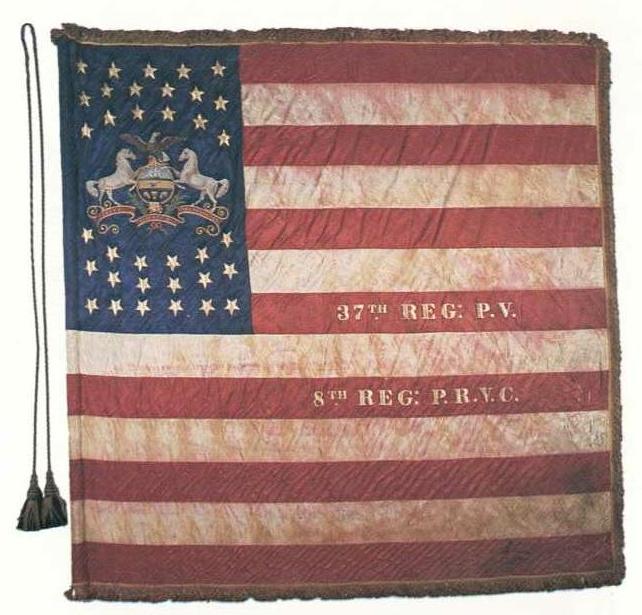
Flag of the 8th Pennsylvania Reserves (courtesy of Pennsylvania Capitol Preservation Committee)
Hill and his friend, Dave Winder, decided at one point in December 1861 to pay a visit to Winder's acquaintances at Camp Griffin, where Gen. "Baldy" Smith's division had its winter quarters.  After "a very muddy walk of three-fourths of a mile" from Camp Pierpont to the neighboring encampment, Winder found his friends and immediately launched into a story.  (Hill 177.)  As Hill describes the scene:
I thought he would never get done telling his friends stories of the battle of Drainesville [sic], in which he asserted that our regiment had been hotly engaged. He stated that, three separate times, our regiment repulsed a brigade of five thousand rebels; and he expressed it as his belief, that the Eighth Regiment alone, unsupported, could charge clear to Richmond. When, at length, he did pause, I suggested the propriety of returning to the pike. Winder, with difficulty, succeeded in tearing himself away from his friends, informing them, as he bade them farewell, that he expected soon to be made captain of the company to which he belonged—that our former captain had been killed in the battle of Drainesville, and that the company would not hear to any other man than himself assuming the position.  (Hill 177.)
Winder certainly enjoyed telling tall tales, as the 8th Pennsylvania Reserves did not even fight at Dranesville, and the Confederate force was considerably smaller than 5,000.  Hill's anecdote about Winder, however, shows the extent to which Union soldiers in Virginia were riveted by the victory at Dranesville in late December 1861.  After all, this engagement was a much-needed win at a time when the North was recovering from defeats at Bull Run and Ball's Bluff, and any man who fought there was likely viewed by other soldiers with esteem or awe.  Winder played on that sentiment.

I've also taken a recent research interest in drinking and army life during the first winter of the war.  (In fact, the other day I wrote about excessive alcohol consumption in the Confederate winter camps around Centreville.)  Hill's story covers the bases when in comes to the use of adult beverages at Camp Pierpont.  Hill notes that "[t]he sale of liquor in the army being prohibited, it was frequently vended by sutlers and others 'on the sly.'"  (Hill 181.)  The veteran recounts a trick that Winder played on a soldier who was desperately looking for some rye:
On reaching the pike we stopped for a few minutes by a sutler's establishment, around which was collected quite a crowd. While there we heard one soldier ask another, in a whisper, if he could inform him where "something to drink" could be procured. (Hill 181.)
Winder told the poor lad, who happened to be from Smith's division, that drink could be procured from a nearby tent.  When the solider went to ask for whiskey, it turned out that Winder had sent him to a colonel's tent.  The officer chased the enlisted man through camp, but he managed to get away and presumably made it back to Camp Griffin.

Whiskey advertisement from Feb. 22, 1862 edition of Harper's Weekly (courtesy of sonofthesouth.net). 
Hill was luckier in meeting his own needs:
On arriving in camp, I was informed, by my messmates, that a "box" had been sent to one of them from home, containing, among other things, two half-gallon tin cans, tightly sealed, one marked in big letters—"preserved Peaches," the other, "Currant Jelly." Now, the one marked "preserved peaches" contained whiskey; that marked "currant jelly" contained whiskey, too. Thus one gallon of the " poison" had walked slyly into camp, beneath the very noses of provost-marshals, officers of the day, etc.
Haman, Dick, Ort, and Enos had been imbibing, and were already right merry when I entered our domicile. They urged me to take "something." Well, I do not think it any harm to take a little now and then while in camp, especially in damp and muddy weather, so I did take a "little" three or four times. By and by all became boozy; Haman and Dick called in everybody that passed by, made everybody drink several times till nearly every man in the company felt right happy.  (Hill 185.)
That night, excessive drinking led to a fight, and one of Hill's messmates was almost shot, but Hill managed to grab the musket from the aggressor.  An officer eventually intervened and put the culprit in the guard house to sober up.  Hill's stories, aside from being just plain entertaining, provide insights into the role that alcohol played in winter camp.

I look forward to reading through other parts of Our Boys, and I will be certain to share with readers any other insights from the book concerning life at Camp Pierpont.  And wish me luck on my search for a first edition!

Note
*There seems to be some degree of confusion over Hill's actual first name. Our Boys lists the author as "A.F. Hill" on the title page and elsewhere.  Google Books indicates that A.F. Hill is "Alonzo F. Hill."  However, the National Park Service database, which is also available on Ancestry.com, indicates that A.F. Hill from Co. D, 8th Pennsylvania Reserves is "Ashbol F. Hill," while a Pennsylvania genealogy site has A.F. Hill from Co. D listed as "Archibald F. Hill."

Tuesday, January 10, 2012

The Presentation of the Colors to the Victors of Dranesville

The month of January 1862 was cold, damp, and miserable for the Pennsylvania Reserves encamped at Langley.  The men huddled inside their crude huts as the snow and rain fell and the ground outside turned into mud.  The winter weather even interfered with the daily routine of army life.  As a soldier from the 7th Pennsylvania Reserves wrote to the Philadelphia Press, "owing to the unfavorable weather with which we have been visited, drill and other duties have been almost suspended."  Nothing, however, not even the elements, could get in the way of bestowing honors on the victors of Dranesville. 

The Pennsylvania Reserves had become the darling of  the political and military establishment ever since the battle.  At the end of the December, Pennsylvania Governor Andrew Curtin visited the Reserves at Camp Pierpont and declared that the regiments involved at Dranesville would have the name of the battle inscribed on their standards.  (See here for a recent post on the governor's visit.)  The flags were soon sent to Washington to be painted with the battle honors. 

Flag of the 6th Pennsylvania Reserves with a barely visible "Dranesville" inscription (courtesy of Pennsylvania Capitol Preservation Committee)

Flag of the 9th Pennsylvania Reserves with a faded "Dranesville" inscription (courtesy of Pennsylvania Capitol Preservation Committee)
A couple weeks later, on January 11, the entire division participated in the presentation of the colors to the men who had won the day at Dranesville.  All fifteen regiments, "in full uniform," formed and marched out to the parade ground, which was "in a wretched condition, occasioned by the rains of the previous day."  ("Letter from Camp Pierpont," Phila. Press, Jan. 20, 1862.)  A fifteen-gun salute was fired by the Reserves' artillery, and various regimental bands "returned the compliment."  ("Letter from Camp Pierpont," Phila. Press, Jan. 20, 1862.)  Speaker of the House Galusha Grow of Pennsylvania traveled to Langley for the occasion and met the Reserves on the parade ground.  As the soldier from the 7th Pennsylvania Reserves described the scene:
. . . the color companies attached to the different regiments in [E.O.C.] Ord's brigade took an advanced position, when the flags on which were neatly inscribed the word "DRANESVILLE," in honor of the late victory, were presented by [Grow] -- the ceremony winding up with a few complimentary remarks from that gentleman.  The cavalry and artillery that accompanied the brigade were also on the ground, and were presented with new flags similarly inscribed.*

Rep. Galusha Grow,  Speaker of the House, 1861-63 (courtesy of Wikipedia)
The regiments then filed past Grow and the other notables gathered on the parade ground.  Overall, the soldier from the 7th considered that "the affair passed off admirably" despite the muck and mire.  Perhaps the review lifted more than a few spirits in the middle of the harsh winter.  The glow of Dranesville, however, would grow dimmer as the new year progressed and the war's toll grew to unimaginable proportions.

Note
*Ord's brigade was comprised of the 6th, 9th, 10th, and 12th Pennsylvania Reserves.  All of these regiments were engaged at Dranesville. The 1st Pennsylvania Rifles ("the Bucktails"), although not part of Ord's brigade, also participated in the battle, and it is likely that they also received the inscribed flag during the ceremony.

Sources
"Letter from Camp Pierpont," dated Jan. 14, 1862, Philadelphia Press, Jan. 20, 1862;  O.R. Howard Thomson & William H. Rauch, History of the "Bucktails" (1906).

Thursday, December 29, 2011

Governor Curtin Comes to Town

Pennsylvania Governor Andrew Curtin traveled to Washington at the end of December 1861.  The main purpose of Curtin's visit was to discuss his state's military preparedness, including "the best means of defending Pennsylvania from a foreign enemy." (Phila. Press, Dec. 27, 1861.)  The trip would also afford Curtin the opportunity to visit the Pennsylvania Reserves, who had recently captured national attention for their victory over Jeb Stuart at Dranesville.

The governor, a loyal supporter of President Lincoln, immediately attracted attention in the nation's capital.  At Willard's on Pennsylvania Avenue, two or three Pennsylvania regimental bands serenaded the governor.  Curtin "was then called out, and addressed the audience, referring to the part Pennsylvania [had] taken in the war."  The governor extolled the state's "patriotism and faithfulness to the Union" in providing such a "large number of troops. . . all in very fine condition"  (Phila. Press, Dec. 30, 1861.)  The governor "manifested the greatest enthusiasm in the success of the troops" at Dranesville, and assured the Pennsylvania regiments present at the hotel of "his desire to secure to them every comfort in his power."  (Phila. Press, Dec. 30, 1861.)


Gov. Andrew Curtin of Pennsylvania (courtesy of Wikipedia)
On Sunday, December 29, Curtin crossed the Potomac to visit the Pennsylvania Reserves at Camp Pierpont in Langley.  It was a "delightful" winter day.  (Phila. Press, Dec. 30, 1861.)  The governor must surely have felt a sense of pride as he moved among the troops.  After all, Curtin was instrumental in the establishment of the Reserves in the days following Ft. Sumter, and their win at Dranesville had helped to boost morale on the Northern home front. 

The division hospitals were the governor's first stop.  There Curtin "spoke a kind word to each of the soldiers wounded" at Dranesville.  (Phila. Press, Dec. 30, 1861.)  The governor then rode to a hill outside of Langley, where he reviewed the entire division, accompanied  by his political rival and fellow Pennsylvanian, Secretary of War Simon Cameron.  Gen. George B. McClellan, commander of the Army of the Potomac, was still recovering from a very severe illness back in Washington and was not present.

The Press reported that the Reserves were caught unaware of Curtin's visit and only received notice of the review at noon.  However, by 1 p.m, the entire division formed on the review ground and was ready to parade before the dignitaries.  According to the Press, the Reserves "performed the various evolutions with the precision and regularity of veterans. . . .  Their recent victory at Dranesville [had] inspired them with new courage and unbounded confidence in their officers."  (Phila. Press, Dec. 30, 1861.)

Following the military maneuvers, Curtin's carriage pulled up in front of the soldiers.  Brig. Gen. E.O.C. Ord, who had served as the immediate commander at Dranesville, introduced the governor.  Curtin stood and addressed his fellow Pennsylvanians.  The governor made no apologies for paying a visit to camp on the Lord's day.  In fact, he told the Reserves that "it could be no desecration of this sacred day for me to come out and look at the faces of the brave men who are illustrating the power of the nation to suppress insurrection and break down the conspiracy which now threatens our Government."   The governor announced that he had ordered the name of the Battle of Dranesville inscribed on the Reserves' standard.  Noting the "thrill of pleasure and of pride" that was felt in Pennsylvania upon learning of the victory at Dranesville, Curtin offered words of gratitude:
In the name of Pennsylvania, I thank you; I thank you for the honor you have reflected upon the Old Keystone State; I thank you for your courage.  Thousands of people at your homes rejoice over the result.   Thousands more will follow you, if need be, in this war; and at all times when our Government is in peril Pennsylvania, from the Delaware to Lake Erie, every man in the state, every dollar of our material wealth, all our blood and treasure, stand upon the side of right and truth, and they will, as ever, be loyal to the Constitution and to an organized, legitimate Government.
Curtin wished the men future success in battle and concluded his oration:
I commend you to the care of these generals, who lead you, and the Government that protects you in your rights.  I go back to Pennsylvania refreshed by this interview, and prouder than ever I have been of the gallant spirits comprising the Reserve Corps.  Pennsylvania expects every man to do his duty.  With that single word falling upon your ears, I bid you farewell.
The soldiers cheered their governor, and then sent up additional hurrahs for Secretary Cameron and the generals of the Pennsylvania Reserves. 

The next day, Cameron placed political rivalries aside and hosted a dinner for Curtin at his private residence.  Several dignitaries were present, including Secretary of the Treasury Salmon P. Chase, Secertary of State William Seward, Senator Benjamin Wade of Ohio, and Senator Charles Sumner of Massachusetts.  During the dinner, President Lincoln himself made an appearance.  The President's drop-by at a Cabinet member's social event apparently broke an unwritten rule of Washington etiquette.  However, as the Pennsylvania Daily Telegraph reasoned, "President Lincoln desired to do the gallant and devoted men of Pennsylvania an honor through his Secretary of War and our Governor."  According to Sumner, much of the conversation focused on the all-consuming Trent affair, although the contribution of the Pennsylvania Reserves at Dranesville likely came up at some point that evening.

The Daily Telegraph reported that Curtin was "eminently successful in his official mission" to Washington.  The governor returned to Pennsylvania, where he continued his efforts on behalf of the Administration and the Union war effort.  Meanwhile, the Reserves could take pride in their own contributions and the recognition that they had received from their esteemed governor.  December had certainly been a month to remember for the soldiers encamped at Langley.

Sources
The Lincoln Institute, Mr. Lincoln's White House, Biography of Andrew G. Curtin; Pennsylvania Daily Telegraph (Harrisburg, Pa.), Dec. 31, 1861; Philadelphia Press, Dec. 27, 1861; Philadelphia Press, Dec. 30, 1861; Edward L. Piece, Memoir and Letters of Charles Sumner, Vol. 4 (1893).

Monday, December 19, 2011

The Confederates Return to Dranesville

Tomorrow marks the 150th anniversary of the Battle of Dranesville.  As readers are well aware, I have covered the engagement here and at greater length in an article for the Civil War Trust.  Dranesville shattered the relative calm that had descended on Northern Virginia by December 1861.  Because I have already discussed the battle itself, I thought that I would dedicate a couple posts to what happened in the Union and Confederate ranks following the engagement.

Dranesville was a tactical Union victory, but that didn't stop Brig. Gen. Jeb Stuart from calling the battle a "glorious success" for the Confederates.  (OR, 1:5, 494.)  After all, the Confederate commander had saved his foraging party from falling into the enemy's hands.   Stuart's self-styled triumph, however, had not come without a cost.  Among his four infantry regiments, one battery, and assorted cavalry units, Stuart lost 43 killed, 143 wounded, and eight missing.  The Union suffered only seven killed and 61 wounded.

Following the two-hour fight on December 20, Stuart's force withdrew from the battlefield towards the Alexandria, Loudoun, & Hampshire Railroad.  When it became clear that his men were out of harm's way, Stuart pushed onward to Frying Pan Church.  There, the Confederates took care of their wounded from the engagement. Meanwhile, the 18th Virginia and 9th Georgia were dispatched from the main camp at Centreville to join Stuart at the church.  The regiments arrived at some point early in the morning.


Frying Pan Church, where Stuart cared for his wounded following the battle.  The church, located along present-day Centreville Road in Fairfax County, was built between 1783 and 1791.  The Baptist congregation included both whites and blacks.  The site is preserved and maintained by Fairfax County.  (See here for more information.)
As dawn broke on December 21, Stuart intended to return to Dranesville.  He soon had the 9th Georgia and 18th Virginia organized and on the way.  As a soldier from the 18th Virginia recalled:
We marched briskly along, it being-quite cold, and we therefore felt the more inclined to exert ourselves to give warmth to our bodies. We had no idea of going so far when we started, but were willing to follow Gen. Stuart anywhere, even to the banks of the Potomac. Onward, still onward we went, winding our way up and down circuitous and zigzag roads, which, though wearisome, were in excellent condition, being entirely free from the stiffing influence of dust. (Richmond Daily Dispatch, Dec. 30, 1861.)
Stuart sent his cavalry ahead to ascertain the presence of the enemy.  The scouts reported that the Union had abandoned Dranesville and that several Confederate wounded were left in town.  The Union commander, Brig. Gen. E.O.C. Ord, had lacked a sufficient number of ambulances and was unable to take all of his wounded prisoners with him to Camp Pierpont in Langley. 


Gen. Jeb Stuart (courtesy of National Park Service)

Stuart, desiring to collect his wounded and dead, pushed his men to Dranesville and arrived around 11 a.m.  Outside of town, in a house not far from the scene of the previous day's action, Stuart's men located between eight and ten wounded Confederate soldiers.  According to the soldier from the 18th Virginia, in front of the home "stood several charmingly looking ladies, who very soon became the paramount attraction":
They were kindly attending our wounded . . . .  They say the Yankees were very kind to our wounded, in bringing them to the house; they also left with them a good many bandages, to be used in dressing their wounds. . . .  These ladies with their mothers had come up from their comfortable homes, bringing with them beds and bed clothes. They also prepared soups and such like delicacies suited to the conditions of the wounded.  (Richmond Daily Dispatch, Dec. 30, 1861).
Stuart ordered his men to place the wounded in ambulances for the return to Centreville.  Two of the men were severely injured, and it soon became clear that they could not survive the long trip back.  Stuart reported that "at their own desire and at the surgeon's advice" the two soldiers "were left in charge of the ladies" in Dranesville  (OR, 1:5, 492.) 

The Confederate general also heard wild rumors about the battle from local inhabitants.  The Union force had consisted of "fifteen regiments of infantry, several batteries, and seven companies of cavalry."  (OR, 1:5, 493.)  In fact, Ord had just five regiments of infantry, one battery, and two squadrons of cavalry, but at the time, Stuart was not entirely certain of the size of Ord's force.  (Some locals may have seen the brigades of John Reynolds and George Meade, who had arrived too late to take part in the fight, and overestimated the number engaged on the 20th.)  The residents of Dranesville also informed Stuart that Ord had left with twenty wagon loads of dead and wounded!

Stuart set about the grisly task of collecting the dead from the battlefield.  The soldier from the 18th Virginia witnessed the carnage.  He wrote:
I was horror-struck by the ghastly appearance of the dead, as they lay all besmeared with their own blood, which in the agents of death they had gotten all over their faces, having as soon as shot clapped their hands to the part affected and drawn across their faces; shots of a more deadly character, I never saw.  (Richmond Daily Dispatch, Dec. 30, 1861.) 
Once the wounded and dead were loaded in wagons, Stuart set out for the Confederate lines at Centreville around 4 p.m.  The colonel of the 18th Virginia gave his men the option of stopping for the night, or going the entire way back to camp.  His men agreed to continue the march.  As the soldier from the 18th Virginia wrote to the Daily Dispatch:
[S]ome of our men complained bitterly of sore feet, made so by traveling so much on this hard frozen ground. Some one or two were so lucky as to get a ride on horseback. Others were obliged to remain the over-night, and come in the following (Sunday) morning. No order as to regularity of marching could be maintained, each getting along as best he could. My Captain, myself, and several others were amongst the first to get to camp — how glad were we to get there. We found hot coffee and warm fires. So, drinking the coffee and toasting our feet, we retired for the night.  (Richmond Daily Dispatch, Dec. 30, 1861.)
Back in Centreville, the Confederates attended to their wounded and buried their dead.  The 11th Virginia, which had fought at Dranesville, was brigaded with the 17th Virginia.  The men of the 17th attended the internment of the 11th's dead, "prompted by the friendly feeling that had existed between the two commands ever since the organization of the brigade."  (Warfield 66.)  As Private Edgar Warfield remembered:
The act brought forth from Colonel [Sam] Garland of the Eleventh a beautiful letter, which was read on dress parade, expressing his grateful appreciation of the soldierly friendship which induced our command to unite with them in paying this last tribute of respect to their dead comrades. (Warfield 66.)
The Confederates recovered from their setback at Dranesville and prepared to celebrate the Christmas holiday.  The battle had been an unsettling experience for many soldiers, including those who visited the scene of the fight on the 21st.  But as 1861 drew to a close, much worse awaited Confederate and Union soldiers alike in the upcoming year and beyond.

Sources

Aside from the OR, the following sources were useful in compiling this post:

National Register of Historic Places Registration Form for Frying Pan Meetinghouse; Richmond Daily Dispatch, Dec. 30, 1861; Edgar Warfield, Manassas to Appomattox: The Civil War Memoirs of Pvt. Edgar Warfield, 17th Virgina Infantry (1996 ed.).

Wednesday, December 14, 2011

Civil War Trust: Battle of Dranesville Article

The Civil War Trust has just published a web page entirely dedicated to the Battle of Dranesville. The engagement, which took place on December 20, 1861, pitted Jeb Stuart's Confederates against soldiers from the Pennsylvania Reserves and resulted in a Union victory.  I am honored that the Civil War Trust asked me to contribute the lead article to their Dranesville page.  (A special thanks goes out to Rob Shenk, the Trust's Director of Internet Strategy and Development.)  Writing this piece allowed me to explore many tactical aspects of the little-known battle.  I also uncovered several interesting stories related to Dranesville. Along with the article, the Civil War Trust has published some modern-day photographs of locations connected to the battle.  Sadly, little remains of the actual battlefield, which has been marred by suburban development.  I'd encourage you to go to the Civil War Trust's site and check out the Dranesville page, and while visiting, learn more about how you can help preserve Civil War battlefields.


Postscript

On a related note, last year I wrote a general overview of the Battle of Dranesville and also took a closer look at "friendly fire" episodes during the engagement.

Thursday, December 16, 2010

Friendly Fire Episodes at Dranesville


As students of the Civil War know, friendly fire-related incidents sometimes occurred during the heat and confusion of battle, often with tragic consequences.  One of the more infamous episodes involved the shooting of "Stonewall" Jackson by his own men during the Battle of Chancellorsville in May 1863.  But battle histories are replete with other, lesser-known examples.  While researching the Battle of Dranesville, I recently came across a few tales related to friendly fire.
Battle flag of the 1st Kentucky (courtesy of Sand Hill Flag Co.)
As J.E.B. Stuart prepared to attack the Union force under General E.O.C. Ord which had entered Dranesville on December 20, 1861, he sent forward the 1st Kentucky and the 6th South Carolina to the left of the Centreville Road.  According to Stuart in his official report of the battle:
The thicket where the Sixth South Carolina and First Kentucky operated was so dense that it was impossible to see either [their] exact position or their progress in the fight, and I regret to say that the First Kentucky and the Sixth South Carolina mistook each other for the enemy, and a few casualties occurred in consequence. . . .
Colonel Conrad F. Jackson, commander of the 9th Pennsylvania Reserves (courtesy of the Pennsylvania Reserve Volunteer Corps Historical Society)

(Stuart's report does not mention the exact number of dead and wounded as a result of this friendly fire incident, but according to The Glories of War by Charles P. Poland, Jr., the 1st Kentucky killed five men of the 6th South Carolina.)  The 1st Kentucky, recovering from this unfortunate encounter, pressed forward into the fight.  Meanwhile, Ord had dispatched the 9th Pennsylvania Reserves south of the Leesburg and Alexandria Turnpike on the Union right.  Before long, Colonel Conrad F. Jackson heard movement in the underbrush and ordered the 9th Pennsylvania into position.  According to a letter to the Pittsburgh Gazette from an unknown soldier of Company A (Pittsburgh Rifles), 9th Pennsylvania Reserves, some men called out "Who are You?," to which the Confederate troops responded, "The 1st Kentucky Regiment."  Other Pennsylvanians heard something else.  As Colonel Jackson recounted:
One of the enemy called out, "Don't fire on us." One of my men imprudently asked, "Are you the Bucktails?" The answer was, "Yes, we are the Bucktails; don't fire."
The unknown soldier recalled that the Kentuckians also shouted "For God's sake don't fire we are your friends."  This deception strengthened the impression for some soldiers that the men in front of them were fellow Pennsylvanians from the Bucktail regiment.  Jackson soon heard from another officer that "the troops opposite were the Bucktails."  Concern over accidentally opening fire on Union soldiers overcame Jackson.  He wrote:
Determined to avoid falling into the fatal error of killing our own men, I at once used all my energy to prevent firing, nor did we fire until after we had received a volley from the enemy, as they proved to be. We received their first fire as Captain Galway was in the act of reporting that he had obtained a view of them, and assured me in the most emphatic manner they were rebels. The order to fire was then given and promptly obeyed, but I found there still existed a doubt on the part of the men as to the true character of the troops we were engaged with, which caused considerable confusion in the ranks, which was overcome to a great extent with some difficulty.
The anonymous soldier had a somewhat different recollection.  He wrote to the Pittsburgh Gazette that Colonel Jackson "rode in the rear of the line begging the men not to fire into the Buck Tails, though the shot was flying thick as hail and our boys were falling on our right and our left."  This soldier's account raises questions about whether in fact the 9th was under an intense attack before Jackson learned that the regiment opposite his men was the 1st Kentucky.  The unknown soldier also indicated that some soldiers may not have waited for the order to fire:
Yet, regardless of all orders, there was firing all along the line, and finally the Colonel could no longer be heard and all loaded and fired as fast as we could for half an hour.  
Jackson and his unknown soldier were in agreement about one thing.  As Jackson wrote in his report of the battle:
I feel perfectly convinced, had the men been assured at the onset that the troops before us were rebels, we might have driven them from their position before they could have fired on us, as we could hear them distinctly load their pieces.
The soldier from the Pittsburgh Rifles likewise believed that "Had we been commanded to fire immediately, we might have done terrible execution."  Regardless, even with the confusion at the outset of the encounter, the 9th Pennsylvania held its ground and drove back the 1st Kentucky.  But this story goes a long way to showing just how soldiers and commanding officers could be gripped by anxiety over friendly fire.  As the earlier encounter between the 1st Kentucky and the 6th Carolina shows, the 9th Pennsylvania had every reason to fear such a costly mistake.

Monday, December 6, 2010

The Action at Dranesville


Of all the skirmishes and minor battles around the Washington area during the Civil War, Dranesville has attracted its fair share of attention.  A quick search on Google reveals plenty of material about this engagement on December 20, 1861.  The Friday after Thanksgiving, my Dad and I set out to explore the area around Dranesville.  The battlefield is now marred by the suburban D.C. development, but a few historical markers recall the encounter, and Fairfax County has preserved an old tavern there.  

The hamlet of Dranesville sat just west of the crossroads of the Leesburg & Alexandria Turnpike (today's VA Route 7/Leesburg Pike) and the Leesburg & Georgetown Turnpike (VA Route 193/Georgetown Pike).  In December 1861, Dranesville occupied "debatable ground" between the Union and Confederate lines in Northern Virginia, characterized by heightened tensions among local inhabitants.  The Union Army learned that enemy cavalry was operating in the region and threatening Union sympathizers.  Brigadier General George A. McCall, commander of the Pennsylvania Reserves, instructed Brigadier General E.O.C. Ord on the evening of December 19 to set out the next morning with his brigade to drive back Confederate pickets and collect forage from secessionist farmers.  Another brigade commander, Brigadier General John F. Reynolds, was instructed to move to Difficult Run, where he was to wait and provide support to Ord if necessary.  Early on the morning of the 20th, Ord left Camp Pierpont in Langley with his brigade of the 6th, 9th, 10th, and 12th Pennsylvania Reserves, along with the "Bucktail" regiment (13th Pennsylvania Reserves), four guns under Captain Hezekiah Easton of Battery A, 1st Pennsylvania Artillery, and two squadrons of the 1st Pennsylvania Cavalry.  All told, the force comprised about 5,000 men.

Brigadier General E.O.C. Ord (courtesy of Georgetown University Library)
The Confederates, meanwhile, were planning a similar foraging expedition in the area.  Brigadier General J.E.B. Stuart was assigned to guard the wagons with around 1,600 infantry of the 1st Kentucky, 6th South Carolina, 10th Alabama, and 11th Virginia, as well as four guns of the Sumter Flying Artillery and 150 cavalry.  When Stuart learned of the approaching Federal brigade, he sent the wagons back towards the Confederate camps in Centreville and prepared to defend what he perceived as a threat to his recently collected supplies.
"The Battle of Dranesville -- Sketched by an Officer Who Was Present," Harper's Weekly, Jan.11, 1862 (courtesy of sonofthesouth.net).  This print depicts a view from the position of Easton's battery.  Ridge Road is to the left of the artillery.  The Thornton House, occupied by the Bucktails, is immediately to the front of the artillery, on the right.
As Ord arrived in the vicinity of Dranesville, Rebel pickets fled before his men.  Ord's soldiers moved west of the intersection of the two pikes.  Ord soon discovered that the Confederate force was advancing in his rear, and dispatched his artillery to high ground east of the intersection.  He then wheeled his regiments around and aligned them facing south, towards the Confederates, who were advancing on either side of Ridge Road (or Centreville Road, more or less today's Reston Avenue).  A hot fight ensued between the two armies, lasting around two hours.  The Union artillery, occupying a dominant position, proved particularly effective and wrecked havoc on the Confederate battery.  The Bucktails engaged the 6th South Carolina and 10th Alabama from an advantageous location in and around the Thornton House in the Union center. Off to the Union right, the 9th Pennsylvania battled the 1st Kentucky.  Finally, Stuart, who feared the arrival of Union reinforcements, withdrew from the field and fell back to Frying Pan Church, about half a dozen miles distant.  Lucky that Stuart left, as Reynolds, and another brigade of Pennsylvania Reserves under Brigadier General George G. Meade, were on the way  after learning of the battle that had erupted at Dranesville.  The Union had lost about 68 killed and wounded, and the Confederates suffered 194 casualties.  McCall, worried that the Rebels might cut off Ord's men from Union lines during the night, ordered Ord to march his brigade back to Camp Pierpont.  Stuart returned the next day to collect the wounded and bury the dead.
Modern view of the intersection of Leesburg Pike and the Georgetown Pike at Dranesville.  Ord aligned his forces along the Leesburg Pike, facing south.  The 9th and 12th Pennsylvania were positioned just beyond the intersection, where the ground slopes down.  Easton's artillery was placed to the right of the intersection on elevated land (not visible here).


State historical marker on the "Action at Dranesville," along Leesburg Pike heading west towards the Dranesville intersection of VA Routes 7 & 193. More information can be found on the Historical Marker Database.  

Dranesville Tavern (c. 1824), located west of the Dranesville intersection.  This historic site is owned by Fairfax County, which restored the tavern to its 1850 appearance.  The tavern was moved about 125 feet southwest of its original location.  During the time of the Civil War, the tavern was considered "one of the best roadside inns in America," according to the Virginia Gazette.  The tavern's role in the Battle of Dranesville is not known.  However, a Civil War Trails marker in front of the tavern commemorates the action at Dranesville.
Dranesville was hailed in Northern papers as a major victory.  After the ignominious defeats at First Bull Run and Ball's Bluff, the North was hungry for a win over the Confederates.  Dranesville gave Northerners the opportunity to celebrate.  Secretary of War Simon Cameron, himself a Pennsylvanian, wrote to General McCall that "[i]t is one of the bright spots that give assurance of the success of coming events, and its effect must be to inspire confidence in the belief that hereafter as heretofore, the cause of our country will triumph."  Confederate papers largely portrayed the engagement as a loss.  The Richmond Examiner, for instance, observed that "[t]he impression is, that we have suffered no inconsiderable disaster."  Larger-scale, more brutal battles would follow, and for all the attention Dranesville got in the winter of 1861, it would soon become, as historian Charles Poland has said, "a virtually forgotten sideshow of the war."

A Note on Sources:

I found several sources useful in learning more about the Battle of Dranesville.

The Glories of War: Small Battles and Early Heroes of 1861, by local historian Charles P. Poland, Jr. has a detailed chapter on the battle.

The Official Records, Series I, Volume V contains official reports of the battle by Union commanders and Confederate General Stuart.

"The Battle of Dranesville, Va." by William S. Hammond in the Southern Historical Society Papers, Vol. XXXV, Richmond, Jan.-Dec. 1907 (available here) provides a concise account of the engagement.

Craig Swain, over at To the Sound of the Guns, does a great job of describing troop positions in relation to the current lay of the land in Dranesville.

Thursday, September 16, 2010

Who Were the Pennsylvanians at Langley?


As a native Pennsylvanian, I was very interested to discover that soldiers from Pennsylvania had encamped in the Langley area during the winter of 1861-62.  Readers may recall that I briefly discussed the Pennsylvania Reserve Volunteer Corps at Camp Pierpont in a previous post about the Civil War in present-day McLean.

In response to President Lincoln's call for volunteers to put down the rebellion in April 1861, Pennsylvania raised more regiments than the U.S. War Department would accept under the state's quota.  Governor Andrew Curtin was not willing to turn away the Pennsylvanians rushing to enlist.  In May 1861, he persuaded the Pennsylvania Legislature to authorize the organization of a "Reserve Volunteer Corps of the Commonwealth" to be armed and equipped from the state treasury.  Four training camps were established in the cities of Easton, Harrisburg, Pittsburgh, and West Chester.  George A. McCall, an 1822 graduate of West Point and decorated Mexican War veteran, was placed in command of the corps.  Notable future commanders would include John F. Reynolds, who rose to lead the First Corps of the Army of the Potomac, only to be killed at Gettysburg, and George G. Meade, Union commander of the Army of the Potomac from Gettysburg until the end of the war.


Brigadier General George A. McCall (Wikipedia)

The Reserve Volunteer Corps consisted of thirteen regiments of infantry, including the famous Pennsylvania "Bucktails" of the 13th Pennsylvania Reserves, also known as the 1st Pennsylvania Rifles.  An artillery regiment and a cavalry regiment were also attached to the corps. The largest number of companies came from Philadelphia County and Allegheny County, where my hometown, Pittsburgh, is located.

A couple of regiments were initially sent to Western Virginia to join the forces of Colonel Lew Wallace.  Following the Union defeat at First Bull Run, the U.S. Government urgently called for additional troops, and requisitioned the Pennsylvania Reserve Volunteer Corps.  The corps was dispatched to Washington and quartered around Tennallytown (now Tenleytown).  On October 9, 1861, the corps, now a division of the Army of the Potomac, marched across Chain Bridge and established Camp Pierpont, around Langley.  Here the division trained and readied itself for the eventual movement on Richmond.  The third brigade under General E.O.C. Ord participated in the Union victory at Dranesville on December 20, 1861.  In the spring of 1862, the Reserve Volunteer Corps, now a division of the First Corps of the Army of the Potomac, marched to the Fredericksburg area.


1863 Flag of the 9th Pennsylvania Reserves, a Pittsburgh regiment (courtesy of Pennsylvania Reserve Volunteer Corps Historical Society)

The Pennsylvania Reserve Volunteer Corps had an illustrious war record. During the Seven Days Battles on the Virginia Peninsula (June 25-July 1, 1862), it fought as part of the Fifth Corps. The division was next assigned to the Third Corps of the Army of Virgina during the August 1862 Second Bull Run Campaign, only to be re-assigned to the First Corps of the Army of the Potomac, where it fought at South Mountain, Antietam, and Fredericksburg. At Fredericksburg in December 1862, the division was instrumental in penetrating a portion of the Confederate line. The division was part of the Fifth Corps at Gettysburg, where it helped in the defense of the Union left flank and drove back the Confederates around Plum Run. When the three-year enlistment of the division's soldiers expired in 1864, many re-enlisted in other Pennsylvania regiments.


Encounter at Plum Run by Dale Gallon (depicts the Pennsylvania Reserves forming up under Brigadier General Samuel Crawford to charge the withdrawing Confederate infantry at Plum Run, 
July 2, 1863; courtesy of Assonet Art)

I am continuing to research the Pennsylvania Reserve Volunteer Corps at Camp Pierpont and hope to include additional material in future posts.  The website of the Pennsylvania Reserve Volunteer Corps Historical Society also contains a wealth of information on the corps, including a a copy of  a complete history of the outfit, written in 1865.

Sunday, July 18, 2010

Today's Book Purchase


Today I purchased Series 1, Volume 5 of The War of the Rebellion: A Compilation of the Official Records of the Union and Confederate Armies, one of the 128 volumes in what is known in Civil War circles as the OR.  (I couldn't resist the good price on Alibris!)  This volume covers operations in Maryland, Virginia, and West Virginia from August 1, 1861 to March 17, 1862.  I look forward to digging deeper into operations in Northern Virginia during the period prior to the Peninsula Campaign.  From a quick look at the table of contents to the volume, I noticed that it includes reports on the skirmishes at Lewinsville and Dranesville, as well as the Battle of Ball's Bluff.  Stay tuned for more detailed information on Civil War history in Fairfax County and other Northern Virginia counties during the early war years.  This is an often overlooked period, but of considerable interest for those who wonder, "What the hell did the Army of the Potomac do before the Peninsula Campaign?"