Showing posts with label Defenses of Washington. Show all posts

Thursday, March 3, 2016

Civil War Views: Log Huts for Contrabands?

Not long ago the Arlington Historical Society posted an engraving from the February 8, 1862 issue of Harper's Weekly on its Facebook page. Entitled, "WINTER-QUARTERS OF THE FOURTEENTH MASSACHUSETTS VOLUNTEERS—GARRISON OF FORTS ALBANY AND RUNYON," the illustration sparked my curiosity. Were these the same quarters used to house contrabands in the spring of 1863?

Camp of the 14th Massachusetts near Fts. Albany and Runyon, from Harper's Weekly, Feb. 8, 1862 (courtesy of sonofthesouth.net)
As I've chronicled at length on the blog, in May 1863, the Union Army decided to relocate freedmen and women from Washington City to abandoned secessionist properties in Northern Virginia. Here the military intended to pay the contrabands to raise crops for the Union war effort. At the start of June, the army established Camp Todd near Ft. Albany in Alexandria County (now Arlington), on the site of Gen. Silas Casey's former encampment there. As the official report on the establishment of the contraband farms states:
At Camp Todd we have used the log huts put up for the accommodation of Gen. CASEY's encampment. These houses have capacity of holding not less than one thousand people, and are in a good degree of preservation. 
Initially, 230 freedpeople were quartered in the empty cabins. So, did the Union quarter the contrabands in the same huts that are pictured in the Harper's Weekly illustration?

In the fall of 1861, the 14th Massachusetts Infantry arrived in Washington and was assigned to the defenses of Washington, including Ft. Albany. (The regiment was later designated the 1st Massachusetts Heavy Artillery and saw heavy fighting in the Overland Campaign through Appomattox.) A regimental history takes note of the fine structures built by Company B, 14th Massachusetts:
Through the first winter, 1861-'62, the company remained at Fort Albany at regimental headquarters and built elaborate log barracks. As it was located first in the line on the way from Washington, its quarters were inspected first by the distinguished men who came from time to time, and on several occasions was honored by visits of President Lincoln, who was evidently proud to show some of the foreign officers the ingenuity displayed by his Massachusetts boys in making themselves clean, healthful and comfortable quarters. (Roe & Nutt 13.)
Presumably the log huts in Harper's Weekly show these huts, or similar ones. Various companies of the 1st Massachusetts Heavy Artillery remained at Ft. Albany until 1864. Meanwhile, in the fall of 1862, part of Silas Casey's division was assigned to protect Ft. Albany. By March 1863, his soldiers had received orders to defend other locations in Northern Virginia. Casey's division was reassigned to Gen. John J. Abercrombie in April 1863, and Casey then took charge of Provisional Brigades around Washington.

All of this history brings us back to the original question -- Could those log huts be the same ones that belonged to Camp Todd? The 1st Massachusetts Heavy Artillery still guarded the fort in June 1863, when the contrabands arrived, and it seems possible that the cabins were more or less in continual use until the regiment left for the front in spring 1864. Or the huts may have been dismantled for their timber and may not even have been in existence when Camp Todd was established. Casey's men probably built their own cabins to survive the winter of 1862-63, and those huts were presumably the same ones that the Union Army used to shelter the freedpeople in June 1863, since Casey's soldiers had left by that time. Only if Casey's men had taken occupancy of the 1st Massachusetts Heavy Artillery's huts, or a portion of them, could we assume that the engraving depicts some or all of those inhabited by the residents of Camp Todd.

I suppose my initial enthusiasm for the engraving was a bit misplaced! The huts in Harper's Weekly are more than likely not the same ones later used to house the freedpeople at Camp Todd. Nevertheless, the illustration gives us a good idea of what such structures may have looked like near the same site. The hunt for pictures of the contraband camps in Northern Virginia continues.

Sources

D.B. Nichols, Official Report on Superintendent Nichols Freedman's Department, South Potomac, Quartermaster for the Department of Washington, July 10, 1863, in New York Times, Aug. 9, 1863; "1st Massachusetts Heavy Artillery," Civil War in the East;  Official Records, 1:21, 939; 1:25:2, 30, 182, 588; Alfred S. Roe & Charles Nutt, History of the First Regiment of Heavy Artillery, Massachusetts Volunteers, Formerly the Fourteenth Regiment of Infantry, 1861-1865 (1917).

Thursday, March 19, 2015

Civil War Views: Battery Martin Scott

This week's "Civil War Views" takes another look at the strategic Potomac River crossing of Chain Bridge. The defenses around the bridge became the subject of many wartime photographs and sketches. Aside from a lower battery at the Washington end of the bridge, another gun emplacement, known as Battery Martin Scott, occupied the heights immediate above. The battery was initially composed of two 32-pounders and one 8-inch seacoast howitzer mounted en barbette. Two 6-pounder rifled guns apparently replaced these three artillery pieces.

A few months ago, I discovered that the New York Public Library has made available a collection entitled, Sketches for Frank Leslie's Illustrated Newspaper : 138 original drawings of the Civil War by staff artists, 1861-1864. This set of drawings contains many fascinating images of Washington and environs during the early days of the Civil War. Among the drawings is this sketch by Arthur Lumley of Battery Martin Scott:

"High Battery at the Chain Bridge" (courtesy of New York Public Library)

As my friend and fellow blogger Craig Swain has pointed out, the three guns depicted here aren't very precise renderings of the actual armaments at the battery. Below the battery, the wooden span of Chain Bridge crosses the Chesapeake & Ohio Canal and the more distant Potomac River. A mule team pulls a boat along the canal. The gun position offers a commanding view of the Virginia shoreline and hills. Incidentally, Forts Marcy and Ethan Allen protected the approaches to Chain Bridge on the Virginia side. They cannot be seen here, but sat on the hills opposite the battery.

Lumley's sketch appears as an engraving in the November 9, 1861 issue of Frank Leslie's:

(courtesy of archive.org)
The paper said the following about the illustration of Battery Martin Scott:
WAR is a fearful and wonderful teacher of topography. Places and objects which a few months ago were known only to travellers, or those dwelling on the spot, are now "familiar as household roads." Washington and its adjacent localities  are to the majority of readers now as well known to them as to their denizens. Among the more prominent spots is the Chain Bridge, which crosses the Potomac river at the Little Falls, about five miles above Washington City. It is the direct route from the camp at Tenellytown and Georgetown to Lewinsville and Langley, and is consequently a position of much importance. Our readers will perceive that the National Government has erected a powerful battery on the Maryland side, so as to sweep with utter destruction any hostile force. Now that the Federal Capital is safe, we trust Kentucky, Missouri and Tennessee will be rescued from the rebel hordes, whose presence is unwelcome to the people of those States as it is humiliating to the National cause. (at 389-90.)
Today, I'd venture to speculate that once again, few outside the Washington area know the Chain Bridge! But Lumley's sketch reminds us of  the importance of such places over 150 years ago. So the next time you cross the river there, whether because you commute across the bridge daily, or because you are on a vacation in the area, think back to the sketch and engraving as you look up at the bluffs overlooking the Potomac.

Source

Benjamin Franklin Cooling III & Walton H. Owen II, Mr. Lincoln's Forts: A Guide to the Civil War Defenses of Washington (2010 ed.);  Frank Leslie's Illustrated Newspaper, Nov. 9, 1861; OR, 1:21:1, 911.

Friday, March 6, 2015

Civil War Views: Lower Battery at Chain Bridge

As readers may have noticed, things are a bit "quiet along the Potomac" here on the blog! With a newborn and increased responsibilities on the home front, the time I have for research and writing each night has dwindled considerably. That said, I have many new topics in the pipeline, and much of the related research is substantially completed, so I hope that I will be able to post some original, in-depth content here as we head into the spring and summer. In the meantime, I am launching a new visual series on the blog called, "Civil War Views."

I've recently come across some amazing drawings and photographs of wartime Washington, DC and Northern Virginia. It seems that every day that the Library of Congress, the National Archives, and other institutions are making more and more visual content available on the Internet. Rather than just post a newly discovered image on Facebook or Twitter, I felt it would be nice to offer a little context about the photograph, sketch, or engraving in a good, old-fashioned blog post! So now, without further ado, here is the first installment. . . .

I've written extensively about Chain Bridge over the years. Many of my posts have focused on the defenses that the Union Army erected to protect this key Potomac River crossing. I particularly like this relatively obscure photograph of the Lower Battery at Chain Bridge:

"Battery at Chain Bridge, Washington, D.C. 1862" (courtesy of the Library of Congress).

The photograph shows the battery that was established in 1861 on the Washington side of Chain Bridge. Gun crews pose next to a 12-pounder howitzer (l) and 24-pounder howitzer (r). (Thanks to my friend and fellow blogger Craig Swain for helping to verify!)  The artillery is positioned to fire through embrasures in the earthwork. A few soldiers stand guard, while others mill around at the end of the bridge. The Chesapeake & Ohio Canal is visible to the right side of the photograph. Incidentally, another gun emplacement, known as Battery Martin Scott, was located on the bluffs above the battery pictured here. More on that one in a future Civil War Views post!

Source

Benjamin Franklin Cooling III & Walton H. Owen II, Mr. Lincoln's Forts: A Guide to the Civil War Defenses of Washington (2010 ed.).

Wednesday, July 16, 2014

An Excursion to Ft. Ward for the 150th of Early's Raid on Washington

Last week marked the 150th anniversary of the Confederate raid on Washington. The National Park Service and local governments hosted a multitude of events to commemorate Gen. Jubal Early's daring advance into Maryland, his victory at Monocacy, and his failed attack on Ft. Stevens. I have been pretty busy recently, so I wasn't sure what, if anything, I could attend.  That said, I managed to find some time this past Sunday to go with my twin boys to the Ft. Ward Museum and Historic Site in Alexandria, which was holding a living history weekend to observe the Sesquicentennial of the Battle of Ft. Stevens. The fort is one of my all time favorite Civil War sites in the Washington area. I've seen a lot of living history events these past few years, but this one promised some great photo-ops and featured a concert by the renowned Federal City Brass Band. My boys also like the place as much as I do, and I thought they'd enjoy seeing and learning a few things about the Civil War while Mom was away at a meeting.

The camp of Co. K, 3rd U.S. Infantry, just outside the reconstructed gate of Ft. Ward.
The boys meet President Lincoln and Mary Todd.  Given that Old Abe personally observed the Battle of Ft. Stevens, I suppose you could say that his attendance at the event was a prerequisite!
Stacked rifles of Co. F, 2nd Rhode Island Infantry.
A view of the camp of Thompson's Independent Battery C near Ft. Ward's reconstructed northwest bastion. The howitzer seen here is usually positioned on an emplacement inside the bastion, but was moved to make way for a firing replica used in Saturday's reenactment of the Battle of Ft. Stevens.
Thompson's Battery's very own Parrott gun and limber inside the fort's northwest bastion.
Looking at the interior of the reconstructed northwest bastion. I never get tired of this site -- no other place related to the Defenses of Washington can compare!

Union reenactors from the 3rd U.S. Infantry held a skirmish drill on the museum's lawn.  Here, an officer explains the maneuvers to the crowd.
The reconstructed officers' hut at the fort was open for viewing. 
One of the exhibits at the event featured Civil War railroads. The living historian is pictured here with his collection of Civil War-era railroad relics such as spikes and link and pin coupling.
Jack enjoys the assortment of 19th century toys, including a cup-and-ball and Jacob's ladder.
The Federal City Brass Band plays on the lawn in front of the Ft. Ward Museum building. At the start of the concert, the group struck up Hail to the Chief  as Lincoln and the First Lady took their seats at the front of the audience. The group performed a wide array of patriotic tunes, including Battle Cry of Freedom and Yankee Doodle. The sound of period brass instruments on a hot summer day carried me right back to 19th century America.

All told, the commemorative event at Ft. Ward was a pleasant way to spend a Sunday afternoon in a picture-perfect, family-friendly setting. The museum did a commendable job of putting together an informative living history program, and I am sure that Saturday's reenactment of the attack on Ft. Stevens brought the battle alive for many. Such events go a long way to helping the public connect to and understand the Civil War, including my own very curious preschoolers!

Wednesday, June 25, 2014

Odds and Ends, June 2014

That time of the year has arrived once again. I am soon off to the Bay State for my family's annual pilgrimage, meaning that I will be on vacation from the blog for a little while. I plan to fit in some antebellum and Civil War-related sightseeing while I am away and promise to report back upon my return. As always, I will remain active on Facebook and Twitter as much as I can. In the meantime, here are a few odds and ends:

*The Sesquicentennial of Jubal Early's raid on Washington is fast approaching. In that vein, there are a myriad of activities being planned at the federal and local level:
The Monocacy National Battlefield will mark the 150th of the  "Battle that saved Washington" from July 5-13. Activities include "real time" walking tours, living history demonstrations, and a "Remembrance of the Fallen" program. Additional information can be found here. 
The Civil War Defenses of Washington unit of the National Park Service (NPS) will be commemorating the 150th anniversary of the Battle of Ft. Stevens, where President Lincoln himself came under fire. Highlights include walks and lectures, a hike in the nation's capital from Battery Kemble to Ft. Stevens, living history encampments, and a memorial program at Battlefield National Cemetery. See here for a full schedule. This flyer from the NPS lists numerous other commemorative activities in the Washington, DC area.  
One of my favorite local Civil War parks, Ft. Ward Museum & Historic Site, is hosting a "Battle of Fort Stevens Reenactment Weekend." Groups representing Union and Confederate regiments will recreate the engagement at the reconstructed northwest bastion of Ft. Ward, which will serve as a stand-in for Ft. Stevens. More details can be found here, on the museum website.

Modern view of restored portion of Ft. Stevens (courtesy of Wikipedia). The marker in front of the guns commemorates Lincoln's visit to the fort. 

*Readers may recall that I have recently written about the appointment of Lydia T. Atkinson to serve as a teacher at the contraband camp in Langley. (See here and here.) The Friends' Association for the Aid and Elevation of the Freedmen decided to send her to Camp Wadsworth upon finding egregious violations of rules governing labor by school-age children. Last month I discovered that the Friends Historical Library at Swarthmore College has Atkinson's diary from her time in Northern Virginia. I wrote to obtain copies and just received excepts on Monday. Needless to say, I am ecstatic. Atkinson's words shed some light into life at Camp Wadsworth from summer 1864 through the end of the war. I will be featuring a future post of two on the diary once I have had the opportunity to study and analyze this precious primary resource.

*And last but not least, I'd like to wish everyone a Happy Fourth of July!


Friday, April 11, 2014

A Surprise Visit to Battery Parrott

A few weeks ago I had the pleasure of attending a reception at the residence of the Belgian Ambassador to the United States. Located along Foxhall Rd., N.W. in Washington, this ornate home sits atop the heights dominating the Potomac River near Chain Bridge. Imagine my surprise when I discovered that that the property was the site of Battery Parrott, part of the defenses of Washington during the Civil War. In fact, the Belgian Embassy website even discusses the history associated with the location.

The Union Army erected Battery Parrott in 1862 on land belonging to local widow Ellen King. The battery was named after Robert P. Parrott, a former captain of ordinance and inventor of the Parrott gun.  Battery Parrott was equipped with two 100-pounder Parrott rifles. Gen. John G. Barnard, Chief Engineer for the Department of Washington, later called Battery Parrott one of the "most perfect and complete" batteries in the defenses of the nation's capital. (Barnard 72-73.) Along with Batteries Cameron and Kemble, Battery Parrott swept the Virginia side of the Potomac from Chain Bridge and Forts Marcy and Ethan Allen to Fort DeKalb (Fort Strong).

The remaining earthworks of Battery Parrott are plainly visible in the backyard of the Belgian Ambassador's Residence. The massive Parrott guns were mounted en barbette behind the parapet.
Battery Parrott was garrisoned at various times by companies from the 1st Maine Heavy Artillery, the 1st New Hampshire Heavy Artillery, and the 9th New York Heavy Artillery. Company K of the 1st Maine Heavy Artillery served the longest at the battery, from August 1862 until being sent to the front during the Overland Campaign in May 1864. Writing to Chief of Staff Henry W. Halleck about the state of Washington's defenses in spring 1864, Gen. A.P. Howe, Inspector of Artillery, observed:
Battery Parrott, Capt. Frederic E. Shaw commanding.–Garrison, one company First Maine Heavy Artillery–1 commissioned officer, 1 ordnance-sergeant, 46 men. Armament, two 100-pounder Parrots. Magazines, one; dry and in good order. Ammunition, full supply and serviceable. Implements, complete and serviceable. Drill in artillery, fair. Drill in infantry, fair. Garrison is sufficient. (in NPS at Vol. I, Appendix E.)
As with nearly all of the forts and batteries around the nations capital, Battery Parrott saw no action during the Civil War.
Photo of a 100-pounder Parrott, this one taken at Ft. Totten outside Washington (courtesy Library of Congress)

At the end of hostilities in 1865, the Union military offered King wood and other materials from the battery as compensation for the occupation of her land. The widow refused at first, but relented in October 1865, accepted the in-kind compensation, and signed a release discharging any future claims against the U.S. Government. King nevertheless filed a claim for rent and the taking of timber in May 1874. Despite the earlier release, King prevailed and was awarded compensation by the U.S. Treasury Department in 1875 and 1876.

Detail from 1865 War Department map of the defenses of Washington showing the position of Battery Parrott (center), as well as other features, including Batteries Cameron and Kemble, Chain Bridge, Ft. Marcy, Ft. Ethan Allen, and Ft. Strong (courtesy of the Library of Congress).


The position of Battery Parrott (blue pin) indicated on a modern map of Washington, DC and Virginia. (See here for a larger map.)

Sipping on a Belgian beer and looking out at the earthworks behind the ambassador's house, I couldn't help but chuckle. Things are sometimes ironic like that in Washington. One hundred and fifty years ago, boys from Maine tramped across this very land, while 100-pounder guns stood guard against the possibility of Rebel incursions, however remote. Now internationally-minded professionals were mingling and eating hors d'oeuvres, most oblivious to the importance of the site during our nation's most trying ordeal.

Sources

John G. Barnard, A Report on the Defenses of Washington (1871); Benjamin Franklin Cooling III & Walton H. Owen II, Mr. Lincoln's Forts: A Guide to the Civil War Defenses of Washington (2010 ed.); Historic Preservation Review Board, Government of the District of Columbia, Application for Historic Landmark or Historic District Designation for the Scheele-Brown Farmhouse (2013); National Park Service, A Historic Resources Study: The Civil War Defenses of Washington, Parts I & II (2004); Official Records, Series 1, Vol. XXV, Pt. 2, at 187 (1889).

Wednesday, October 30, 2013

Civil War Fairfax 1863 Exhibition at the Fairfax Museum and Visitor Center

A few weeks ago I finally had the opportunity to see the Civil War Fairfax 1863 exhibition at the Fairfax Museum and Visitor Center. The museum has assembled an impressive array of artifacts to explore the story of the war's third year in Fairfax Court House and the surrounding area. The exhibit covers themes such as emancipation, life in the Union Army camps, partisan warfare, and civilians. Curator Susan Gray, who was nice enough to give me a personal tour of the exhibition, provided some interesting insights into the numerous objects on display.

Any exhibition on 1863 in Fairfax would be incomplete without a section devoted to John Mosby and his Rangers, who rode into the headlines with the daring raid on Fairfax Court House in March of that year. The museum has chosen to showcase some real treasures. One wall is covered with items that were found in Mosby's saddlebags when Union soldiers stole his horse, including papers signed by Turner Ashby and J.E.B. Stuart. Memorabilia from post-war reunions of Mosby's Rangers is also on display.

Entrance to the exhibition, with Mosby front and center
The museum has not forgotten about other partisan activity. An interpretive panel discusses the Chinquapin Rangers, an irregular cavalry company raised in Fairfax and Prince William Counties. A Burnside carbine and Colt Army revolver belonging to a member of the Loudoun Rangers are also on display. As the label accompanying the weapons reminds us, "Yes, There Were Union Partisan Rangers!"

A section dealing with emancipation discusses the fate of freed slaves in Northern Virginia, including the contraband camps in Fairfax. (I provided the museum with research on the camps, which they kindly attributed to me as part of the exhibit.) The display features a rare photograph of a slave family at the Volusia farm in eastern Fairfax County near Alexandria. The photograph was likely taken in 1862 by Lt. James E. Larkin, whose regiment, the 5th New Hampshire, had established a camp at Volusia.

Portion of the exhibition dealing with the impact of emancipation. The enlarged photograph of a slave family at Volusia is visible at the center of the display.
By 1863, Fairfax played home to many Union regiments serving in the outer defenses of Washington, and the museum dedicates considerable space to examining the life of the common soldiers encamped in the area. An outside individual loaned the museum many items from his impressive personal collection, including cartes de visite from the 17th New York Light Artillery, an original Union artillery uniform, and a carved bone grip pocket knife belonging to a member of the 7th Michigan Cavalry. As an added bonus, the section on Union Army life features an interesting display of Civil War-era dog tags (called "medals" at the time). Soldiers purchased the brass or pewter discs from sutlers and had their names stamped on one side. The reverse side usually displayed a patriotic-themed design.

A colorful print of the military record of Company I, 16th Vermont Infantry (1862). The regiment was encamped in Fairfax Courthouse and southern Fairfax County from December 1862 until June 1863, when it marched north with the rest of the Second Vermont Brigade to repel the Confederate invasion of Pennsylvania. The 16th Vermont participated in the defense of the Union center during Pickett's Charge.

The exhibition also looks at the civilian side of the war in Fairfax. Most of the interpretation focuses on locals who were rounded up by the Union authorities on suspicion of disloyalty and sent to Old Capitol Prison. For the romantics out there, another wall is dedicated to the relationship between Antonia Ford, a Confederate spy, and Union Maj. Joseph C. Willard, a co-owner of Washington's famed Willard Hotel. Among the artifacts are Ford's love letters to Willard, as well as the couple's DC marriage certificate.

The ledger book for Thomas Harrison's store, which was located to the west of Fairfax Court House. Notes in the ledger refer to the arrest of Harrison and several of his neighbors by the Union Army following Mosby's Fairfax Raid in March 1863.

If you live in the area, or are just visiting during the holidays, be sure to check out Civil War Fairfax 1863. I spent a long time studying the artifacts and reading the interpretive panels. Although covering the usual suspects (i.e., Mosby), the exhibition doesn't neglect other important topics like contrabands and civilian-military relations. Kudos to Susan Gray and the museum staff for organizing such an informative and interesting exhibition. I left learning a thing or two, and I am sure you will too.

About Visiting

Civil War Fairfax 1863 runs now through January 12, 2014. For more information about visiting, see the Fairfax Museum and Visitor Center homepage. While at the museum, be sure to check out the permanent collection, which features other Civil War-related items.

Friday, June 21, 2013

The Pennsylvania Reserves in Northern Virginia: The Path to Gettysburg

This past spring I wrote a four-part series on the return of the Pennsylvania Reserves to Northern Virginia at the start of 1863. This storied division had experienced heavy losses during the previous year's fighting, and after political intervention by top-ranking generals and Pennsylvania's own governor, the Reserves were sent to the defenses of Washington to rest and recruit. As June 1863 began, the division was scattered across Northern Virginia and Washington City. The month would end with two-thirds of the division on the march north to join the Army of the Potomac in pursuit of Gen. Robert E. Lee's Confederates.

A New Commander and a Return to the Old Dominion

On June 1, 1863, Gen. Samuel P. Heintzelman, commander of the Department of Washington, named Gen. Samuel W. Crawford to replace Col. Horatio G. Sickel at the head of the First and Third Brigades of the Pennsylvania Reserves. (OR, 1:51:1, 1043.) The Second Brigade was to remain attached to the Military District of Alexandria. Heintzelman ordered Crawford to make his headquarters at Fairfax Station, where the First Brigade was encamped. The Third Brigade, which was performing provost duty in Washington City, was directed to cross the Potomac and proceed to Upton's Hill, not far from Falls Church.*
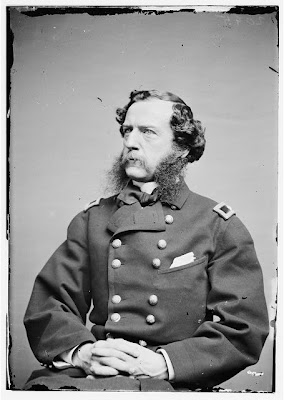
Brig. Gen. Samuel W. Crawford (courtesy of Library of Congress). Crawford was born in Franklin County, Pennsylvania in 1829. He was the surgeon in charge at Ft. Sumter during the bombardment in April 1861. Crawford joined the Union infantry and rose to brigade command by spring of 1862. He briefly led a Twelfth Corps division at Antietam until being wounded in the thigh. Following his recovery, Crawford was given command of the Pennsylvania Reserves.

On the evening of June 1, the men of the Third Brigade under Col. Joseph W. Fisher marched out of the city "to the sounds of martial music." (Columbia Spy, June 6, 1863.) The soldiers "were in fine spirits," and "cheered as they passed through [the] streets, glad again to be in the field." (Phila. Press, June 2, 1863.) Spectators along the sidewalk and in hotel windows echoed the soldiers' hurrahs for Ulysses S. Grant, Joseph Hooker, George B. McClellan, William Rosecrans, and other generals. (Columbia Spy, June 6, 1863.)

Rallying to the Defense of the Keystone State

Events soon took an alarming turn. As talk of a Confederate invasion of Pennsylvania spread, the Reserves grew anxious to leave Northern Virginia and defend their native soil against Lee's army. According to one regimental history, the thought of remaining behind in the defenses of Washington "was rather mortifying." (Woodward, Our Campaigns, 259.) Officers made entreaties to Washington and Harrisburg to have the Reserves return to the field along with the Army of the Potomac. In one instance, the commander of the 2nd Pennsylvania Reserves and his fellow officers petitioned Col. William McCandless, head of the First Brigade:
We, the undersigned. . . having learned that our mother State has been invaded by a Confederate force, respectfully ask, that you will, if it be in your power, have us ordered within the borders of our State, for her defence. 
. . . we have more than once met and fought the enemy, when he was at home. We now wish to meet him again where he threatens our homes, our families and our firesides. 
Could our wish in this behalf be realized, we feel confident that we could do some service to the State that sent us to the field, and not diminish, if we could not increase, the lustre that already attaches to our name. (Woodward, Our Campaigns, 260.)
McCandless received the petition on June 17 and "forwarded it through the proper channel to Washington." (Woodward, Our Campaigns, 259.) Meanwhile, Gens. John F. Reynolds and George G. Meade, who had both led the Reserves through the bloody trials of 1862, requested that the War Department transfer the division to their respective army corps. (See, e.g., Sypher 448; Thomson & Rauch 260; Woodward, The Third Reserve, 226.)

Col. William McCandless (courtesy of PRVC Historical Society).
At Last! -- Rejoining the Army of the Potomac

The fate of the Reserves became part of the larger question of reinforcing Hooker as he chased down Lee's army. General-in-Chief Henry W. Halleck, worried about keeping the nation's capital safe from a possible Confederate advance, maintained a tight grip on the soldiers belonging to the defenses of Washington. (Coddington 96.) In the end, Halleck relented and agreed to send Hooker around 8,400 infantry reinforcements, including two brigades of the Pennsylvania Reserves. (Sears 220.)**

Late on June 23, Hooker directed Crawford "to hold [his] command in readiness to move at very short notice," with ten days' subsistence. (OR, 1:27:3, 273.) Pickets were to remain posted "until further orders." (OR, 1:27:3, 273.) Less than two days later, Hooker put the Reserves in motion to catch up with the rest of the army, which was already in pursuit of Lee. At 9:30 in the morning on June 25, Crawford was directed to "march with your command to-day, via the Leesburg turnpike, to Edwards Ferry, and, if possible . . . cross the river at that point, should you reach the Ferry in season." (OR, 1:27:3, 309.)

Not long afterwards, Hooker was shocked to learn from Crawford that John P. Slough, military governor of Alexandria, had detained the Second Brigade of Pennsylvania Reserves. He fired off a note to Halleck, demanding that "General Slough be arrested at once" and promising that "charges will be forwarded as soon as I have time to prepare them." (OR, 1:27:1, 56.) Hooker sharply warned Halleck, "You will find, I fear, when it is too late, that the effort to preserve department lines will be fatal to the cause of the country." (OR, 1:27:1, 56.) The General-in-Chief wasted no time in brushing aside Hooker's request:
The Second Brigade, to which you refer in your telegram, forms no part of General Crawford's command, which was placed at your orders. No other troops can be withdrawn from the Defenses of Washington. (OR, 1:27:1, 57.)  
That same day, the First and Third Brigades struck camp and began their march from Fairfax Station and Upton's Hill.*** The soldiers proceeded as far as the area around Vienna, where they bivouacked for the night. (OR, 1:27:1, 143; Woodward, Our Campaigns, 261). Early the next morning the Reserves resumed their march. The Pennsylvanians moved up the Leesburg-Alexandria Turnpike, past Dranesville, where many of them had first experienced battle.**** A "violent and constant" rainfall turned the roads into "almost knee-deep" mud. (Woodward, Our Campaigns, 261.) Despite such miserable conditions, the division reached Goose Creek that night. (OR, 1:27:1, 143.) At daylight on June 27, the Reserves headed a short distance to the Potomac and crossed the river at Edwards Ferry via pontoon bridge. (OR, 1:27:3, 353.) The division pushed through Maryland and arrived that night at the mouth of the Monocacy River, "in spite of the heavy roads." (Woodward, Our Campaigns, 261; see also OR, 1:27:1, 143.) Finally, on June 28, the Reserves crossed the Monocacy and marched to Ballinger's Creek near Frederick, where they joined the Fifth Corps. (OR, 1:27:1, 144; Hardin 141.)***** By the time the Reserves caught up with the Fifth Corps, Meade had taken command of the Army of the Potomac, and Gen. George Sykes had replaced him at the head of the corps.

Detail of Edwards Ferry, Goose Creek, and vicinity from 1862 Union Army map of Northeastern Virginia (courtesy of Library of Congress).  The Leesburg Turnpike, also visible here, served as the Pennsylvania Reserves main route of march to the crossing at Edwards Ferry.
The Pennsylvania Reserves continued their movement northward through Maryland and into Pennsylvania. The division arrived at Gettysburg on July 2 during the second day of the battle. That evening, the First Brigade drove into the Plum Run Valley and beat back an assault by troops from James Longstreet's corps on the Union left near Little Round Top. Crawford himself seized the colors and led the charge. The division's overall losses at Gettysburg stood at 26 killed, 181 wounded, and 3 missing. (OR, 1:27:1, 180.) The Reserves had proven their mettle once again and made a contribution to the Confederate defeat. Before long, the Pennsylvanians would return with the rest of the army to the familiar soil of the Old Dominion. In this war, there was no staying away.

Notes

*The 11th Pennsylvania Reserves of the Third Brigade were still stationed in Northern Virginia in June, most likely in the vicinity of Vienna or Fairfax Station. (Gibbs 214-15.)

**The other units sent to Hooker from the Department of Washington included a brigade of New Yorkers under Gen. Alexander Hays and the Second Vermont Brigade under Gen. George Stannard. Both brigades would go on to distinguish themselves at Gettysburg. Halleck also agreed to furnish a division of cavalry under Gen. Julius Stahel, as well as artillery units, including the 9th Massachusetts Battery.

***The drive to replenish the ranks of the Reserves while in the defenses of Washington met with little success. (Gibbs 213; Thomson & Rauch 256-57.) The two brigades that set out on June 25 totaled just 3,817 officers and men. (Coddington 98.)

****The Battle of Dranesville took place on December 20, 1861, and pitted a brigade of the Reserves against J.E.B. Stuart's Confederates.

*****The Pennsylvania Reserves officially became the Third Division of the Fifth Corps.

Sources

Aside from the Official Records, the following sources were useful in compiling this post:

Civil War in the East (on-line database); Edwin B. Coddington, The Gettysburg Campaign: A Study in Command (1979 ed.); Columbia Spy, June 6, 1863; Joseph Gibbs, Three Years in the Bloody Eleventh: The Campaigns of a Pennsylvania Reserves Regiment (2002); Martin D. Hardin, History of the Twelfth Regiment Pennsylvania Reserve Volunteer Corps (1890); Harrisburg Daily Patriot and Union, June 27, 1863; Philadelphia Press, June 2, 1863; Stephen W. Sears, Gettysburg (2003); Jeffrey F. Sherry, "The Terrible Impetuosity: The Pennsylvania Reserves at Gettysburg," Gettysburg Magazine, Issue No. 16, Jan. 1, 1997 (courtesy of P.R.V.C. Hist. Soc.); J.R. Sypher, History of the Pennsylvania Reserve Corps (1865); O.R. Howard Thomson & William H. Rauch, History of the "Bucktails" (1906); Evan M. Woodward, History of the Third Pennsylvania Reserve (1883); Evan M. Woodward, Our Campaigns (1865).

Additional Reading

An excellent and detailed account of the Pennsylvania Reserves' march from Upton's Hill/Fairfax Station to Edwards Ferry, including maps, can be found here, at Craig Swain's Civil War blog, To the Sound of the Guns. Also be sure to check out Craig's on-going series of posts on the march of the Union army through Loudoun County in the days prior to Gettysburg.

For the full story of the Pennsylvania Reserves at Gettysburg, see "The Terrible Impetuosity: The Pennsylvania Reserves at Gettysburg," by James Sherry in Gettysburg Magazine, Issue No. 16, Jan. 1, 1997.

Thursday, May 23, 2013

The Pennsylvania Reserves in Northern Virginia 1863, Part IV: Daily Life in the Department of Washington

Today's post marks the final installment in my series on the Pennsylvania Reserves in Northern Virginia during the first half of 1863. The veteran division from the Keystone State arrived in Alexandria at the start of February 1863. The Union Army had sent the men to the Department of Washington to rest and recruit away from the front lines. As I wrote last week, the Reserves spent a lot of time on picket, fatigue, and guard duty. The constant threat of attacks by Confederate guerrillas made the work a little less than pleasant, but the men otherwise settled into the daily routine of camp life.

The weather proved uncooperative during the Reserves' first few months in Northern Virginia. As Richard Woolworth of the 4th Pennsylvania Reserves told his sister on March 22, "[s]now, hail, rain and sunshine alternately make the walking very disagreeable. We have been hoping for a change for the better but have been disappointed." A regimental history of the Bucktails recalled:
The winter. . . was remarkably severe, snow alternating with heavy rain making things generally uncomfortable. Even as late as March 31st, eighteen inches of snow were recorded; nor was this the last fall, as on April 5th, another heavy snow storm obstructed the camp. (Thomson & Rauch 245.)
All of the wet weather made for hard marching. The 2nd Pennsylvania Reserves broke camp on March 28 and headed for Fairfax Station. The distance was just four miles, but constant downpours had turned the road into a nearly impassable mess. The men "plunged through the mud up to their knees" and labored for several hours to reach their destination. (Woodward 256.) Towards the end of April, the weather began to show signs of improvement. Americus Murray of Co. H, 4th Pennsylvania Reserves told his cousins that on April 21, "[t]he Weather is pleasant and warm, the buds are opening, and the grass is growing very nicely, and I hope that we have had our last cold storm for this Spring."

Despite all of the miserable weather, the men reported generally healthy conditions in camp. Private Lewis Prall of Co. A, 1st Pennsylvania Reserves, informed his sister on March 16, "There is not much sickness here now. There is no cases of smallpox around here. All the boys are well and lively." Woolworth of the 4th felt much the same. He noted to his sister on March 22 that "we mostly enjoy good health." Of the sixteen sick soldiers, most were "very trifling cases." One man, who appeared "very low spirited" and "home sick," was sent to his family. The Bucktails, meanwhile, suffered from an outbreak of smallpox, but "the cases were few and the disease did not spread." (Thomson & Rauch 246.)

Soldiers' letters back home testify to relatively comfortable conditions in camp. Prall of the 1st Pennsylvania Reserves told his sister in March:
We have a good tent with a large fireplace in it and have six woolen blankets over us. We sleep warm at night. We get plenty to eat. We get fresh bread 3 times a week, also fresh beef besides sugar, coffee, crackers, rice, beans, salt pork, salt beef, and several other things. We have plenty to wear and will soon have plenty of money – we expect to get paid this week.
Sgt. Thomas Dick, Co. A, 12th Pennsylvania Reserves wrote to his brother on March 6 that "[w]e have comfortable quarters plenty of soft br[ea]d fresh beef and other things in proportion." Family members also supplemented the soldiers' victuals with packages from home. At the end of March, Prall "went to Alexandria to the express office and brought up 21 boxes for the regiment," including his own. The contents of Prall's package were "in good order" and "nothing was spoiled, except two or three pies was a little moldy."

Camp of the 1st Pennsylvania Reserves (30th Pennsylvania Infantry) near Fairfax Court House, June 1863 (courtesy of fold3.com; information on photo from MOLLUS-Massachusetts Civil War Photographs, U.S. Army Heritage & Education Center). 
Like all soldiers, the men of the Pennsylvania Reserves found a variety of ways to pass their down time in camp. Reading and letter writing were popular. The soldiers also bet their paychecks on card games like poker. Prall turned to a more productive past time and whittled rings from wood to send to his mother and little sister. Col. Charles Taylor of the Bucktails, who would soon fall at Gettysburg, sponsored a target shooting contest and offered a fifty cent prize to the winner. Some of the Reserves spent their free time playing baseball. Sgt. Dick of the 12th Reserves seemed rushed to finish a letter to his sister so he could enjoy the weather and check out the friendly athletic competition:
For it is such a beautiful day outside, that I can scarcely content myself to remain indoors while I write it. I can hear the loud shouts of the boys who are engaged at a game of ball while I write.
Some soldiers also took advantage of the proximity of the nation's capital. Murray of the 4th Reserves wrote to his cousins of an April trip to Washington City:
I have been in Washington to day and visited some places of interest. It is a grand sight to go over the Capitol grounds and view that noble structure, which is not yet finished, and will not be for a number of years yet. The Capitol is built of marble, and when completed will be one of the finest buildings in the world. The Capitol grounds are at present covered with a growth of fresh green grass; the parks contain a great variety of trees and shrubs, which are just putting forth their green leaves. The avenues and promenades are bordered by a great variety of flowers, many of which are already in full blossom.
A wartime view of Washington showing the unfinished Capitol dome and Trinity Episcopal Church, c. 1863 (courtesy of The Atlantic). Such sights awaited the men of the Pennsylvania Reserves who visited Washington City.
Camp life also provided time for quiet reflection. Sgt. Dick spoke for many in the Reserves when he wrote to his brother on March 6 about the sacrifices of the past year:
Our company presents quite a different appearance now to what it did when we were here before It is but a skeleton of its former self. We now draw rations for over 40 men. how does that compare with last winter when we drew rations for over 90 men; and the missing where are they? The bones of some of them black in the blood stained soil of the peninsula: Some of them repose on the disastrous plains of manasses; While others who fell at south mountain and antietam received a decent burial in the faithful old state of Maryland. I thought I had done. But others yet who perished at Fredericksburg go to swell the number in the graveyard of Virginia. There are others still who may be classed among the missing of Co H. some of them are languishing in the hospitals that have become so common in our land and others I suppose you see almost daily: some with their arms hangings powerless by their sides; and others with their limbs bent in an uncomely shape. and some with an empty coat sleeve that shows to plainly that they were members of the glorious old reserve.
Dick was all too aware of the toll that the war had taken. As he and the other soldiers continued their duty in front of Washington, an even bigger fight loomed on the horizon. Before long, many of these same men would be marching off to defend their home soil against Robert E. Lee's Confederates.

Sources

Ltr. from Thomas Dick to Brother, Mar. 6, 1863; Ltr. from Thomas Dick to Sister, Mar. 25, 1863; Ltr. from Americus Murray to Cousins, Apr. 19, 1863; Ltr. from Lewis Prall to Sister, March 16, 1863; Ltr. from Lewis Prall to Unknown (likely Sister), Apr. 1, 1863; Ltr. from Richard Woolworth to Sister, Mar. 22, 1863; O.R. Howard Thomson & William H. Rauch, History of the "Bucktails" (1906); Evan M. Woodward, Our Campaigns (1865).

Spelling and grammar are as in the original letters.

I would like to thank the Pennsylvania Reserve Volunteer Corps Historical Society for publishing all of the letters referenced in this post. This group is doing invaluable work to preserve the story of the Reserves. Please check out the society's website and lend your support.

Thursday, May 16, 2013

The Pennsylvania Reserves in Northern Virginia 1863, Part III: Military Duties in and Around Washington

Following a brief interlude, I return this week to the story of the Pennsylvania Reserves in Northern Virginia during the first half of 1863. The hard-fighting division had suffered heavy losses in the bloodletting of the previous year. Generals and politicians lobbied tirelessly to have the Reserves sent back to the Keystone State to recuperate and fill their ranks with new recruits. (See Part I.) In the end, the Union Army settled on an alternative course of action designed to accomplish the same goals. (See Part II.)

At the start of February 1863, the division's three brigades boarded transports at Belle Plain, Virginia and headed up the Potomac.* The Reserves were slated to join the newly-formed 22nd Corps of the Department of Washington, composed of soldiers who were assigned to the defense of the nation's capital. On February 7, the Pennsylvanians disembarked at the port of Alexandria and marched towards their old campgrounds around Fairfax Seminary.

Orders finally came on February 10. (OR, 1:51:1, 985.) Gen. Samuel P. Heintzelman, commander of the Department of Washington, directed the First Brigade to proceed to Fairfax Courthouse. The Second Brigade was ordered to Upton's Hill, while the Third Brigade was to occupy Minor's Hill.** The Reserves performed a variety of tasks, from the mundane to the downright dangerous.

Gen. Samuel P. Heintzelman, commander of the Department of Washington and 22nd Corps (courtesy of Wikimedia Commons).
The experience of the 2nd Pennsylvania Reserves was typical of the regiments assigned to the area around Fairfax. The 2nd took the Orange & Alexandria Railroad from Alexandria to Fairfax Station on February 12 and established camp near Fairfax Court House. On February 21 the men received orders to guard the fords across Bull Run. The 2nd's picket line stretched for seven miles. As one regimental historian described duty there:
Our posts at the fords were almost nightly visited by the guerrillas, who exchanged a few shots with the pickets and disappeared. When a shot was fired, not knowing the strength or object of the enemy, the reserve at the post was turned out, and as this occurred several times through the night, the men's sleep was constantly liable to be disturbed. This tour of duty lasted sixteen days, and we were all glad when it was over. (Woodward, Our Campaigns, 254.)
During the night of March 8, the 2nd Reserves proceeded to Union Mills and the next day returned to camp at Fairfax. By March 16, the regiment was on the move again. This time they were assigned to dig rifle pits outside town along the road to Centreville. Finally, on March 28, the 2nd marched four miles to Fairfax Station, where the men established a more permanent camp. As May got underway, the partisan rangers became more active, and the 2nd had to contend with intensified attacks on the picket lines and the railroad around Fairfax.

The Bucktails, also from the First Brigade, proceeded to Fairfax on February 12. Here they engaged in picket and scouting duty, dug rifle trenches, cut trees, and buried dead horses. On the night of March 8, Confederate ranger John Mosby captured Gen. Edwin Stoughton in a raid on Fairfax. Accordingly, "to guard against a repetition of such a humiliating experience, the Bucktails were ordered to move their camp closer to the village." (Thomson & Rauch 47.) A regimental history claims that due to this precautionary measure, "Mosby's Rangers did not again penetrate the Union line in that vicinity" while the Bucktails were in Fairfax. (Thomson & Rauch 247.)

The 4th and 7th Pennsylvania Reserves performed guard duty at Camp Convalescent, a few miles from Alexandria along Four Mile Run.*** This massive facility was home to thousands of soldiers recovering from wounds and illnesses. Camp Convalescent consisted of fifty barracks as well as officers' quarters, dining rooms, cook houses, and hospitals.

Period engraving of Camp Convalescent, outside of Alexandria (courtesy of NYPL Digital Gallery). The camp was new when the Pennsylvania Reserves arrived for guard duty in early 1863. The conditions at the previous camp had become so bad that it earned the nickname, "Camp Misery."
Regiments from the Third Brigade were also detailed to areas outside Minor's Hill. The 11th Pennsylvania Reserves encamped in Vienna near the Alexandria, Loudoun & Hampshire Railroad. Private Lindley H. Addleman described the daily routine in a letter to his sister:
. . .we halve been doing fatigue duty pretty near every day since we came but it is easy [work] Some days we load carrs with cordwood and Some days we on load hay oats and corn and rashions for the cavalry well that is what we halve to do beside camp guarding. (Spelling and grammar as in original.)
The 12th Pennsylvania Reserves were assigned to a spot near the railroad bridge over Bull Run in February and early March. Sergeant Thomas Dick of Company H seemed far from bothered by his routine. As he told his brother in a February 22 letter, "[o]ur duty is not very arduous here." Dick came on duty "about once a week . . .to guard the railroad." The sergeant seemed almost nonchalant about the risks involved:
Have nothing to annoy us but the guerrillas They pop one over occasionally. Major Larimer of the 5th was killed a short time ago while leading a skirmishing party. (Grammar as in original.)
New orders arrived on April 19. Heintzelman directed the Second Brigade, "except the detachment now on duty at the Convalescent Camp," to "report without delay to Brigadier General John P. Slough, military governor of Alexandria." (OR, 1:51:1, 1008.) The commander kept the 11th Pennsylvania Reserves in Vienna, but ordered the remainder of the Third Brigade to report immediately to Gen. J.H. Martindale, the military governor of Washington. The First Brigade remained in Fairfax Court House and environs.

The 3rd Pennsylvania Reserves, along with other regiments in the Second Brigade, contributed to the defense of Alexandria. Following the Union defeat at Chancellorsville in May, earthworks were erected around the city. The 3rd encamped about a mile from the fortifications. An alarm was raised "a number of times, but no enemy appeared." (Woodward, The Third Reserve, 226.) Moreover, "upon several occasions," the regiment acted "as a guard to the railroad trains carrying forage to [Joseph] Hooker's army, they going as far as Warrenton Junction." (Woodward, The Third Reserve, 226.)

The regiments of the Third Brigade performed provost duty in Washington. The men maintained order and guarded Confederate prisoners and U.S. Government property. Private Benjamin Addleman of the 10th Pennsylvania Reserves and Lindley's brother, was quartered in barracks on East Capitol Hill. In a May 12 letter to his sister, Benjamin reported that "there has been a great many prisoners fetched to Washington from the army of the Potimack." Just the other day, he "helpt to fetch 795 rebls from the wharf. . . ." (Spelling and grammar as in original.) Thomas Dick of the 12th guarded Old Capitol  Prison at the end of May. As he told his sister, "we are off duty two days and on one: It is very nice duty."

Old Capitol Prison, Washington, DC (courtesy of Wikimedia Commons). The building served as the temporary meeting place for Congress (1815-19) after the British burned the Capitol during the War of 1812. Old Capitol Prison held Confederate sympathizers, spies, and prisoners of war. The Supreme Court now sits on this location east of the U.S. Capitol.  
By the start of June 1863, the three brigades of the Pennsylvania Reserves were scattered across Northern Virginia and Washington. Since arriving in February, the Pennsylvanians had fended off attacks by partisan rangers, built entrenchments, and performed other necessary but mundane tasks. As one history of the Reserves summed up military life during that time, "picket duty here [was] more arduous than it was with the Army of the Potomac, and altogether the duties were no lighter nor the quarters any better than they were in the active army." (Hardin 137; see also Sypher 434; Thomson & Rauch 245; Woodward, The Third Reserve, 226.) Men like Thomas Dick and Lindley Addleman, however, may have begged to differ. Whatever the case, much harder days were only a month away for many of the soldiers.

Notes

*The Pennsylvania Reserves were under the overall command of Col. Horatio G. Sickel. The First Brigade, led by Col. William McCandless, was composed of the 1st, 2nd, 6th, and 13th (Bucktails) Pennsylvania Reserves. The Second Brigade, under Col. Henry C. Bolinger, was composed of the 3rd, 4th, 7th, and 8th Pennsylvania Reserves. The Third Brigade, under Col. Joseph W. Fisher, was composed of the 5th, 9th, 10th, 11th, and 12th Pennsylvania Reserves.

**Upton's Hill sits on the Arlington County-Fairfax County boundary. Minor's Hill is a bit farther to the northwest and also straddles the border between the two counties. Both eminences are to the east of Falls Church and northwest of Alexandria. For a period map, see here.

***Camp Convalescent sat on land belonging to the present-day Army-Navy Country Club in Arlington County.

Sources

"Brief History of the 7th Pennsylvania Reserves (36th Infantry)," from Samuel Bates, History of the Pennsylvania Volunteers, 1861-1865 (1869-71) (courtesy of Pa. Res. Hist. Soc.); "Brief History of Company B, 7th Reserves, 'The Biddle Rifles,'" Perry County in the Civil War (courtesy of Pa. Res. Hist. Soc.); James G. Barber, Alexandria in the Civil War (1988); Civil War in the East (on-line database); Joseph Gibbs, Three Years in the Bloody Eleventh: The Campaigns of a Pennsylvania Reserves Regiment (2002); Martin D. Hardin, History of the Twelfth Regiment Pennsylvania Reserve Volunteer Corps (1890); Ltr. from Benjamin P. Addleman to Sister, May 12, 1863 (courtesy of Pa. Res. Hist. Soc.); Ltr. from Lindley H. Addleman to Sister, Apr. 30, 1863 (courtesy of Pa. Reserves Hist. Soc.); Ltr. from Thomas W. Dick to Brother, Feb. 22, 1863 (courtesy of Pa. Reserves Hist. Soc.); Ltr. from Thomas W. Dick to Sister, May 31, 1863 (courtesy of Pa. Res. Hist. Soc.); Ltr. from Americus Murray to Cousins, Apr. 19, 1863 (courtesy of Pa. Reserves Hist. Soc.); "Other Government Buildings: Old Capitol Prison," Mr. Lincoln's White House (website); J.R. Sypher, History of the Pennsylvania Reserve Corps (1865); O.R. Howard Thomson & William H. Rauch, History of the "Bucktails" (1906); Evan M. Woodward, History of the Third Pennsylvania Reserve (1883); Evan M. Woodward, Our Campaigns (1865).

Friday, April 19, 2013

The Pennsylvania Reserves in Northern Virginia 1863, Part II: Farewell to Hooker's Army

As I wrote in my last post, the Pennsylvania Reserves faced a somewhat uncertain future at the start of 1863.  The division had experienced tremendous losses during the bloody battles of 1862.  Gen. George G. Meade, a former commander of the Reserves, took up his old division's cause and pushed to have the Reserves sent back to Pennsylvania to recruit and reorganize.  Pennsylvania's Governor, Andrew Curtin, likewise urged the Lincoln Administration to allow the Reserves to return temporarily to the Keystone State.  These pleas went unheeded at army headquarters, and the Pennsylvanians soon joined the rest of Ambrose Burnside's men on the ill-fated "Mud March."

A Plan is Hatched

By the end of January, the situation began to look brighter for the hard-fought Pennsylvanians.  Gen. Joseph Hooker, the new commander of the Army of the Potomac, and General-in-Chief Henry W. Halleck finally agreed on a plan to deal with the manpower problems facing the Reserves.  The division was to be detached from the Army of the Potomac and sent to the defenses of Washington in exchange for a like number of Pennsylvania troops then stationed around the capital.  (OR, 1:25:2, 12.)  The Pennsylvania Reserves would return to the front once they had some time to replenish their ranks and recover from combat duty.  Gen. Samuel P. Heintzelman, head of the Department of Washington, was less than enthusiastic about the idea.  He worried that the Reserves were ill-equipped for provost duty in Washington given that "some of the companies are commanded by sergeants and corporals."  (OR, 1:25:2, 10.)  Heintzelman told Halleck, "I fear that the exchange cannot be made with any benefit to the service in my command."  (OR, 1:25:2, 10.)  Whatever his objections, however, Heintzelman would have no choice but to accept his superior's decision.

Gen. Joseph Hooker (courtesy of Wikipedia)

Meanwhile, the men in the ranks began to hear rumors about their imminent departure for Washington.  A soldier from Co. H, 6th Pennsylvania Reserves wrote on January 28 to his hometown paper, "[W]e – that is the old regiments of the Pennsylvania Reserve Corps of Volunteers – are soon to be relieved from the front (where they have always been found), by the troops now stationed in and about Washington, while we are to take their place."  (Wellsboro Agitator, Feb. 11, 1863.)  He felt that the division was "not in the least dissatisfied with the arrangement, altho’ we wish to have no men see the service that the Reserves have been obliged to."  (Wellsboro Agitator, Feb. 11, 1863.)  Sgt. Thomas W. Dick of Co. H, 12th Pennsylvania Reserves, informed his brother of "reliable information to the effect that we are going back to Washington to rest and recruit."  (Ltr. from T.W. Dick to Brother, Feb. 2 1863.)  Dick  approved of the plan, telling his brother, "its what should have been done before this There is now but a miserable remnant of the gay old division that marched from [Camp] Pierpont last spring."  (Ltr. from T.W. Dick to Brother, Feb. 2 1863) (grammar as in original)

Orders!

On February 5, Hooker finally issued orders to transfer the Pennsylvania Reserves.  (OR, 1:25:2, 49-50; 52-53.)  He instructed Gen. John F. Reynolds, head of the First Corps, to send the division to Alexandria with instructions to report to Heintzelman for orders.  Hooker added that "[t]he sick and all the baggage of the troops should be taken with them."  (OR, 1:25:2, 50.)  The chief quartermaster would "furnish the transportation," although Hooker told Reynolds that "[t]he details of the embarkation are left with you, with reliance upon your energy and attention."  (OR, 1:25:2, 50.) 

That same day, Reynolds issued an order directing the Pennsylvania Reserves to embark at Belle Plain for Alexandria, "as soon as transportation is furnished."  (OR, 1:51:1, 981.)  The 121st and 142nd Pennsylvania, who were not part of the original Pennsylvania Reserve Volunteer Corps, were ordered to remain behind, along with three artillery batteries.  Reynolds informed the men that they would receive three days' cooked rations for the trip north.  He finished his order on a sentimental note:
In separating from the Pennsylvania Reserve Corps, with which the commanding general has been so closely allied for the past eighteen months, he cannot but express his deep regrets. They are, however, lessened by the hope that soon their thinned ranks will be filled, and they, once more restored and reorganized, will be returned to the field prepared to add new luster to a name already endeared to our patriotic State.  (OR, 1:51:1, 981-82.) 
Wartime view of Belle Plain, Virginia on Potomac Creek (courtesy of Library of Congress)
The men of the Pennsylvania Reserves received news of their impending move with enthusiasm.  According to one regimental history, "[i]n despite of the cold rain the camp-fires were soon brightly burning, around which the boys gathered and talked of the good times coming until late at night."  (Woodward, Third Reserve, 224.)  The next afternoon, February 6, the division struck camp and marched about four miles to Belle Plain on Potomac Creek. The journey lasted well into the evening due to the wet and muddy conditions.  The First Brigade boarded transports during the night and headed up the Potomac.  The Second and Third Brigades set out for Alexandria in the morning.  As the men arrived at the wharves along the river, they must surely have felt a sense of relief to leave behind life at the front, if only for a little while.

Postscript

The transfer of the Reserves soon became mired in a dispute between Hooker and Washington.  Gen. Abner Doubleday, who assumed command of the Pennsylvania Reserves for a short while in the middle of January, had gone to the capital to oversee arrangements for the exchange. (OR, 1:51:1, 974.)  After the division arrived in Washington, Doubleday reported to Hooker that "[t]he Pennsylvania regiments given in place of the Reserves do not contain as many men as the latter brought here."  (OR, 1:25:2, 63.)  He concluded that there was "a deficiency of about 250 men."  (OR, 1:25:2, 63.)  Hooker fired off a dispatch to Halleck on February 10,  insisting that "this deficiency be made up, and that General Heintzelman be directed to send the full number, according to the understanding, viz, the same number of men as were returned in the Pennsylvania Reserves."  (OR, 1:25:2, 63.) Halleck tersely replied that "[r]egiments cannot be broken up in order to exactly equalize."  (OR, 1:25:2, 63.)

Hooker wouldn't let the shortfall go.  He pressed his cause with Heintzelman directly.  (OR, 1:25:2, 69-70.)  The commander of the Washington defenses informed Hooker that he had been told to exchange the Reserves for Pennsylvania troops only and that some of some of the soldiers designated for the Army of the Potomac had been detained in Washington for reasons beyond his control.  He had no more to give.  Heintzelman alleged that "[t]he numbers at my disposal were well understood by General Doubleday when he made the application."  (OR, 1:25:2, 83.)

Hooker next unleashed his wrath on Doubleday, demanding that he "report what agreement was entered into by you with General Heintzelman with regard to the exchange of the Pennsylvania Reserves."  (OR, 1:25:2, 87.)   Doubleday insisted that he had done nothing wrong, claiming that "no special agreement was entered into" between him and Heintzelman.  (OR, 1:25:2, 90.)   He told Hooker:
It was understood that I was to have an equal number of men with those I furnished. I never supposed I should have a less number until the Reserves had actually arrived in Alexandria, and a report of their number was laid before General Heintzelman. He then informed me that the aggregate would be less than that furnished by some 230 men.  (OR, 1:25:2, 90.)
Doubleday also took offense at Hooker's accusation that he had not given his personal attention to the matter, explaining that he had "visited General Heintzelman's office every day, and frequently several times a day, in relation to it," and "was also a daily visitor at the Adjutant-General's Office of the General-in-Chief" concerning the exchange.  (OR, 1:25:2, 90.)  Heintzelman received a copy of Doubleday's response, but when all was said and done, Hooker turned his attention to more pressing matters.   Meanwhile, the Reserves prepared for duty on the picket line in front of the capital.

Up Next:  Military duties in front of Washington.

Sources

Aside from the Official Records, the following sources were useful in compiling this post:

John H. Eicher & David J. Eicher, Civil War High Commands (2001); Joseph Gibbs, Three Years in the Bloody Eleventh: The Campaigns of a Pennsylvania Reserves Regiment (2002); Ltr. from T.W. Dick to Brother, Feb. 2 1863 (courtesy of P.R.V.C. Historical Society); J.R. Sypher, History of the Pennsylvania Reserve Corps (1865); Wellsboro Agitator, Feb. 11, 1863 (courtesy of P.R.V.C. Historical Society); Evan M. Woodward, History of the Third Pennsylvania Reserve (1883); Evan M. Woodward, Our Campaigns (1865).