Showing posts with label Ft. Ward. Show all posts

Wednesday, July 16, 2014

An Excursion to Ft. Ward for the 150th of Early's Raid on Washington

Last week marked the 150th anniversary of the Confederate raid on Washington. The National Park Service and local governments hosted a multitude of events to commemorate Gen. Jubal Early's daring advance into Maryland, his victory at Monocacy, and his failed attack on Ft. Stevens. I have been pretty busy recently, so I wasn't sure what, if anything, I could attend.  That said, I managed to find some time this past Sunday to go with my twin boys to the Ft. Ward Museum and Historic Site in Alexandria, which was holding a living history weekend to observe the Sesquicentennial of the Battle of Ft. Stevens. The fort is one of my all time favorite Civil War sites in the Washington area. I've seen a lot of living history events these past few years, but this one promised some great photo-ops and featured a concert by the renowned Federal City Brass Band. My boys also like the place as much as I do, and I thought they'd enjoy seeing and learning a few things about the Civil War while Mom was away at a meeting.

The camp of Co. K, 3rd U.S. Infantry, just outside the reconstructed gate of Ft. Ward.
The boys meet President Lincoln and Mary Todd.  Given that Old Abe personally observed the Battle of Ft. Stevens, I suppose you could say that his attendance at the event was a prerequisite!
Stacked rifles of Co. F, 2nd Rhode Island Infantry.
A view of the camp of Thompson's Independent Battery C near Ft. Ward's reconstructed northwest bastion. The howitzer seen here is usually positioned on an emplacement inside the bastion, but was moved to make way for a firing replica used in Saturday's reenactment of the Battle of Ft. Stevens.
Thompson's Battery's very own Parrott gun and limber inside the fort's northwest bastion.
Looking at the interior of the reconstructed northwest bastion. I never get tired of this site -- no other place related to the Defenses of Washington can compare!

Union reenactors from the 3rd U.S. Infantry held a skirmish drill on the museum's lawn.  Here, an officer explains the maneuvers to the crowd.
The reconstructed officers' hut at the fort was open for viewing. 
One of the exhibits at the event featured Civil War railroads. The living historian is pictured here with his collection of Civil War-era railroad relics such as spikes and link and pin coupling.
Jack enjoys the assortment of 19th century toys, including a cup-and-ball and Jacob's ladder.
The Federal City Brass Band plays on the lawn in front of the Ft. Ward Museum building. At the start of the concert, the group struck up Hail to the Chief  as Lincoln and the First Lady took their seats at the front of the audience. The group performed a wide array of patriotic tunes, including Battle Cry of Freedom and Yankee Doodle. The sound of period brass instruments on a hot summer day carried me right back to 19th century America.

All told, the commemorative event at Ft. Ward was a pleasant way to spend a Sunday afternoon in a picture-perfect, family-friendly setting. The museum did a commendable job of putting together an informative living history program, and I am sure that Saturday's reenactment of the attack on Ft. Stevens brought the battle alive for many. Such events go a long way to helping the public connect to and understand the Civil War, including my own very curious preschoolers!

Wednesday, June 25, 2014

Odds and Ends, June 2014

That time of the year has arrived once again. I am soon off to the Bay State for my family's annual pilgrimage, meaning that I will be on vacation from the blog for a little while. I plan to fit in some antebellum and Civil War-related sightseeing while I am away and promise to report back upon my return. As always, I will remain active on Facebook and Twitter as much as I can. In the meantime, here are a few odds and ends:

*The Sesquicentennial of Jubal Early's raid on Washington is fast approaching. In that vein, there are a myriad of activities being planned at the federal and local level:
The Monocacy National Battlefield will mark the 150th of the  "Battle that saved Washington" from July 5-13. Activities include "real time" walking tours, living history demonstrations, and a "Remembrance of the Fallen" program. Additional information can be found here
The Civil War Defenses of Washington unit of the National Park Service (NPS) will be commemorating the 150th anniversary of the Battle of Ft. Stevens, where President Lincoln himself came under fire. Highlights include walks and lectures, a hike in the nation's capital from Battery Kemble to Ft. Stevens, living history encampments, and a memorial program at Battlefield National Cemetery. See here for a full schedule. This flyer from the NPS lists numerous other commemorative activities in the Washington, DC area.  
One of my favorite local Civil War parks, Ft. Ward Museum & Historic Site, is hosting a "Battle of Fort Stevens Reenactment Weekend." Groups representing Union and Confederate regiments will recreate the engagement at the reconstructed northwest bastion of Ft. Ward, which will serve as a stand-in for Ft. Stevens. More details can be found here, on the museum website.

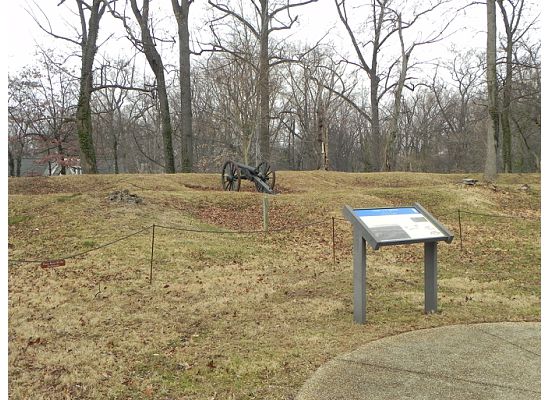
Modern view of restored portion of Ft. Stevens (courtesy of Wikipedia). The marker in front of the guns commemorates Lincoln's visit to the fort. 

*Readers may recall that I have recently written about the appointment of Lydia T. Atkinson to serve as a teacher at the contraband camp in Langley. (See here and here.) The Friends' Association for the Aid and Elevation of the Freedmen decided to send her to Camp Wadsworth upon finding egregious violations of rules governing labor by school-age children. Last month I discovered that the Friends Historical Library at Swarthmore College has Atkinson's diary from her time in Northern Virginia. I wrote to obtain copies and just received excepts on Monday. Needless to say, I am ecstatic. Atkinson's words shed some light into life at Camp Wadsworth from summer 1864 through the end of the war. I will be featuring a future post of two on the diary once I have had the opportunity to study and analyze this precious primary resource.

*And last but not least, I'd like to wish everyone a Happy Fourth of July!


Thursday, February 14, 2013

Improving Historical Interpretation at Ft. Ethan Allen

A couple years ago I took a tour of the Civil War forts of Arlington.  During the excursion, I learned that the county would be making much-needed improvements to the site of Ft. Ethan Allen, but timing seemed uncertain.  Built in the fall of 1861, the fort guarded the approaches to the strategic crossing of the Potomac River at Chain Bridge.  Today several earthworks survive and are preserved as part of Ft. Ethan Allen Park.  Unfortunately, visitors will find little in the way of interpretation aside from a couple historical markers.  (See here and here.)  All of this is about to change.

One of the existing historical markers at the entrance to Ft. Ethan Allen Park.  The remains of the fort's southern face can be seen in the background.
In 2011 Arlington provided $473,000 in funds to develop interpretive features at Ft. Ethan Allen Park.  The Arlington County Department of Community Planning, Housing, and Development has responsibility for the project, and the plans for the site were recently posted on-line.  According to a presentation by Arlington County, construction and installation of the new interpretative elements should be complete by late November 2013.  Arlington will recreate one of the fort's gun emplacements, complete with a 20-pounder Parrott.   Several markers will be placed across the site to explain different aspects of the fort, including the existing remains of the guard house, bombproof, and powder magazines.  The county will also install a 3-D model of Ft. Ethan Allen along with a memorial to the soldiers who garrisoned the fort.  If what Arlington did at Ft. C.F. Smith is any guide, we should be very excited to see the final results.

Remains of the bombproof at Ft. Ethan Allen
Arlington commissioned the project management firm Versar to conduct an archaeological survey of the impact of the planned improvements on the historic site.  The archaeologists investigated three locations where the county intends to place the interpretive features.  According to Versar's final report, the team "found little new evidence of Fort Ethan Allen’s past. . . ."  Unfortunately, "much of the ground surface has been significantly altered during the course of the 20th century."  The archaeologists discovered a few Civil War artifacts, including lead bullets, but "all of these appeared to have been moved around in the years since they were initially dropped or lost."  They also located the probable location of the fort's well, which was filled with rubble sometime last century.  Versar considered that "[t]he most significant surviving elements of the original fort appear to be the massive remains of the earthworks themselves clearly visible on the surface."  The report concluded that the interpretive elements "were unlikely to disturb any intact cultural deposits or features" and recommended that the 3-D model and memorial "be placed and constructed to avoid the well. . . ."* 

The improvements to Ft. Ethan Allen are a welcome addition to the park, which currently suffers from a lack of sufficient interpretation when compared to other local sites like Ft. C.F. Smith in Arlington and Ft. Ward in Alexandria.  Starting this fall, Ft. Ethan Allen will become an even more compelling destination in Northern Virginia for those interested in the defenses of Washington.  I will be sure to keep readers informed as the project at Ft. Ethan Allen progresses throughout the year.

Note

*One of the best parts of the report is the digital recreation of Ft. Ethan Allen and environs.  (See p. 14.)  I only wish I had such computer graphics skills!

Wednesday, May 2, 2012

Living History at Ft. Ward: The Union Army's Balloon Corps

This past weekend my parents were visiting and helping me with the boys while my wife was out of town.  I was looking for a family-friendly activity to fill Saturday morning.  (Believe me, with 22 month-old twins, it's best to get out and about.)  Lucky for us, the Ft. Ward Museum and Historic Site in Alexandria was holding a "Civil War Balloon Corps Living History Event."  So we packed into the SUV and headed to one of my favorite Civil War sites in the Washington area.

The event featured a reenactor portraying Thaddeus S.C. Lowe, the head of the Union Army's Balloon Corps.  Kevin Knapp, a retired Army officer and professional balloonist, has established a name for himself as an expert on Lowe and the military use of balloons during the Civil War.  He set up a balloon on the grounds of Ft. Ward, complete with replica gas generators and a basket draped in patriotic bunting.  The balloon is actually a 1941 Navy trainer, but bears a resemblance to the type of netted gas balloons used by Lowe and other period aeronauts.  Incidentally, Knapp is the same reenactor who made a widely-publicized appearance on the the National Mall last summer as part of a reenactmet of Lowe's June 1861 balloon demonstration for President Abraham Lincoln. 


Thaddeus S.C. Lowe (Kevin Knapp) poses in front of his balloon.  Knapp, a professional balloon pilot, brings first-hand flying experience to his interpretation of Civil War aviation.


View of the balloon attached to replica gas generators on the grounds of Ft. Ward.  Knapp explained to me that the actual balloon was used by the Navy to transition pilots from light-than-air flight to airships.  The Genesee County Village & Museum in Mumford, New York is currently building an exact replica of one of Lowe's balloons and will offer rides to visitors.

Lowe inflating his balloon Intrepid at Fair Oaks, Virginia.  Note the gas generators mounted on wagons.  The event at Ft. Ward replicated a wartime scene like the one above (courtesy of Smithsonian Air & Space Museum).
Knapp could not fully inflate the balloon due in part to the airspace restrictions around the nation's capital. That's too bad, because many spectators surely had come to see the balloon floating high above the fort and museum.  On the other hand, Knapp was on the ground and available to answer questions.  I spoke with the reenactor for a few minutes and learned quite a bit about the Balloon Corps in such a short amount of time.  I am not too familiar with the subject, and Knapp whetted my appetite to learn more.  His enthusiasm for the topic was contagious.

View of a replica gas generator used to inflate balloons in the field.  Balloonists mixed sulfuric acid and iron filings to produce hydrogen gas.  The gas flowed from the generator to the balloon.  Of course, authenticity only goes so far, and Knapp uses a cold air fan to inflate his balloon.  The two replica generators at the event were somewhat smaller than the originals because Knapp built them to fit on wagons provided to him for last year's reenactment on the Mall.

The event featured a miniature replica of a Civil War balloon, which floated above the trees at Ft. Ward.  At least spectators were able to see something in the air without Knapp and museum staff drawing the ire of the Federal authorities.
The West End of Alexandria, where Ft. Ward is located, was no stranger to military ballooning during the Civil War.  In the fall of 1861, John LaMountain, one of Lowe's rivals, obtained a job with Gen. William B. Franklin's division at Cloud's Mill, not far from Ft. Ward.  Earlier in 1861, La Mountain had served with Gen. Benjamin Butler at Ft. Monroe, but a new Federal commander there had little appreciation for aerial technology and sent LaMountain to Washington. 

John LaMountain, period engraving (courtesy of U.S. Centennial of Flight Commission)
Unlike Lowe, who tethered his balloons to the ground, La Mountain believed in free flight reconnaissance.  LaMountain may have possessed an on-site gas generator, but he also filled his balloons at a lighting gas plant in Alexandria.  LaMountain ascended at least seven times while based in Alexandria.  As he floated over Northern Virginia, LaMountain was able to observe the Confederate lines around Centreville, Manassas, and other spots.  LaMountain never fully accepted Lowe's appointment as head of the Balloon Corps and incessantly criticized his rival.  Gen. George B. McClellan eventually dismissed LaMountain for insubordination in February 1862.  (I'd like to take a closer look at La Mountain's activities in future posts.)

The fact that there is a reenactor portraying Lowe, and not LaMountain, says a lot about how we've come to remember the wartime balloonists.  I discussed with Knapp why Lowe still captures the public's imagination, while other aeronauts, like LaMountain, have drifted into obscurity. (No pun intended.)  The fact that Lowe had correspondents following his every move, and that he had friends in high places may have had something to do with ensuring Lowe's place in history.  Wartime photographers also seemed obsessed with Lowe's military operations and left a remarkable visual record for future generations.  In any event, it's refreshing to see living history events aside from battle reenactments, and Knapp's impression of Lowe helps to focus public attention on an interesting aspect of the Civil War and technology. 

Sources

Timothy J. Dennee, "John LaMountain and the Alexandria Balloon Ascensions," Historic Alexandria Quarterly, Vol. 2, No. 3, Fall 1997; U.S. Centennial of Flight Commission, "Balloons in the American Civil War;" Brett Zongker, Associated Press, "Smithsonian Recounts Balloon Flights of Civil War," June 10, 2011. 

Wednesday, March 2, 2011

Civil War Forts of Arlington Tour, Part II: Fort C.F. Smith & Fort Bennett

As I wrote in my last post, this past Saturday I went on a tour of Civil War forts sponsored by Arlington County.  Our first stop was Fort Ethan Allen, close to the Chain Bridge over the Potomac.  The group headed next to Fort C.F. Smith Park (2411 24th Street N., Arlington VA 22207), where our guide, David Farner, is park manager.  The 19-acre park contains the remains of Fort C.F. Smith, as well as a walking trail, ornamental peace garden, and bird creek.  A 20th-century mansion on the grounds can be rented for weddings and other occasions.  The property was purchased by Arlington County in the mid-1990s.  This move prevented the site from falling into the hands of private developers who may have been less inclined towards preserving and interpreting the history of the property. 

Fort C.F. Smith

The Union Army built Fort C.F. Smith in early 1863 to extend the "Arlington Line" of forts in Alexandria (now Arlington) County to the Potomac River.  This installation, together with Forts Strong, Morton, and Woodbury, served to protect the Chesapeake & Ohio (C&O) Canal crossing at Aqueduct Bridge, near the current day Key Bridge.  Fort C.F. Smith also covered a tributary ravine of Spout Run that was not under the protection of Fort Strong's artillery.

The fort, built as a lunette with a west and south face, had a perimeter of 368 yards.  Of the two faces, only part of the west wall remains.  Although there were emplacements for 22 guns and four siege mortars, just16 guns and four mortars were installed.  Various buildings, including the mess hall, barracks, and officers' quarters were erected to the east of the fort, but these structures were torn down after the war, and no traces remain.  Fort C.F. Smith was garrisoned by troops from several regiments, including the 2nd New York Heavy Artillery, the 1st New Hampshire Heavy Artillery, and the 4th Massachusetts Heavy Artillery.
 
The fort was built on land belonging to Thomas Jewell.  The Union Army wrecked Jewell's home, which was painted a distinct red, to make way for the fort.  Initially called the "Fort at Red House," the fort was named after Major General Charles Ferguson Smith, who commanded soldiers under Ulysses S. Grant at Fort Donelson in February 1862. As the defeated Confederate force prepared to surrender, Smith advised that Grant ask the enemy for nothing less than "unconditional and immediate surrender." Grant obliged, and the "Unconditional Surrender" nickname stuck with Grant throughout the remainder of the war.  Smith died of complications from a seemingly minor non-combat leg injury in April 1862.
 

Major General C.F. Smith (courtesy of the Library of Congress)

Several features of Fort C.F. Smith are still visible, including the west wall and ditch, north magazine, gun platforms, and bombproof. 

Looking towards the west wall and gun platforms.  A replica M1841 6-pounder occupies one of the emplacements. Visible in the foreground is a Civil War Trails marker, one of four historical markers on the property.

Co. F, 2nd New York Heavy Artillery along the west wall, August 1865.  This photograph was taken from the north magazine (courtesy of the Library of Congress). 


Remains of the north magazine near the west rampart of the fort.

A close-up view of the 6-pounder in an emplacement along the west wall.  A limber sits in front of the north magazine.

Well-preserved remains of gun placements along the west wall.

Looking along the west face of the fort towards the north.  The ditch is clearly visible below.

Remains of the western side of the bombproof.

Co. K, 2nd New York Heavy Artillery, in front of the east side of the bombproof. The timber was removed after the war, and today, only remnants of the dirt cover are visible.
Fort Bennett

After completing our tour at Fort C.F. Smith, we headed deeper into another residential neighborhood and parked around the 1600 block of 22nd Street N.  A historical marker tells the story of Fort Bennett, but no traces of the fort remain. The marker is actually located downhill from the original site of the fort, now buried underneath the suburban streets.  Arlington also runs  Fort Bennett Park, which overlooks the Potomac River and Georgetown.  We made a quick stop at the park to examine the terrain.


Fort Bennett Historical Marker, 22nd Street N., Arlington, Virginia.

In May 1861, the Union Army entered Virginia and began construction of the first defensive works. Fort Bennett, with a perimeter of just 146 yards and five artillery emplacements, was designed to protect the Aqueduct Bridge and lend support to nearby Fort Corcoran. Looking at the commanding position above the Potomac River and Key Bridge from Fort Bennett Park, I gained a good understanding of why the fort was built in this area. The fort's namesake is Captain Michael P. Bennett of the 28th New York Infantry, who directed its construction.

Close-up view from Fort Bennett Park across the Potomac to the surviving abutment of the Aqueduct Bridge in Georgetown.

View of Aqueduct Bridge from across the Potomac in Virginia, roughly in the same spot where the above photograph was taken (courtesy of the Library of Congress).
After this short stop at the Fort Bennett site, we set out for our final stop. Overall, I was very impressed by Fort C.F. Smith.  Along with Ft. Ward in Alexandria, Fort C.F. Smith is one of the best sites to visit in the Civil War defenses of Washington.  As the pictures indicate, the remains of the fort are very well preserved, and a visitor can really get a sense for the apprearance of the place during the war.  Fort Bennett represents the opposite extreme -- history lost to time and development.  At least a marker bears witness to what happend on the heights of Arlington nearly 150 years ago.

Saturday, December 18, 2010

Civil War Christmas on the Web


"Christmas Eve, 1862" Harper's Weekly, January 3, 1863 (drawing by Thomas Nast, courtesy of sonofthesouth.net)

As we approach the Christmas holiday, I thought that readers might be interested in how Christmas was celebrated at the time of the Civil War.  There is an abundance of material concerning the Civil War and Christmas available on the Internet.  Rather than reinvent the wheel based on these secondary sources, I thought that I would share links to some of the more interesting sites out there on this topic:

The Smithsonian Civil War Studies Institute has published an article entitled "Christmas North and South," which examines Christmas in America during the 1860s.  The Smithsonian describes how the holiday was evolving from a day of somber reflection to a more festive celebration.

The Fort Ward Museum and Historic Site provides a relatively detailed look at Christmas for each year of the Civil War.  The article, "Ought it not be a Merry Christmas? Holiday Observances During the American Civil War," is based on the book We Were Marching on Christmas Day: A History and Chronicle of Christmas During the Civil War by Kevin Rawlings. Although wartime Christmas was marked by hardship and sadness across the North and South, soldiers still found ways to celebrate the holiday in camp.

Finally, the Civil War blog TOCWOC ("The Order of Civil War Obsessively Compulsed") has published a post entitled "Christmas in the 1860's," which illustrates some differences in how Americans celebrated Christmas in the mid-19th century.  Particularly outlandish is the quote from the head of a nativist Know-Nothing lodge, who commented, "we’ll have . . . no Popish ceremonies like a Christmas Tree." Talk about a Scrooge!

Tuesday, October 5, 2010

Fort Ward: One of the Best, but Little-Known, Civil War Sites in the D.C. Area


Back in 2006, when I began dating my wife, she introduced me to Fort Ward Museum and Historic Site, not far from her condominium on the outskirts of Old Town Alexandria.  When I went to check out Fort Ward one morning, I was amazed at what I found.  Despite living in the D.C. area on and off for around seventeen years, I had never heard of, let alone visited, the place.  Now, it is one of my favorite Civil War sites around.  In a region where governments and the private sector have done a relatively inadequate job of preserving and interpreting the Civil War defenses around the nation's capital, Fort Ward -- run by the City of Alexandria -- stands out as a gem. (See here, here, and here for a description of the woeful state of preservation of the D.C. forts.)

Fort Ward was part of the ring of defensive works around Washington that totaled 161 forts and batteries by war's end.  The Union Army began construction of Fort Ward in July 1861 and completed work by September 1861.  The initial earthwork fort was 540 yards in perimeter and had 24 gun emplacements.  The fort was named after Commander James H. Ward, the first Union Naval officer to be mortally wounded in the Civil War.  Scheduled for rebuilding in 1863, Fort Ward was expanded to a perimeter of 818 yards and 36 gun emplacements by April 1865.  During the war, the fort was garrisoned by soldiers from many different units, including regiments of heavy artillery from Connecticut, New York, Massachusetts, and Pennsylvania.  Fort Ward, which stood guard over the approaches to Alexandria via the Leesburg Turnpike and the Little River Turnpike, never came under attack.  The Army closed the fort permanently in December 1865 and sold any salvageable materials at auction.


Map of Fort Ward (Courtesy of Fort Ward Museum and Historic Site)

In 1961, the City of Alexandria began restoration of Fort Ward as part of the Civil War Centennial.  The project focused on restoring the Northwest Bastion of the fort to its 1864 appearance.  Alexandria even had reproduction cannon manufactured and installed based on Fort Ward's table of armaments.  Fort Ward Museum and Historic Site opened in 1964.  Today, due to commendable preservation efforts, 90-95% of Fort Ward's earthen walls survive.  A few years ago, I noticed in horror that picnickers were climbing the preserved walls of the fort.  The City has since placed markers warning visitors to keep off.  Unfortunately, far too many people who visit for recreational reasons aren't there for the history, and have no idea what they are doing when they walk on fragile earthworks and rifle trenches.

Reconstruction of entrance gate to Fort Ward, originally completed in 1865.  The arch is topped by a castle, the insignia of the U.S. Army Corps of Engineers, which designed and constructed Fort Ward.

Interior of the Northwest Bastion, which guarded the approach to Alexandria along the Leesburg Turnpike.  The restored bastion is armed with six reproduction weapons.  Note also the filling room in the foreground.  Artillery shells were armed and sometimes stored there.

6-pounder James rifle (foreground) and 24-pounder howitzer (background) in the Northwest Bastion

24-pounder howitzer (foreground) and two 4.5-inch rifled cannon (background) in the Northwest Bastion

Exterior view of emplacement for 24-pounder howitzer in the Northwest Bastion

Exterior view of Northwest Bastion and ditch.  Note gun emplacements.  Fort Ward's walls were 18-22 feet high, 12-14 feet thick, and slanted at 45 degrees.

Remains of a rifle trench which extended from the North Bastion to a battery located beyond the Leesburg Turnpike.  This ditch and wall were designed to protect infantry from enemy fire in the event of an attack.

Reconstruction of officers' hut, in typical board-and-batten style.  At Fort Ward, the officers' huts, soldiers barracks, and mess hall were located outside the walls of the fort, near the present-day site of the Museum.

Fort Ward Museum, patterned after a Union Army headquarters building.  There is no indication that such a building stood at Fort Ward, although structures like this were constructed at other forts around Washington.
While touring the historic site, visitors should also check out the Fort Ward Museum, which houses a small but worthwhile collection of objects related to the Civil War defenses of Washington and the Union occupation of Alexandria.  In fact, the museum is the closest thing the D.C. area has to a visitors center for the defenses of Washington. One of my favorite artifacts is a wooden letter which was part of the sign on the Marshall House, site of the death of Union Col. Elmer Ellsworth, who became a martyr to the Northern cause early in the Civil War.  The Confederate flag that Ellsworth removed from the Marshall House is also on display.  The Museum contains a research library of around 2,000 volumes, and throughout the year, hosts a variety of events, including living history demonstrations and a Civil War-era Christmas celebration.  I also encourage readers to join the Friends of Fort Ward, whose "primary goal is to work to support the City of Alexandria’s stewardship of the Fort, provide supplemental funding for the Fort Ward Museum, and advocate for the Fort Ward Museum and Historic Site’s best interests."

Note on Sources:
The Fort Ward Museum and Historic Site website, linked to above, has a wealth of material on the history of Fort Ward.  In addition, the Historical Marker Database provides information on all of the markers at the site.  The photos are from the author's personal collection.