Showing posts with label Pennsylvania Reserves. Show all posts

Thursday, October 9, 2014

A Visit to 1862 Battlefields and Return Trip to Cold Harbor

This past weekend I attended wedding festivities in the Richmond area. Having a little "down time" before the ceremony on Saturday, I managed to secure a "free pass" to tour some Civil War battlegrounds not far from our hotel. My father-in-law (a.k.a. "the Colonel") was nice enough to accompany me, and we were soon on our way to visit a few sites belonging to the Richmond National Battlefield Park.

As followers of my Facebook and Twitter feeds have probably seen by now, I first stopped to explore Beaver Dam Creek and Gaines' Mill. I've always been more of an early war enthusiast, so I was excited to finally tour the location of two of the Seven Days' Battles. Much of the Beaver Dam Creek field is unfortunately lost, but the National Park Service has saved a key piece of the terrain along the stream. Gaines' Mill was more extensively preserved, and I walked the loop trail with the Colonel to get a feel for the Union position and Confederate assaults, including John B. Hood's famous attack. We were really the only people out on the battlefields that morning, which provided time for quiet reflection and study.

A view across Beaver Dam Creek. At this location on June 26, 1862, Confederate troops under A.P. Hill and D.H. Hill attacked a brigade of Pennsylvania Reserves positioned on the east bank (left). The modern footbridge crosses the creek and takes visitors to the traces of the historic Cold Harbor Road and the site of the Union line near Ellerson's Mill (now gone).

The Watt House served as HQ for the Union V Corps commander, Gen. Fitz John Porter, during the Battle of Gaines' Mill on June 27, 1862.

Looking down the slope towards Boatswain's Swamp at Gaines' Mill. Late on June 27, Confederate regiments under Hood charged up this hill and helped to break the Federal line as part of a massive frontal assault by Gen. Robert E. Lee.
Looking at the position of the 5th Massachusetts Battery at Gaines' Mill. Confederate soldiers, including Hood's brigade, surged across the field from the right and overwhelmed the Union line. Overall, the Federals lost 23 guns at Gaines' Mill. A desperate charge by the 5th U.S. Cavalry failed to halt the onslaught.

Being so close, I also decided to return to the Cold Harbor battlefield, which I had visited back at the end of May for the 150th anniversary of the battle. Part of my tour this summer focused on finding the ground where my ancestor, Pvt. William Baumgarten of the 102nd Pennsylvania, fought on June 3, 1864. (For details of the 102nd's role, see my previous post.) Readers may remember that my iPhone lost power, and I was unable to snap pictures just as I was placing the 102nd Pennsylvania's position.  I also went to Cold Harbor National Cemetery back in May, but once again, couldn't take any photos. Not so this past weekend. I made sure that my phone was fully charged and set out to capture some meaningful images related to William's participation in the battle.
The 102nd Pennsylvania advanced on the Confederate line over ground to the northwest of Tour Stop 3 (courtesy of National Park Service).
Looking towards the area where the 102nd Pennsylvania likely advanced on June 3, 1864.

The Pennsylvania Monument stands guard over graves at the Cold Harbor National Cemetery. 
The Commonwealth of Pennsylvania erected the monument in 1909 to honor those regiments from the Keystone State "which participated in the operations from May 31 to June 12, 1864, incident to and during the Battle of Cold Harbor, Virginia, June 1-3, 1864."

One side of the Pennsylvania Monument lists the infantry regiments that fought at Cold Harbor, including. . .
. . . the 102nd Pennsylvania.

The morning tour of three battlefields was a pleasant surprise. When I left for Richmond last Friday, I wasn't sure whether I'd have the chance to visit some of the nearby Civil War sites. In the end, not only did I get to see two 1862 battlefields for the first time, but I also had the opportunity to reconnect with my family's Civil War past at Cold Harbor way earlier than I had anticipated. Not bad for a bit of spare time before attending a wedding. Then again, such things are often possible in the Commonwealth!

Wednesday, June 18, 2014

An Afternoon at the Langley Ordinary

This past Saturday I had the pleasure of visiting the Langley Ordinary and participating in a living history event on the lawn outside of the historic home. Since starting All Not So Quiet Along the Potomac, I've featured the Langley Ordinary in several posts. The dwelling sits not more than a mile and a half from my home in McLean.

George F.M. Walters built the Ordinary in 1850, or at some point between 1856-61, depending on the source. Gen. George A. McCall, head of the Pennsylvania Reserves, established his divisional headquarters there in October 1861. After McCall left Langley with the Reserves in March 1862, the Union Army took over the building for use as a hospital.

Owner Doug DeLuca of Federal Home Co., and his business partner, Matt Bronczek, helped to save the Langley Ordinary from almost certain destruction. At the time that Doug bought the property, the structure was riddled with mold and water damage. Three days before closing in 2011, two large trees fell on the house and crashed through the attic and second floor ceiling. (See here.) Doug and Matt worked tirelessly to restore and renovate the house. Thanks to their efforts, the Langley Ordinary survives.

The restored Langley Ordinary sits along Georgetown Pike (VA-193) near the intersection with Chain Bridge Rd. The property, along with a few others, forms part of the Langley Fork Historic District in McLean, Virginia.
This past Saturday Doug hosted a book signing for Mary Randolph Carter's Never Stop to Think...Do I Have a Place for This? The lavishly illustrated book, which focuses on home decorating with antiques and heirlooms, features the Langley Ordinary. Doug invited my friend Keith Foote and other reenactors from Cooper's Battery B, 1st Pennsylvania Light Artillery to provide a living history demonstration on the grounds of the Ordinary. The choice of the unit made a lot of sense. Attached to McCall's division as part of the 14th Pennsylvania Reserves, the battery was quartered at Camp Pierpont in Langley during the first winter of the war along with the rest of the Reserves. Their camp site sat along the Leesburg-Georgetown Turnpike, not far from the Ordinary.

Keith asked if I would like to attend the event at the Ordinary with his reenactment group. I gladly accepted his invitation, and on Saturday afternoon Keith dropped off a uniform for me. Dressed as an artillery corporal (a promotion already?), I headed off to the Langley Ordinary to help with the living history side of the event. This was my first time doing any type of reenacting, unless you count those summer days as a kid when I ran around with plastic guns playing war.

A view from the front porch of the Ordinary. As I stood here, I imagined the Union officers and enlisted men who once walked across this very spot over 150 years ago.

I had a chance to walk through the Langley Ordinary during my time there on Saturday. The above picture is a view of the library. Doug has decorated his home with numerous pieces of Americana, including the portraits of Lincoln and Washington seen here.

The stairwell at the Langley Ordinary. Doug preserved much of the original flooring throughout the house.
A view of the attic, which likely served as sick ward for Union soldiers from nearby posts. 
The walls and ceilings of the Langley Ordinary are dotted with graffiti from occupants, Union soldiers, and other visitors. Most of the inscriptions in the attic (seen here) date from the late 19th and early 20th centuries. Other graffiti was lost when trees fell on the roof of the Ordinary. 
Acting as the No. 5 man on the gun crew, I advance the round to the No. 2 man in preparation for firing.
The crew fires the replica 10-pounder Parrott. Langley had not heard such sounds for well over 150 years. All told, the crew fired four blank rounds for the benefit of the guests at Doug's event.
The gun crew poses in front of Langley Ordinary. I am standing to the far left in the first row. Keith Foote is just to my left.
All told, I had a great time at the Langley Ordinary on Saturday. Thanks to the owner's hospitality, I was finally able to walk around a historic residence that I have written so much about. Participating in a living history demonstration with Keith and the other members of Cooper's Battery was an added bonus. I also enjoyed chatting with the reenactors and local residents about the Civil War history of McLean. It just goes to show that you don't always need to go more than a few miles from home to have a rewarding historical experience.

Sources & Notes

Harry English, "The Langley Ordinary," Echoes of History, Vol. 1-5, 1970 (on file with author); Scott Sowers, "Restoring ‘Langley Ordinary’ a project of passion for builder Doug DeLuca," Washington Post, June 27, 2013; Scott Trompeter, "Local Builders Restore, Modernize Antebellum Langley Ordinary," Inside NOVA, May 1, 2013.

Doug has put the Langley Ordinary up for sale. Information about purchasing the property can be found here.

Keith has written a history of Cooper's Battery entitled "Mark the Lines of Your Weary Marches." A signed copy can be purchased for $30 plus shipping. Contact Keith at parafeet@hotmail.com or at 570-975-5034.

Wednesday, April 30, 2014

Odds and Ends, April 2014

This week I offer readers a few odds and ends of interest. There is a lot going on, and sometimes it's good to just throw it all out there!

*The busy season for the 1864 Sesquicentennial is about to begin. Over the next few months, we will commemorate the Overland Campaign, the siege of Petersburg, Jubal Early's raid and the Battles of Monocacy and Ft. Stevens, and the Atlanta Campaign, to name a few. Most immediately, Fredericksburg & Spotsylvania National Military Park is observing the 150th anniversary of Wilderness and Spotsylvania. The park has set up a dedicated web page for all Sesquicentennial-related matters. Check here for a complete program of events, including living history and Ranger-led, real-time hikes. The offerings are truly dizzying, and I hope you'll be able to attend at least some of these very special events, which start May 3. I unfortunately have limited vacation time right now, but whatever I do, I'll be sure to report back. And look for my buddy, fellow blogger, and Sesquicentennialist extraordinaire Craig Swain, who will be in the thick of it, live Tweeting and all that good stuff.

*Closer to home, Falls Church will hold its annual Civil War Day on Saturday, May 17, from 10 a.m. to 3 p.m. on the grounds of the historic Cherry Hill House and Farm (c. 1845), a Unionist property during the conflict. The Cherry Hill website promises a day filled with numerous activities:
Learn how the Civil War affected Falls Church as re-enactors portray both civilians and soldiers from the period. Watch soldiers conduct firing and drilling exercises, listen to spy stories, letter readings and period music. Look for our children’s tent filled with lots of activities for kids.  
Old-fashioned box lunches with fried chicken, cole slaw, corn bread, ginger cake, and lemonade can be pre-ordered for $8.00. Call (703) 248-5171 for more information.This event is always a fun and interesting time for those interested in the Civil War in these parts.

My sons meet General Lee (Frank Orlando) while Fairfax Museum Curator Susan Gray looks on.
*Speaking of local happenings, last Saturday I took my boys to the 14th Annual Fairfax Civil War Day at Historic Blenheim in the City of Fairfax. This was my first time attending the event, which offered activities for young and old alike. Exhibits, tours, and lectures covered a variety of topics, including German-American caricaturists in the Civil War, preserving Fairfax history, railroads, and medicine. Visitors could see an 1862 traveling forage in action, as well as the remnants of a corduroy road recently unearthed along VA-123. My twins are only three, so we were limited to the taking horse-drawn wagon rides, visiting the camp of the 17th Virginia, meeting General Lee, feeding the horses of the Black Horse Cavalry, and climbing the hay pyramid. But I was happy to expose the boys to Civil War history and introduce them to our rural past. I take it as a good sign that they rushed to buy souvenirs in the gift shop! (A Springfield musket pen and 34-star flag....) I was also pleased to see so many other families with young children enjoying the day. As an added bonus, I had a chance to catch up with a few local historians.

*I have begun work on a possible Civil War Trails marker to commemorate the winter encampment of the Pennsylvania Reserves at Camp Pierpont in Langley. As readers know, my interest in this topic borders on an obsession. At the present time, nothing in Langley marks the site where one of the Army of the Potomac's most storied units spent the first winter of the war under the leadership of McCall, Meade, Reynolds, and Ord. Hopefully this will change in the relatively near future. I will keep everyone informed as I move forward with this project.

*The April 2014 edition of the Civil War News includes an article by reporter Nancy J. Olds about a nineteenth-century Sunday school tract that a reader gave me last year. The book contains an inscription indicating that it was taken from the home of a "Rebel" near Lewinsville,Virginia by Sgt. William A.C. Oaks of the 7th Pennsylvania Reserves. I wrote a post about the artifact last year.

Looking over graveyard towards Lewinsville Presbyterian Church in McLean.

*Last week I had the pleasure of meeting Roland McElroy, a freelance writer and congregant of Lewinsville Presbyterian Church. During the government shutdown in October, I found myself with free time and decided to do some field research at the church. Lewinsville Presbyterian was established in 1846 and sustained extensive damage during the Union occupation of Lewinsville, now part of McLean. The original church building is long gone, but the old cemetery survives. An assistant in the church's office gave me Roland's name and told me that he had just written a history of Lewinsville Presbyterian. When we finally met for coffee, he presented me with his work, Pilgrims and Pioneers Always: The History of Lewinsville Presbyterian Church, 1846-2013. Roland also gave me a copy of The Lewinsville Presbyterian Church: A Concise History of the Congregation, written by Frank W. Gapp in 1976. I am indebted to Roland for these two books, which contain priceless details about the church during the Civil War. (Incidentally, copies of Roland's book can be purchased in person at Lewinsville Presbyterian, 1724 Chain Bridge Road, McLean for $10.) Roland and I also plan to collaborate on research. He is going through the church archives and uncovering some very useful and interesting information. I hope to blog about the church in upcoming posts. Like for many congregations around Northern Virginia, the war brought tremendous and often unwanted change.

Wednesday, July 17, 2013

Rebel Property Returns to Lewinsville: A Priceless Relic of Northern Virginia's Civil War Past

A few weeks ago I received an email from a woman named Susan in Ohio. She was going through her father's personal effects and found an antique book from the mid-nineteenth century. Inside was written the following inscription:
Contraband Captured at the House of a Rebel near Lewinsville Va. by William A.C. Oaks Seargent of Co. C. 7th Regt P.R.V.C.
I was floored. I have blogged about the Pennsylvania Reserve Volunteer Corps (P.R.V.C.) in Northern Virginia since starting this blog. The Pennsylvania Reserves arrived in Langley, Virginia in October 1861, where they established Camp Pierpont. Lewinsville was not far up the road, and Sgt. Oaks apparently found this book in one of the abandoned secessionist homes during his stay in the neighborhood. The Reserves bid farewell to Langley in March 1862.

Inscription by Sgt. William A.C. Oaks
Susan was unfamiliar with Lewinsville, and her research had led her to my blog. (Incidentally, both Langley and Lewinsville are part of present-day McLean, Virginia.) She was extremely generous and offered to send the book to me free of charge. Needless to say, I was thrilled.

The Book

The small book, entitled Sketches of Home Life, was published by the American Sunday School Union. Founded in Philadelphia in 1824, this organization was dedicated to the spread of literacy and Christianity through the establishment of Sunday schools. The book carries a copyright of 1848, although the actual date of printing remains uncertain. A blurred handwritten inscription on the inside front cover appears to say, "Lewinsville Sab. School No. 44." It is possible that the book was one of many belonging to the Lewinsville Presbyterian Church. The church may have numbered them and distributed them to children for use in Sabbath, or Sunday, school. Lewinsville Presbyterian, established in 1846, was the only church in Lewinsville at the time of the Civil War.

Title page


Inscription reading "Lewinsville Sab. School No. 44." on the inside front cover
According to the Oaks' inscription, he took this book from a "house of a Rebel" near Lewinsville. Unfortunately, the book contains no indication of which home. Several secessionist families lived in the vicinity of Lewinsville, and without additional clues, it is impossible to say where Oaks found the book. Presumably if Oaks had come across the book in the church, the inscription would have noted this fact. I assume that Oaks scribbled this information himself around the time that he took the book, but it is possible that he wrote it well after the fact, or that someone else wrote the inscription years later.

Marbled cover of Sketches of Home Life.
The Story of William A.C. Oaks

I immediately wanted to know more about William A.C. Oaks. What I found reveals a man with a varied and interesting service record who survived the war and built a life in Berks Country, Pennsylvania and beyond. Oaks was born in the Keystone State in February 1835. He joined Company C of the 7th Pennsylvania Reserves (36th Pennsylvania Infantry) in August 1861. The unit, raised in Lebanon Country, Pennsylvania, was known as the "Iron Artillery" or "Iron Artillerists." (I am unsure why an infantry company carried this nickname.)

Oaks soon joined his regiment in front of Washington on the Maryland side of the Potomac. The 7th Pennsylvania Reserves marched to Langley at the start of October 1861 and remained at Camp Pierpont until the following March. The regiment was sent to fight with the Army of the Potomac on the Peninsula in June 1862. Oaks, as a part of the 7th Reserves, likely saw intense action during the Seven Days Battles and at Second Manassas, South Mountain, and Antietam. In December 1862, Oaks was dismissed on a surgeon's certificate. Conflicting dates are provided in various military records, and no medical reason is given, so it is unclear whether Oaks participated in Fredericksburg on December 13, and whether he was wounded there.

Even a medical discharge could not keep Oaks from volunteering again. When Robert E. Lee's Confederates threatened Pennsylvania, Oaks enlisted with Co. H of the 31st Pennsylvania Militia. He served as both a First Lieutenant and Captain before being mustered out in August 1863. The 31st Pennsylvania Militia, like nearly all such militia units, never saw any action. Not one to remain away from military life for very long, Oaks was back again in February 1864, as a First Sergeant with Co. E of the 186th Pennsylvania. This regiment mainly performed provost duty in Philadelphia.

Oaks was motivated to seek even greater opportunities with the Union Army. In January 1865 he passed the examination in Washington to become an officer of African-American troops and was recommended for a captaincy. A commission did not come until after the war had ended. In June 1865, Oaks was finally appointed as a Second Lieutenant of the 29th Connecticut Infantry (Colored). He met his new regiment in City Point, Virginia and set sail for Texas on June 10, 1865.  Arriving at Brazos de Santiago on July 3,  the 29th Connecticut (Colored) marched to Brownsville and remained there until ordered to report back to Connecticut in October 1865. Oaks was mustered out and returned to civilian life in Reading, Pennsylvania.
Flag of the 7th Pennsylvania Reserves (courtesy of Pennsylvania Capitol Preservation Committee)

In 1869, Oaks married Sarah Deysher, a widow from Reading who already had a couple children of her own. The 1870 Census listed Oaks as a machinist. It appears that two young children, ages 10 and 5, lived with William, Sarah, and her two children in Reading. (An 1880 Census returns indicates that Oaks was their father, which means that he may have been married before Sarah. Subsequent records confirm this likelihood of a prior marriage, which means that Oaks had a family when he left for war.) Oaks even dabbled in local politics. From 1873-75 he served as a councilman for Reading's First Ward.

By 1880, Oaks had moved his family to Jeffersonville, Indiana, where he worked as a foundry man. William and Sarah had two children of their own. The family experienced tragedy in 1882, when Sarah passed away. At some point in the 1880s, Oaks took a job as a mechanic in Antrim, New Hampshire. Here he met Margaret H. "Maggie" Kane, a young Irish immigrant. Oaks married her in 1887, and the couple had a son in 1890.

Oaks eventually returned to Reading. In his later years, the old veteran secured a patent for an apple-paring machine. He died in May 1917 at the age of 82 and was buried at Charles Evans Cemetery in Reading. In 1922 Maggie donated her husband's iron leg brace to the Historical Society of Berks County. According to an article in the Reading Eagle:
The leg-brace, worn by Capt. Oaks in the Civil War [after he had been wounded], enabled him to continue in command of his company. Gov. [Andrew] Curtin declined at first to commission him, but Capt. Oaks proved that with his leg and knee-cap supported by this peculiar device of the blacksmith's art, he could proceed along as well and as rapidly as most men.
In 1930, Congress awarded Maggie an increase in her widow's pension to $40 per month.

Postscript

I count Oaks' book among my most cherished possessions. Over 150 years after being taken from a "Rebel house," this small volume found its way back to Lewinsville through pure happenstance. Holding the book, I wonder whether Oaks carried this with him during the bloody battles of 1862. Did he derive some degree of spiritual comfort from this Christian publication? Or was it simply a reminder of far easier days at Camp Pierpont?  This book is a gateway to the past, and ties together my strong interest in the Pennsylvania Reserves and local Civil War history in a way that no other object could. I am thankful to Susan for entrusting me with this relic and am happy to share it with my readers, who are equally as passionate about our nation's most trying ordeal.

Sources

An Act Granting pensions and increase of pensions to certain soldiers and sailors of the Civil War and certain widows and dependent children of soldiers, 71st Cong. (1930); Samuel P. Bates, History of Pennsylvania Volunteers, 1861-1865, Vol. 1 (1869); Samuel P. Bates, History of Pennsylvania Volunteers, 1861-1865, Vol. 5 (1871); Compiled Military Service Records of Volunteer Union Soldiers Who Served with the U.S. Colored Troops: Infantry Organizations, 26th Through 30th, Including 29th Conn., available at fold3.com; "Martin Deysher (1833-1860)," Find-a-Grave (website); Index to Compiled Service Records of Volunteer Union Soldiers Who Served in Organizations from the State of Pennsylvania, available at fold3.com; C.M. Ingersoll, Catalogue of Connecticut Volunteer Organizations, (Infantry, Cavalry, and Artillery,) in the Service of the United States, 1861-1865 (1869); Lewinsville Presbyterian Church, "Our History" (website); Ellen Little, Elizabeth Nesbitt Room: American Sunday School Union Resource (website of Univ. of Pittsburgh); Morton L. Montgomery, Political Hand-Book of Berks Country, Pennsylvania, 1752-1883 (1883); National Park Service, Soldiers and Sailors Database (website); New Hampshire, Marriage Records Index, 1637-1947, available at ancestry.com; New Hampshire, Marriage and Divorce Records, 1659-1947, available at ancestry.com; Official Gazette of the United States Patent Office, Vol. 183 (1912); Organization Index to Pension Files of Veterans Who Served Between 1861 and 1900, available at fold3.com; Pennsylvania Church and Town Records, 1708-1985, available at ancestry.com; Pennsylvania, Veterans Burial Cards, 1777-1999, available at ancestry.com; Phila. Press, Jan. 30, 1865; P.R.V.C. Hist. Soc., Co. C, 7th Pennsylvania Reserves Muster Roll; Reading Eagle, July 2, 1922; U.S. Census Bureau, 1860, 1870, 1880, 1900, and 1910 Federal Census Returns for the States of Indiana and Pennsylvania, available at ancestry.com

Friday, June 21, 2013

The Pennsylvania Reserves in Northern Virginia: The Path to Gettysburg

This past spring I wrote a four-part series on the return of the Pennsylvania Reserves to Northern Virginia at the start of 1863. This storied division had experienced heavy losses during the previous year's fighting, and after political intervention by top-ranking generals and Pennsylvania's own governor, the Reserves were sent to the defenses of Washington to rest and recruit. As June 1863 began, the division was scattered across Northern Virginia and Washington City. The month would end with two-thirds of the division on the march north to join the Army of the Potomac in pursuit of Gen. Robert E. Lee's Confederates.

A New Commander and a Return to the Old Dominion

On June 1, 1863, Gen. Samuel P. Heintzelman, commander of the Department of Washington, named Gen. Samuel W. Crawford to replace Col. Horatio G. Sickel at the head of the First and Third Brigades of the Pennsylvania Reserves. (OR, 1:51:1, 1043.) The Second Brigade was to remain attached to the Military District of Alexandria. Heintzelman ordered Crawford to make his headquarters at Fairfax Station, where the First Brigade was encamped. The Third Brigade, which was performing provost duty in Washington City, was directed to cross the Potomac and proceed to Upton's Hill, not far from Falls Church.*
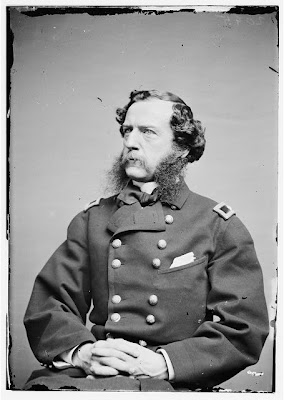
Brig. Gen. Samuel W. Crawford (courtesy of Library of Congress). Crawford was born in Franklin County, Pennsylvania in 1829. He was the surgeon in charge at Ft. Sumter during the bombardment in April 1861. Crawford joined the Union infantry and rose to brigade command by spring of 1862. He briefly led a Twelfth Corps division at Antietam until being wounded in the thigh. Following his recovery, Crawford was given command of the Pennsylvania Reserves.

On the evening of June 1, the men of the Third Brigade under Col. Joseph W. Fisher marched out of the city "to the sounds of martial music." (Columbia Spy, June 6, 1863.) The soldiers "were in fine spirits," and "cheered as they passed through [the] streets, glad again to be in the field." (Phila. Press, June 2, 1863.) Spectators along the sidewalk and in hotel windows echoed the soldiers' hurrahs for Ulysses S. Grant, Joseph Hooker, George B. McClellan, William Rosecrans, and other generals. (Columbia Spy, June 6, 1863.)

Rallying to the Defense of the Keystone State

Events soon took an alarming turn. As talk of a Confederate invasion of Pennsylvania spread, the Reserves grew anxious to leave Northern Virginia and defend their native soil against Lee's army. According to one regimental history, the thought of remaining behind in the defenses of Washington "was rather mortifying." (Woodward, Our Campaigns, 259.) Officers made entreaties to Washington and Harrisburg to have the Reserves return to the field along with the Army of the Potomac. In one instance, the commander of the 2nd Pennsylvania Reserves and his fellow officers petitioned Col. William McCandless, head of the First Brigade:
We, the undersigned. . . having learned that our mother State has been invaded by a Confederate force, respectfully ask, that you will, if it be in your power, have us ordered within the borders of our State, for her defence. 
. . . we have more than once met and fought the enemy, when he was at home. We now wish to meet him again where he threatens our homes, our families and our firesides. 
Could our wish in this behalf be realized, we feel confident that we could do some service to the State that sent us to the field, and not diminish, if we could not increase, the lustre that already attaches to our name. (Woodward, Our Campaigns, 260.)
McCandless received the petition on June 17 and "forwarded it through the proper channel to Washington." (Woodward, Our Campaigns, 259.) Meanwhile, Gens. John F. Reynolds and George G. Meade, who had both led the Reserves through the bloody trials of 1862, requested that the War Department transfer the division to their respective army corps. (See, e.g., Sypher 448; Thomson & Rauch 260; Woodward, The Third Reserve, 226.)

Col. William McCandless (courtesy of PRVC Historical Society).
At Last! -- Rejoining the Army of the Potomac

The fate of the Reserves became part of the larger question of reinforcing Hooker as he chased down Lee's army. General-in-Chief Henry W. Halleck, worried about keeping the nation's capital safe from a possible Confederate advance, maintained a tight grip on the soldiers belonging to the defenses of Washington. (Coddington 96.) In the end, Halleck relented and agreed to send Hooker around 8,400 infantry reinforcements, including two brigades of the Pennsylvania Reserves. (Sears 220.)**

Late on June 23, Hooker directed Crawford "to hold [his] command in readiness to move at very short notice," with ten days' subsistence. (OR, 1:27:3, 273.) Pickets were to remain posted "until further orders." (OR, 1:27:3, 273.) Less than two days later, Hooker put the Reserves in motion to catch up with the rest of the army, which was already in pursuit of Lee. At 9:30 in the morning on June 25, Crawford was directed to "march with your command to-day, via the Leesburg turnpike, to Edwards Ferry, and, if possible . . . cross the river at that point, should you reach the Ferry in season." (OR, 1:27:3, 309.)

Not long afterwards, Hooker was shocked to learn from Crawford that John P. Slough, military governor of Alexandria, had detained the Second Brigade of Pennsylvania Reserves. He fired off a note to Halleck, demanding that "General Slough be arrested at once" and promising that "charges will be forwarded as soon as I have time to prepare them." (OR, 1:27:1, 56.) Hooker sharply warned Halleck, "You will find, I fear, when it is too late, that the effort to preserve department lines will be fatal to the cause of the country." (OR, 1:27:1, 56.) The General-in-Chief wasted no time in brushing aside Hooker's request:
The Second Brigade, to which you refer in your telegram, forms no part of General Crawford's command, which was placed at your orders. No other troops can be withdrawn from the Defenses of Washington. (OR, 1:27:1, 57.)  
That same day, the First and Third Brigades struck camp and began their march from Fairfax Station and Upton's Hill.*** The soldiers proceeded as far as the area around Vienna, where they bivouacked for the night. (OR, 1:27:1, 143; Woodward, Our Campaigns, 261). Early the next morning the Reserves resumed their march. The Pennsylvanians moved up the Leesburg-Alexandria Turnpike, past Dranesville, where many of them had first experienced battle.**** A "violent and constant" rainfall turned the roads into "almost knee-deep" mud. (Woodward, Our Campaigns, 261.) Despite such miserable conditions, the division reached Goose Creek that night. (OR, 1:27:1, 143.) At daylight on June 27, the Reserves headed a short distance to the Potomac and crossed the river at Edwards Ferry via pontoon bridge. (OR, 1:27:3, 353.) The division pushed through Maryland and arrived that night at the mouth of the Monocacy River, "in spite of the heavy roads." (Woodward, Our Campaigns, 261; see also OR, 1:27:1, 143.) Finally, on June 28, the Reserves crossed the Monocacy and marched to Ballinger's Creek near Frederick, where they joined the Fifth Corps. (OR, 1:27:1, 144; Hardin 141.)***** By the time the Reserves caught up with the Fifth Corps, Meade had taken command of the Army of the Potomac, and Gen. George Sykes had replaced him at the head of the corps.

Detail of Edwards Ferry, Goose Creek, and vicinity from 1862 Union Army map of Northeastern Virginia (courtesy of Library of Congress).  The Leesburg Turnpike, also visible here, served as the Pennsylvania Reserves main route of march to the crossing at Edwards Ferry.
The Pennsylvania Reserves continued their movement northward through Maryland and into Pennsylvania. The division arrived at Gettysburg on July 2 during the second day of the battle. That evening, the First Brigade drove into the Plum Run Valley and beat back an assault by troops from James Longstreet's corps on the Union left near Little Round Top. Crawford himself seized the colors and led the charge. The division's overall losses at Gettysburg stood at 26 killed, 181 wounded, and 3 missing. (OR, 1:27:1, 180.) The Reserves had proven their mettle once again and made a contribution to the Confederate defeat. Before long, the Pennsylvanians would return with the rest of the army to the familiar soil of the Old Dominion. In this war, there was no staying away.

Notes

*The 11th Pennsylvania Reserves of the Third Brigade were still stationed in Northern Virginia in June, most likely in the vicinity of Vienna or Fairfax Station. (Gibbs 214-15.)

**The other units sent to Hooker from the Department of Washington included a brigade of New Yorkers under Gen. Alexander Hays and the Second Vermont Brigade under Gen. George Stannard. Both brigades would go on to distinguish themselves at Gettysburg. Halleck also agreed to furnish a division of cavalry under Gen. Julius Stahel, as well as artillery units, including the 9th Massachusetts Battery.

***The drive to replenish the ranks of the Reserves while in the defenses of Washington met with little success. (Gibbs 213; Thomson & Rauch 256-57.) The two brigades that set out on June 25 totaled just 3,817 officers and men. (Coddington 98.)

****The Battle of Dranesville took place on December 20, 1861, and pitted a brigade of the Reserves against J.E.B. Stuart's Confederates.

*****The Pennsylvania Reserves officially became the Third Division of the Fifth Corps.

Sources

Aside from the Official Records, the following sources were useful in compiling this post:

Civil War in the East (on-line database); Edwin B. Coddington, The Gettysburg Campaign: A Study in Command (1979 ed.); Columbia Spy, June 6, 1863; Joseph Gibbs, Three Years in the Bloody Eleventh: The Campaigns of a Pennsylvania Reserves Regiment (2002); Martin D. Hardin, History of the Twelfth Regiment Pennsylvania Reserve Volunteer Corps (1890); Harrisburg Daily Patriot and Union, June 27, 1863; Philadelphia Press, June 2, 1863; Stephen W. Sears, Gettysburg (2003); Jeffrey F. Sherry, "The Terrible Impetuosity: The Pennsylvania Reserves at Gettysburg," Gettysburg Magazine, Issue No. 16, Jan. 1, 1997 (courtesy of P.R.V.C. Hist. Soc.); J.R. Sypher, History of the Pennsylvania Reserve Corps (1865); O.R. Howard Thomson & William H. Rauch, History of the "Bucktails" (1906); Evan M. Woodward, History of the Third Pennsylvania Reserve (1883); Evan M. Woodward, Our Campaigns (1865).

Additional Reading

An excellent and detailed account of the Pennsylvania Reserves' march from Upton's Hill/Fairfax Station to Edwards Ferry, including maps, can be found here, at Craig Swain's Civil War blog, To the Sound of the Guns. Also be sure to check out Craig's on-going series of posts on the march of the Union army through Loudoun County in the days prior to Gettysburg.

For the full story of the Pennsylvania Reserves at Gettysburg, see "The Terrible Impetuosity: The Pennsylvania Reserves at Gettysburg," by James Sherry in Gettysburg Magazine, Issue No. 16, Jan. 1, 1997.

Thursday, May 23, 2013

The Pennsylvania Reserves in Northern Virginia 1863, Part IV: Daily Life in the Department of Washington

Today's post marks the final installment in my series on the Pennsylvania Reserves in Northern Virginia during the first half of 1863. The veteran division from the Keystone State arrived in Alexandria at the start of February 1863. The Union Army had sent the men to the Department of Washington to rest and recruit away from the front lines. As I wrote last week, the Reserves spent a lot of time on picket, fatigue, and guard duty. The constant threat of attacks by Confederate guerrillas made the work a little less than pleasant, but the men otherwise settled into the daily routine of camp life.

The weather proved uncooperative during the Reserves' first few months in Northern Virginia. As Richard Woolworth of the 4th Pennsylvania Reserves told his sister on March 22, "[s]now, hail, rain and sunshine alternately make the walking very disagreeable. We have been hoping for a change for the better but have been disappointed." A regimental history of the Bucktails recalled:
The winter. . . was remarkably severe, snow alternating with heavy rain making things generally uncomfortable. Even as late as March 31st, eighteen inches of snow were recorded; nor was this the last fall, as on April 5th, another heavy snow storm obstructed the camp. (Thomson & Rauch 245.)
All of the wet weather made for hard marching. The 2nd Pennsylvania Reserves broke camp on March 28 and headed for Fairfax Station. The distance was just four miles, but constant downpours had turned the road into a nearly impassable mess. The men "plunged through the mud up to their knees" and labored for several hours to reach their destination. (Woodward 256.) Towards the end of April, the weather began to show signs of improvement. Americus Murray of Co. H, 4th Pennsylvania Reserves told his cousins that on April 21, "[t]he Weather is pleasant and warm, the buds are opening, and the grass is growing very nicely, and I hope that we have had our last cold storm for this Spring."

Despite all of the miserable weather, the men reported generally healthy conditions in camp. Private Lewis Prall of Co. A, 1st Pennsylvania Reserves, informed his sister on March 16, "There is not much sickness here now. There is no cases of smallpox around here. All the boys are well and lively." Woolworth of the 4th felt much the same. He noted to his sister on March 22 that "we mostly enjoy good health." Of the sixteen sick soldiers, most were "very trifling cases." One man, who appeared "very low spirited" and "home sick," was sent to his family. The Bucktails, meanwhile, suffered from an outbreak of smallpox, but "the cases were few and the disease did not spread." (Thomson & Rauch 246.)

Soldiers' letters back home testify to relatively comfortable conditions in camp. Prall of the 1st Pennsylvania Reserves told his sister in March:
We have a good tent with a large fireplace in it and have six woolen blankets over us. We sleep warm at night. We get plenty to eat. We get fresh bread 3 times a week, also fresh beef besides sugar, coffee, crackers, rice, beans, salt pork, salt beef, and several other things. We have plenty to wear and will soon have plenty of money – we expect to get paid this week.
Sgt. Thomas Dick, Co. A, 12th Pennsylvania Reserves wrote to his brother on March 6 that "[w]e have comfortable quarters plenty of soft br[ea]d fresh beef and other things in proportion." Family members also supplemented the soldiers' victuals with packages from home. At the end of March, Prall "went to Alexandria to the express office and brought up 21 boxes for the regiment," including his own. The contents of Prall's package were "in good order" and "nothing was spoiled, except two or three pies was a little moldy."

Camp of the 1st Pennsylvania Reserves (30th Pennsylvania Infantry) near Fairfax Court House, June 1863 (courtesy of fold3.com; information on photo from MOLLUS-Massachusetts Civil War Photographs, U.S. Army Heritage & Education Center). 
Like all soldiers, the men of the Pennsylvania Reserves found a variety of ways to pass their down time in camp. Reading and letter writing were popular. The soldiers also bet their paychecks on card games like poker. Prall turned to a more productive past time and whittled rings from wood to send to his mother and little sister. Col. Charles Taylor of the Bucktails, who would soon fall at Gettysburg, sponsored a target shooting contest and offered a fifty cent prize to the winner. Some of the Reserves spent their free time playing baseball. Sgt. Dick of the 12th Reserves seemed rushed to finish a letter to his sister so he could enjoy the weather and check out the friendly athletic competition:
For it is such a beautiful day outside, that I can scarcely content myself to remain indoors while I write it. I can hear the loud shouts of the boys who are engaged at a game of ball while I write.
Some soldiers also took advantage of the proximity of the nation's capital. Murray of the 4th Reserves wrote to his cousins of an April trip to Washington City:
I have been in Washington to day and visited some places of interest. It is a grand sight to go over the Capitol grounds and view that noble structure, which is not yet finished, and will not be for a number of years yet. The Capitol is built of marble, and when completed will be one of the finest buildings in the world. The Capitol grounds are at present covered with a growth of fresh green grass; the parks contain a great variety of trees and shrubs, which are just putting forth their green leaves. The avenues and promenades are bordered by a great variety of flowers, many of which are already in full blossom.
A wartime view of Washington showing the unfinished Capitol dome and Trinity Episcopal Church, c. 1863 (courtesy of The Atlantic). Such sights awaited the men of the Pennsylvania Reserves who visited Washington City.
Camp life also provided time for quiet reflection. Sgt. Dick spoke for many in the Reserves when he wrote to his brother on March 6 about the sacrifices of the past year:
Our company presents quite a different appearance now to what it did when we were here before It is but a skeleton of its former self. We now draw rations for over 40 men. how does that compare with last winter when we drew rations for over 90 men; and the missing where are they? The bones of some of them black in the blood stained soil of the peninsula: Some of them repose on the disastrous plains of manasses; While others who fell at south mountain and antietam received a decent burial in the faithful old state of Maryland. I thought I had done. But others yet who perished at Fredericksburg go to swell the number in the graveyard of Virginia. There are others still who may be classed among the missing of Co H. some of them are languishing in the hospitals that have become so common in our land and others I suppose you see almost daily: some with their arms hangings powerless by their sides; and others with their limbs bent in an uncomely shape. and some with an empty coat sleeve that shows to plainly that they were members of the glorious old reserve.
Dick was all too aware of the toll that the war had taken. As he and the other soldiers continued their duty in front of Washington, an even bigger fight loomed on the horizon. Before long, many of these same men would be marching off to defend their home soil against Robert E. Lee's Confederates.

Sources

Ltr. from Thomas Dick to Brother, Mar. 6, 1863; Ltr. from Thomas Dick to Sister, Mar. 25, 1863; Ltr. from Americus Murray to Cousins, Apr. 19, 1863; Ltr. from Lewis Prall to Sister, March 16, 1863; Ltr. from Lewis Prall to Unknown (likely Sister), Apr. 1, 1863; Ltr. from Richard Woolworth to Sister, Mar. 22, 1863; O.R. Howard Thomson & William H. Rauch, History of the "Bucktails" (1906); Evan M. Woodward, Our Campaigns (1865).

Spelling and grammar are as in the original letters.

I would like to thank the Pennsylvania Reserve Volunteer Corps Historical Society for publishing all of the letters referenced in this post. This group is doing invaluable work to preserve the story of the Reserves. Please check out the society's website and lend your support.

Thursday, May 16, 2013

The Pennsylvania Reserves in Northern Virginia 1863, Part III: Military Duties in and Around Washington

Following a brief interlude, I return this week to the story of the Pennsylvania Reserves in Northern Virginia during the first half of 1863. The hard-fighting division had suffered heavy losses in the bloodletting of the previous year. Generals and politicians lobbied tirelessly to have the Reserves sent back to the Keystone State to recuperate and fill their ranks with new recruits. (See Part I.) In the end, the Union Army settled on an alternative course of action designed to accomplish the same goals. (See Part II.)

At the start of February 1863, the division's three brigades boarded transports at Belle Plain, Virginia and headed up the Potomac.* The Reserves were slated to join the newly-formed 22nd Corps of the Department of Washington, composed of soldiers who were assigned to the defense of the nation's capital. On February 7, the Pennsylvanians disembarked at the port of Alexandria and marched towards their old campgrounds around Fairfax Seminary.

Orders finally came on February 10. (OR, 1:51:1, 985.) Gen. Samuel P. Heintzelman, commander of the Department of Washington, directed the First Brigade to proceed to Fairfax Courthouse. The Second Brigade was ordered to Upton's Hill, while the Third Brigade was to occupy Minor's Hill.** The Reserves performed a variety of tasks, from the mundane to the downright dangerous.

Gen. Samuel P. Heintzelman, commander of the Department of Washington and 22nd Corps (courtesy of Wikimedia Commons).
The experience of the 2nd Pennsylvania Reserves was typical of the regiments assigned to the area around Fairfax. The 2nd took the Orange & Alexandria Railroad from Alexandria to Fairfax Station on February 12 and established camp near Fairfax Court House. On February 21 the men received orders to guard the fords across Bull Run. The 2nd's picket line stretched for seven miles. As one regimental historian described duty there:
Our posts at the fords were almost nightly visited by the guerrillas, who exchanged a few shots with the pickets and disappeared. When a shot was fired, not knowing the strength or object of the enemy, the reserve at the post was turned out, and as this occurred several times through the night, the men's sleep was constantly liable to be disturbed. This tour of duty lasted sixteen days, and we were all glad when it was over. (Woodward, Our Campaigns, 254.)
During the night of March 8, the 2nd Reserves proceeded to Union Mills and the next day returned to camp at Fairfax. By March 16, the regiment was on the move again. This time they were assigned to dig rifle pits outside town along the road to Centreville. Finally, on March 28, the 2nd marched four miles to Fairfax Station, where the men established a more permanent camp. As May got underway, the partisan rangers became more active, and the 2nd had to contend with intensified attacks on the picket lines and the railroad around Fairfax.

The Bucktails, also from the First Brigade, proceeded to Fairfax on February 12. Here they engaged in picket and scouting duty, dug rifle trenches, cut trees, and buried dead horses. On the night of March 8, Confederate ranger John Mosby captured Gen. Edwin Stoughton in a raid on Fairfax. Accordingly, "to guard against a repetition of such a humiliating experience, the Bucktails were ordered to move their camp closer to the village." (Thomson & Rauch 47.) A regimental history claims that due to this precautionary measure, "Mosby's Rangers did not again penetrate the Union line in that vicinity" while the Bucktails were in Fairfax. (Thomson & Rauch 247.)

The 4th and 7th Pennsylvania Reserves performed guard duty at Camp Convalescent, a few miles from Alexandria along Four Mile Run.*** This massive facility was home to thousands of soldiers recovering from wounds and illnesses. Camp Convalescent consisted of fifty barracks as well as officers' quarters, dining rooms, cook houses, and hospitals.

Period engraving of Camp Convalescent, outside of Alexandria (courtesy of NYPL Digital Gallery). The camp was new when the Pennsylvania Reserves arrived for guard duty in early 1863. The conditions at the previous camp had become so bad that it earned the nickname, "Camp Misery."
Regiments from the Third Brigade were also detailed to areas outside Minor's Hill. The 11th Pennsylvania Reserves encamped in Vienna near the Alexandria, Loudoun & Hampshire Railroad. Private Lindley H. Addleman described the daily routine in a letter to his sister:
. . .we halve been doing fatigue duty pretty near every day since we came but it is easy [work] Some days we load carrs with cordwood and Some days we on load hay oats and corn and rashions for the cavalry well that is what we halve to do beside camp guarding. (Spelling and grammar as in original.)
The 12th Pennsylvania Reserves were assigned to a spot near the railroad bridge over Bull Run in February and early March. Sergeant Thomas Dick of Company H seemed far from bothered by his routine. As he told his brother in a February 22 letter, "[o]ur duty is not very arduous here." Dick came on duty "about once a week . . .to guard the railroad." The sergeant seemed almost nonchalant about the risks involved:
Have nothing to annoy us but the guerrillas They pop one over occasionally. Major Larimer of the 5th was killed a short time ago while leading a skirmishing party. (Grammar as in original.)
New orders arrived on April 19. Heintzelman directed the Second Brigade, "except the detachment now on duty at the Convalescent Camp," to "report without delay to Brigadier General John P. Slough, military governor of Alexandria." (OR, 1:51:1, 1008.) The commander kept the 11th Pennsylvania Reserves in Vienna, but ordered the remainder of the Third Brigade to report immediately to Gen. J.H. Martindale, the military governor of Washington. The First Brigade remained in Fairfax Court House and environs.

The 3rd Pennsylvania Reserves, along with other regiments in the Second Brigade, contributed to the defense of Alexandria. Following the Union defeat at Chancellorsville in May, earthworks were erected around the city. The 3rd encamped about a mile from the fortifications. An alarm was raised "a number of times, but no enemy appeared." (Woodward, The Third Reserve, 226.) Moreover, "upon several occasions," the regiment acted "as a guard to the railroad trains carrying forage to [Joseph] Hooker's army, they going as far as Warrenton Junction." (Woodward, The Third Reserve, 226.)

The regiments of the Third Brigade performed provost duty in Washington. The men maintained order and guarded Confederate prisoners and U.S. Government property. Private Benjamin Addleman of the 10th Pennsylvania Reserves and Lindley's brother, was quartered in barracks on East Capitol Hill. In a May 12 letter to his sister, Benjamin reported that "there has been a great many prisoners fetched to Washington from the army of the Potimack." Just the other day, he "helpt to fetch 795 rebls from the wharf. . . ." (Spelling and grammar as in original.) Thomas Dick of the 12th guarded Old Capitol  Prison at the end of May. As he told his sister, "we are off duty two days and on one: It is very nice duty."

Old Capitol Prison, Washington, DC (courtesy of Wikimedia Commons). The building served as the temporary meeting place for Congress (1815-19) after the British burned the Capitol during the War of 1812. Old Capitol Prison held Confederate sympathizers, spies, and prisoners of war. The Supreme Court now sits on this location east of the U.S. Capitol.  
By the start of June 1863, the three brigades of the Pennsylvania Reserves were scattered across Northern Virginia and Washington. Since arriving in February, the Pennsylvanians had fended off attacks by partisan rangers, built entrenchments, and performed other necessary but mundane tasks. As one history of the Reserves summed up military life during that time, "picket duty here [was] more arduous than it was with the Army of the Potomac, and altogether the duties were no lighter nor the quarters any better than they were in the active army." (Hardin 137; see also Sypher 434; Thomson & Rauch 245; Woodward, The Third Reserve, 226.) Men like Thomas Dick and Lindley Addleman, however, may have begged to differ. Whatever the case, much harder days were only a month away for many of the soldiers.

Notes

*The Pennsylvania Reserves were under the overall command of Col. Horatio G. Sickel. The First Brigade, led by Col. William McCandless, was composed of the 1st, 2nd, 6th, and 13th (Bucktails) Pennsylvania Reserves. The Second Brigade, under Col. Henry C. Bolinger, was composed of the 3rd, 4th, 7th, and 8th Pennsylvania Reserves. The Third Brigade, under Col. Joseph W. Fisher, was composed of the 5th, 9th, 10th, 11th, and 12th Pennsylvania Reserves.

**Upton's Hill sits on the Arlington County-Fairfax County boundary. Minor's Hill is a bit farther to the northwest and also straddles the border between the two counties. Both eminences are to the east of Falls Church and northwest of Alexandria. For a period map, see here.

***Camp Convalescent sat on land belonging to the present-day Army-Navy Country Club in Arlington County.

Sources

"Brief History of the 7th Pennsylvania Reserves (36th Infantry)," from Samuel Bates, History of the Pennsylvania Volunteers, 1861-1865 (1869-71) (courtesy of Pa. Res. Hist. Soc.); "Brief History of Company B, 7th Reserves, 'The Biddle Rifles,'" Perry County in the Civil War (courtesy of Pa. Res. Hist. Soc.); James G. Barber, Alexandria in the Civil War (1988); Civil War in the East (on-line database); Joseph Gibbs, Three Years in the Bloody Eleventh: The Campaigns of a Pennsylvania Reserves Regiment (2002); Martin D. Hardin, History of the Twelfth Regiment Pennsylvania Reserve Volunteer Corps (1890); Ltr. from Benjamin P. Addleman to Sister, May 12, 1863 (courtesy of Pa. Res. Hist. Soc.); Ltr. from Lindley H. Addleman to Sister, Apr. 30, 1863 (courtesy of Pa. Reserves Hist. Soc.); Ltr. from Thomas W. Dick to Brother, Feb. 22, 1863 (courtesy of Pa. Reserves Hist. Soc.); Ltr. from Thomas W. Dick to Sister, May 31, 1863 (courtesy of Pa. Res. Hist. Soc.); Ltr. from Americus Murray to Cousins, Apr. 19, 1863 (courtesy of Pa. Reserves Hist. Soc.); "Other Government Buildings: Old Capitol Prison," Mr. Lincoln's White House (website); J.R. Sypher, History of the Pennsylvania Reserve Corps (1865); O.R. Howard Thomson & William H. Rauch, History of the "Bucktails" (1906); Evan M. Woodward, History of the Third Pennsylvania Reserve (1883); Evan M. Woodward, Our Campaigns (1865).