Showing posts with label 1st S.C.. Show all posts

Sunday, June 19, 2011

Reenactment of the Battle of Vienna

This past Saturday I convinced my wife to accompany me to the reenactment of the Battle of Vienna before heading out to dinner.  The Town of Vienna, Historic Vienna, Inc., and the Vienna Sesquicentennial Committee sponsored an entire weekend of living history surrounding the 150th anniversary of the battle, including the capstone reenactment on Saturday evening.  Jim Lewis, well-known local historian and member of the Hunter Mill Defense League, provided the public with an overview of the skirmish and narrated the reenactment, which was coordinated by the 5th Regiment ANV and 17th Virginia Infantry Regiment, Company G.
 
Replica locomotive on loan from Strasburg, Virginia.  In a recent post, I examined the Battle of Vienna's key place in railroad history.

Reenactors portraying the 1st Ohio approach Vienna aboard a platform car.  The car was placed on the old railbed of the  Alexandria, Loudoun, & Hampshire R.R., later the Washington & Old Dominion (W&OD) R.R., and now the W&OD Trail.

The reenactment was held on the grounds of the Vienna Community Center, just off the W&OD Trail near the actual site of the 1861 action. Staging the event this close to the original location brought with it a few incongruities, as suburbia has long since established its presence here.  The Town of Strasburg, Virginia, which had earlier conducted a railroad-themed reenactment of its own, donated the use of a replica Civil War locomotive. Of course, the railroad is no longer there, so the organizers had to use a few men to move a flatbed trailer of some sort, which served as a stand-in for one of the platform cars that carried soldiers of the 1st Ohio. As the Union troops were pushed along the old railroad bed in front of the locomotive, the reenactment began with the earth shattering boom of a Confederate canon.  When I heard a few infants in the audience cry, I knew there was a reason I didn't bring along my twin boys!  The reenactors took some degree of historical license as the skirmish unfolded in front of the spectators.  The "battle" ended in about thirty minutes, with the 1st South Carolina driving the 1st Ohio back in the direction of Alexandria. Overall, the event drew a large crowd, and the town once again did a commendable job in educating the public through living history.

The train "pushes" the platform car carrying the men of the 1st Ohio towards Vienna.

A Confederate artillery crew, representing part of Kemper's Battery, prepares to surprise the Yankees on the rail car.

Soldiers from the 1st Ohio rush from the platform car after taking a hit from the Rebel artillery...

...and form a skirmish line.

The 1st South Carolina drives back the Union skirmishers.

Thursday, June 16, 2011

The Rumor of "Black Confederates" at Vienna

The topic of so-called "black Confederates" always generates a lot of controversy in the blogosphere.  Although the use of black troops was reluctantly authorized in the dying days of the Confederacy, some groups and individuals erroneously claim that considerable numbers of African-Americans fought for the South during the Civil War. (See, for example, here and here.)   Occasionally, the Battle of Vienna figures on the list of engagements where black Confederates saw action.  (See here and here.)  While researching the skirmish for this week's posts, I decided to dig a little deeper on the issue.  Based on the sources that I reviewed, the veracity of this story seems dubious at best. 

Brigadier General Robert Schenck, the Union commander at Vienna, filed a supplement to his official report of June 18, 1861. (Schenck Report, OR, Series 1, Vol. 2, Part 1, p. 127.)  According to Schenck, "[a] perfectly reliable Union man, residing in Vienna, [and who] was there during the attack" had come to him with more information about the Confederate force that had engaged the 1st Ohio.  This is the same man, incidentally, who brought six of the Union dead to Schenck's camp in his wagon.  Schenck wrote that the Unionist told  him that the Confederates under Col. Maxcy Gregg had "a body of 150 armed picked negroes, who were posted nearest us in a grain field on our left flank." (emphasis added)  However, Schenck also noted that these men were "not observed by us, as they lay flat in the grain and did not fire a gun."  Overall, based on the Unionist's information, Schenck overestimated the Confederate numbers at Vienna and concluded that "the whole force attacking us was at least 2,000."  (In fact, the Rebels numbered around 750.)

The New York Times also picked up the story about the rumored black soldiers.  In an article on June 18, 1861, the newspaper reported on the estimated strength of the Confederate force at Vienna:
Some of the Ohio men pretend to say that there were 800 South Carolinians present, subsequently reinforced by 600 Virginians from Falls Church.  It is added, moreover, that the Palmettoans had two flank companies of picked negroes, armed with muskets and sabre-bayonets-these sable soldiers acting as servants and pack-horses in time of peace, and as soldiers whenever fighting is the business immediately on hand.
Even the Times disputed this account.  The correspondent concluded that "[t]hese stories, I may add, are not confirmed by any evidence; and there are many of the more incredulous order, who maintain that there never was any larger rebel force near the train than fifty Virginians, using a single field piece under cover of the woods. I confess that the weight of evidence at present would seem to be in favor of this theory."

These accounts have little value as clear-cut evidence that black Confederates actually fought at Vienna.  Schenck, who was also present at the battle, indicated that no one on the Union side observed the blacks.  Given that the original source of the rumor provided Schenck faulty evidence of Southern troop strength, it is not much of a stretch to think that the local Unionist was also mistaken as to the presence of armed blacks.  Col. Gregg, commander of the 1st South Carolina, never mentioned the alleged force of 150 armed African-Americans in his official report on the battle.  (Gregg Report, OR, Series 1, Vol. 2, Part 1, pp. 128-30.)  And the New York Times, whose source appears to be men from the 1st Ohio, pointed to the lack of evidence backing up the rumors about the Confederate troops at Vienna, including the use of blacks in the battle.
Confederate soldiers in camp with an African-American servant.  This image is of the Clinch Rifles, 5th Georgia Infantry, but based on a report in the OR, it appears that such servants may have accompanied the 1st S.C.  (courtesy of the Georgia Sharpshooters)
All of these primary sources raise questions about what the Unionist saw, if not "150 armed picked negroes."  Brigadier General Irvin McDowell, overall Union commander in the area, forwarded to Union Army headquarters a report from an informant not long after the battle.  The spy, who had surveyed the Confederate lines, observed:
The South Carolina regiments were the best armed and equipped and in high spirits, 'freezing for a fight,' being much elated by the Vienna affair. Negroes with them as servants. (OR, Series 1, Vol. 2, Part 1, p. 722.) 
It is possible that several slaves accompanied the 1st South Carolina during Gregg's reconnaissance mission and that they took cover in a grain field when the battle erupted in Vienna.  Or maybe the Unionist somehow mistook white soldiers for African-Americans due to the smoke and confusion along the train tracks.  The answer is likely lost to history.  What we do know is that we can place little confidence in the rumors of  black Confederate combatants at the Battle of Vienna.

Sunday, June 12, 2011

Battle of Vienna, June 17, 1861: An Overview

This upcoming Friday marks the 150th anniversary of the so-called "Battle of Vienna." This little-known encounter in Northern Virginia is now getting its fair share of attention, at least in the D.C. area.  The Town of Vienna will even be putting on a reenactment of the battle this Saturday, complete with a locomotive brought in from the Shenandoah Valley.  (More on the train a little later....)  There are some interesting angles to explore in connection with this early action in the Civil War, so I've decided to dedicate the entire week to the skirmish.
General Robert Schenck (courtesy of Library of Congress)
On June 17, 1861, Brigadier General Irvin McDowell, commander of the Union Department of Northeastern Virginia, ordered Brigadier General Robert Schenck to undertake a reconnaissance mission in the direction of Vienna.  Schenck selected the 1st Ohio, and set out with his troops on the Alexandria, Loudoun, and Hampshire Railroad.  At a wagon crossroads near Falls Church, he relieved the 69th New York with two companies.  He sent two other companies to patrol Falls Church, and dispatched an additional two companies to guard the railroad and bridge between the crossroads and Vienna.  With the remaining four companies of 271 men, Schenck proceeded slowly towards Vienna.  A locomotive pushed the train along the tracks.  Most of the soldiers sat on platform cars, while Schenck rode in a passenger car with Col. Alexander M. McCook, commander of the 1st Ohio.

Col. Maxcy Gregg (courtesy of Wikipedia)
The day before, Col. Maxcy Gregg, head of the 1st South Carolina, was ordered to conduct a reconnaissance towards the Potomac River.  He set out from camp near Fairfax Court House with about 575 soldiers and 70 cavalrymen.  At Frying Pan Church, Gregg met an additional 70 cavalry, as well as an artillery detachment of 34 men and two guns.  The force proceeded towards the Potomac, where on June 17 Gregg "went in person to the bank of the river to reconnoiter," but he "could see but few troops of the enemy, and no boats prepared for crossing the river." (Gregg Report, OR, Series 1, Vol. 2, Part 1, p. 129.)   The Confederate troops began the long march back towards camp.  In Vienna, Gregg expected to see the enemy, who had recently sent an expedition to the area, but detecting no Federals, he ordered his men to proceed to Fairfax Court House.  At around 6 p.m., however, "a distant railroad whistle was heard." (Gregg Report, OR, Series 1, Vol. 2, Part 1, p. 129.)  As Gregg wrote in his battle report:
I marched the troops back, placing the two 6-pounder guns on the hill commanding the bend of the railroad, immediately supported by Company B, First South Carolina Volunteers. . . . . The rest of the regiment . . . was formed on the crest of the hill to the right of the guns. The cavalry were drawn up still farther to the right. (Gregg Report, OR, Series 1, Vol. 2, Part 1, p. 129.)
As the 1st Ohio turned the curve outside of Vienna, the Confederate battery opened fire with shot, shell, and grapeshot.  The first platform car was untouched, but the second and third cars received the deadliest fire.  The train encountered some mechanical difficulties, and the engineer could not pull the train out of range of the guns.  (By some accounts, the breaks had locked when the engineer slammed them at the outset of the attack.)  The soldiers, coming to the realization that they were sitting ducks, "left the cars, and retired to right and left of [the] train through the woods."  (Schenck Report, OR, Series 1, Vol. 2, Part 1, p.126.)  Meanwhile, to Schenck's disgust and amazement, the engineer "instead of retiring slowly, as I ordered, detached his engine with one passenger car from the rest of the disabled train and abandoned us, running to Alexandria." (Schenck Report, OR, Series 1, Vol. 2, Part 1, p.126.) Believing that his force was badly outnumbered by as many as 1,500 Confederates, Schenck threw skirmishers out along his flanks and retired towards Arlington.  Without the train, his men were forced to carry the wounded on litters or in blankets.
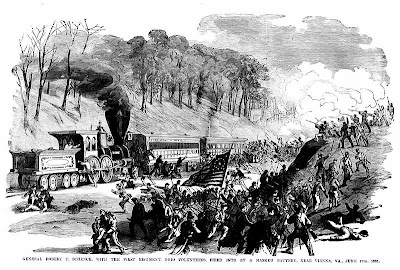
Fanciful sketch of the Battle of Vienna, from Frank Leslie's Illustrated Newspaper (courtesy of Wikipedia)
Gregg dispatched two companies to skirmish with the retiring Union soldiers, but seeing that they were slipping out of his grasp, he sent cavalrymen in pursuit.  As Gregg later recounted, "[f]rom the lateness of the hour, however, the nature of the ground, and the start which the enemy had, they could not be overtaken." (Gregg Report, OR, Series 1, Vol. 2, Part 1, p. 129.)  He also may have been convinced that he was outnumbered by a larger Union force.  Under orders "to avoid any unnecessary engagement, and not to remain absent from my camp more than one night," Gregg marched his regiment back to Fairfax after burning the railroad cars that were abandoned in Vienna. (Gregg Report, OR, Series 1, Vol. 2, Part 1, p. 129.)

A Unionist from Vienna eventually loaded six of the dead into his wagon and took them to Schenck's camp.  In all, Schenck reported eight dead and four wounded in the engagement.  The casualties came entirely from Companies G and H, which had been positioned on the second and third rail cars.

In the immediate aftermath of the skirmish, McDowell wanted to move in force upon Vienna.  As he wrote in his official report, "[h]ad the attack not been made, I would not suggest this advance at this time; but now that it has, I think it would not be well for us to seem even to withdraw."  (McDowell Report, OR, Series 1, Vol. 2, Part 1, p. 125.) General-in-Chief Winfield Scott, however, opposed the idea of sending more troops in the direction of the town.  He would soon recall Brigadier General Daniel Tyler from an advanced position at Falls Church, which Scott viewed as too exposed and vulnerable.

The news of the skirmish at Vienna spread across the North. The New York Times was particularly critical of the defeat, which followed closely on the heels of the Union loss at Big Bethel.  According to a June 20, 1861 article, a local man had flagged the train near Vienna and warned the 1st Ohio of an impending disaster, but Schenck did not halt the train or prepare his soldiers for an attack.  (Schenck makes no mention of this episode in his report.)  The Times also questioned the failure of the Union force to send scouts or skirmishers ahead of the train to ascertain any dangers.  As the Times wrote on June 19:
In the present case an entirely inadequate body of men was actually within the enemy's lines, in a railroad train, with no more careful exploration of the country than a traitorous engineer, or an accidental glance from a car-window, might furnish. . . .   Surely, the simplest knowledge of military matters must condemn so heedless a movement as to the last degree reckless and unscientific, and may fairly sit in judgment upon those who planned it. The entire policy of these detached and apparently purposeless expeditions is questionable. If they are understood to be what are technically known as reconnaissances in force, they should have force in the possession of flying-artillery, and dragoons. To enter upon doubtful territory, where the enemy may be in the greatest strength, without precaution, is simply foolhardiness.
Such reporting fed concerns about the preparedness of the Union volunteers camped around Washington.  As journalists dissected the action at Vienna, however, the Union high command was busy contemplating its next move.  

Note on Sources

The Battle at Bull Run by William C. Davis and The Glories of War: Small Battles and Early Heroes of 1861 by Charles P. Polland, Jr. contain fairly detailed accounts of the Battle of Vienna.