Showing posts with label J.F. Reynolds. Show all posts

Friday, June 21, 2013

The Pennsylvania Reserves in Northern Virginia: The Path to Gettysburg

This past spring I wrote a four-part series on the return of the Pennsylvania Reserves to Northern Virginia at the start of 1863. This storied division had experienced heavy losses during the previous year's fighting, and after political intervention by top-ranking generals and Pennsylvania's own governor, the Reserves were sent to the defenses of Washington to rest and recruit. As June 1863 began, the division was scattered across Northern Virginia and Washington City. The month would end with two-thirds of the division on the march north to join the Army of the Potomac in pursuit of Gen. Robert E. Lee's Confederates.

A New Commander and a Return to the Old Dominion

On June 1, 1863, Gen. Samuel P. Heintzelman, commander of the Department of Washington, named Gen. Samuel W. Crawford to replace Col. Horatio G. Sickel at the head of the First and Third Brigades of the Pennsylvania Reserves. (OR, 1:51:1, 1043.) The Second Brigade was to remain attached to the Military District of Alexandria. Heintzelman ordered Crawford to make his headquarters at Fairfax Station, where the First Brigade was encamped. The Third Brigade, which was performing provost duty in Washington City, was directed to cross the Potomac and proceed to Upton's Hill, not far from Falls Church.*

Brig. Gen. Samuel W. Crawford (courtesy of Library of Congress). Crawford was born in Franklin County, Pennsylvania in 1829. He was the surgeon in charge at Ft. Sumter during the bombardment in April 1861. Crawford joined the Union infantry and rose to brigade command by spring of 1862. He briefly led a Twelfth Corps division at Antietam until being wounded in the thigh. Following his recovery, Crawford was given command of the Pennsylvania Reserves.

On the evening of June 1, the men of the Third Brigade under Col. Joseph W. Fisher marched out of the city "to the sounds of martial music." (Columbia Spy, June 6, 1863.) The soldiers "were in fine spirits," and "cheered as they passed through [the] streets, glad again to be in the field." (Phila. Press, June 2, 1863.) Spectators along the sidewalk and in hotel windows echoed the soldiers' hurrahs for Ulysses S. Grant, Joseph Hooker, George B. McClellan, William Rosecrans, and other generals. (Columbia Spy, June 6, 1863.)

Rallying to the Defense of the Keystone State

Events soon took an alarming turn. As talk of a Confederate invasion of Pennsylvania spread, the Reserves grew anxious to leave Northern Virginia and defend their native soil against Lee's army. According to one regimental history, the thought of remaining behind in the defenses of Washington "was rather mortifying." (Woodward, Our Campaigns, 259.) Officers made entreaties to Washington and Harrisburg to have the Reserves return to the field along with the Army of the Potomac. In one instance, the commander of the 2nd Pennsylvania Reserves and his fellow officers petitioned Col. William McCandless, head of the First Brigade:
We, the undersigned. . . having learned that our mother State has been invaded by a Confederate force, respectfully ask, that you will, if it be in your power, have us ordered within the borders of our State, for her defence. 
. . . we have more than once met and fought the enemy, when he was at home. We now wish to meet him again where he threatens our homes, our families and our firesides. 
Could our wish in this behalf be realized, we feel confident that we could do some service to the State that sent us to the field, and not diminish, if we could not increase, the lustre that already attaches to our name. (Woodward, Our Campaigns, 260.)
McCandless received the petition on June 17 and "forwarded it through the proper channel to Washington." (Woodward, Our Campaigns, 259.) Meanwhile, Gens. John F. Reynolds and George G. Meade, who had both led the Reserves through the bloody trials of 1862, requested that the War Department transfer the division to their respective army corps. (See, e.g., Sypher 448; Thomson & Rauch 260; Woodward, The Third Reserve, 226.)

Col. William McCandless (courtesy of PRVC Historical Society).
At Last! -- Rejoining the Army of the Potomac

The fate of the Reserves became part of the larger question of reinforcing Hooker as he chased down Lee's army. General-in-Chief Henry W. Halleck, worried about keeping the nation's capital safe from a possible Confederate advance, maintained a tight grip on the soldiers belonging to the defenses of Washington. (Coddington 96.) In the end, Halleck relented and agreed to send Hooker around 8,400 infantry reinforcements, including two brigades of the Pennsylvania Reserves. (Sears 220.)**

Late on June 23, Hooker directed Crawford "to hold [his] command in readiness to move at very short notice," with ten days' subsistence. (OR, 1:27:3, 273.) Pickets were to remain posted "until further orders." (OR, 1:27:3, 273.) Less than two days later, Hooker put the Reserves in motion to catch up with the rest of the army, which was already in pursuit of Lee. At 9:30 in the morning on June 25, Crawford was directed to "march with your command to-day, via the Leesburg turnpike, to Edwards Ferry, and, if possible . . . cross the river at that point, should you reach the Ferry in season." (OR, 1:27:3, 309.)

Not long afterwards, Hooker was shocked to learn from Crawford that John P. Slough, military governor of Alexandria, had detained the Second Brigade of Pennsylvania Reserves. He fired off a note to Halleck, demanding that "General Slough be arrested at once" and promising that "charges will be forwarded as soon as I have time to prepare them." (OR, 1:27:1, 56.) Hooker sharply warned Halleck, "You will find, I fear, when it is too late, that the effort to preserve department lines will be fatal to the cause of the country." (OR, 1:27:1, 56.) The General-in-Chief wasted no time in brushing aside Hooker's request:
The Second Brigade, to which you refer in your telegram, forms no part of General Crawford's command, which was placed at your orders. No other troops can be withdrawn from the Defenses of Washington. (OR, 1:27:1, 57.)  
That same day, the First and Third Brigades struck camp and began their march from Fairfax Station and Upton's Hill.*** The soldiers proceeded as far as the area around Vienna, where they bivouacked for the night. (OR, 1:27:1, 143; Woodward, Our Campaigns, 261). Early the next morning the Reserves resumed their march. The Pennsylvanians moved up the Leesburg-Alexandria Turnpike, past Dranesville, where many of them had first experienced battle.**** A "violent and constant" rainfall turned the roads into "almost knee-deep" mud. (Woodward, Our Campaigns, 261.) Despite such miserable conditions, the division reached Goose Creek that night. (OR, 1:27:1, 143.) At daylight on June 27, the Reserves headed a short distance to the Potomac and crossed the river at Edwards Ferry via pontoon bridge. (OR, 1:27:3, 353.) The division pushed through Maryland and arrived that night at the mouth of the Monocacy River, "in spite of the heavy roads." (Woodward, Our Campaigns, 261; see also OR, 1:27:1, 143.) Finally, on June 28, the Reserves crossed the Monocacy and marched to Ballinger's Creek near Frederick, where they joined the Fifth Corps. (OR, 1:27:1, 144; Hardin 141.)***** By the time the Reserves caught up with the Fifth Corps, Meade had taken command of the Army of the Potomac, and Gen. George Sykes had replaced him at the head of the corps.

Detail of Edwards Ferry, Goose Creek, and vicinity from 1862 Union Army map of Northeastern Virginia (courtesy of Library of Congress).  The Leesburg Turnpike, also visible here, served as the Pennsylvania Reserves main route of march to the crossing at Edwards Ferry.
The Pennsylvania Reserves continued their movement northward through Maryland and into Pennsylvania. The division arrived at Gettysburg on July 2 during the second day of the battle. That evening, the First Brigade drove into the Plum Run Valley and beat back an assault by troops from James Longstreet's corps on the Union left near Little Round Top. Crawford himself seized the colors and led the charge. The division's overall losses at Gettysburg stood at 26 killed, 181 wounded, and 3 missing. (OR, 1:27:1, 180.) The Reserves had proven their mettle once again and made a contribution to the Confederate defeat. Before long, the Pennsylvanians would return with the rest of the army to the familiar soil of the Old Dominion. In this war, there was no staying away.

Notes

*The 11th Pennsylvania Reserves of the Third Brigade were still stationed in Northern Virginia in June, most likely in the vicinity of Vienna or Fairfax Station. (Gibbs 214-15.)

**The other units sent to Hooker from the Department of Washington included a brigade of New Yorkers under Gen. Alexander Hays and the Second Vermont Brigade under Gen. George Stannard. Both brigades would go on to distinguish themselves at Gettysburg. Halleck also agreed to furnish a division of cavalry under Gen. Julius Stahel, as well as artillery units, including the 9th Massachusetts Battery.

***The drive to replenish the ranks of the Reserves while in the defenses of Washington met with little success. (Gibbs 213; Thomson & Rauch 256-57.) The two brigades that set out on June 25 totaled just 3,817 officers and men. (Coddington 98.)

****The Battle of Dranesville took place on December 20, 1861, and pitted a brigade of the Reserves against J.E.B. Stuart's Confederates.

*****The Pennsylvania Reserves officially became the Third Division of the Fifth Corps.

Sources

Aside from the Official Records, the following sources were useful in compiling this post:

Civil War in the East (on-line database); Edwin B. Coddington, The Gettysburg Campaign: A Study in Command (1979 ed.); Columbia Spy, June 6, 1863; Joseph Gibbs, Three Years in the Bloody Eleventh: The Campaigns of a Pennsylvania Reserves Regiment (2002); Martin D. Hardin, History of the Twelfth Regiment Pennsylvania Reserve Volunteer Corps (1890); Harrisburg Daily Patriot and Union, June 27, 1863; Philadelphia Press, June 2, 1863; Stephen W. Sears, Gettysburg (2003); Jeffrey F. Sherry, "The Terrible Impetuosity: The Pennsylvania Reserves at Gettysburg," Gettysburg Magazine, Issue No. 16, Jan. 1, 1997 (courtesy of P.R.V.C. Hist. Soc.); J.R. Sypher, History of the Pennsylvania Reserve Corps (1865); O.R. Howard Thomson & William H. Rauch, History of the "Bucktails" (1906); Evan M. Woodward, History of the Third Pennsylvania Reserve (1883); Evan M. Woodward, Our Campaigns (1865).

Additional Reading

An excellent and detailed account of the Pennsylvania Reserves' march from Upton's Hill/Fairfax Station to Edwards Ferry, including maps, can be found here, at Craig Swain's Civil War blog, To the Sound of the Guns. Also be sure to check out Craig's on-going series of posts on the march of the Union army through Loudoun County in the days prior to Gettysburg.

For the full story of the Pennsylvania Reserves at Gettysburg, see "The Terrible Impetuosity: The Pennsylvania Reserves at Gettysburg," by James Sherry in Gettysburg Magazine, Issue No. 16, Jan. 1, 1997.

Friday, April 19, 2013

The Pennsylvania Reserves in Northern Virginia 1863, Part II: Farewell to Hooker's Army

As I wrote in my last post, the Pennsylvania Reserves faced a somewhat uncertain future at the start of 1863.  The division had experienced tremendous losses during the bloody battles of 1862.  Gen. George G. Meade, a former commander of the Reserves, took up his old division's cause and pushed to have the Reserves sent back to Pennsylvania to recruit and reorganize.  Pennsylvania's Governor, Andrew Curtin, likewise urged the Lincoln Administration to allow the Reserves to return temporarily to the Keystone State.  These pleas went unheeded at army headquarters, and the Pennsylvanians soon joined the rest of Ambrose Burnside's men on the ill-fated "Mud March."

A Plan is Hatched

By the end of January, the situation began to look brighter for the hard-fought Pennsylvanians.  Gen. Joseph Hooker, the new commander of the Army of the Potomac, and General-in-Chief Henry W. Halleck finally agreed on a plan to deal with the manpower problems facing the Reserves.  The division was to be detached from the Army of the Potomac and sent to the defenses of Washington in exchange for a like number of Pennsylvania troops then stationed around the capital.  (OR, 1:25:2, 12.)  The Pennsylvania Reserves would return to the front once they had some time to replenish their ranks and recover from combat duty.  Gen. Samuel P. Heintzelman, head of the Department of Washington, was less than enthusiastic about the idea.  He worried that the Reserves were ill-equipped for provost duty in Washington given that "some of the companies are commanded by sergeants and corporals."  (OR, 1:25:2, 10.)  Heintzelman told Halleck, "I fear that the exchange cannot be made with any benefit to the service in my command."  (OR, 1:25:2, 10.)  Whatever his objections, however, Heintzelman would have no choice but to accept his superior's decision.

Gen. Joseph Hooker (courtesy of Wikipedia)

Meanwhile, the men in the ranks began to hear rumors about their imminent departure for Washington.  A soldier from Co. H, 6th Pennsylvania Reserves wrote on January 28 to his hometown paper, "[W]e – that is the old regiments of the Pennsylvania Reserve Corps of Volunteers – are soon to be relieved from the front (where they have always been found), by the troops now stationed in and about Washington, while we are to take their place."  (Wellsboro Agitator, Feb. 11, 1863.)  He felt that the division was "not in the least dissatisfied with the arrangement, altho’ we wish to have no men see the service that the Reserves have been obliged to."  (Wellsboro Agitator, Feb. 11, 1863.)  Sgt. Thomas W. Dick of Co. H, 12th Pennsylvania Reserves, informed his brother of "reliable information to the effect that we are going back to Washington to rest and recruit."  (Ltr. from T.W. Dick to Brother, Feb. 2 1863.)  Dick  approved of the plan, telling his brother, "its what should have been done before this There is now but a miserable remnant of the gay old division that marched from [Camp] Pierpont last spring."  (Ltr. from T.W. Dick to Brother, Feb. 2 1863) (grammar as in original)

Orders!

On February 5, Hooker finally issued orders to transfer the Pennsylvania Reserves.  (OR, 1:25:2, 49-50; 52-53.)  He instructed Gen. John F. Reynolds, head of the First Corps, to send the division to Alexandria with instructions to report to Heintzelman for orders.  Hooker added that "[t]he sick and all the baggage of the troops should be taken with them."  (OR, 1:25:2, 50.)  The chief quartermaster would "furnish the transportation," although Hooker told Reynolds that "[t]he details of the embarkation are left with you, with reliance upon your energy and attention."  (OR, 1:25:2, 50.) 

That same day, Reynolds issued an order directing the Pennsylvania Reserves to embark at Belle Plain for Alexandria, "as soon as transportation is furnished."  (OR, 1:51:1, 981.)  The 121st and 142nd Pennsylvania, who were not part of the original Pennsylvania Reserve Volunteer Corps, were ordered to remain behind, along with three artillery batteries.  Reynolds informed the men that they would receive three days' cooked rations for the trip north.  He finished his order on a sentimental note:
In separating from the Pennsylvania Reserve Corps, with which the commanding general has been so closely allied for the past eighteen months, he cannot but express his deep regrets. They are, however, lessened by the hope that soon their thinned ranks will be filled, and they, once more restored and reorganized, will be returned to the field prepared to add new luster to a name already endeared to our patriotic State.  (OR, 1:51:1, 981-82.) 
Wartime view of Belle Plain, Virginia on Potomac Creek (courtesy of Library of Congress)
The men of the Pennsylvania Reserves received news of their impending move with enthusiasm.  According to one regimental history, "[i]n despite of the cold rain the camp-fires were soon brightly burning, around which the boys gathered and talked of the good times coming until late at night."  (Woodward, Third Reserve, 224.)  The next afternoon, February 6, the division struck camp and marched about four miles to Belle Plain on Potomac Creek. The journey lasted well into the evening due to the wet and muddy conditions.  The First Brigade boarded transports during the night and headed up the Potomac.  The Second and Third Brigades set out for Alexandria in the morning.  As the men arrived at the wharves along the river, they must surely have felt a sense of relief to leave behind life at the front, if only for a little while.

Postscript

The transfer of the Reserves soon became mired in a dispute between Hooker and Washington.  Gen. Abner Doubleday, who assumed command of the Pennsylvania Reserves for a short while in the middle of January, had gone to the capital to oversee arrangements for the exchange. (OR, 1:51:1, 974.)  After the division arrived in Washington, Doubleday reported to Hooker that "[t]he Pennsylvania regiments given in place of the Reserves do not contain as many men as the latter brought here."  (OR, 1:25:2, 63.)  He concluded that there was "a deficiency of about 250 men."  (OR, 1:25:2, 63.)  Hooker fired off a dispatch to Halleck on February 10,  insisting that "this deficiency be made up, and that General Heintzelman be directed to send the full number, according to the understanding, viz, the same number of men as were returned in the Pennsylvania Reserves."  (OR, 1:25:2, 63.) Halleck tersely replied that "[r]egiments cannot be broken up in order to exactly equalize."  (OR, 1:25:2, 63.)

Hooker wouldn't let the shortfall go.  He pressed his cause with Heintzelman directly.  (OR, 1:25:2, 69-70.)  The commander of the Washington defenses informed Hooker that he had been told to exchange the Reserves for Pennsylvania troops only and that some of some of the soldiers designated for the Army of the Potomac had been detained in Washington for reasons beyond his control.  He had no more to give.  Heintzelman alleged that "[t]he numbers at my disposal were well understood by General Doubleday when he made the application."  (OR, 1:25:2, 83.)

Hooker next unleashed his wrath on Doubleday, demanding that he "report what agreement was entered into by you with General Heintzelman with regard to the exchange of the Pennsylvania Reserves."  (OR, 1:25:2, 87.)   Doubleday insisted that he had done nothing wrong, claiming that "no special agreement was entered into" between him and Heintzelman.  (OR, 1:25:2, 90.)   He told Hooker:
It was understood that I was to have an equal number of men with those I furnished. I never supposed I should have a less number until the Reserves had actually arrived in Alexandria, and a report of their number was laid before General Heintzelman. He then informed me that the aggregate would be less than that furnished by some 230 men.  (OR, 1:25:2, 90.)
Doubleday also took offense at Hooker's accusation that he had not given his personal attention to the matter, explaining that he had "visited General Heintzelman's office every day, and frequently several times a day, in relation to it," and "was also a daily visitor at the Adjutant-General's Office of the General-in-Chief" concerning the exchange.  (OR, 1:25:2, 90.)  Heintzelman received a copy of Doubleday's response, but when all was said and done, Hooker turned his attention to more pressing matters.   Meanwhile, the Reserves prepared for duty on the picket line in front of the capital.

Up Next:  Military duties in front of Washington.

Sources

Aside from the Official Records, the following sources were useful in compiling this post:

John H. Eicher & David J. Eicher, Civil War High Commands (2001); Joseph Gibbs, Three Years in the Bloody Eleventh: The Campaigns of a Pennsylvania Reserves Regiment (2002); Ltr. from T.W. Dick to Brother, Feb. 2 1863 (courtesy of P.R.V.C. Historical Society); J.R. Sypher, History of the Pennsylvania Reserve Corps (1865); Wellsboro Agitator, Feb. 11, 1863 (courtesy of P.R.V.C. Historical Society); Evan M. Woodward, History of the Third Pennsylvania Reserve (1883); Evan M. Woodward, Our Campaigns (1865).

Thursday, April 4, 2013

The Pennsylvania Reserves in Northern Virginia 1863, Part I: What to Do with a "Decimated" Division?

This blog has frequently featured stories on the Pennsylvania Reserves.  The division, also known as the Pennsylvania Reserve Volunteer Corps, was encamped around Langley, Virginia during the first winter of the war.  In spring 1862 the Reserves relocated to Alexandria before marching south to Falmouth.  They eventually joined the Army of the Potomac just in time for the Seven Days Battles on the Peninsula.  The Reserves also saw intense combat at Second Manassas, South Mountain, Antietam, and Fredericksburg.  As the bloody second year of the war drew to a close, the Union Army's high command debated the future of the battered division and finally decided to move the Reserves back to the Washington area.  In the next few posts, I will take a look at the return of the storied Pennsylvania Reserves to Northern Virginia. 

Even before the costly engagements at Antietam and Fredericksburg, brigade commander George G. Meade had begun to worry about the state of the Reserves.  The general wrote to his wife on September 4, 1862 that "[o]ur division, the Reserves, is pretty well used up, and ought, strictly speaking, to be withdrawn, reorganized, filled up with recruits, and put in efficient condition."   (Meade 308.)   Meade led the Reserves through the carnage at Antietam, where the division suffered causalities of around 20 percent. (OR, 1:19:1, 270-71.)  After the battle, Meade discussed the "decimated condition" of the division with George B. McClellan, head of the Army of the Potomac.  As he wrote to his wife:
I. . . told [McClellan] that I had no idea they would ever be filled up by recruiting officers, and the only course I saw to adopt was to send them in a body back to Pennsylvania, and ask the Governor and State to fill them up within a specified time; but if it could not be done, they were to be mustered out of service.  (Meade 315.)
Around the same time, Pennsylvania Governor Andrew Curtin attempted to enlist political support for the reorganization of the Reserves.  In a September 30 letter to President Abraham Lincoln, Curtin suggested that the heavily depleted division be returned temporarily to the Keystone State.  The governor explained to the President:
The brilliant history of the Reserve Corps in the war, and the State pride which has followed them since they entered the service, together with the circumstances surrounding their organization, would, I have no doubt, prove such incentives to enlistment that the Corps could be filled to the maximum in a short space of time. (in Sypher 398.) 
Lincoln forwarded Curtin's letter to General-in-Chief Henry W. Halleck and Secretary of War Edwin M. Stanton for consideration.  The General-in-Chief "entirely disapprov[ed] of withdrawing regiments in the field" for purposes of filling the ranks with new recruits.  (OR, 3:2, 625.)  Curtin also wrote to McClellan, who "thought favorably of the plan, but having immediate use for the troops, was unwilling to retire them at that time."  (Sypher 398; OR, 1:21, 878.)   The division would stay at the front for now.

Gen. George G. Meade (courtesy of Civil War Wiki.Net)
After the fight at Fredericksburg in December, Meade tried once again to deal with the poor condition of the Pennsylvania Reserves.  On December 23, he sent a report on the state of the unit to Gen. William B. Franklin, commander of the Left Grand Division.  As Meade told Franklin, only 195 officers and 4,249 enlisted men were present for duty.  Another 159 officers and 3,740 men were absent with permission.  Meade noted that "to fill these regiments to the maximum authorized, will require 153 officers and 4,864 men."  (OR, 1:21, 877-78.)   However, he cautioned that "of the number reported as absent, a very large proportion are the wounded, most of whom are so maimed and disabled that no expectation need be formed of their returning to active duty."  (OR, 1:21, 878.)  Meade felt that in reality a reorganization of the Pennsylvania Reserves "required the appointment of over 200 officers and the enlistment of over 7,000 men."  (OR, 1:21, 878.)

The general proposed a course of action to revitalize the Reserves.  Recruiters had gone to Pennsylvania three different times to fill the ranks, but their efforts had met little success.  Meade recognized that the Army could "consolidate the existing force into a number of regiments equal to the officers and men for duty."  He disliked this plan, since it would "destroy[] the organization, and the prestige which the good conduct of the corps has acquired for it."  (OR, 1:21, 878.)  Instead, Meade recommended that the Reserves be withdrawn temporarily from the field and sent to Pennsylvania for two or three months, "where, it is believed, from the great reputation the corps has acquired, the pride the State takes in it, and the enthusiasm its return would create, that in a short time its ranks would be filled, after pruning them of all useless members."  (OR, 1:21, 878.)

Gen. John F. Reynolds, head of the First Corps and a former commander of the Reserves, forwarded Meade's proposal to Franklin on January 10, 1863.  Reynolds "concur[red] most heartily" in Meade's recommendation to send the division back home to recover and recruit.  (OR, 1:21, 878.)  The next day, Franklin sent Meade's plan to Gen. Ambrose E. Burnside, commander of the Army of the Potomac.  Complimenting the Reserves on their "excellent service," Franklin endorsed Meade's proposal.  (OR, 1:21, 878-79.)

Col. Horatio G. Sickel, who assumed command of the Pennsylvania Reserves upon Meade's promotion at the end of 1862, soon weighed in on the future of the division.  The colonel hoped to enlist Governor Curtin's support in reorganizing the Pennsylvania Reserves.  Sickel sent a copy of Meade's report to Curtin and got the desired response.  The governor readily took up his old cause and forwarded Sickel's correspondence to the War Department.  Secretary of War Stanton, however, had no appetite for Meade's proposal.  According to a history of the Reserves, the Secretary informed Curtin "that numerous similar applications were on file from other States, that all could not be granted without greatly reducing the strength of the army, and that therefore all must be refused."  (Sypher 436.)

The Pennsylvania Reserves had the misfortune of remaining at the front long enough to take part in Burnside's disastrous "Mud March."  But change was in the air by the end of January.  Joseph Hooker took command of the Army of the Potomac and worked with General-in-Chief Halleck to effect a transfer of the Pennsylvania Reserves. The division, however, was far from homeward bound.

Up Next: The Pennsylvania Reserves bid farewell to Hooker's army and board transports for Alexandria.

Sources

Aside from the Official Records, the following sources were useful in compiling this post:

John H. Eicher & David J. Eicher, Civil War High Commands (2001); Joseph Gibbs, Three Years in the Bloody Eleventh: The Campaigns of a Pennsylvania Reserves Regiment (2002); George G. Meade, The Life and Letters of George Gordon Meade, Vol. 1 (1913); J.R. Sypher, History of the Pennsylvania Reserve Corps (1865).

Thursday, December 20, 2012

"Baldy" Smith's Division and Dranesville

Today marks the 151st anniversary of the Battle of Dranesville.  I've written a few times about this engagement that pitted Gen. E.O.C. Ord's brigade of Pennsylvania Reserves against a smaller force under Gen. Jeb Stuart.  I even authored the lead piece on the battle for the Civil War Trust's website.  Not too long ago historian John Hennessy sent me a period newspaper article that has shed some additional light on the events surrounding the fight at Dranesville.

Ord's men, accompanied by the famed Bucktails and a force of artillery and cavalry, set off from Camp Pierpont in Langley, Virginia during the early morning hours of December 20, 1861.  Gen. George A. McCall, commander of the Pennsylvania Reserves, ordered Gen. John F. Reynold's brigade to follow in support.  Ord ran into Stuart's men at the tiny hamlet of Dranesville, and a brisk fight ensued.  Reynold's troops, who were stopped at Difficult Run along the Leesburg-Georgetown Turnpike (VA-193), marched towards the battlefield.  Gen. George G. Meade's brigade of Reserves also left Langley and headed down the pike to Dranesville.  Both brigades arrived too late to participate in the fight, which resulted in a Union tactical victory.

The role that Reynolds and Meade played (or did not play) is well known.  Thanks to the article that John Hennessy sent my way, I recently learned that the Gen. William F. "Baldy" Smith's division also got involved in the day's events.  Smith's men were quartered for the winter at Camp Griffin, in the same general vicinity as Camp Pierpont (today's McLean, Virginia).  His command included the Vermont Brigade and another brigade under Gen. Winfield S. Hancock.  According to a December 24, 1861 account from a soldier-correspondent of the 6th Vermont:
On Thursday last, Gen. McCall had a fight with some 8000 of the enemy.*  About one o'clock, on that day, our brigade was drawn up, together with Gen. Hancock's brigade, the batteries of [Capt. Thaddeus] Mott and [Capt. Romeyn] Ay[res], also some Maine regiments, for the purpose of proceeding to the scene of action and if possible to flank the enemy on their retreat. ** We marched at a rapid pace some ten or twelve miles in the vicinity of Hunter's Mills and Drainsville [sic], but come to a sudden halt on account of a bridge being burnt.  All we had to do was to "about face" and march back, reaching camp a little before eight, tired enough to rest.  The next morning at four we were tramped out on picket. ("A March," Vermont Journal (Windsor), Jan. 4, 1862, courtesy of John Hennessy.)
This article intrigued me, as I didn't recall coming across any references to Smith's men playing a role, however remote, in the engagement at Dranesville.  I at once searched for additional references and found a letter that Corporal Dan Mason, Co. D, 6th Vermont sent to his fiancee, Harriet B. Clark.  The facts in this correspondence closely track the details from the Vermont Journal article.  On December 27, 1861, Mason wrote:
I dare say you have heard of the battle at Drainsville a few days since We heard the firing from our camp. Gen McCalls division of Penn soldiers went out in the morning on a foraging & scouting expedition (this Div is encamped about a mile north of our camp) Our division started about 2 oclock P M. to assist them if nessessary We marched 12 miles we came to a branch of the Potomac the rebels had burned the bridge so that we were compelled to face about & march homeward the boys were in the best of spirits until the order to about face came. that made them look disappointed quite a number fell out by the way & were picked up the ambulances which follow an army to pick up those that are wounded or sick & are not able to march. . . . (spelling and grammar as in original; courtesy of Vermont Historical Society, On-Line Collection of Dan Mason Letters.)
Co. D, 6th Vermont Volunteer Infantry at Camp Griffin (courtesy of Library of Congress)
Both of these accounts explain that the march to Dranesville was interrupted when Smith's men stumbled upon a destroyed bridge.  Given that the Pennsylvania Reserves moved freely back and forth along the Leesburg-Georgetown Turnpike, including the portion that crosses the Potomac tributary of Difficult Run, it appears that Smith's men took a different route towards Dranesville.  Their line of march towards Dranesville may have continued due west from Camp Griffin (today's McLean) in the direction of Hunter's Mills, or could have turned northwest onto the Leesburg-Alexandria Turnpike (current VA-7).  Both routes passed over creeks, and Confederate soldiers may very well have burned the bridge at any of the crossings.  (For a detailed map, see here.)

The mobilization of Smith's men on the afternoon of December 20 makes sense.  A fight had erupted at Dranesville between a Union brigade and a Confederate force of unknown size.  As word reached the camps around Langley, Smith took action to render assistance to the Pennsylvania Reserves.  Of course, Ord beat Stuart without needing help from other brigades.  In any event, Smith's men were blocked at the site of a burned down bridge, and it is unclear how much they could have contributed that day.

Notes

*The Battle of Dranesville occurred on a Friday, not a Thursday.  The correspondent greatly exaggerated the size of Stuart's force, which consisted of 1,600 infantry, 150 cavalry, and a four-gun battery of artillery.  (OR, 1:5, 490.)
**"Our brigade" means the Vermont Brigade.  Two Maine regiments --the 6th and 7th Maine-- belonged to Smith's division. The 6th Maine was part of Hancock's brigade.  (See George B. McClellan, Report on the Organization and Campaigns of the Army of the Potomac (1864).)

Thursday, April 12, 2012

The Pennsylvania Reserves at Manassas: A Drunken State of Mind

As I discussed last week, the Pennsylvania Reserves left the outskirts of Alexandria during the second week of April 1862 and established camp near Manassas Junction.  The division was on the move along with the rest of Gen. Irvin McDowell's command, which President Lincoln had recently detached from the Army of the Potomac.  Although their stay at Manassas was a short one, the Pennsylvanians found plenty of ways to pass the time. 

Consumption of intoxicating beverages apparently ranked near the top of the list.  The more I read regimental histories, memoirs, and newspapers accounts, the more I am convinced that if the soldiers weren't fighting and marching, they were drinking.  And nothing stood in the way of the men procuring their own supply of liquor at Manassas.  As Archibald Hill of the 8th Pennsylvania Reserves recalled:
[F]rom some source, a considerable quantity of spirits had made its way among the boys. Upon inquiring "whence such great good-fortune," I was informed that a train of cars laden with whiskey, bound for [Nathaniel] Banks' Division, via Manassas Gap, had broken down just beyond the junction, and that OUR BOYS had flocked over, and unhesitatingly appropriated said whiskey to their own use. (Hill 226-27.)
The men of Hill's regiment took full advantage of their discovery:
Scarcely a man was there who had not his canteen full; the most of the boys had already become inebriated, and were making an unwarrantable amount of noise. . . .  Before the close of that eventful day there may possibly have been ten sober men remaining in the regiment; but I doubt it.   (Hill 227-28.) 
Likewise, a few Bucktails pried open a boxcar and discovered about a dozen bottles of whiskey that were intended for use by the Pennsylvania Reserves' medical director.  The story, unfortunately, had a less than happy ending.  The Bucktails began to drink from other bottles in the stash.  A soldier tried to warn his companions that what they were drinking was "no bitters at all," but they continued to imbibe.  (Thomson & Rauch 92.)  The bottles actually contained laudanum, and two men died the next day from ingesting the bitter-tasting narcotic.

"Drunken Soldier" by A.R. Waud (courtesy of Library of Congress).  The sketch is a bit light, but I couldn't resist using the image.
A New York Times reporter visiting the Pennsylvania Reserves was appalled by the soliders' bad behavior:
It is to be regretted that at Manassas Junction the most lamentable misrule prevails. Stragglers or drunken soldiers are the only objects of interest to be seen in the vicinity. . . .  (N.Y. Times, Apr. 11, 1862.)
He singled out the 5th Pennsylvania Reserves for particular scorn:
Your correspondent, passing through the place this morning, saw a First Lieutenant and Sergeant of the Fifth Pennsylvania Reserve arm in arm, staggering together over the rail track, in a state of disgraceful inebriety. It is stated that the Colonel of the Fifth Pennsylvania Reserve serves out whisky to his men twice daily and that this morning the Conductor of a train opened six barrels of the beverage, and gave the soldiers free access thereto. . . .  It is certain that over a hundred drunken gorillas, with the number of that regiment on their caps, were occupying the place, threatening to shoot peaceful contrabands as being prime causes of the war -- insulting peaceful travelers -- subject to no rule whatever. It is to be hoped that a speedy stop will be put to such disgraceful proceedings.  (N.Y. Times, Apr. 11, 1862.)
Maj. George Dare from the 5th Pennsylvania Reserves rushed to defend his regiment's honor in a letter submitted to the Philadelphia Press.  He admitted that upon arriving at Manassas on April 10, "some of the men found there a lot of whiskey in some of the open cars."  (Phila. Press, Apr. 25, 1862.)  However, Dare denied the allegations of drunkenness and misbehavior.  He rebuked the Times for publishing an article which "vilifies a thousand of Pennsylvania's best young men, and a colonel who has occupied various positions in our regular army for the past twenty-five years. . . ."  (Phila. Press, Apr. 25, 1862.) 

The Columbia (Pa.) Spy also entered the fray.  In an article published on April 26, 1862, the Spy explained:
We have not seen the paper, and only learn the charge through Lieut. [Sam] Evans, Quartermaster of the Fifth, who authorizes us to deny it as altogether false.  (Columbia Spy, Apr. 26, 1862.)
The Spy informed readers of Evans' version of events:
He says in explanation of the origin of the report, that Government has been supplying the men with a whiskey ration in bad weather.  The Division Commissary had brought on the cars from Alexandria several barrels of whiskey, which the "Bucktails" discovered, and knocking in the heads, they, with assistance from a New York Regiment, finished it.  Of course there was a disgraceful frolic, in which we are sorry to learn, two men from the Fifth participated, one of whom got drunk.  The only officers drunk (and there were several) were of the New York regiment.  (Columbia Spy, Apr. 26, 1862.)*
The paper took aim at war correspondents from the Empire State:
The New York dailies employ a reckless set of reporters, who, deprived of their past facilities for betraying the movements of the army to the enemy, resort to the safer and equally congenial occupation for their mischievous pens--blackening the character of Pennsylvania soldiers.  No repetition of warning will ever teach these slanderous scribblers caution. . . until a half dozen of them are shot as wholesome examples.  (Columbia Spy, Apr. 26, 1862.)
The actual version of events is probably lost to history, but the seemingly trivial debate over the behavior of the 5th Pennsylvania Reserves tells us something about moral attitudes towards alcohol consumption and drunkenness in the army.  Soldiers drank to escape the realities of war (and because it was fun), but knew that intoxication could also bring contempt from the outside world.  Such an awareness goes a long way to explaining why Hill felt a bit guilty about his own drinking at Manassas and tried to ease his conscience:
Readers, perhaps you are an advocate of the temperance cause; I hope you are—I am. But I beg you will not censure me for drinking on this occasion. You may be a civilian—a lady, perhaps—and you don't know how a man feels when exposed to the inclemency of the weather—his feet wet and cold—his clothes damp, and a chill wind penetrating them! Under circumstances like these "something," dear reader, is of inconceivable service, warming one up, and making one feel good generally.  (Hill 227.)
Wartime view of officers drinking in a sutler's tent by Arthur Lumley (courtesy of Library of Congress).
Not all liquor was taken from army trains at the railroad junction.  One sutler smuggled hard cider into camp and offered the drink at a price of ten cents a glass.  Even this supply was not safe from the Pennsylvania boys.  A few enterprising men cut a hole in the sutler's tent from behind, tapped the back side of the barrel, and sold two times the cider for half the price.  According to Evan Woodward of the 2nd Pennsylvania Reserves, these soldiers were "liberally patronized" and soon drained the barrel of cider.  (Woodward 92.)

Thankfully for the sake of military discipline and sobriety, the Pennsylvania Reserves soon resumed their march.  On April 17, John F. Reynold's brigade struck camp and moved along the Orange & Alexandria Railroad towards Catlett's Station.  (OR, 1:12:3, 80; Sypher 174.)  The brigades of George Meade and E.O.C. Ord joined the advance the next day.  (OR, 1:12:3, 85; Sypher 174.)  By the start of May, the Pennsylvania Reserves had marched to Falmouth, across the Rappahannock from Fredericksburg.  In June, the men would join the Army of the Potomac on the Peninsula. Amidst the carnage of the Seven Days, many soldiers from the Reserves would probably have given anything to be back in Manassas, enjoying a bottle of whiskey with their comrades.

Note
*The whiskey supply mentioned here was likely the same one discussed above in connection with the Bucktails episode.

Sources
Columbia Spy, Apr. 26, 1862; A.F. Hill, Our Boys: The Personal Experiences of a Soldier in the Army of the Potomac (1864); New York Times, Apr. 11, 1862; Philadelphia Press, Apr. 25, 1862; J.R. Sypher, History of the Pennsylvania Reserve Corps (1865); O.R. Howard Thomson & William H. Rauch, History of the "Bucktails" (1906); Edward Morrison Woodward, Our Campaigns (1865).

Thursday, April 5, 2012

The Pennsylvania Reserves on the Move (Again): McCall's Division Heads to Manassas

The last time we visited Gen. George McCall's Pennsylvania Reserves, they had just settled into camp near Alexandria after passing several months in Langley. As part of Gen. Irvin McDowell's First Corps, the Reserves waited for orders to go to the Peninsula with the rest of the Army of the Potomac.  Instead, on April 4, 1862, the First Corps was detached from Gen. George McClellan's command and retained for the defenses of Washington as part of the newly-created Department of the Rappahannock.  McDowell, who was placed in charge of the department, wasted little time in sending his troops south along the Orange & Alexandria (O&A) Railroad.

Rufus King's division marched first on April 4.  McCall was not far behind.  On April 8, McDowell ordered McCall's division to advance to Manassas the following day.  The artillery and cavalry were to proceed "via Fairfax Court-House and Centreville," while the infantry was to move "by rail."  (OR, 1:12:3, 61.)

Gen. John F. Reynolds, commander of the First Brigade, Pennsylvania Reserve Volunteer Corps (courtesy of Wikipedia).  Reynolds would rise to lead the First Corps, Army of the Potomac.  He was killed at Gettysburg on July 1, 1863.
Gen. John F. Reynold's brigade was chosen to go first.  On the morning of April 9, his men struck camp and marched "in the midst of a furious storm of mingled rain and hail" to a point along the O&A Railroad outside of Alexandria.  (Soger Boy, Wellsboro Agitator, Apr. 23, 1862.)  As Orrin Stebbins of the Bucktail regiment (13th Pennsylvania Reserves) wrote to his local paper:
We traveled three miles [from camp] in the mud boot deep and the cold wind beating the frozen rain into our faces, and wetting our clothes to freeze during the day.  We arrived at the cars about noon--stood in the storm and mud two hours, then piled into or on them five or seven deep, sat there two hours longer, then the old engine gave a few snorts and began to move off.  (Col. Crockett, Wellsboro Agitator, Apr. 23, 1862.)*
Some of Reynold's soldiers were unlucky enough to ride in open cars, where they were exposed to the harsh weather on the way to Manassas.  Still others, including some men from the 5th and 8th Pennsylvania Reserves, were forced to spend the night waiting for additional transportation to arrive.  As Maj. George Dare of the 5th Pennsylvania Reserves recalled, the men sought "what comforts they could find in a few vacant houses, while others were without any other shelter than their blankets."  (Phila. Press, Apr. 25, 1862.)

The soldiers who managed to find space on the rail cars complained of the slow, arduous journey to Manassas.  Stebbins felt that the railroad was "the poorest and. . . steepest grade of any I ever saw." (Col. Crockett, Wellsboro Agitator, Apr. 23, 1862.)  Another Bucktail going by the pen name "Soger Boy" told the Wellsboro Agitator:
I have seen and been on what were considered slow coaches in the railroad line, but the Orange and Alexandria road can take my hat.  This must have been the Railroad the chap referred to when he said they had to put the cow-catcher on behind to keep the cattle from running over the train.  (Soger Boy, Wellsboro Agitator, Apr. 23, 1862.)
The bad weather continued unchecked as the train crawled towards its destination.  Snow was falling at a rapid clip.  By the time the trains arrived near Manassas late that night, the men had suffered through damp, freezing weather for hours on end.  As Stebbins recalled, "[t]his was the harshest storm I ever saw in the South."  (Col. Crockett, Wellsboro Agitator, Apr. 23, 1862.)  He was nonetheless confident that the army brass had not made the men suffer unnecessarily:
It is useless to say that there was some tall swearing at those high in command for moving an army in such a storm to lie idle in good weather, but of course they had good reasons for doing so, for I have no reason to think that they wish to expose our lives and health without an object.  (Col. Crockett, Wellsboro Agitator, Apr. 23, 1862.)
Reynold's men gladly left the train cars about two miles beyond Bull Run.  Here the soldiers discovered winter huts that the Confederates had abandoned when they left Manassas back in March.  As Evan Woodward of the 2nd Pennsylvania Reserves remembered:
We had anticipated a hard night of it, in the open fields without fires, so these proved a perfect god-send to us, as the snow was deep and the storm was raging with fury, and many of the men had been exposed through the day on platform cars, so closely huddled together that they could hardly move. We were in the cabins but a few moments before bright crackling fires were burning in the ample chimney-places and we were partaking of a bountiful supper of hot coffee, crackers and junk.  (Woodward, Our Campaigns, 90.)
The snowfall continued overnight and by the next morning, five inches coated the ground.  Reynolds men formed at 8 a.m. and marched three miles south along the O&A Railroad.  Passing through Manassas Junction, the soldiers observed the ruin that the Confederates had left behind.  Stebbins described the scene of what he perceived as a hasty retreat:
The whole country was one vast field of destruction--one barren desert, covered only with sham forts, rifle pits, barrels filled with sand, old wagons, broken down engines and cars, chimneys and walls of burnt buildings, dead horses, piles of burned cracker barrels, coffins, tomb stones and monuments of every kind and description that a panic-stricken would value less than life. . . .  (Col. Crockett, Wellsboro Agitator, Apr. 23, 1862.)
The men continued their march and finally set up camp near the edge of a pine forest outside of the railroad junction.  The units who were left behind in Alexandria boarded cars that day for Manassas and joined their fellow soldiers in camp.

Meanwhile, McCall's Second Brigade under Gen. George G. Meade and Third Brigade under Gen. E.O.C. Ord learned that they would be advancing to Manassas by foot.  Meade, seemingly pleased with the news, wrote to his wife:
The bad storm we have had has ceased, and the weather looks favorable, so that the change from being cooped up in cars to marching is agreeable.  (Meade 258.)
Considering the logistical difficulties of going by rail, the change in plans was a wise one.  On April 11, the two brigades left Alexandria and marched down the Little River Turnpike.**  That night the men encamped about three miles beyond Fairfax Court House.  The next day the two brigades moved through Centreville and prepared their dinner along Bull Run. They joined the rest of the division outside Manassas that evening.  McCall's men would remain in the area for almost a week before bidding the region good-bye. 

Up Next
My next post will look at the the Pennsylvania Reserves in camp at Manassas.  I hope readers will indulge my recent obsession with the Reserves.  I have followed their adventures and exploits while at Langley, so it was only natural that I picked up the trail once they left.  Of course, this blog is not just about the Reserves, so my next post will be the last one on McCall's men for the time being, until they move back into the geographic space covered by this blog.

Notes
*Sources indicate that Reynold's brigade set out from Alexandria some time between  three and five that afternoon.  (Col. Crockett, Wellsboro Agitator, Apr. 23, 1862; Meade 257; Phila. Press, Apr. 25, 1862; Woodward, Our Campaigns, 89.) 

**J.R. Sypher's classic history of the Pennsylvania Reserves indicates that the entire division moved to Manassas on April 9, 1862, but most sources, including letters written around the time of the advance, confirm that Meade and Ord's men marched from camp near Alexandria on April 11, 1862 and arrived in Manassas the next day.  (Hardin 23; Meade 258-59; Soger Boy, Wellsboro Agitator, Apr. 23, 1862; Sypher 172-73; Woodward, Third Reserve, 68.)

Sources
Col. Crockett, Wellsboro Agitator, Apr. 23, 1862; M.D. Hardin, History of the Twelfth Regiment Pennsylvania Reserve Volunteer Corps (1890); A.F. Hill, Our Boys: The Personal Experiences of a Soldier in the Army of the Potomac (1864); George Meade, The Life and Letters of George Gordon Meade, Vol. 1 (1913); Alan T. Nolan, The Iron Brigade: A Military History (1994 ed.); Phila. Press, Apr. 25, 1862; Stephen W. Sears, To the Gates of Richmond: The Peninsula Campaign (1992); Soger Boy, Wellsboro Agitator, Apr. 23, 1862; J.R. Sypher, History of the Pennsylvania Reserve Corps (1865); O.R. Howard Thomson & William H. Rauch, History of the "Bucktails" (1906); Edward Morrison Woodward, History of the Third Pennsylvania Reserve (1883); Edward Morrison Woodward, Our Campaigns (1865).

Monday, January 30, 2012

Vignettes of a Solider's Life at Camp Pierpont

While researching for my article on the Battle of Dranesville, I came across an interesting memoir by A.F. Hill of the 8th Pennsylvania Reserves.*  Published in 1864, Our Boys: The Personal Experiences of a Solider in the Army of the Potomac tells Hill's story from enlistment through the Battle of Antietam, where Hill was wounded and lost his left leg.  Hill belonged to Company D ("Brownsville Grays"), which was raised in Brownsville, Fayette County, Pennsylvania.  He rose to the rank of sergeant before being discharged after Antietam.  Hill dedicated Our Boys to George B. McClellan, "our loved and honored commander."  I have not yet read the entire book, but it seems like a lively and perhaps sentimental account of life in the Union Army.  I hope to add a first edition of Our Boys to my antique book collection in the near future!

There are a few passages from the book that are worth sharing for the window they provide into the everyday life of the Pennsylvania Reserves at Camp Pierpont in Langley during the winter of 1861-62.  I particularly like this excerpt, which describes the heart of the camp along what is today the Georgetown Pike, or VA-193:
The Pennsylvania Reserve Corps was encamped so as to occupy, about equally, both sides of the "Georgetown and Leesburg" pike. This road was to us as Broadway to New York—as Chestnut Street to Philadelphia; it was our thoroughfare—our most public avenue. A number of independent sutlers had erected their temporary store-houses by the pike; several generals, among them [George A.] McCall and [John F.] Reynolds, had established their head-quarters immediately by it; and it was altogether quite a public street. (Hill 176.)
The pike is now a two-lane commuter road, lined with large homes and sometimes choked with traffic, but the Langley Ordinary, site of McCall's HQ, survives as a witness to the war years. 
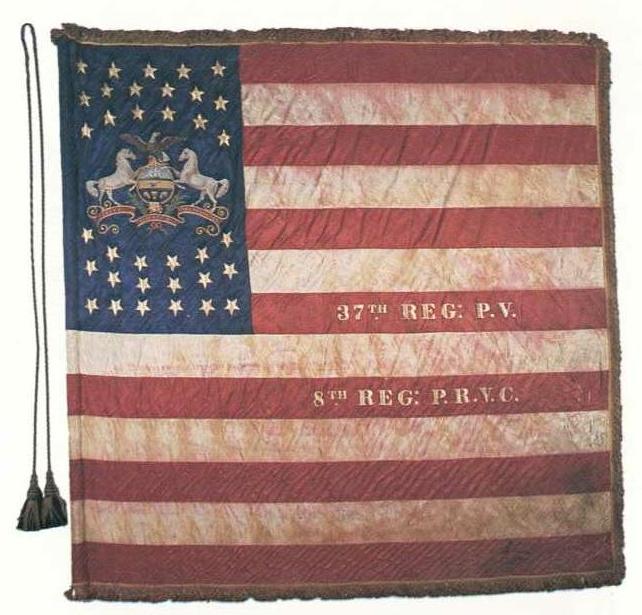
Flag of the 8th Pennsylvania Reserves (courtesy of Pennsylvania Capitol Preservation Committee)
Hill and his friend, Dave Winder, decided at one point in December 1861 to pay a visit to Winder's acquaintances at Camp Griffin, where Gen. "Baldy" Smith's division had its winter quarters.  After "a very muddy walk of three-fourths of a mile" from Camp Pierpont to the neighboring encampment, Winder found his friends and immediately launched into a story.  (Hill 177.)  As Hill describes the scene:
I thought he would never get done telling his friends stories of the battle of Drainesville [sic], in which he asserted that our regiment had been hotly engaged. He stated that, three separate times, our regiment repulsed a brigade of five thousand rebels; and he expressed it as his belief, that the Eighth Regiment alone, unsupported, could charge clear to Richmond. When, at length, he did pause, I suggested the propriety of returning to the pike. Winder, with difficulty, succeeded in tearing himself away from his friends, informing them, as he bade them farewell, that he expected soon to be made captain of the company to which he belonged—that our former captain had been killed in the battle of Drainesville, and that the company would not hear to any other man than himself assuming the position.  (Hill 177.)
Winder certainly enjoyed telling tall tales, as the 8th Pennsylvania Reserves did not even fight at Dranesville, and the Confederate force was considerably smaller than 5,000.  Hill's anecdote about Winder, however, shows the extent to which Union soldiers in Virginia were riveted by the victory at Dranesville in late December 1861.  After all, this engagement was a much-needed win at a time when the North was recovering from defeats at Bull Run and Ball's Bluff, and any man who fought there was likely viewed by other soldiers with esteem or awe.  Winder played on that sentiment.

I've also taken a recent research interest in drinking and army life during the first winter of the war.  (In fact, the other day I wrote about excessive alcohol consumption in the Confederate winter camps around Centreville.)  Hill's story covers the bases when in comes to the use of adult beverages at Camp Pierpont.  Hill notes that "[t]he sale of liquor in the army being prohibited, it was frequently vended by sutlers and others 'on the sly.'"  (Hill 181.)  The veteran recounts a trick that Winder played on a soldier who was desperately looking for some rye:
On reaching the pike we stopped for a few minutes by a sutler's establishment, around which was collected quite a crowd. While there we heard one soldier ask another, in a whisper, if he could inform him where "something to drink" could be procured. (Hill 181.)
Winder told the poor lad, who happened to be from Smith's division, that drink could be procured from a nearby tent.  When the solider went to ask for whiskey, it turned out that Winder had sent him to a colonel's tent.  The officer chased the enlisted man through camp, but he managed to get away and presumably made it back to Camp Griffin.

Whiskey advertisement from Feb. 22, 1862 edition of Harper's Weekly (courtesy of sonofthesouth.net). 
Hill was luckier in meeting his own needs:
On arriving in camp, I was informed, by my messmates, that a "box" had been sent to one of them from home, containing, among other things, two half-gallon tin cans, tightly sealed, one marked in big letters—"preserved Peaches," the other, "Currant Jelly." Now, the one marked "preserved peaches" contained whiskey; that marked "currant jelly" contained whiskey, too. Thus one gallon of the " poison" had walked slyly into camp, beneath the very noses of provost-marshals, officers of the day, etc.
Haman, Dick, Ort, and Enos had been imbibing, and were already right merry when I entered our domicile. They urged me to take "something." Well, I do not think it any harm to take a little now and then while in camp, especially in damp and muddy weather, so I did take a "little" three or four times. By and by all became boozy; Haman and Dick called in everybody that passed by, made everybody drink several times till nearly every man in the company felt right happy.  (Hill 185.)
That night, excessive drinking led to a fight, and one of Hill's messmates was almost shot, but Hill managed to grab the musket from the aggressor.  An officer eventually intervened and put the culprit in the guard house to sober up.  Hill's stories, aside from being just plain entertaining, provide insights into the role that alcohol played in winter camp.

I look forward to reading through other parts of Our Boys, and I will be certain to share with readers any other insights from the book concerning life at Camp Pierpont.  And wish me luck on my search for a first edition!

Note
*There seems to be some degree of confusion over Hill's actual first name. Our Boys lists the author as "A.F. Hill" on the title page and elsewhere.  Google Books indicates that A.F. Hill is "Alonzo F. Hill."  However, the National Park Service database, which is also available on Ancestry.com, indicates that A.F. Hill from Co. D, 8th Pennsylvania Reserves is "Ashbol F. Hill," while a Pennsylvania genealogy site has A.F. Hill from Co. D listed as "Archibald F. Hill."

Wednesday, December 7, 2011

Collecting Forage, Building Huts, and Marching in Little "Grand Reviews": Camp Pierpont, December 1861

As December 1861 got underway, thousands of soldiers from Pennsylvania called Camp Pierpont in Langley their home away from home.  Federal commander George B. McClellan had sent Brig. Gen. George A. McCall's division to Langley back in October as part of an advance into Northern Virginia.  Now McCall's division had the privilege of occupying the far right of the Union lines, not far from the banks of the Potomac River.  But with such responsibility also came the monotony of camp life, consisting mainly of drills, picket duty, and all around bad food, not to mention disease.  The harsh winter weather also loomed just around the corner.  Things were pretty quiet along the Potomac, although the men occasionally had the chance to experience something a little more interesting.

A Few Excursions to the Environs of Dranesville

The Pennsylvania Reserves required forage, and McCall knew perfectly well that a ready supply awaited him on the secessionist farms lying in the no-man's land between the Union and Confederate armies.  At the start of December, he dispatched two expeditions to the area near Dranesville, about ten miles down the Leesburg-Georgetown Turnpike (today's VA-193) from Langley.  The first expedition on December 3, with the brigade of Brig. Gen. John F. Reynolds in the lead, succeeded in carrying away 50 wagons full of forage.

A few days later, on December 6, Brig. Gen. George G. Meade headed to the farm of "bitter secessionist" John Gunnell, two and half miles northeast of Dranesville. (OR, 1:5, 455.)  Meade was to collect forage and arrest two of Gunnell's nephews, who were "reported . . . to have shot two stragglers of [Nathaniel] Banks' division, and left them for the hogs to devour."  (OR, 1:5, 456.)  The brigade of Brig. Gen. E.O.C. Ord followed behind, just in case.

Gen. George G. Meade, commander of the Second Brigade of the Pennsylvania Reserves and later head of the Army of the Potomac (courtesy of civilwarhome.com)
Meade's brigade set out early in the morning from Camp Pierpont.  An anonymous soldier from the 11th Pennsylvania Reserves described what happened at Gunnell's in a letter to the Ebensburg Alleghanian:
Companies A and D . . . were detailed to take charge of the farm and loaded the wagons of which latter articles we had about sixty. The boys immediately fell to with a will and in a comparatively short space of time every wagon was loaded down with wheat, corn and potatoes. In addition we captured eleven head of horses, a pair of oxen and wagon, thirty-eight hogs, averaged two hundred pounds each, two buggies, a splendid carriage and a lot of excellent light harness. Two negro slaves, the property of said Gunnell were also taken in tow and brought into camp. They were exceedingly glad to be afforded opportunity to effect their liberty and are now, I understand, employed as cooks in some of the regiments.
As prisoners, Meade's men brought back Gunnell's nephews and three other "rank secessionists." (OR, 1:5, 456.)   The entire expedition returned to Langley by around six that evening.

Meade was not fully satisfied with his day's work. The general had experienced more than a few disciplinary issues with his men, who "got into their heads that the object of the expedition was the punishment of a rebel, and hence the more injury they inflicted, the more successful was the expedition."  (Meade 234.)  As he lamented to his wife, "it was with considerable trouble they could be prevented from burning everything" that was not carried away.  (Meade 234.)  Meade, whose conciliationist sensibilities were offended, was "ashamed of our cause." (Meade 234.)

McCall painted a somewhat different picture.  In his official report, he informed McClellan about "the very exemplary conduct of all the troops on this occasion" and "commend[ed] from personal observation the good discipline maintained."  (OR, 1:5, 456.)   Perhaps McCall was still bristling from "a very severe letter" he received from McClellan in November commenting on the poor state of the discipline in his division and wanted to avoid even the suggestion of lax behavior of the part of his men. (Meade 226.) 

Winter Quarters

Back in camp, the Pennsylvanians prepared for the season ahead.  As the unknown soldier from the 11th wrote to the Alleghanian, "[t]he weather here is becoming pretty cold and winter-like, but considering that
 . . . the climate is not far different from that of Pennsylvania and in fact of the Alleghenies, we should not expect it to be otherwise."  The troops ensured that they would be well protected from the elements by constructing crude log huts topped with tents.   According to solider from the 11th, "some of them boast of the possession of stoves; others compromise on homemade fire places called 'California stoves.' Between the two we are right comfortably situated."

Photograph of a Union winter camp showing typical log huts, similar to those described in the letter to the Alleghanian (courtesy Library of Congress)
The Grand Review

McCall's entire division participated in a military review in front of Johnston's Hill near Langley on December 12.  The Philadelphia Press noted that since the Grand Review at Bailey's Crossroads on November 20, "there has been no such military display on the line of the Potomac."  Many officers from other divisions attended, although it is uncertain whether McClellan himself was present. The regimental bands "by their inspiring music, gave patriotic zest and liveliness to the occasion."  (Phila. Press, Dec. 14, 1861.)  The  Press could not help but notice that the soldiers' movements "were marked with the precision of old and long-drilled regulars."  Apparently McCall had instilled some degree of discipline, at least for the purposes of parading.  The review ended after two hours, and "all who witnessed it pronounced it a brilliant success."  (Phila. Press, Dec. 14, 1861.)  In a little more than a week, some of these same soldiers would be sent on another expedition to Dranesville, and would score even greater accolades.

Sources 

Ebensburg Alleghenian, Dec. 26, 1861; Meade, George Gordon, ed., The Life and Letters of George Gordon Meade, Vol. 1 (New York, 1913); Philadelphia Press, Dec. 14, 1861.

A few other good accounts of the foraging expeditions to Dranesville can be found here and here.  In an upcoming post, I also hope to explore the secessionists of Dranesville in more detail.