Showing posts with label Salmon P. Chase. Show all posts

Friday, November 16, 2012

Little Mac, Lincoln, and Military Reviews: Engravings from Frank Leslie's

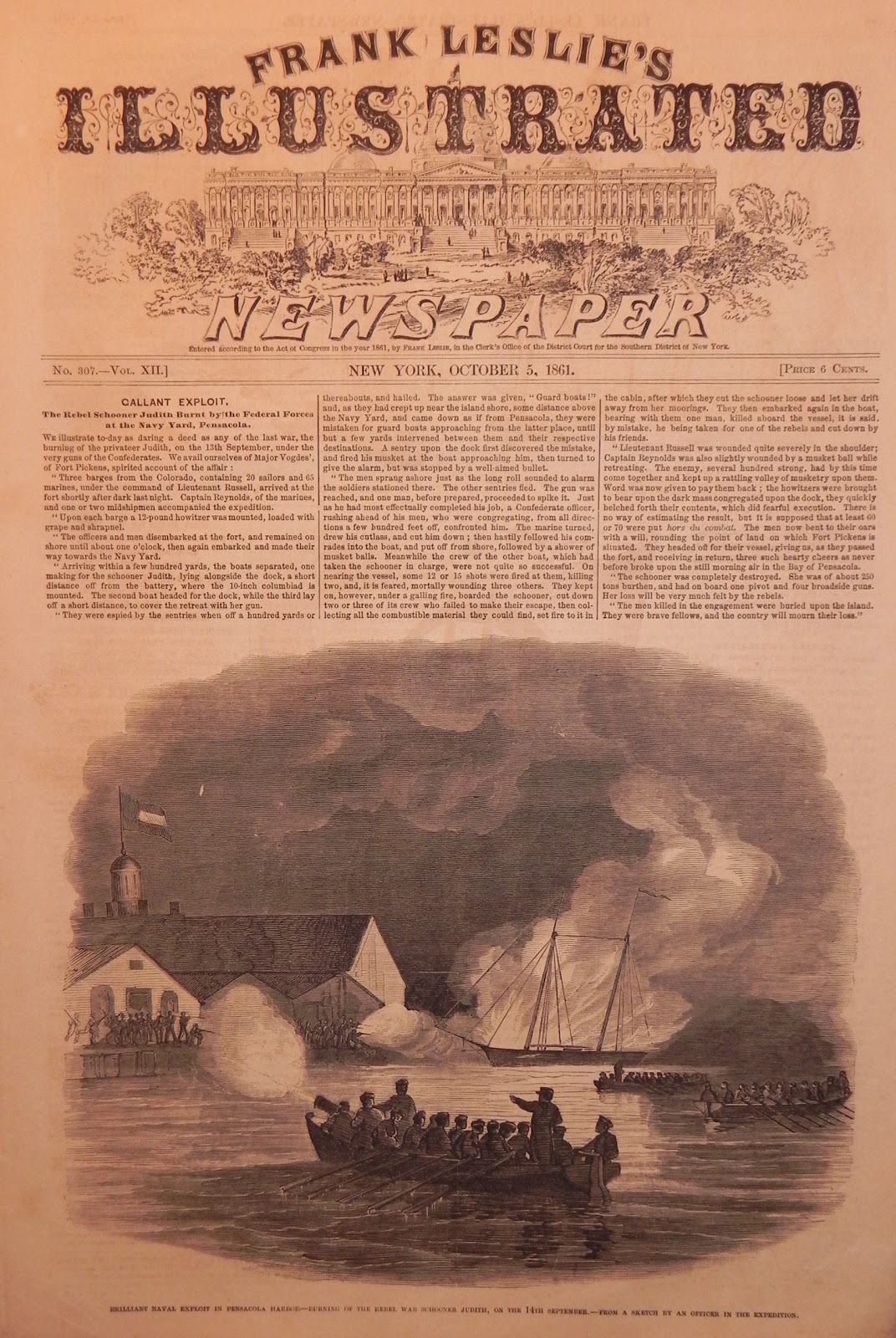
My hobby of collecting Civil War newspapers has become quite the obsession.  I often search eBay and other online sites for additions to my collection, which focuses heavily on the lesser-known aspects of the war in and around Washington.  The other day I won an auction for an October 5, 1861 edition of Frank Leslie's Illustrated Newspaper.  This particular issue contains a multitude of interesting engravings and articles about the time when all was truly quiet along the Potomac.  Two oversized illustrations pertain to military reviews, which were all the rage with the Army of the Potomac in the fall of 1861.

Cover of the Oct. 5, 1861 edition of Frank Leslie's Illustrated Newspaper, showing "Brilliant Naval Exploit in Pensacola Harbor--Burning of the Rebel War Schooner Judith on the 14th September."
Berdan's Sharpshooters Take Aim
On September 20, 1861, President Lincoln, accompanied by Secretary of State William H. Seward and the Prince de Joinville of France, rode out to Camp Burnside near Washington to review soldiers under the command of Col. Hiram Berdan.  Known popularly as "Berdan's Sharpshooters," this famed regiment was composed of top marksmen from across the Union.  "At a late hour," Gen. George B. McClellan finally arrived on the field and greeted the President and Secretary of State.  (Frank Leslie's, Oct. 5, 1861, 326.)  McClellan dismounted and chatted with the Prince and his sons before proceeding to review Berdan's men at target practice.  According to Frank Leslie's:
General McClellan walked down the line of the troops, looking every man in the eye, and afterwards watched with interest the progress of the shooting.  He complimented the men for their skill, and expressed his gratitude to Colonel Berdan at the neatness and excellent discipline that pervaded the camp. . . .  (Frank Leslie's, Oct. 5, 1861, 326.)
Other dignitaries were in attendance that day, along with "[a] large number of ladies and citizens of Washington."  (Frank Leslie's, Oct. 5, 1861, 326.)  It is unclear whether this is the same review of Berdan's men where Lincoln fired a rifle "to the great delight of the many soldiers and civilians surrounding."  (Stevens 10.)  The President on that occasion apparently remarked, "Boys, this reminds me of old-time shooting."   (Stevens 10.)  The article in Frank Leslie's makes no mention of the President's participation.

"'Sharpshooting'--Trial of Skill of Berdan's Riflemen, Before General McClellan and Staff, Near Washington, Friday, September 20--From a Sketch by our Special Artist Attached to General McClellan's Command," Frank Leslie's Illustrated Newspaper, Oct. 5, 1861.  McClellan is presumably the person standing in uniform talking to the men in top hats.
The newsweekly chose to illustrate the event with a two-page spread of McClellan, his staff, and spectators gathered to watch the sharpshooters engage in target practice.  The paper reported that of 240 shots fired at a distance of three-quarters of a mile, "130 hit the target, and nearly all the other shots struck very near it."  (Frank Leslie's, Oct. 5, 1861, 326.)  Overall, the Frank Leslie's correspondent considered that "[t]he affair was successful, so far as the shooting was concerned, and was highly interesting to the spectators."   (Frank Leslie's, Oct. 5, 1861, 326.)  Not to be outdone, the rival Harper's Weekly published a front-page illustration of Berdan's Sharpshooters on the same day.

A Grand Review of Artillery and Cavalry

On September 24, McClellan held yet another review of his army in the making.  Frank Leslie's accorded the event a two-page spread in the October 5 edition.  Once again, the accompanying article portrayed  McClellan as the man of the hour.  This grand review involved over 2,000 troopers from "two full regiments of cavalry, the 5th regular and the Kentucky Volunteers, together with such portions of the Lincoln, Ira Harris and Cameron Guards as had their horses and sabres."  (Frank Leslie's, Oct. 5, 1861, 327.)  In addition, "there were eight batteries of U.S. Regular Flying Artillery, comprising 48 heavy rifled and howitzer field pieces, with caissons, carriages, horses, riders and gunners, in full quota." (Frank Leslie's, Oct. 5, 1861, 327.) 

The artillery and cavalry units were encamped "near the extremities of Seventh and Fourteenth streets" and had to march about three miles to the parade ground, which sat a mile east of the Capitol.  The paper reported that "[t]housands of men, women and children streamed after them" as they made their way through the streets of Washington to the review.  (Frank Leslie's, Oct. 5, 1861, 327.)  Many dignitaries assembled on the parade ground, including the President, the First Lady, and Secretary of the Treasury Salmon P. Chase. 

Finally, "at four o'clock General McClellan, accompanied by his staff -- among whom were the Comte de Paris and Duc du Chartres -- rode upon the ground, and were received with six guns."  (Frank Leslie's, Oct. 5, 1861, 327.)  The day culminated in McClellan's review of the assembled cavalry and artillery units:
The General rode slowly along the line, and carefully scrutinized the equipment, arms and bearing of the troops.  He then inspected the artillery. . . .  Eight batteries numbering 48 heavy guns, then rode in thunderous line before the young Commander-in-Chief, and elicited his hearty approval.  This closed the review, and by sundown the glorious pageant was over.  (Frank Leslie's, Oct. 5, 1861, 327.)
"Grand Review in Washington of Eight Batteries of Artillery and Three Regiments of Cavalry, by the President, General McClellan, and a Portion of the Cabinet, Tuesday, September 24--From a Sketch by our Special Artist Attached to General McClellan's Command," Frank Leslie's Illustrated Newspaper, Oct. 5, 1861.  McClellan sits mounted at the center of the engraving.  It is unclear which figure is the President.  The person in the black coat and top hat next to McClellan most resembles Lincoln, although according to the accompanying article, the President was seated in a carriage with his wife and Secretary Chase during the review.  In the engraving, a carriage with two men and a woman is visible to the left.  The bearded individual in the carriage could also be the President.  Perhaps Frank Leslie's should have gotten better engravers!
Harper's Weekly was even more effusive, calling the review "[o]ne of the finest displays of cavalry and artillery ever witnessed upon this continent."  (Harper's Weekly, Oct. 12, 1861, 652.)  The New York Times struck a more reserved, if not critical, tone:
The display was most grand and impressive, but it lacked the spirit and hurrah of a European review. Gen. MCCLELLAN reviews very much as if he were minutely inspecting the equipments of the men. This gives him perhaps a very good knowledge of the material which he has in his hand, but it does little or nothing to arouse martial spirit or to awaken enthusiasm. It brings out no evidence of the dashing recklessness which carries all before it, and which nine times out of ten alone wins battles.  (N.Y. Times, Sept. 25, 1861.)
The Times was on to something.  Although McClellan was a superb organizer and administrator, he certainly lacked the aggressiveness it took to crush the Confederacy.  On the other hand, the Times misread Little Mac's ability to inspire his own men, who ended up admiring McClellan perhaps more than any other commander of the Army of the Potomac.

These engravings and related stories make the war seem like a sideshow compared to the carnage that was to follow over the course of four long years.  The nation, however, was hungry for war news, and the papers were there to report on whatever was happening around the nation's capital at the time.  Surely McClellan didn't mind the publicity.  Reviews offered the chance to stir patriotic feelings and showcase the Union's military might.  And the October events were only a preview for what was to come.  A few months later, on November 20, the general would conduct the grandest review of them all at Bailey's Crossroads. 

Sources

Adam Goodheart, "Killing Jeff Davis," N.Y. Times Disunion Blog, Aug. 6, 2011; Harper's Weekly, Oct. 5, 1861; Harper's Weekly, Oct. 12, 1861; New York Times, Sept. 25, 1861; C.A. Stevens, Berdan's United States Sharpshooters in the Army of the Potomac, 1861-1865 (1892).

Thursday, March 22, 2012

Military Reviews to Pass the Time: McDowell's Corps Waits in Alexandria

As I discussed in last Thursday's post, Federal commander George McClellan ordered the scattered elements of his army to concentrate at Alexandria in mid-March 1862.   Tens of thousands of men soon boarded transports at the city docks and headed down the Potomac, destined for the Peninsula and the advance on Richmond.  The soldiers in Gen. Irvin McDowell's First Corps, however, remained in camp near Alexandria as the rest of the army moved south.  McClellan had originally intended to send McDowell to the Peninsula first, but plans changed for logistical and strategic reasons.  Private A.F. Hill of the 8th Pennsylvania Reserves recalled the prevailing sentiment among many of his fellow soldiers:
Day after day passed away; troops were continually embarking, and still our turn did not come. Anxiously and impatiently did we await the order to go on board; for we wanted to be off for Dixie. All felt that some important movement was about to be made, and we were eager to begin active operations—to meet the rebels. (Hill 210.)
The days spent in camp presented the perfect opportunity for one of Little Mac's favorite pastimes.  On Tuesday afternoon, March 25, the entire First Corps -- three whole divisions -- assembled outside of Alexandria near Fairfax Seminary and Ft. Ward for a grand review.  The sights and sounds of such pageantry made quite an impression on many of the young men that day.  William Ray of the 7th Wisconsin observed that "[t]he whole country seemed to be alive, so great were the number of men of all grades and in all positions of modern warfare."  (Ray in Herdegen & Murphy 72.)  The review stirred a sense of pride and patriotism.  As Orren Stebbins, a Bucktail from George A. McCall's Pennsylvania Reserves, wrote to his hometown paper:
There were 45,000 in one solid mass, which looked like a moving forest of bayonetts [sic] -- they looked invincible, and I believe they are, when fighting for that which is dearer than life itself -- "Liberty and Union." (Wellsboro Agitator, Apr. 9, 1862.) 
The review also gave soldiers the opportunity to get a glimpse of McClellan himself.  In words reminiscent of a proclamation that Little Mac had recently issued to his men, Stebbins told the Agitator that "McClellan sat upon his fiery steed, and moved not, but watched every move as a father would watch the movements of his children."  (Wellsboro Agitator, Apr. 9, 1862.)*  All in all, the Bucktail felt that "I never saw but one thing surpassed it, and that was the grand review [at Bailey's Crossroads] last fall."  (Wellsboro Agitator, Apr. 9, 1862.)

Gen. Irvin McDowell with Gen. George McClellan, from The Photographic History of the Civil War in Ten Volumes, Vol. 1: The Opening Battles (courtesy of Wikipedia)
The day was not without a comedic moment.  An entourage of journalists followed a group of high-ranking Union officers as they rode past the assembled soldiers at the start of the review.   William Howard Russell of The London Times was an "awkward rider" and struggled to keep up.  (Ray in Herdegen & Murphy 72.)  According to Ray, Russell's poor horsemanship "caused a great deal of sport," and the men of the 7th Wisconsin "just hooted at him."  (Ray in Herdegen & Murphy 72.)

The grand review elicited a generally favorable reaction from the newspapers. A headline in the Philadelphia Press proclaimed, "A Magnificent Display."  (Phila. Press, Mar. 26, 1862.)  Betraying a sense of pride in McDowell's men, the New York Times reported that "[t]he troops never looked better."  Russell noted that British officers who attended the grand review had an "exceedingly favorable" impression of the event, "partly owing, perhaps, to the idea they had formed of this great volunteer army, and partly in consequence of the undeniably good physical properties of the troops."  (as reprinted in N.Y. Times, Apr. 30, 1862.)  Surely these soldiers were destined for great things in the name of the Union.

Lord Lyons, British Minister to the United States, 1858-65 (courtesy of Wikipedia)
Most of the men had little down time before the next big event.  McDowell decided to hold a review in honor of Lord Lyons, the British Minister to the United States.  On March 27, the corps commander hosted a lunch for the Minister and several British Army officers.  After the repast, Lord Lyons and the other dignitaries proceeded to the nearby parade ground outside of Alexandria.  Around two to three thousand spectators had gathered to watch the review, including "many carriages of ladies and several equestriennes."  (N.Y. Times, Mar. 28, 1862.)  McDowell's wife also attended.  Starting at 2:30, the divisions of Gen. William B. Franklin and Rufus King paraded before the dignitaries under a beautiful spring sky. (OR, 1:51:1, 64.)  Gen. McCall's Pennsylvanians, however, were not invited to attend the review.   According to Gen. George G. Meade, a brigade commander in McCall's division, McDowell claimed that "the ground was limited, and that he found it took too much time to review three divisions, and therefore he only ordered two on the ground." (Meade 254-55.)

Following the review, Lord Lyons and the other guests joined McDowell for tea, a most English of traditions.  By all accounts, the foreign guests were impressed with what they saw.  According to a glowing report in the Weekly Mariettian:
[T]hese gentlemen spoke in terms of unqualified approbation of the general appearance of the troops, not only in point of discipline, but of physique, and in addition, remarked that they had never seen a finer body of men in any army.  They also spoke in the highest terms of Gen. McDowell.  (Weekly Mariettian, Apr. 5, 1862.) 
Not everyone was so pleased with the review.  The Pennsylvania boys in McCall's division were still smarting from McDowell's decision to exclude them.  Meade wrote to his wife on March 28 that many of the Pennsylvanians had a sneaking suspicion that McDowell "did not consider them sufficiently presentable for his English friends."  (Meade 255.)  He elaborated on the reaction of McCall's men to the perceived slight and provided his own assessment of the Pennsylvanians in his division:
. . . some little feeling has been excited by [McDowell's] course, particularly as he has had the bad taste to come out to-day with an order extolling the troops for their yesterday's appearance, and announcing that the English officers pronounced them equal to any troops in the world. I was quite satisfied with the inspection of the appearance and movements of the men, that our Pennsylvania ragamuffins are fully equal to them, though in some few instances, like Phil Kearney's brigade (who had spent a mint of money on them), their uniforms were in rather better order. Our fellows console themselves with the reflection that the only troops in the First Army Corps that have beaten the enemy in a fair field, with equal numbers, are the Pennsylvania ragamuffins, whereas of the divisions deemed worthy to be presented to the Englishmen the greater portion were regiments who either did nothing or else behaved shamefully at Bull Run.  (Meade 255.)**
Secretary of Treasury Salmon P. Chase worried about the message that the spectacles were sending to a Northern public hungry for action against the Rebels.  He wrote to McDowell "as a true friend" not long after the March 25 review:
It grieves me to see the confidence of the country, which was revived by the late movement of the Army of the Potomac, already relapsing into distrust. Let me beg you to do all that is possible to inspire vigor and energy. Permit me also to suggest the expediency of having no more reviews. The country is in no mood to hear of anything, however useful and valuable in itself, which savors of show rather than action. Think how much is to be done and how near is midsummer.  (in Warden 422.)
Some of the men in McDowell's corps were also getting tired of the reviews and wanted nothing more than to join their fellow soldiers on the Peninsula.  John Chase of the 1st Massachusetts Light Artillery in Franklin's division told his brother about the recent spate of reviews in a March 29, 1862 letter.  As he wrote, "we have had Lord Lyons and all the rest of the great men to see us. . . ."  (in Collier & Collier 71.)  But Chase had already become jaded. The artilleryman was starting to "grow sick of this cleaning up carriages and harnesses and uniforms and I think if they dont [sic] want us to fight they had better send us home."  (in Collier & Collier 71.)  Unfortunately for Chase and others like him,  McDowell's men had a while to go before the Union Army would put them to good use against the Confederates.

Notes

*On March 14, 1862, McClellan issued a proclamation to the "Soldiers of the Army of the Potomac," in which he expressed his affection for the men under his command:
I am to watch over you as a parent over his children, and you know that your General loves you from the depths of his heart. It shall be my care -- it has ever been -- to gain success with the least possible loss. But I know that if it is necessary you will willingly follow me to our graves for our righteous cause.  (N.Y. Times, Mar. 16, 1862.)
**Meade's reference is to Dranesville, a battle won by soldiers from the Pennsylvania Reserves on December 20, 1861.

Sources

Russel Beatie, Army of the Potomac: McClellan's First Campaign, March-May 1862 (2007); John S. Collier & Bonnie B. Collier (eds.), Yours for the Union: The Civil War Letters of John W. Chase, First Massachusetts Light Artillery (2004); Lance Herdegen & Sherry Murphy (eds.), Four Years with The Iron Brigade: The Civil War Journal of William R. Ray, Company F, Seventh Wisconsin Volunteers (2002); A.F. Hill, Our Boys: The Personal Experiences of a Soldier in the Army of the Potomac (1864); George B. McClellan, Report on the Organization and Campaigns of the Army of the Potomac (1864); George Meade, The Life and Letters of George Gordon Meade, Vol. 1 (1913); New York Times, Mar. 26, 1862; N.Y. Times, Mar. 16, 1862; N.Y. Times, Mar. 28, 1862; N.Y. Times, Apr. 30, 1862; Official Records, 1:51:1, 63-64; Philadelphia Press, Mar. 26, 1862; Edmund J. Raus, Jr., Banners South: A Northern Community at War (2005); J.R. Sypher, History of the Pennsylvania Reserve Corps (1865); Robert B. Warden, An Account of the Private Life and Public Services of Salmon Portland Chase (1874); Weekly Mariettian (Marietta, Pa.), Apr. 5, 1862; Wellsboro (Pa.) Agitator, Apr. 9, 1862.