Showing posts with label Simon Cameron. Show all posts

Thursday, July 26, 2012

Mr. Lincoln's Washington: New Resources

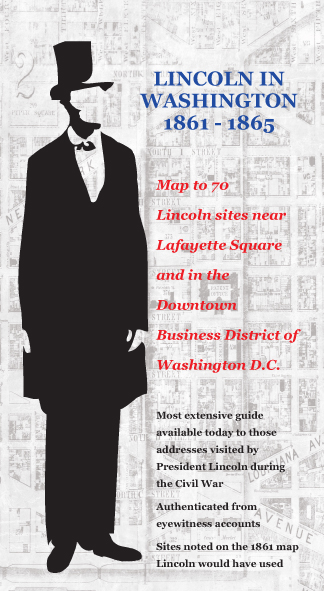
Last year I had the pleasure of meeting John O'Brien after I wrote a post for my employer's blog on the historic Winder Building in downtown DC.  O'Brien, a local expert on President Abraham Lincoln, was researching sites in Washington related to Lincoln's presidency and the Civil War.  He contacted me after reading the post.  O'Brien and I chatted about my office building, which housed several key offices visited by Lincoln during the war, and I arranged a tour for him with the chief preservationist of the Executive Office of the President.  I was extremely pleased when O'Brien recently sent me the fruits of his extensive and meticulous research  -- a newly-published fold-out map entitled, Lincoln in Washington: 1861-1865.

(courtesy of Lincoln in Washington)

The map provides incredible insights into Washington at the time of the Civil War.  One side depicts wartime Lafayette Square, near the White House, and discusses twenty-three sites connected with Lincoln that were located on or near the square, including the Wilkes-Madison House, where Gen. George B. McClellan worked and resided in the late summer and fall of 1861.  O'Brien has also written special inserts on "Lincoln in Public," the headquarters building for the Defenses of Washington, and Secretary of State William Seward's house.  The  reverse side of Lincoln in Washington contains a period map of Washington marking forty-nine other sites associated with the 16th President.  O'Brien offers descriptions for each of these places of interest.  Some of the sites are well-known, like Ford's Theatre and Willard's Hotel.  Many others, such as Secretary of War Simon Cameron's house, are more obscure, and reflect O'Brien's thorough research on Civil War Washington.  And yes, the Winder Building is included.  Some of these places are still standing, while others have been demolished, and the map simply indicates the former location.

The map is a must-have for Lincoln buffs, as well as Civil War enthusiasts with an interest in Washington City at the time of the conflict.  O'Brien tells me that the map is for sale at Ford's Theatre and the Lincoln Memorial.  But never fear.  You can order a copy here.

I'd also like to welcome John to the blogosphere.  He has started a blog, Lincoln in Washington, where he provides readers with even more detail on the various sites related to the 16th President in the nation's capital.  Despite the summer humidity, I can't wait to start hitting the streets of downtown DC armed with information from O'Brien's map and blog!

Thursday, December 29, 2011

Governor Curtin Comes to Town

Pennsylvania Governor Andrew Curtin traveled to Washington at the end of December 1861.  The main purpose of Curtin's visit was to discuss his state's military preparedness, including "the best means of defending Pennsylvania from a foreign enemy." (Phila. Press, Dec. 27, 1861.)  The trip would also afford Curtin the opportunity to visit the Pennsylvania Reserves, who had recently captured national attention for their victory over Jeb Stuart at Dranesville.

The governor, a loyal supporter of President Lincoln, immediately attracted attention in the nation's capital.  At Willard's on Pennsylvania Avenue, two or three Pennsylvania regimental bands serenaded the governor.  Curtin "was then called out, and addressed the audience, referring to the part Pennsylvania [had] taken in the war."  The governor extolled the state's "patriotism and faithfulness to the Union" in providing such a "large number of troops. . . all in very fine condition"  (Phila. Press, Dec. 30, 1861.)  The governor "manifested the greatest enthusiasm in the success of the troops" at Dranesville, and assured the Pennsylvania regiments present at the hotel of "his desire to secure to them every comfort in his power."  (Phila. Press, Dec. 30, 1861.)


Gov. Andrew Curtin of Pennsylvania (courtesy of Wikipedia)
On Sunday, December 29, Curtin crossed the Potomac to visit the Pennsylvania Reserves at Camp Pierpont in Langley.  It was a "delightful" winter day.  (Phila. Press, Dec. 30, 1861.)  The governor must surely have felt a sense of pride as he moved among the troops.  After all, Curtin was instrumental in the establishment of the Reserves in the days following Ft. Sumter, and their win at Dranesville had helped to boost morale on the Northern home front. 

The division hospitals were the governor's first stop.  There Curtin "spoke a kind word to each of the soldiers wounded" at Dranesville.  (Phila. Press, Dec. 30, 1861.)  The governor then rode to a hill outside of Langley, where he reviewed the entire division, accompanied  by his political rival and fellow Pennsylvanian, Secretary of War Simon Cameron.  Gen. George B. McClellan, commander of the Army of the Potomac, was still recovering from a very severe illness back in Washington and was not present.

The Press reported that the Reserves were caught unaware of Curtin's visit and only received notice of the review at noon.  However, by 1 p.m, the entire division formed on the review ground and was ready to parade before the dignitaries.  According to the Press, the Reserves "performed the various evolutions with the precision and regularity of veterans. . . .  Their recent victory at Dranesville [had] inspired them with new courage and unbounded confidence in their officers."  (Phila. Press, Dec. 30, 1861.)

Following the military maneuvers, Curtin's carriage pulled up in front of the soldiers.  Brig. Gen. E.O.C. Ord, who had served as the immediate commander at Dranesville, introduced the governor.  Curtin stood and addressed his fellow Pennsylvanians.  The governor made no apologies for paying a visit to camp on the Lord's day.  In fact, he told the Reserves that "it could be no desecration of this sacred day for me to come out and look at the faces of the brave men who are illustrating the power of the nation to suppress insurrection and break down the conspiracy which now threatens our Government."   The governor announced that he had ordered the name of the Battle of Dranesville inscribed on the Reserves' standard.  Noting the "thrill of pleasure and of pride" that was felt in Pennsylvania upon learning of the victory at Dranesville, Curtin offered words of gratitude:
In the name of Pennsylvania, I thank you; I thank you for the honor you have reflected upon the Old Keystone State; I thank you for your courage.  Thousands of people at your homes rejoice over the result.   Thousands more will follow you, if need be, in this war; and at all times when our Government is in peril Pennsylvania, from the Delaware to Lake Erie, every man in the state, every dollar of our material wealth, all our blood and treasure, stand upon the side of right and truth, and they will, as ever, be loyal to the Constitution and to an organized, legitimate Government.
Curtin wished the men future success in battle and concluded his oration:
I commend you to the care of these generals, who lead you, and the Government that protects you in your rights.  I go back to Pennsylvania refreshed by this interview, and prouder than ever I have been of the gallant spirits comprising the Reserve Corps.  Pennsylvania expects every man to do his duty.  With that single word falling upon your ears, I bid you farewell.
The soldiers cheered their governor, and then sent up additional hurrahs for Secretary Cameron and the generals of the Pennsylvania Reserves. 

The next day, Cameron placed political rivalries aside and hosted a dinner for Curtin at his private residence.  Several dignitaries were present, including Secretary of the Treasury Salmon P. Chase, Secertary of State William Seward, Senator Benjamin Wade of Ohio, and Senator Charles Sumner of Massachusetts.  During the dinner, President Lincoln himself made an appearance.  The President's drop-by at a Cabinet member's social event apparently broke an unwritten rule of Washington etiquette.  However, as the Pennsylvania Daily Telegraph reasoned, "President Lincoln desired to do the gallant and devoted men of Pennsylvania an honor through his Secretary of War and our Governor."  According to Sumner, much of the conversation focused on the all-consuming Trent affair, although the contribution of the Pennsylvania Reserves at Dranesville likely came up at some point that evening.

The Daily Telegraph reported that Curtin was "eminently successful in his official mission" to Washington.  The governor returned to Pennsylvania, where he continued his efforts on behalf of the Administration and the Union war effort.  Meanwhile, the Reserves could take pride in their own contributions and the recognition that they had received from their esteemed governor.  December had certainly been a month to remember for the soldiers encamped at Langley.

Sources
The Lincoln Institute, Mr. Lincoln's White House, Biography of Andrew G. Curtin; Pennsylvania Daily Telegraph (Harrisburg, Pa.), Dec. 31, 1861; Philadelphia Press, Dec. 27, 1861; Philadelphia Press, Dec. 30, 1861; Edward L. Piece, Memoir and Letters of Charles Sumner, Vol. 4 (1893).
Wednesday, November 16, 2011

The Grand Review at Bailey's Crossroads: Glowing Reports and a Public Reassurance

This upcoming Sunday marks the 150th anniversary of an impressive display of Union military might.  On November 20, 1861, Maj. George B. McClellan, commander of the Army of the Potomac, staged a "Grand Review" of between 50,000 and 70,000 Union soldiers from seven divisions at Bailey's Crossroads, Virginia.  President Lincoln, Secretary of War Simon Cameron, and other dignitaries, along with 20,000 to 30,000 spectators, witnessed McClellan's organizational prowess unfold on the open fields a few miles outside of Washington.  Readers will recall that only a few months before, Bailey's Crossroads was the site of a picket war between the two armies.
Maj. Gen. George McClellan, as depicted on 1861 sheet music (courtesy of Indiana State Museum)
Last year, I wrote a few posts about McClellan's Grand Review, so I won't cover old ground here.  For a complete story of the review, check out this post.  I also discussed Gen. George G. Meade's the less-than-enthusiastic reaction to the review.  Others have shared my interest in the topic.  A group known as the Lincoln at the Crossroads Alliance recently sponsored a sesquicentennial reenactment of the Grand Review at Ft. McNair.  (Staging at the original location would have been a logistical nightmare!)  I had planned to attend, but other obligations got in the way.

The review was the largest ever held on the North American continent up to that time.  Not surprisingly, Northern newspapers provided glowing accounts of the spectacle.  According to the headline in the November 21, 1861 edition of the New York Times, the review was a "Magnificent Military Pageant."  The Philadelphia Press called the event "indescribably grand."  (Nov. 21, 1861 ed.)  The Press reported that Prince de Joinville, a member of French nobility accompanying McClellan, was "in raptures over the grand review, alleging that he never saw anything compared to it in the old world, when the regularity, promptitude, and harmony of the movements are taken into consideration."  (Nov. 23, 1861 ed.)

For all the praise, however, there surely were skeptics out there, or so the Beaver (Pa.) Weekly Argus thought.  As the Argus elaborated on November 27:
The Eastern Papers of this week were filled with the details of the ceremony, which, however, possesses little interest for the general reader except as showing what a splendid army we have in the field.
As some of our friends may not see the necessity of these reviews, we clip from the Scientific American, the following sensible remarks in vindication of the policy of the General-in-Chief:
"This system of reviewing troops is somewhat novel in our army operations, and many who are not familiar with its objects regard such demonstrations as unmeaning.  Gen. McClellan's experience in the Crimea in '55 fully convinced him of the importance of such reviews.  Frederick the Great, Napoleon, Wellington, and all the great military commanders were in the habit of holding frequent grand reviews, and the system is kept up in all European nations.  It is very inspiring, not only to the troops, but also to the officers."
The "Young Napoleon" surely would have approved of this rationale for holding the Grand Review.  If anything, the event showcased for the Union leadership and the Northern public what McClellan could do to organize and drill an army.  Now he just had to demonstrate that he could defeat the Rebels, and for an answer, the nation would have to wait until springtime.

Note on Sources:
All Pennsylvania news articles can be found on the extensive Pennsylvania Civil War Era Newspaper Collection maintained by the Libraries of Penn State University.

Monday, November 8, 2010

The Grand Review at Bailey's Crossroads


Looking today at the commercial sprawl of Bailey's Crossroads in Northern Virginia, it is difficult to imagine the rural character of the landscape during the nineteenth century.  In November1861, Bailey's Crossroads was the site of the largest military review ever seen on North American soil up to that time.  Throughout the previous months, the area around Bailey's Crossroads lay in a virtual "no-man's land" between Confederate forces at Munson's Hill to the northwest and Union lines outside of Alexandria.  The area fell into Northern hands when the Confederates withdrew in late September 1861.

General George B. McClellan, commander of the Army of the Potomac, had expended much effort after the defeat at Bull Run whipping his raw recruits into a fighting force.  A Grand Review would provide McClellan with an opportunity to showcase the results of his organizational prowess.  Early on the cold morning of November 20, 1861, troops from seven divisions of the Army around Washington began marching towards Bailey's Crossroads.  McClellan wanted a great display of force, but as the New York Times reported, he ensured that the "pickets on the outposts [were] considerably strengthened" while the divisions were away.

Around 20,000 to 30,000 spectators gathered to watch the review.   According to the Times:
As no passes were required it was free to everyone who could procure a conveyance, or who chose to walk, the distance being about eight miles by the route which they were obliged to take. The roads were guarded the entire distance, so that civilians without written permission could not diverge from the prescribed limits of travel. 
The scene made an impression on Sergeant Oren M. Stebbins of the famed 1st Pennsylvania Rifles, also known as the "Bucktails." In a November 24, 1861 letter to his local newspaper, he noted that spectators were "filling the trees, covering the house tops and barns, and swarming on every vacant spot, all anxious to behold the grandest military display, that ever was witnessed in America."

As the troops arrived in Bailey's Crossroads, they were organized into a semi-circle of four miles.  At the start of the ceremony, fifteen batteries fired a salute and then McClellan, along with President Lincoln, Secretary of War Simon Cameron, and Secretary of State William H. Seward, "all on horseback, rode rapidly along the line, meeting with continuous and enthusiastic cheers from the soldiers."  (New York Times, Nov. 21, 1861.)  As J.P. Sheibley of the 7th Pennsylvania Reserves described the scene to his brother, McClellan, Lincoln, and the Cabinet, "were welcomed with loud huzza's from the soldiers, and bands playing 'Hail to the Chief'.  It was a sight that made the pulse beat quick."


"The Great Review at Bailey's Cross Roads, Virginia, on November 20, 1861 -- Sketched by Our Special Artist From the Top of a Barn," Harper's Weekly, December 7, 1861 (courtesy of sonofthesouth.net)
The dignitaries returned to the review stand, and at one-thirty in the afternoon, the seven divisions began to file past in a procession that lasted three hours.  General George A. McCall's Pennsylvania Reserves, led by the  "Bucktails," went first, followed by the divisions of Generals Samuel P. Heintzelman, William "Baldy" Smith, William B. Franklin, Louis Blenker, Fitz John Porter, and Irvin McDowell.  According to the Times, the force consisted of "a total of 76 regiments of infantry, 17 batteries and seven regiments of cavalry, perhaps in all about 70,000 men."  (Most accounts, including Harper's Weekly, reported 70,000; McClellan claimed 65,000 in a letter written that day, while the historical marker in Bailey's Crossroads notes 50,000.) After passing the review stand, the soldiers headed back to their camps around Washington.

Bailey's Crossroads, at the corner of Leesburg Pike and Columbia Pike (in 1861, the Leesburg & Alexandria Turnpike and the Columbia Turnpike).  In 1837, Hachaliah Bailey from Westchester County, New York purchased land at this intersection and built his home "Moray" here.  Union officers and their families boarded at Moray during the Civil War.  Today, only Moray Lane remains.  The windmill to the left of the highway marker is all that is left of the rural landscape. (Thanks to my wife for snapping the picture.)
The reaction of officers present in the stands was described by Harper's Weekly in the December 7, 1861 edition:
The passage of this large army of volunteers elicited the strongest praise from the very formidable body of old army officers who sat in review. General Stunner, who now for the first time since his return from the Pacific witnessed an exhibition of the progress in drill of the volunteers, expressed much surprise that men coming from civil life should, in so short a period, have been able to compete in soldierly appearance with the veterans of the regular army.
McClellan also was very content with his Army's performance.  He wrote to his wife that night at half past eight:
The Grand Review went off splendidly. . . not a mistake was made, not a hitch.  I never saw so large a Review in Europe so well done -- I was completely satisfied & delighted beyond expression.
Unfortunately for McClellan, his skills on the battlefield did not match his skills as an organizer of military reviews. 


Sunday, June 13, 2010

McClellan's Reaction to Lewinsville: Looking for Victory Where You Can Find It


In light of Thursday's post on the Civil War history of McLean, I thought readers might be interested in General George McClellan's take on the first skirmish in Lewinsville, Virginia on September 11, 1861.  I recently came across this interesting telegram sent on the day of the battle by McClellan to President Lincoln, Secretary of War Simon Cameron, and General-in-Chief Winfield Scott:

Gen'l Smith made reconnaissance with two thousand men to Lewinsville, remained several hours & completed examination of the ground. When work was completed & the command had started back the enemy opened fire with shell, killing two men & wounding three.
Griffin's battery silenced the enemy's battery. 
Our men then came back in perfect order & excellent spirits.  They behaved most admirably under fire.

We shall have no more Bull Run affairs. 

Interesting how McClellan reacted to this small skirmish.  After the utter defeat of First Bull Run, it is not surprising that the commanding general was looking for any way to reassure himself and his superiors that the Army of Potomac was capable of something.  And the concluding line is classic -- a boastful promise to McClellan's bosses that he will not let them down.  Before long, he would be in trouble for moving too slowly.  As Lincoln once quipped, if McClellan wasn't going to use his army, he would like to borrow it for a time.  It's easy to have no more Bull Runs when you are paralyzed by inaction!