Showing posts with label L. Atkinson. Show all posts

Thursday, April 9, 2015

"Heaven Has Seemed to Prosper and Aid Our Cause": Lydia Atkinson Reactsto Lee's Surrender

Today marks the Sesquicentennial of General Robert E, Lee's surrender at Appomattox Court House, Virginia. On this occasion, I thought readers might enjoy a particularly relevant except that I discovered in the diary of Lydia T. Atkinson, a teacher at the contraband camp on Mason's Island.

(courtesy of Wikipedia)

In summer 1864 the Friends' Association for the Aid and Elevation of the Freedmen had sent Atkinson to teach former slaves at Camp Wadsworth in Langley. Due to government policies of binding out children at the camp, her school lost pupils, and the Friends transferred her to Mason's Island in fall 1864. A few months later, Atkinson learned of the momentous news of Lee's surrender. She described her feelings in a diary entry dated April 10, 1865:
Joy upon Joy—cheer upon cheer—love and thanksgiving and praise everywhere! Glory to God in the Highest on earth and Peace Good Will toward men! At dawn this morning were wakened by the loud thundering of guns from the neighboring forts and half sleepily I murmured “Lee has surrendered!” We really thought little of it however until the paper came announcing the glorious tidings! Oh! such a happy, grateful feeling took possession of the heart -- as we began to realize that the war must indeed be over -- and the blessed angel of Peace rest upon our noble banner. It was not the insanity of joy felt when Richmond fell—but a deep quiet happiness too intense for words! Truly God’s blessing seems now to rest upon the American nation! As we have learned to deal justly by the Negro—so Heaven has seemed to prosper and aid our cause.
Atkinson's sense of happiness and relief are incredibly moving, even after 150 years. Her feelings echo those of a war-weary nation upon learning of Lee's surrender that Palm Sunday at Appomattox Court House. Most strikingly, Atkinson's words bear witness to her deep-seated personal belief in the righteousness of the Union's fight for freedom and emancipation. The Quaker teacher, who through her own deeds contributed to the cause, plainly saw the hand of God in the victory over Lee's army.

Reminder

On a related note, I wanted to remind readers that I will be speaking this evening before the Arlington Historical Society about the contraband camps of Northern Virginia. The event will start at 7 p.m at the Reinsch Library auditorium on the campus of Marymount University. Please click here for more information. I hope to see you there!

Source

Thanks to the Friends Historical Library of Swarthmore College for providing me with the excepts from Lydia T. Atkinson's Personal Diary from 1864.

Friday, February 6, 2015

Contraband Camp Developments, Late Summer & Fall 1864, Part II

Last week I wrote about the efforts of the Friends' Association for the Aid and Elevation of the Freedmen to assist the contrabands living on government farms in Northern Virginia during the summer and fall of 1864. As the organization continued to send more teachers and supplies to help transition former slaves to freedom and self-sufficiency, the Union Army in the Department of Washington pursued tougher policies that were designed to reduce dramatically the number of freedmen and women dependent on the government. Capt. Joseph Brown, head of the Department's Bureau of Freedmen and Government Farms, led the campaign to cut costs.

James Mott, member of the Board of Managers of the Friends' Association and husband of fellow member and famed abolitionist Lucretia Mott (courtesy of Wikipedia).

In November 1864, the Association sent Helen Longstreth and James Mott to the contraband facilities at Mason's Island and Camp Wadsworth. On Mason's Island they found that "the condition of the people had improved" since the Association's visit earlier that fall. (First Annual Rpt. 12.) Longstreth and Mott were pleased with the educational arrangements, despite the loss of one teacher:
The new school room is large, well lighted and ready for the stoves which are promised this week. The discontinuance of the school taught by a daughter of the superintendent places all the children under our care; these at present number about one hundred who can be accommodated in this commodious room. (12.)
Seeing that the supply of water, although better than before, was still "insufficient," they pressed the camp's superintendent, as well as Capt. Brown, to complete construction of an additional well. Both men promised that the work would be "finished at once." (12.)

Longstreth and Mott visited with and interviewed many of the freedmen and women on Mason's Island:
The countenances of a few beamed with pleasure, as they showed us useful articles which they had purchased, with the proceeds of their paid labor. Some were preparing their dinners, but the greater number were sitting listlessly around the stoves, evidently suffering for want of something to occupy their thoughts and attention. Upon our asking them whether they would like to do some kind of work, their faces brightened, and their answers conveyed the idea that anything would be better than idleness, even if they received "no pay," but they preferred "pay." (12-13.)
Based on these observations, they recommended to Brown that the Government support the establishment of an "industrial school, in which [the contrabands] could be employed in making up new, and mending their partly worn, clothing, [and] also receive instruction in cutting out, making and mending such." (13.) They "found him ready to co-operate with us in establishing a school of this kind." The Association "offered to supply one or more teachers," and Brown agreed to furnish a room and supplies. (13.) Nevertheless, the captain warned Longstreth and Mott that the "Government was unwilling to make costly outlays, as the permanency of the camp in this place is doubtful on account of the unhealthiness of the island during several months of the year." (13.) Given Brown's desire to reduce the numbers of contrabands from Mason's Island and other camps, he may have exaggerated the influence that the weather had on his decision about spending more money on the contrabands. [1]

On November 5, Longstreth and Mott traveled to Camp Wadsworth near Langley.They made a troubling discovery that largely stemmed from Brown's policies of apprenticing children and hiring out adults:
Before leaving home we had learned that there were but few children at either the upper or lower camp. [2] The present policy of the Government is to find homes for all children of suitable age to bind out. Many parents not wishing to be parted from their children have left these camps, preferring the uncertainties of seeking their own livelihood without the aid of Government to the probability of what may prove a permanent separation from them. This movement has nearly broken up Lydia T. Atkinson's school. (13.) 
The pair recommended "the transfer of her remaining pupils to the lower camp. . . under the care of Mary McLain, and [Atkinson's] removal to Mason's Island where our school has been so greatly increased." (13.) The two "regret[ted] this suggested change, as the children under [Atkinson's] care had advanced rapidly in their studies, and the adults had greatly improved in house keeping." (13.)

The Friends also uncovered additional issues at Camp Wadsworth:
At the lower camp we found that our teacher had been equally faithful in the performance of her duties, but we were much disappointed to see that the superintendent had built her a very small cabin, which judging from its loose construction will barely protect her from the winter weather. (14.)
Longstreth and Mott went to see the superintendent at his home, but he was not there, so they instead talked to his wife. Based on this conversation, they concluded:
. . . [I]f we wish to do our work well, we must use our influence to induce conscientious farmers and their wives to seek such situations as this man holds, for unless those who have the care of these Government farms go hand in hand with us, and with our teachers, we shall be able to do our duty but partially, and throw discouragements in the path of those who look to us as their true friends. (14.)
The pair at least had some good news to report about Camp Wadsworth and made a few recommendations for future action:
The greater part of the Freed-people, in these two camps, are earning money by cultivating the farms. They are inclined to spend it judiciously. We, therefore, suggest, that our teachers here be furnished with a stock of trimmings and a few other articles in order to form a nucleus for a small store in case it should prove desirable to establish one here. Now, they are obliged to send nine miles to Georgetown for needles, tapes, and other similar articles. (14.)
Longstreth and Mott returned to Philadelphia with their findings. Unfortunately, the Association had little choice but to transfer Atkinson away from Camp Wadsworth due to the impact of Capt. Brown's policies. Time would tell whether the Union Army would deliver on its other promises to assist the Friends in their work among the contrabands. In the meantime, even the two visitors appeared to recognize that the contraband camps had limitations and were perhaps a temporary measure: "We must not, however, forget that it is equally our duty to obtain all the information we can, upon the various modes for elevating the Freedman, in order that we may be prepared to work in other directions, so soon as it is thought best for us to do so." (14.)

PERSONAL NOTE

If you notice a decline in activity on the blog in the upcoming weeks, it's not because I have lost interest in the Civil War! My wife and I are expecting, and things are about to get really busy around the house with a newborn and twin preschoolers. I will try to blog whenever possible, but right now I won't make any promises about regularity of my posts. That said, I will remain active on Twitter and Facebook, so be sure to follow me there as well.

Notes

[1] Between July 1864 and March 1865, the Department reduced the number of freedmen and women on Mason's Island from 1,200 to 500, and the camp was shuttered by mid-1865. (Berlin et al. 261.)

[2] Camp Wadsworth was located on two different properties that had belonged to secessionists before the war. The reference to "upper" and "lower" camp likely refers to this division.

Sources
Ira Berlin et al., Freedom: A Documentary History of Emancipation, 1861-1867, Selected from the Holdings of the National Archives of the United States, Series I, Volume II, The Wartime Genesis of Free Labor: The Upper South (1993); Board of Managers, Friends' Assn. for the Aid and Elevation of the Freedmen, First Annual Report of the Board of Managers of the Friends' Assn. for the Aid and Elevation of the Freedmen (1865);  Friends' Intelligencer: A Religious and Family Journal, Vol. XXIII (1867).

Wednesday, January 28, 2015

Contraband Camp Developments, Late Summer and Fall 1864, Part I

As the Union Army fought over the future of Northern Virginia's contraband camps in the late summer of 1864, the Friends' Association for the Aid and Elevation of the Freedmen continued its work to improve the lives of former slaves living on government farms near Washington. Established by Philadelphia Quakers at the start of the year, the organization provided supplies and teachers to supplement the efforts of Union military authorities. But the debate within the government was not without consequences, and by the end of 1864, the Friends would face the unwelcome challenge of a new and harsher policy towards the contrabands.

An important part of the Friends' charitable activities centered on education. Since starting work in Northern Virginia earlier in the year, the association had sent teachers to Camp Rucker in Falls Church, Camp Wadsworth in Langley, and Mason's Island. In August 1864, the Friends decided to increase the number of teachers to meet the growing needs of the contraband community. Mary McLain was dispatched to Camp Wadsworth, while Margaret Preston was installed at Mason's Island. [1]

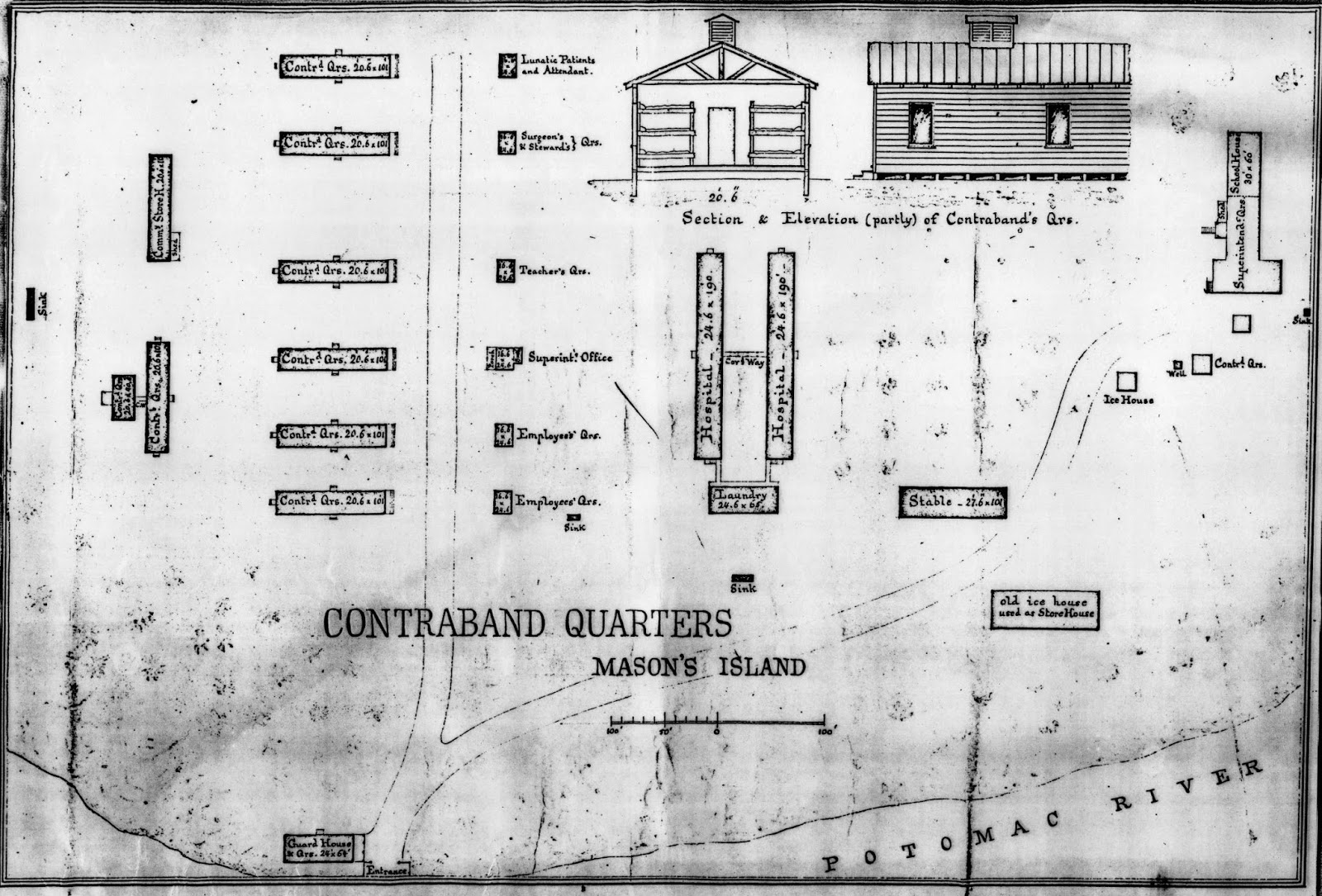
Map of contraband quarters at Mason's Island (courtesy of TR Center). Hospital buildings are shown in the center of the drawing.

The Friends also provided the contraband camps with clothing, sewing supplies, dry goods, and other household items. At least some of these donations were sold to the freedmen and women, presumably at a discount. [2] In September 1864, the Friends' Association decided to disband its Committee on Supplies and established a new Sanitary Committee. The Board appropriated $500 to the committee for the purchase of hospital supplies for Mason's Island. That month, the committee issued the call for donations in the Friends' Intelligencer:
The undersigned, a sanitary committee of said Association, solicit from Friends and others, contributions of hospital stores, which will be judiciously distributed by nurses and teachers sent out by the Association to Mason’s Island, Camp Wadsworth, and other points in the vicinity of Washington. 
The articles most needed, are dried fruits,such as apples, peaches, cherries, plums, and blackberries; also blackberry and other syrups, and all other articles suitable for the sick and convalescent.
Contributions of bed-covering, and clothing for women and children, will be very acceptable, as they are greatly needed. Free transportation has been granted by Government from Philadelphia. (456.)

At the same time the Friends were intensifying their involvement with the camps, Capt. Joseph Brown, an assistant quartermaster, took over primary responsibility for the contrabands in the Department of Washington from the outgoing Chief Quartermaster, Lt. Col. Elias Greene. Brown pursued decidedly stricter policies than Greene, who had lost his job as the result of an Army report critical of his management of the contraband camps. Brown, the head of the Department's Bureau of Freedmen and Government Farms, wanted to rid the government of the expense and trouble of caring for the freedmen and women in the camps and tried to send as many to the Northern States as possible. He also departed from Greene's policy of keeping families together. Brown thought nothing of apprenticing children to local households and hiring out their parents on separate jobs.

Toward the end of September the Friends' Sanitary Committee sent Louisa J. Roberts and Margaret A. Griscom to Mason's Island. Roberts wanted to meet with the new Chief Quartermaster of the Department of Washington, Col. John Ellison, to explain "the wants of our teachers and the people among whom they labor." (First Annual Rpt. 10.) Following her conversations with Ellison, Roberts reported that "[o]ur teachers appear to have his entire confidence, and he seems willing to do all that lies in his power, to promote their comfort and efficiency." (First Annual Rpt. 10.) As to Mason's Island, the visitors found:
The condition of the people. . . is much improved; the great mortality that prevailed during the latter part of the summer, has given place to a more healthy condition, attributable to the success that has attended our efforts to provide hospital accommodations, and to the approach of colder weather. (First Annual Rpt. 11.)
Nonetheless, Roberts and Griscom saw indications of troubles yet to come. As the Friends' Education Committee reported in October, "many grievances were found to exist at Camp Wadsworth, and it was believed that through their representations to the proper authorities most of these would be redressed." (Friends' Intelligencer 521.) The Friends were betting on the willingness of the new military leadership to assist, but Brown's policies were fast becoming a part of the problem.

Up Next

Camp Wadsworth suffers a setback.

Notes

[1] Preston was also charged with nursing responsibilities, as the circumstances required.

[2] According to the Friends' Association's First Annual Report:
The people on the two farms composing [Camp Wadsworth] evince a desire to support themselves, and they have paid for a considerable  portion of the clothing distributed among them. (10.)
Sources

Ira Berlin et al., Freedom: A Documentary History of Emancipation, 1861-1867, Selected from the Holdings of the National Archives of the United States, Series I, Volume II, The Wartime Genesis of Free Labor: The Upper South (1993); Board of Managers, Friends' Assn. for the Aid and Elevation of the Freedmen, First Annual Report of the Board of Managers of the Friends' Assn. for the Aid and Elevation of the Freedmen (1865);  Friends' Intelligencer: A Religious and Family Journal, Vol. XXI (1865).

Wednesday, August 27, 2014

Lydia Atkinson Arrives in the Old Dominion to Teach at Camp Wadsworth

During the spring and summer of 1864, the Friends' Association for the Aid and Elevation of the Freedmen became an integral part of relief efforts in the contraband camps across Northern Virginia. One facet of the group's activities involved the appointment of teachers to educate former slaves living in the camps. The Friends' Association was appalled by reports of child labor abuses on the government farm at Camp Wadsworth and in June 1864 sought to remedy the situation by sending a teacher there. As I have written in previous posts, the Friends' Association chose 20-year-old Lydia T. Atkinson of New Jersey to serve as the teacher at the camp near Langley.

A few months ago I discovered that the Friends Historical Library at Swarthmore College has Atkinson's diary from the period that she was teaching in Northern Virginia. I wrote to obtain copies and received excepts a few weeks later. I wanted to share with readers some impressions that Atkinson recorded around the time that she began her charitable work in Northern Virginia.

At the end of July 1864, Atkinson's father accompanied her to Philadelphia, where she planned to take an overnight train to Washington. As Atkinson bid her dad farewell, she felt overcome by the pain of separation:
Ah, not until that last sad parting came, did I realize how great a trial it was to leave all that was dearest to me behind. It was hard to leave my home and mother yet father was with me then, but when his dear form was really lost to sight -- it seemed for a moment as though I must spring apart and implore him not to leave me! (Diary, July 24, 1864.)
Following a visit with some friends, Atkinson headed to the depot and boarded the train, which was soon "speeding away towards Washington." (Diary, July 24, 1864.)  According to the teacher, "[i]t was a magnificent night -- the full moon shone gloriously down, lending a strange witching charm to every object we passed." (Diary, July 24, 1864.) As the train continued over the miles of track, Atkinson had a hard time finding some rest:
It was long before my eyelids grew heavy with sleep, the beauty of the scene -- the novelty of my position, thoughts of dear ones at home and the new and untried life I was about to enter kept me wide awake until mid-night, after which I dozed but woke at all places of interest. (Diary, July 24, 1864.)
The teacher was well aware of Jubal Early's recent raid into Maryland:
All was quiet as we passed through the cities -- Wilmington, Havre de Grace, Baltimore, etc. Crossing the "Gunpowder" which a week before had been the scene of such intense excitement while the rebels were in Maryland. I began to realize that I was passing over ground that had been trodden by our bitter foes. (Diary, July 24, 1864.) 
Atkinson's thoughts turned to the nation at war:
When I closed my eyes for a moment to rest, I seemed to be vaguely wandering in a dreamland or among the fairies. I dreaded the day dawn which should bring me to a realization of my position. All was so beautiful and calm whispering to the awakened of the goodness and mercy of Him who created all these beauties and reigns in eternal majesty above us. I marveled can it be that man can look upon such a night and not feel toward all mankind a Christ-like love and charity. Yet at that very hour, thousands in our fair land were engaged in deadly conflict with other thousands conscious only of the bitterest hatred and undying hostility towards their foes. Such, alas, is war. The fearful result of the foul war that has so long attended our nation's glory. (Diary, July 24, 1864.)
Engraving of a freedmen's school (courtesy of Georgia Studies Images).

Atkinson arrived in the nation's capital and arranged for transportation to Virginia. On July 26 she recorded her thoughts and impressions as she headed to Virginia and arrived at Camp Wadsworth; the passage is well worth quoting at length:
At last I have reached my destination and stand on the "Sacred Soil" alone among strangers, home and friends so far away! And how do I feel? I scarcely dare attempt to define the emotions that thrill my heart -- everything is so new and strange around me. . . The wagon come for us this morning about eleven and dear Auntie Bigelow accompanied me to my new home. The country we rode through was very beautiful and at first I enjoyed it -- but as we came on and on each weary mile we passed seemed a broken link between home and dear ones and my heart grew oh so heavy! Had I been alone I should have felt almost despairing, especially when one of the numerous guards found some flaw in our pass and we were obliged to return nearly two miles to the Provost Marshall's office. Of course he had gone to dinner and we must wait nearly an hour, not knowing then but we wo'd have to return to the city. We made it all right however and we were allowed to proceed, but I felt so discouraged! At length we reached the long talked of Camp Wadsworth. Driving in, women and children crowded around the carriage, and when it was whispered the new teacher had come, there were evident signs of delight. (Diary, July 26, 1864.)
Atkinson assumed her new duties at the contraband farm, and by November, the Friends Association could report that "the children under her care had advanced rapidly in their studies, and the adults had greatly improved in housekeeping." (First Annual Rpt. 13.)

A month after Atkinson's arrival, the Friends dispatched another teacher to join her at Camp Wadsworth. Mary McLain soon arrived to work at a second school on the government farm. The Friends placed a high priority on educating the freedmen and women around the nation's capital, and Camp Wadsworth clearly stood at the front and center of their efforts.

Sources

Board of Managers, Friends' Assn. for the Aid and Elevation of the Freedmen, First Annual Report of the Board of Managers of the Friends' Assn. for the Aid and Elevation of the Freedmen (1865); Lydia T. Atkinson, Personal Diary (1864).

Wednesday, June 25, 2014

Odds and Ends, June 2014

That time of the year has arrived once again. I am soon off to the Bay State for my family's annual pilgrimage, meaning that I will be on vacation from the blog for a little while. I plan to fit in some antebellum and Civil War-related sightseeing while I am away and promise to report back upon my return. As always, I will remain active on Facebook and Twitter as much as I can. In the meantime, here are a few odds and ends:

*The Sesquicentennial of Jubal Early's raid on Washington is fast approaching. In that vein, there are a myriad of activities being planned at the federal and local level:
The Monocacy National Battlefield will mark the 150th of the  "Battle that saved Washington" from July 5-13. Activities include "real time" walking tours, living history demonstrations, and a "Remembrance of the Fallen" program. Additional information can be found here. 
The Civil War Defenses of Washington unit of the National Park Service (NPS) will be commemorating the 150th anniversary of the Battle of Ft. Stevens, where President Lincoln himself came under fire. Highlights include walks and lectures, a hike in the nation's capital from Battery Kemble to Ft. Stevens, living history encampments, and a memorial program at Battlefield National Cemetery. See here for a full schedule. This flyer from the NPS lists numerous other commemorative activities in the Washington, DC area.  
One of my favorite local Civil War parks, Ft. Ward Museum & Historic Site, is hosting a "Battle of Fort Stevens Reenactment Weekend." Groups representing Union and Confederate regiments will recreate the engagement at the reconstructed northwest bastion of Ft. Ward, which will serve as a stand-in for Ft. Stevens. More details can be found here, on the museum website.

Modern view of restored portion of Ft. Stevens (courtesy of Wikipedia). The marker in front of the guns commemorates Lincoln's visit to the fort. 

*Readers may recall that I have recently written about the appointment of Lydia T. Atkinson to serve as a teacher at the contraband camp in Langley. (See here and here.) The Friends' Association for the Aid and Elevation of the Freedmen decided to send her to Camp Wadsworth upon finding egregious violations of rules governing labor by school-age children. Last month I discovered that the Friends Historical Library at Swarthmore College has Atkinson's diary from her time in Northern Virginia. I wrote to obtain copies and just received excepts on Monday. Needless to say, I am ecstatic. Atkinson's words shed some light into life at Camp Wadsworth from summer 1864 through the end of the war. I will be featuring a future post of two on the diary once I have had the opportunity to study and analyze this precious primary resource.

*And last but not least, I'd like to wish everyone a Happy Fourth of July!


Wednesday, June 11, 2014

The Friends' Association Reports on the State of the Contraband Camps, June 1864

During late spring 1863, the Union Army resettled nearly nine hundred former slaves on abandoned secessionist properties across Northern Virginia. Lt. Col. Elias Greene, the Chief Quartermaster of the Department of Washington, wanted to put the contrabands to work raising crops for the Union war effort and viewed the government farms as a way to improve the condition of the freedmen and women who had fled to the nation's capital in search of freedom and opportunity. The Friends' Association for the Aid and Elevation of the Freedmen and other charitable organizations supplemented the government's efforts to assist the contrabands who lived in the camps. As summer 1864 fast approached, the farms were already a year old. Just how had conditions evolved since Greene launched his ambitious program to manage the contraband situation and improve the lot of the former slaves?

In June 1864, Harriet E. Stockly of the Friends' Association made a "visit of examination to the camps near Washington." (First Annual Rpt. 4.) Her final report, which was published in the Friends' Intelligencer of June 25, 1864, provides useful insights into the condition of the government farms in Northern Virginia at the time.

Camp Todd

Camp Todd sat across the Potomac from Washington in Alexandria (now Arlington) County. When the government established the camp in June 1863, Greene chose to house the freedmen and women in former army barracks near Ft. Albany. Stockly counted 280 persons a year later. [n1] Two-thirds were "adult women" because "most of the men belonging to these families [were] in 2d District regiment, stationed at Key West, Fa." (Friends' Intelligencer 249.) [n2] The noted abolitionist Emily Howland served as superintendent and teacher. Stockly described the economic activity at Camp Todd:
Those in camp are working industriously on the Hunter farm, in which there are 200 acres under cultivation. Many of the women are also working on the farm. The men receive from $8 to $10 , and the women from $6 to $8 per month. The vegetable garden belonging to government contains twenty acres. 
Here, as at all the camps, Stockly found that "[t]here seems a prevalent want . . . of a spot of ground to
belong to each family where they can raise vegetables for themselves, and also to give their homes a more attractive appearance."

Detail from 1862 Union Army map of N.E. Virginia showing properties associated with Camp Todd (courtesy of Library of Congress). Ft. Albany sat on land belonging to James Roach, a wealthy contractor with secessionist sympathies. The abandoned army huts used by the former slaves were located close to Ft. Albany, possibly on Roach's property. Today the area is bisected by I-395 near the Pentagon. According to Stockly's report, the contrabands farmed land belonging to the Hunter family, likely the property marked "Genl Hunter" on the map above. The Hunter plantation was known as Abingdon. Gen. Alexander Hunter had died by the time of the Civil War, but the plantation remained in his family through his brother and nephew, who entered the Confederate service in 1861. Today the grounds of Ronald Reagan National Airport occupy the site of Abingdon. Another possibility for the Hunter farm is the land belonging to a Mrs. Hunter situated to the west of Ft. Albany along Columbia Turnpike.
Camp Wadsworth

Stockly also visited Camp Wadsworth in Langley, where she counted "[o]ne hundred and seventy Freedmen" in the care of superintendent Philip Fowler and farmer Ephrafm Plowman. [n3] Five hundred acres were "under cultivation, worked by about 60 persons" for "10 hours a day." According to Stockly,"[t]he farm looks well, and it is supposed 30 bushels of wheat and 50 bushels of rye will be raised to the acre." On the downside, Stockly was shocked to find that "some children of only eleven years of age are put to daily labor in direct violation of Government regulations, which require that they be sent to school till they are 14." Her findings helped to spur the appointment of teacher Lydia T. Atkinson.

Stockly took stock of living situation at Camp Wadsworth, reporting that "[t]he Freedmen occupy two houses three-quarters of a mile apart." [n4] As for alternatives, Stockly observed that "[t]here are only three or four cabins and six acres appropriated to them, but the farmer promises to make a different arrangement." [n5]

Camp Rucker

At Camp Rucker near Falls Church, Stockly found "[e]ighty-six men, women and children -- 20 men, 32 women, and 34 children" under superintendent Fowler and farmer Oliver Beesley. [n6] Sarah Ann Cadwallader were serving as a teacher at the camp. All told, "there [were] at this time, on this farm, 90 acres in winter grain, 85 in corn, 50 in grass, 7 in garden, 2 1/2 in black-eyed peas, 25 of white beans, 2 1/2 of corn for horses, and 1 acre in potatoes."

Camp Rucker had been established on property belonging to Maj. William D. Nutt, who fled to Richmond upon arrival of Union troops in September 1861. The government initially sheltered the contrabands in tents, but by the time Stockly arrived, the situation had changed. She noted:
Since last fall, all the cabins, 15 in number, have been built: with four exceptions, they are 16 feet by 14 feet, and ample in height. There are upon an average about six persons to each house. Should the Freedmen remain here, there will be more cabins erected. Government has disposed of this farm, and the people will have to be removed, but this probably may not occur for two or three years. [n7]
Camp Rucker left Stockly with am extremely positive, if not somewhat exaggerated, impression:
The condition of the Freedmen here is very satisfactory. Their cabins are whitewashed outside and in, and all neatly kept. The people are clean, tidy and highly appreciative of the improvement in their condition. Many of them escaped from severe masters, and they manifest a degree of gratitude to those who have aided them which I have never seen excelled. They are exceedingly attached to their teacher, and fear lest she should leave them. She has labored indefatigably, and in a measure successfully, for their elevation, and it is their testimony that their condition has been greatly improved since she came among them. There is a smaller number at this camp than at any other, which gives them a decided advantage. The standard of morality is high, and they are well cared for. 
Stockly concluded:
The people here will not be likely to need further supplies from us. The teacher thinks that when the present supply is exhausted they will be self-sustaining, unless an unexpected calamity shall befall them.
While at Camp Rucker, Stockly had a chance to attend a wedding ceremony:
. . . I never saw a ceremony of the kind conducted with greater dignity or propriety. They were married by a colored clergyman, who read the Episcopal service, frequently pausing to consider the words before pronouncing them. We were honored with an invitation to the supper. The order in which it was partaken by the guests was somewhat peculiar. First the bride and groom ate alone, then the first bridesmaid and groomsmen, then the second, then their white friends, then their colored friends.
Stockly also visited other contraband settlements in Washington City, Alexandria, Falls Church, Freedman's Village, and Mason's Island before returning home.

Conclusion

Thanks to Stockly's report, we have an idea about how the freedmen and women were faring in the contraband camps of Northern Virginia after a year in operation. The number of former slaves at Camps Rucker, Todd, and Wadsworth remained roughly the same. Hundreds of acres were under cultivation, providing the government with crops and the freedmen and women with an income, however modest. Conditions at Camp Rucker had progressed to a point of near self-sufficiency, and the former slaves there finally had a roof over their heads. Teachers were also holding classes for those who had never learned to read and write. Of course, the situation was far from perfect. Unlawful child labor remained prevalent at Camp Wadsworth. The former slaves also lacked opportunities to own and farm their own plots of land. And left unsaid in Stockly's report, the very existence of the camps raised questions about how long a successful transition from slavery to freedom and economic independence would take. The Friends' Association, as well as the U.S. Government, had much work left to do.

Notes

1. The Superintendent of Freemen, Rev. Danforth B. Nichols, reported 230 persons in Camp Todd on June 30, 1863.

2. This regiment was also known as the 2nd United States Colored Troops.

3. Nichols reported 178 residents in June 1863, slightly more than a year later.

4. The dwellings belonged to Lewis D. Means and Confederate Navy officer James W. Cooke, secessionists who had fled Langley at the start of the war. See my previous post for more information about the owners.

5. It is unclear who built these cabins and where they were located.

6. By contrast, there were 105 residents of Camp Rucker in June 1863.

7. According to an item in the Alexandria Gazette on March 1, 1864, Nutt's property near Falls Church was seized and sold by the U.S. Government under the Direct Tax Act.

Sources

Alexandria Gazette, Mar. 1, 1864; Assn. of Friends (ed.), Friends' Intelligencer: A Religious and Family Journal, Vol. XXI (1865); Board of Managers, Friends' Assn. for the Aid and Elevation of the Freedmen, First Annual Report of the Board of Managers of the Friends' Assn. for the Aid and Elevation of the Freedmen (1865); Benjamin Franklin Cooling III & Walton H. Owen II, Mr. Lincoln's Forts: A Guide to the Civil War Defenses of Washington (2010 ed.); Alexander Hunter, Johnny Reb and Billy Yank (1905);  "The Hunter Family Marker: Abingdon Plantation," HMdb.org; D.B. Nichols, Official Report on Superintendent Nichols Freedman's Department, South Potomac, Quartermaster for the Department of Washington, July 10, 1863, in New York Times, Aug. 9, 1863 ("Official Report"); "Prospect Hill Marker," HMdb.org.

Thursday, May 22, 2014

Relief Efforts for the Contraband Camps Continue in Northern Virginia, May & June 1864

Last month I wrote about the establishment of the Friends' Association for the Aid and Elevation of the Freedmen. Founded by Philadelphia Quakers in January 1864, this charitable organization decided to focus its energies on assisting the contrabands living in camps around the nation's capital. As the Army of the Potomac battled Robert E. Lee's Confederates at places like Spotsylvania and Totopotomoy Creek, relief efforts for the freedmen continued back in Northern Virginia.

The association took steps to improve the material condition of the contrabands, providing clothing, bedding, and household items like sewing supplies. On May 19, the group sent the following to Camp Rucker, near Falls Church:
. . . 2 doz. Madras hdk's., 3 pieces of muslin, 3 pieces gingham, 1 piece of print, 2 pieces shirting, 1 gross buttons, 8 prs. small scissors, 2 prs. large scissors, 1 pr. shears, 1 lb. drab thread, and a donation from Franklin Wilson of 2 gross pant, buttons, 1 boy's shirt, 5 prs. stockings, man's coat, boy's jacket and pants, and a quilt. (First Annual Rpt. 21.)
The Friends' Association dispatched another box on May 28 to Camp Wadsworth in Langley (present-day McLean):
. . . dry goods valued $90-99. 12 infant slips, 12 girls' dresses, 2 prs. pants, 63 under garments, 1 gross thimbles, 2 gross buttons, 3 doz, spools cotton, 250 needles, one dollar's worth of garden seeds, 1 school bell, 5 brushes, stationery, valued at $30.68. (First Annual Rpt. 21.)
A somewhat idealized version of a contraband school, from Mary S. Peake, The Colored Teacher at Fortress Monroe by Lewis C. Lockwood (courtesy of Project Gutenberg).


Former slaves lacked even the most basic educational skills, and the Friends' Association also worked to organize schools on the government farms. Sarah Ann Cadwallader had already taken a teaching position at Camp Rucker earlier in the year. The Friends' Association conducted an inspection of Camp Wadsworth in June and reported that "some children of only eleven years of age are put to daily labor in direct violation of Government regulations, which require that they be sent to school till they are fourteen." (First Annual Rpt. 4.) This finding prompted the appointment of 20 year-old Lydia T. Atkinson of New Jersey to serve as a teacher at Camp Wadsworth.* Such efforts often filled a gap where the Union Army was unwilling, unprepared, or unable to lend a hand. As the spring turned into summer, the Friends' Association would become even more active in the camps around Washington.

Note

*The PBS program, Finding Your Roots, featured a segment on Lydia T. Atkinson. (See here.) The Quaker teacher is actor Kevin Bacon's great-grandmother -- a relation that is even less than the famed six degrees!

Sources

Board of Managers, Friends' Assn. for the Aid and Elevation of the Freedmen, First Annual Report of the Board of Managers of the Friends' Assn. for the Aid and Elevation of the Freedmen (1865).